

Familiar Story Ends With Ishpeming Title
November 30, 2013
By Geoff Kimmerly
Second Half editor
DETROIT – The knowledge gap covering 466 miles between Ishpeming and Detroit Loyola certainly was bridged when the two met in last season’s Division 7 Final.
Ishpeming – winner that day 20-14 – knew what Loyola had coming back this fall, and heard about a new quarterback coming in. The Hematites watched from afar as the Bulldogs continued to dominate against a beefed-up schedule – and laughed perhaps a little anxiously when 50-0 scores regularly showed up among the Friday night results.
Loyola finished the regular season ranked No. 2. Ishpeming was No. 1. Needless to say, the interest continued to intensify.
“We knew they were going to be in the Finals,” Ishpeming senior quarterback Alex Briones said. “Right when they were doing selection Sunday, we saw Loyola on the other side of the bracket and we kept them in the back of our heads. We knew we were probably going to meet up with them. But we had to take care of our business first.”
The Hematites did again Saturday, in much the same way but with a few twists as when they beat Loyola a year ago.
With similar toughness but a little different strategy, Ishpeming came away with its second straight MHSAA title and fourth overall by downing the Bulldogs 22-12.
“It was the same story. From what a lot of people said, we were still the underdog – and rightfully so,” Ishpeming coach Jeff Olson said. “They’re a good team, big and strong. I think it really came down to we made plays.”
Ishpeming displayed the same toughness as in 2012 in standing up against a much larger Bulldogs team that had beaten its previous playoff opponents by a combined score of 205-14.
But how the Hematites made the deciding plays this time was a little bit different. After running for 236 yards and throwing for only 29 in the 2012 win, Ishpeming managed only 146 yards on the ground – but got a key 76 through the air with Briones utilizing play-action to complete six passes including two for touchdowns against a defense stacked for the run.
The first scoring strike, 17 yards to junior Marcus Antilla, came three minutes after Loyola fumbled the opening kickoff. Briones completed a two-yard scoring strike to senior Mitch Laurin seconds into the second quarter and then scored on a two-yard run a little more than halfway through the third to push Ishpeming’s advantage to 22-0.
 “Obviously this was a pretty big thing after last year, coming back to this. And when we turn the ball over like that on the opening kickoff, put them in scoring position and they capitalize … it makes it hard to climb out,” Loyola coach John Callahan said. “It’s not that we couldn’t have done it and shouldn’t have done it. It just wasn’t there.”
There was another unfortunate similarity to last season’s Final for Loyola that certainly played a part this time again. During the first series in 2012, the Bulldogs lost towering offensive tackle KaJohn Armstrong for the game with an injury. Saturday, they lost two-way starting guard Anthony Fitzpatrick, which added salt to the wounds of that fumble plus three interceptions.
Ishpeming hadn’t seen much passing during its regular season. But the Hematites were prepared for Loyola’s air game after getting tastes against Lake City and Harbor Beach the last two weeks, respectively.
They also hadn’t had to resort to the pass much themselves during a season that saw only Negaunee and Lake City get within 30 points before Saturday. But when called upon, Briones and his receivers were ready.
“Sometimes, we’re coming out and trying to pass the ball. We’ll incomplete one and Coach says, ‘That’s it. We’re not passing anymore,’” Briones said. “He’s a little stubborn on that subject, … but we were able to execute it today, so that was good.”
Briones also ran for 60 yards total, and senior fullback Adam Prisk ran for a game-high 77. All four Hematites ball carriers Saturday were seniors, as were four of five who caught passes and the team’s top five tacklers. Total, 16 Ishpeming contributors played their final high school game.
“Over the last two years, we’ve developed a brotherhood. We work together, hang out together, laugh together and we even pick on each other,” Prisk said. “That’s what brothers kinda do, and it’s one thing we’re going to miss.”
Bulldogs senior quarterback Garrett Schaller did throw for 201 yards and two scores, both to senior receiver Keith Graves. They are two of 10 seniors on their team, but Loyola should return a number of standouts in 2014 including leading rusher Marvin Campbell and some of its defensive leaders.
“There’s no loser in this game. You’re either a winner, or you learn,” Loyola junior linebacker Darryl Clemons said. “We’ve just got to come back next year and do better.”
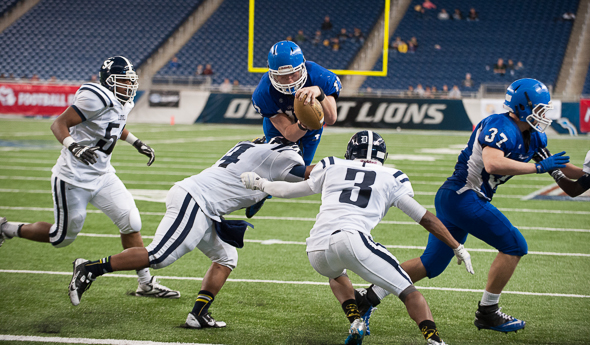
PHOTOS: (Top) Ishpeming quarterback Alex Briones attempts to leap two Detroit Loyola tacklers during Saturday's Final. (Middle) The Hematites pose with their trophy after winning Division 7 for the second straight season. (Click to see more from Terry McNamara Photography.)

Scheduling Controversy
November 14, 2017
A dozen years ago, I asked our counterpart organizations in other states if they scheduled their schools’ regular-season varsity football games. Very few did so.
More recently, I’ve realized that I didn’t ask enough questions. It turns out that few statewide high school associations tell schools who they play each week of the regular season. However, many more give schools the group of opponents they may schedule. They place schools in leagues and/or districts and/or regions and instruct schools to schedule from among those schools only or predominantly.
I have been waiting for the tipping point where a sufficient number of high schools in Michigan are sufficiently stressed over scheduling football games that they would turn to the MHSAA to solve the problem.
I’m anticipating this might occur first among schools playing 8-player football, and that success there will lead to our assistance for 11-player schools.
One approach – the simpler solution – would work like this:
-
All 8-player schools within the enrollment limit for the 8-player tournament would be placed in two divisions on the basis of enrollment in early March. About 32 schools in each, based on current participation.
-
At the same time, each division would be divided into four regions of about eight schools.
-
In April, the schools of each region would convene to schedule seven regular season games for each school.
-
Based on current numbers, schools would still have two open weeks to fill, if they wish, for games with schools in other regions or of the other division or in neighboring states.
A second option – the date-specific solution – would provide every school its weekly schedule for all nine dates, or weeks 1 through 8, or weeks 2 through 8, depending on local preferences. This would not be difficult in concept once there is agreement on what criteria would be used and what value each criterion would have.
For example, one important criterion would be similarity of enrollment; another of great value would be proximity. Perhaps league affiliation would be a factor with some value. Perhaps historic rivalries would be another factor with a value. Then the computer spits out schedules for each school for every week for two years, home and away.
I don’t campaign for this task because, frankly, it will produce complaints and controversy. But if this organization exists to serve, then this is a service that today’s chronic complaints tell us we should begin to provide soon.
I suggest we do this for 8-player football for the 2019 and 2020 seasons (with a paper trial run for 2018). If it proves successful, we could expand the service to 11-player schools as soon after as they are satisfied with our efforts for 8-player schools.