

FHC's Hallock Shines in Green & White
August 22, 2018
By Dean Holzwarth
Special for Second Half
GRAND RAPIDS – It was pretty much a foregone conclusion that Tate Hallock would eventually wind up wearing green and white.
 The Grand Rapids Forest Hills Central senior receiver already has had plenty of success wearing those colors, and he’s always wanted to follow in the footsteps of his family members.
In June, Hallock verbally committed to sign with Michigan State’s football program. He will join his brother Tanner, a second-year walk-on who redshirted last year.
Hallock’s father, Ty, played at MSU from 1989-92 and was drafted by the Detroit Lions in 1993. Ty Hallock played eight seasons in the NFL with three teams (Detroit, Jacksonville and Chicago). Tate’s mother, Jennifer, also graduated from MSU.
“I think my whole life I knew I wanted to go to Michigan State,” said the 6-foot-4, 190-pound Tate, who also was recruited by Notre Dame and several Mid-American Conference schools.
“Obviously my brother plays there, so that was a huge factor, and overall the legacy of my family going to Michigan State played a huge role in that, too. My brother and I had a plan when we were younger that we were going to play together there, so I was able to get that opportunity and commit.”
The Spartans will get a playmaker who produced on both sides of the ball last season as the Rangers turned in one of the best in school history.
Forest Hills Central set a school record for wins, finishing 12-1 with the lone loss a shutout by Livonia Franklin in the Division 2 Semifinals.
 Hallock had 779 receiving yards and 10 touchdowns a year ago, while also recording 81 tackles on defense.
“He is a threat to score on every down on offense,” FHC coach Tim Rogers said. “He has excellent speed and can go up and take the ball away from most defensive backs. We will move him from free safety to strong safety this season. He’s always around the ball, and he’s a violent tackler.”
Tate Hallock is in daily contact with his brother, who played a major role in FHC’s resurgence two years ago as the starting quarterback.
Tanner Hallock helped lead the Rangers to a nine-win season and playoff berth in 2016.
“We are very close, and I talk to him every day,” Tate Hallock said. “We’re always keeping each other in line, and I’ve learned a ton from him. He was a huge leader two years ago, and he really helped put the program back on track.”
Tate Hallock was just born when his father retired from the NFL, but he’s been around football his entire life.
He credits his father for teaching him the game and providing encouragement when needed.
“My dad has really taught me everything, and he just talks to me about being a leader and playing my role,” Tate Hallock said. “He’s my best motivator and the one I really look up to.”
While Tate Hallock waits for his time in East Lansing, he’s excited to play one more high school season and build off last year’s historic run.
“I’m definitely looking forward to next year, but I’m glad I’m finally done with the recruiting process so I can focus on this year and bringing home something for FHC.”
Hallock will benefit from having his longtime friend around to throw him the ball.
Senior dual-threat quarterback Luke Majick returns to engineer a potent Rangers’ offense. He threw for 1,787 yards and 21 touchdowns last season while also rushing for 840 yards and 15 touchdowns.
“I think it’s very important that we’re both back, but definitely Luke, because you need a quarterback and he brought a lot to us last year,” Tate Hallock said. “I think that will be the key to our success this year.”
 Tate Hallock and Majick aren’t just teammates. They’ve known each other since elementary school and have developed a bond on and off the field.
It’s a connection that has enabled both of them to thrive.
“We’ve been best friends since fourth grade,” Tate Hallock said. “I think I’m capable of getting open, and he just knows where I am. We have good chemistry because he’s used to throwing me the ball.”
Majick echoed those sentiments, as both seem to always be in sync.
“We have great chemistry because we’re best buds, and I always know where he is going to be at on the field,” Majick said. “He’s so fast and tall, he makes my job a lot easier.
“Going to Michigan State has always been his dream, and I’ve been to a couple games with him. It seems that’s where his heart’s at, and I’m sure he’ll do great there.”
Tate Hallock hopes to prove last season wasn’t a one-time phenomenon. The Rangers have similar goals in mind, and ending the season at Ford Field instead of watching at home would be at the top of the list.
“I think you should prove something every year, and we definitely showed that last year and the year before,” he said. “The senior class really took a step forward last year, and now we need to take another step forward and show what we are all about.
“We definitely want to go undefeated during the regular season again and get to the state championship, but it’s really a day-by-day process starting with Jenison (on Thursday) and going from there.”
 Dean Holzwarth covered primarily high school sports for the Grand Rapids Press and MLive for 16 years and more recently served as sports editor of the Ionia Sentinel and as a sports photojournalist for WZZM. Contact him at [email protected] with story ideas for Allegan, Kent and Ottawa counties.
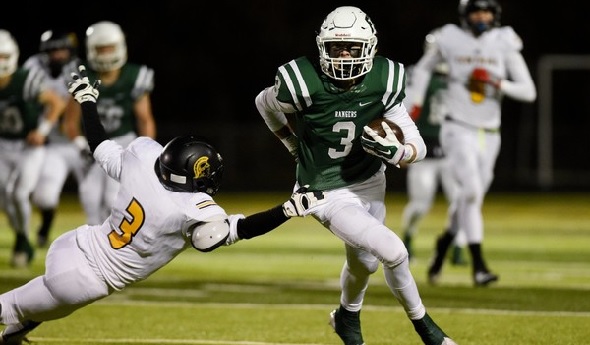
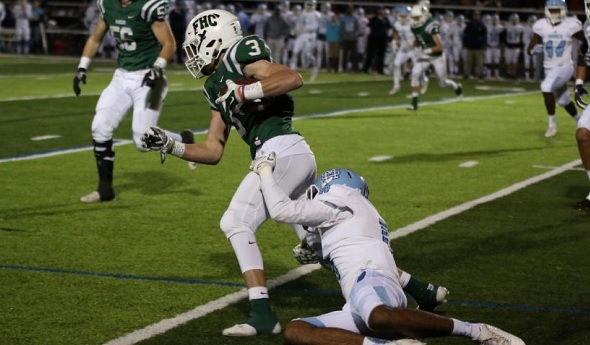
PHOTOS: (Top) Tate Hallock (3) turns up field looking for yardage last season against Traverse City Central. (Middle) Hallock works to pull away from a Muskegon Mona Shores defender. (Action photos courtesy of The Central Trend.)

Powers North Central Extends Title Legacy
November 18, 2016
By Geoff Kimmerly
Second Half editor
GREENVILLE – Their parents are taking credit for this, and for many reasons, rightfully so.
But the moms and dads who birthed the athletes rolling through Powers North Central’s football and boys basketball programs these last few years never stacked championships like this. For that matter, no class at any Michigan school has accomplished what the Jets seniors added to Friday night.
North Central’s 58-22 win over Deckerville at Legacy Field finished a second straight undefeated 8-player football championship season for the Jets, to go with two straight undefeated Class D championship teams for their boys basketball team – and ignited questions of how a school with only 115 students from a small Upper Peninsula community could come up with such a collection of talent.
Jets assistant coach Gerald Whitens provided his son, star quarterback and hoops guard Jason Whitens, with one explanation.
“Most of our parents went to North Central. It’s coming back around,” Jason Whitens said. “We had a good family group that stayed at Powers North Central, and we just kept filtering through and growing as a group. My dad said he blazed the path for us, and we just made it even bigger. So I have to give him a little credit.”
Added senior running back Bobby Kleiman, whose dad Scott also is a football assistant and played with Gerald Whitens on the school’s 1984 Class D champion basketball team: “(This kind of group) doesn’t come by often, I can tell you that. But we’re blessed to have the kids we have. The timing, everything, it just fell into place. We grew up with each other, we love each other, and it’s just a blessing to have the kids we have.”
That blessing to North Central athletics has been an unmovable obstacle for football opponents the last two seasons.
The Jets finished this run 13-0 to move to 26-0 since switching to 8-player before the start of the 2015 season.
But this most recent win didn’t come as smoothly as the score might indicate – at least during most of one quarter.
The first belonged to North Central, and the 6-foot-4, 210-pound Whitens in particular. In 2015, Kleiman became the first player in the then-five seasons of 8-player football to run for more than 200 yards in an MHSAA Final, finishing with 205. Whitens obliterated that record in the first quarter Friday, running for 231 yards and three touchdowns on only five carries as the Jets opened up a 20-0 lead.
 But Deckerville, also undefeated and making its first championship game appearance since winning 8-player in 2012, didn’t fold. In fact, the Eagles (11-1) rode the running of senior tailback Austin Fritch and senior quarterback Brandon Pattullo, who combined for 162 yards rushing and three touchdowns during the second quarter to put the Eagles up suddenly 22-20 with 1:57 to play before the break.
North Central had trailed only once before this season, into the third quarter Week 2 against Crystal Falls Forest Park before coming back to win 60-42.
“We’re not used to other people scoring on us and having close games,” Bobby Kleiman said. “But we played Crystal Falls two weeks ago (a 60-50 Regional Final rematch); they’re an exact replica of this team. We had one of the craziest games ever with them, and they really prepared us for this game.”
Indeed, Whitens scored on a 44-yard run a minute after Deckerville took its lead, and the Jets never trailed again. Kleiman added a 49-yard scoring run less than three minutes into the third quarter, and Whitens added 37 and 2-yard scoring runs and a 71-yard touchdown pass to senior Marcus Krachinski.
Whitens finished with an 8-Player Finals rushing record that may not be broken in some time, 352 yards on only 17 carries (20.7 yards per carry) with six touchdowns. His numbers could’ve been greater, or at least different if for just two plays, both dropped passes that likely would’ve resulted in touchdowns. Still, Whitens completed 6 of his 12 throws for 100 yards despite rain that blew sideways for most of the first three quarters.
Deckerville had given up only 50 points total this season and only 18 during the playoffs despite facing two other undefeated teams.
“We made a nice comeback there, but you’ve still got to keep going, and we weren’t able to make some plays,” Deckerville coach Bill Brown said. “We can’t give up big plays and expect to win. We don’t have a kid like that that can get 80-yard runs every time and score.”
Fritch and Pattullo did both finish with 133 yards rushing, Pattullo on only 12 carries for an average of 11.1 yards per attempt.
Kleiman added 123 yards rushing on 10 carries despite what North Central read as Deckerville aligning to stop him early on. That read led to Whitens’ big first quarter, including a 38-yard run on the first offense play of the game, on the “dart” quarterback keeper play that North Central continued to throw at the Eagles throughout the night.
 The addition of Friday’s performance gave Whitens 2,496 yards and 44 touchdowns passing this season, along with 943 yards and 22 touchdowns rushing.
He’s one of 11 seniors who played his last high school football game – and six of those seniors also played in last season’s Class D Basketball Final.
“This is the best class probably ever in the state, to do what they’ve done,” North Central coach Kevin Bellefeuil said. “Two basketball titles, two football titles, and they have to be a favorite to win a third one (in hoops).
“This is a special group of kids. We have the right mix of skill players, offensive linemen, linebackers; we have a little bit of everything.”
And some will take only a short break. Whitens said at first he’d be back to work for basketball Saturday morning. Then he self-corrected – he’ll wait until Monday instead.
“You’re never satisfied with who you were last year, or the day before. You’re always growing to get better each and every day of your life, and that’s how I go about my life,” Whitens said.
“We’ve got our eyes on the ultimate prize. This is our last year, last run at it, and we’re going to enjoy it. … I’m going to get home, join our community, let them bask in the glory with us. And then Monday morning, I’m ready to go.”
The MHSAA Football Finals are sponsored by the Michigan National Guard.
PHOTOS: (Top) Powers North Central quarterback Jason Whitens breaks away for one of his six rushing touchdowns Friday. (Middle) A Deckerville ball carrier works to get free of a North Central defender. (Below) Whitens confers with Jets coach Kevin Bellefeuil. (Photos by John Johnson/MHSAA.)