

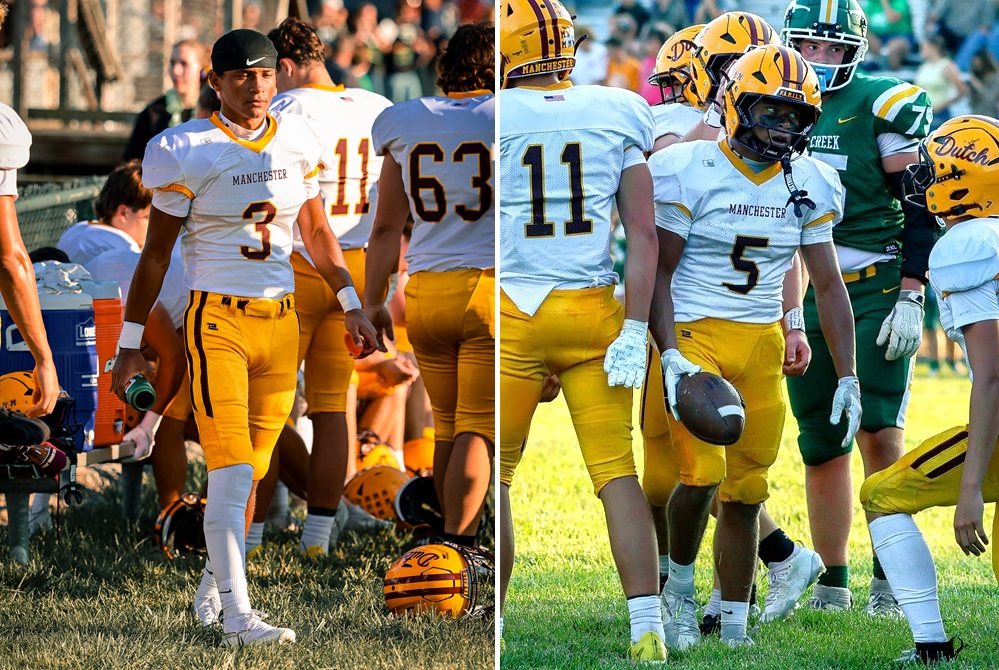
Finally on Field Together, Johnson Twins Form Prolific Pair in Manchester Backfield
By
Doug Donnelly
Special for MHSAA.com
November 11, 2026
When Donte Johnson was a freshman, he was called up to the Manchester varsity football team. At first, he was a fifth-quarter player, moving up from the junior varsity to also play one quarter in the varsity’s games. He eventually made the Flying Dutchman special teams lineup.
 Jayden Johnson, his twin brother, didn’t play varsity as a freshman, but stepped in as a sophomore when the projected Manchester starter at his position got hurt. Jayden responded with a great fall. Unfortunately, Donte missed that fall due to a knee injury suffered during basketball season.
As juniors, big things were expected from the duo, but injuries slowed Donte, and Jayden struggled as part of a very young Manchester team.
This season, seemingly out of nowhere, the two blossomed into the dynamic duo, both recording 1,000-yard rushing seasons for a 7-4 Manchester team that played in the Cascades Conference championship game and made the Division 8 playoffs. The trigger was a new offense installed in the offseason as the Flying Dutchmen went from the T formation to the single wing.
“I really liked the offense a lot more,” Jayden said. “I feel like it was meant for us. The T didn’t let our players use their full ability. With this team, this was perfect because we had a lot of speed.”
Donte agreed.
“I think it was interesting,” he said. “We knew we were going to run a different offense, but Coach really didn’t tell us until we went to the Olivet camp. I think it was the best change we could have done.”
Joshua Lindeman, who just completed his third season coaching the Flying Dutchmen, said seeing the Johnson twins together on the football field and playing at such a high level was great not only for the team, but for them as individuals as well.
“I think, because of some of the things they have gone through in the past, football and sports have become part of their identity,” Lindeman said. “To see them together, on the football field, finally, was a great thing to see. They couldn’t be more different, but they genuinely love each other and are great young men.”
The twins are from Manchester, where they have family, including grandparents. At a young age, they moved to northwest Tennessee. They returned to the Manchester area as fifth graders but had to reclassify as students and had different classmates from when they left.
“We had the choice of where we wanted to go to school, but we chose Manchester,” Jayden said. “It had always been home.”
Over the last 18 months, the two were adopted by their aunt, the sister of their mother.
“Sports has been their constant,” said Lindsey Beerens, their aunt. “It was a bad deal for them for a long time, but sports helped them. They moved around a lot when they were younger.
“This year, it was great to see them healthy and playing together. They are so supportive of one another.”
Lindeman said while the twins were both running backs, they couldn’t be more different off the field.
Donte, he said, is the one who talks more frequently, always with something on his mind.
“He is like the donkey from Shrek,” Lindeman said. “I’ve learned that is just who he is. He talks all of the time. It drives Jayden nuts.”
Jayden, on the other hand, is the more reserved of the two, but is also more open to talking about things he has gone through personally.
“If I had a dime for every time I had to tell those two to leave each other alone, I would be driving a much better car,” Lindeman said.
Ultimately, the two are great teammates – to each other and the rest of the team.
“One thing you will see, even though they can be bickering at each other at practice all week or in a game, when the other makes a play, the happiest guy on the field is the other one,” Lindeman said. “The celebration and joy they have over each other’s success is great. If you talk to them, like after Donte makes a good run, Jayden will say something like, ‘I’d (have) made it look better.’ But he has true joy in his heart and is happy for him.
“They are two competitive souls with each other.”
Jayden said Lindeman’s arrival helped spark a change in not only him but the team and community.
“There was a noticeable change,” he said. “I feel like he is pulling everyone together. We are one big family now. The community feels so much closer. Everyone is involved. We have so much support, dads from the community come out every Friday and help set up stuff.
“We have a motto – Family means Forget About Me, I Love You – and I think that pulls everyone together. It makes me want to work hard for everyone around me.”
Donte said he and his brother started playing tackle football at age 8 while they were in Tennessee. They play other sports – Jayden focuses on indoor track in the winter and outdoor track in the spring, and Donte is planning to play baseball this upcoming season – but football has been their main sport for as long as they can remember.
Lindeman said there was a time when he wasn’t sure Donte would play football again, which is one of the reasons this past season was so much fun.
“I watched film of him as a freshman and I thought, ‘There’s my starting quarterback for the next three years,’” Lindeman said. “Then, when I met him, he was hobbling around because of his knee. He sat on the couch in my office at one point and said he wasn’t going to play. When he came back and started playing, you could see his confidence. His whole personality started to shine.”
Together, the twins did more than just lead the Manchester football team to a great season. They lifted up everyone around them.
“They genuinely love each other,” Lindeman said. “It’s been special to watch how both of them were good for us this year because of what they’ve gone through. To watch both of them to do it together was very cool.”
 Doug Donnelly has served as a news and sports reporter at the Adrian Daily Telegram and the Monroe News for 30 years, including 10 years as city editor in Monroe. He's written a book on high school basketball in Monroe County and compiles record books for various schools in southeast Michigan. He is now publisher and editor of The Blissfield Advance, a weekly newspaper. E-mail him at [email protected] with story ideas for Jackson, Washtenaw, Hillsdale, Lenawee and Monroe counties.
PHOTOS (Top) At left, Jayden Johnson, and right, twin Donte Johnson, were both 1,000-yard rushers for Manchester this season. (Photos by Tyler George).
Inside Selection Sunday: Mapnalysis '15
October 26, 2015
By Geoff Kimmerly
Second Half editor
Consider that one hour Sunday night was the product of nine weeks of games on top of two more weeks of practice, hours of lifting weights, conditioning and camps and a total of six months of work at the MHSAA office, in addition to hours upon hours put in by athletic directors scheduling years in advance.
The anticipation for the release of another year's MHSAA Football Playoff pairings is matched by a giant exhale only after the results are broadcast on Fox Sports Detroit, streamed online and posted on locker room doors and Facebook walls all over our state.
 And then the fun begins again.
But the Selection Sunday Show is the favorite hour of the season for many fans across our state. And that’s why, for the fifth year, we’ll explain our most difficult decisions in this Mapnalysis 2015 breakdown of how we paired 272 teams that will play next month for championships across nine divisions.
For those familiar with our playoff selection process, or who have read this report in the past and don’t want a refresher on how we do what we do, skip the next section and go directly to the “Observations & Answers: 2015.” For the rest, what follows is an explanation of how we selected the playoff pairings during the morning hours Sunday, followed by how we made some of the toughest decisions and a few thoughts on the breakdown of the field.
Ground Rules
Our past: The MHSAA 11-player playoff structure – with 256 teams in eight divisions, and six wins equaling an automatic berth (or five wins for teams playing eight or fewer games) – debuted in 1999. An 8-player tournament was added in 2011, resulting in nine champions total each season.
The first playoffs were conducted in 1975 with four champions. Four more football classes were added in 1990 for a total of eight champions each fall. Through 1998, only 128 teams made the postseason, based on their playoff point averages within regions (four for each class) that were drawn before the beginning of the season. The drawing of Districts and Regionals after the end of the regular season did not begin until the most recent playoff expansion.
In early years of the current process, lines were drawn by hand. Dots representing qualifying schools were pasted on maps, one map for each division, and those maps were then covered by plastic sheets. Districts and Regionals literally were drawn with dry-erase markers.
Our present: After a late Saturday night tracking scores, we file in as the sun rises Sunday morning for a final round of gathering results we may still need (which can include making a few early a.m. calls to athletic directors). Re-checking and triple-checking of enrollments, what schools played in co-ops and opted to play as a higher class start a week in advance, and more numbers are crunched Sunday morning as the fields are set.
This season, there were a record-low 216 automatic qualifiers by win total – with the final 40 at-large then selected, by playoff-point average, one from each class in order (A, B, C, D) until the field was filled. There were only four Class D additional qualifiers with 5-4 or 4-4 (playing eight games) records from which we could choose – so after those four we added 12 teams each from Class A, Class B and Class C.
Those 256 11-player teams are then split into eight equal divisions based on enrollment, and their locations are marked on digital maps that are projected on wall-size screens and then discussed by nearly half of the MHSAA staff plus a representative from the Michigan High School Football Coaches Association. Only the locations themselves are marked (by yellow dots) – not records, playoff point averages or names of the schools or towns. In fact, mentions of those are strictly prohibited. Records and playoff points are not part of the criteria. Matchups, rivalries, previous playoff pairings, etc. also DO NOT come into play.
The same process is followed for organizing the 8-player bracket, with the difference that the 16 teams are selected purely on playoff-point average.
Geography rules: This long has been rule number one for drawing MHSAA brackets in any sport. Travel distance and ease DO come into play. Jumping on a major highway clearly is easier than driving across county-wide back roads, and that’s taken into consideration. Also, remember there’s only one Mackinac Bridge and hence only one way to cross between peninsulas – and boats are not considered a possible form of transportation. When opponents from both peninsulas will be in the same District, distance to the bridge is far more important than as the bird flies.
Tradition doesn’t reign: Every group of 32 dots is a new group – these 32 teams have not been placed in a bracket together before. How maps have been drawn in the past isn’t considered – it’s hard to say a division has been drawn in a certain way traditionally when this set of 32 teams is making up a division for the first time.
Observations & Answers: 2015
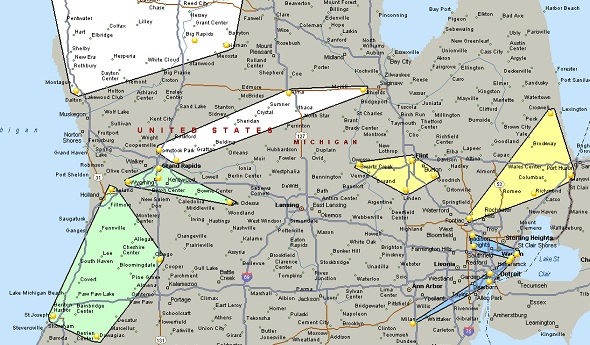
Go north with ease: For the most part, most Regional pairings were easier to draw than in past years. For the most part. Divisions 2 and 4 were not easy, specifically when it came to deciding which teams would be paired with an Upper Peninsula qualifier or a team from the Traverse City area. Keep in mind, distance on these maps isn’t based on how the bird flies, but how a bus would drive. In Division 2, that meant putting Muskegon, Muskegon Mona Shores and Grand Rapids Forest Hills Northern – near U.S. 31 and U.S. 131 – with Traverse City Central instead of sending Midland and Midland Dow west, up I-75 and then east-to-west again on more non-highway roads. In Division 4, we considered pairing Alma and Saginaw Swan Valley with Escanaba instead of Big Rapids and Remus Chippewa Hills. That decision came down to Big Rapids being about 14 miles closer to Escanaba than Swan Valley (Whitehall would go with Big Rapids and Chippewa Hills regardless.).
Four counties wide: Yes, on first glance it looks a little odd that Bay City John Glenn and Orchard Lake St. Mary’s would be in the same Division 3 District – but look at the map as a whole. Eight Division 3 teams are located south and mostly east of St. Mary’s, and John Glenn is the only team that could be considered in the northeastern quarter of the Lower Peninsula (Mount Pleasant and Gaylord are right down the middle and naturals to go with Sault Ste. Marie and Petoskey.). With the thumb playoff qualifiers of near-similar size in Division 4, there were no other options than to create this four-county trip between the Eaglets and Bobcats.
Semifinal selection: When all the Regional lines are drawn for a division, we also must figure out which Regionals will meet for Semifinals. This annually provides some challenges. Do we match east vs. west or north vs. south? If something seems iffy in four weeks when those games are played, again, keep in mind the entire map and entire Regionals that are matched up.
Scheduled strong: Because we’re looking only at dots on a map, we don’t see the matchups until everything is drawn – and in that way, we’re like everyone else. It wasn’t lost on us that two 9-0 teams will have road games this week or three 5-4 at-large qualifiers will be at home. For those 9-0 teams, it’s true: there’s nothing more they could’ve done on the field. But here’s why they will travel.
- Clinton, in Division 6, hasn’t lost a regular-season game since 2011, and in fact plays in a strong Tri-County Conference made up of Class C schools and one Class D. Four of eight from the league made the playoffs, and the competition was so strong that Morenci and Petersburg-Summerfield will host games in Division 8. But Clinton’s opponent, Monroe St. Mary Catholic Central, while it did have one loss, fell to one-loss Class B Lansing Catholic – and the Falcons played eight Class B and one Class A school this season. Beating a Class B team is worth 16 points more than beating a Class C and 32 more than beating a Class D (with those points then divided over the number of games a team plays that season) – and all of that made the difference in St. Mary’s final eight-point playoff average edge over Clinton.
- Saugatuck in Division 7 is a similar story. The Indians are one of three undefeated teams in their District, and did play a pair of Class B opponents. But by no fault of their own, especially in league play where the schedule is set, Saugatuck didn’t face a team this season that won more than five games. Hesperia played three Class B opponents including one that finished 6-3 – enough for the slim 1.8 points more in playoff average that earned the Panthers homefield advantage. Pewamo-Westphalia has the highest average in the District and didn’t play a Class B – the Pirates actually played three Class D teams. But they also beat four teams that made the playoffs including two that finished 8-1 – giving them a 2.7-point edge on Hesperia and 4.5 edge on Saugatuck.
- The 5-4 teams that will host – Redford Thurston in Division 3 and Escanaba and Benton Harbor in Division 4, all earned their spots. Escanaba faced six playoff teams and beat three, Class B Benton Harbor played eight Class A teams, and Thurston played five playoff teams and a sixth that just missed an at-large bid.
At the end of the day ...
What you see is what our committee decided upon after multiple discussions among multiple groups that broke down every sensible possibility we could muster. There are certainly points open to argument – and we likely made those arguments as well.
Those who would like to see the playoff selection process changed are in favor of a larger strength-of-schedule component, and it’s interesting to see how strength of schedule inadvertently made a larger impact this season than in the recent past – especially given the examples above of undefeated teams going on the road and at-large teams hosting.
Why were there fewer automatic qualifiers than ever before? Here's one theory. There were 11 fewer teams in 11-player football this season than in 2014 (most moved to 8-player). An argument can be made that there were fewer wins to be gained against teams that last season might have struggled to field 11-player teams, shifting the balance to fewer automatic qualifiers and more parity with stronger teams facing each other to fill their schedules.
Meanwhile, the 8-player field grew by nine teams this fall and has its strongest ever, with seven teams that finished 5-4 missing the postseason after a team with a sub-.500 record got in just a year ago.
Given how some matchups shook out this fall, the next argument by those seeking change likely will center on seeding entire Regionals instead of just Districts. But keep this in mind as well: if Regionals were seeded with this year's groupings, it would create possibilities of first-week trips like Battle Creek to Traverse City and Cedar Springs to Sault Ste. Marie. We're fairly sure most coaches and players would dread such journeys for a first-round game.
It's a lot to digest, and the scrutinizing will surely continue long after these playoffs are done as we all work to conduct the best tournament possible.
But at the end of the day – and the end of these next five weeks – to be the best, teams will need to beat the best no matter the matchups. And we’ve got plenty to look forward to starting this weekend and all the way through the 11-player Division 3 Final on Nov. 28 at Ford Field.
The MHSAA Football Playoffs are sponsored by the Michigan National Guard.
PHOTO: The Division 4 map was among the most difficult to draw during this year's selection process.