

Finally on Field Together, Johnson Twins Form Prolific Pair in Manchester Backfield
By
Doug Donnelly
Special for MHSAA.com
November 11, 2026
When Donte Johnson was a freshman, he was called up to the Manchester varsity football team. At first, he was a fifth-quarter player, moving up from the junior varsity to also play one quarter in the varsity’s games. He eventually made the Flying Dutchman special teams lineup.
 Jayden Johnson, his twin brother, didn’t play varsity as a freshman, but stepped in as a sophomore when the projected Manchester starter at his position got hurt. Jayden responded with a great fall. Unfortunately, Donte missed that fall due to a knee injury suffered during basketball season.
As juniors, big things were expected from the duo, but injuries slowed Donte, and Jayden struggled as part of a very young Manchester team.
This season, seemingly out of nowhere, the two blossomed into the dynamic duo, both recording 1,000-yard rushing seasons for a 7-4 Manchester team that played in the Cascades Conference championship game and made the Division 8 playoffs. The trigger was a new offense installed in the offseason as the Flying Dutchmen went from the T formation to the single wing.
“I really liked the offense a lot more,” Jayden said. “I feel like it was meant for us. The T didn’t let our players use their full ability. With this team, this was perfect because we had a lot of speed.”
Donte agreed.
“I think it was interesting,” he said. “We knew we were going to run a different offense, but Coach really didn’t tell us until we went to the Olivet camp. I think it was the best change we could have done.”
Joshua Lindeman, who just completed his third season coaching the Flying Dutchmen, said seeing the Johnson twins together on the football field and playing at such a high level was great not only for the team, but for them as individuals as well.
“I think, because of some of the things they have gone through in the past, football and sports have become part of their identity,” Lindeman said. “To see them together, on the football field, finally, was a great thing to see. They couldn’t be more different, but they genuinely love each other and are great young men.”
The twins are from Manchester, where they have family, including grandparents. At a young age, they moved to northwest Tennessee. They returned to the Manchester area as fifth graders but had to reclassify as students and had different classmates from when they left.
“We had the choice of where we wanted to go to school, but we chose Manchester,” Jayden said. “It had always been home.”
Over the last 18 months, the two were adopted by their aunt, the sister of their mother.
“Sports has been their constant,” said Lindsey Beerens, their aunt. “It was a bad deal for them for a long time, but sports helped them. They moved around a lot when they were younger.
“This year, it was great to see them healthy and playing together. They are so supportive of one another.”
Lindeman said while the twins were both running backs, they couldn’t be more different off the field.
Donte, he said, is the one who talks more frequently, always with something on his mind.
“He is like the donkey from Shrek,” Lindeman said. “I’ve learned that is just who he is. He talks all of the time. It drives Jayden nuts.”
Jayden, on the other hand, is the more reserved of the two, but is also more open to talking about things he has gone through personally.
“If I had a dime for every time I had to tell those two to leave each other alone, I would be driving a much better car,” Lindeman said.
Ultimately, the two are great teammates – to each other and the rest of the team.
“One thing you will see, even though they can be bickering at each other at practice all week or in a game, when the other makes a play, the happiest guy on the field is the other one,” Lindeman said. “The celebration and joy they have over each other’s success is great. If you talk to them, like after Donte makes a good run, Jayden will say something like, ‘I’d (have) made it look better.’ But he has true joy in his heart and is happy for him.
“They are two competitive souls with each other.”
Jayden said Lindeman’s arrival helped spark a change in not only him but the team and community.
“There was a noticeable change,” he said. “I feel like he is pulling everyone together. We are one big family now. The community feels so much closer. Everyone is involved. We have so much support, dads from the community come out every Friday and help set up stuff.
“We have a motto – Family means Forget About Me, I Love You – and I think that pulls everyone together. It makes me want to work hard for everyone around me.”
Donte said he and his brother started playing tackle football at age 8 while they were in Tennessee. They play other sports – Jayden focuses on indoor track in the winter and outdoor track in the spring, and Donte is planning to play baseball this upcoming season – but football has been their main sport for as long as they can remember.
Lindeman said there was a time when he wasn’t sure Donte would play football again, which is one of the reasons this past season was so much fun.
“I watched film of him as a freshman and I thought, ‘There’s my starting quarterback for the next three years,’” Lindeman said. “Then, when I met him, he was hobbling around because of his knee. He sat on the couch in my office at one point and said he wasn’t going to play. When he came back and started playing, you could see his confidence. His whole personality started to shine.”
Together, the twins did more than just lead the Manchester football team to a great season. They lifted up everyone around them.
“They genuinely love each other,” Lindeman said. “It’s been special to watch how both of them were good for us this year because of what they’ve gone through. To watch both of them to do it together was very cool.”
 Doug Donnelly has served as a news and sports reporter at the Adrian Daily Telegram and the Monroe News for 30 years, including 10 years as city editor in Monroe. He's written a book on high school basketball in Monroe County and compiles record books for various schools in southeast Michigan. He is now publisher and editor of The Blissfield Advance, a weekly newspaper. E-mail him at [email protected] with story ideas for Jackson, Washtenaw, Hillsdale, Lenawee and Monroe counties.
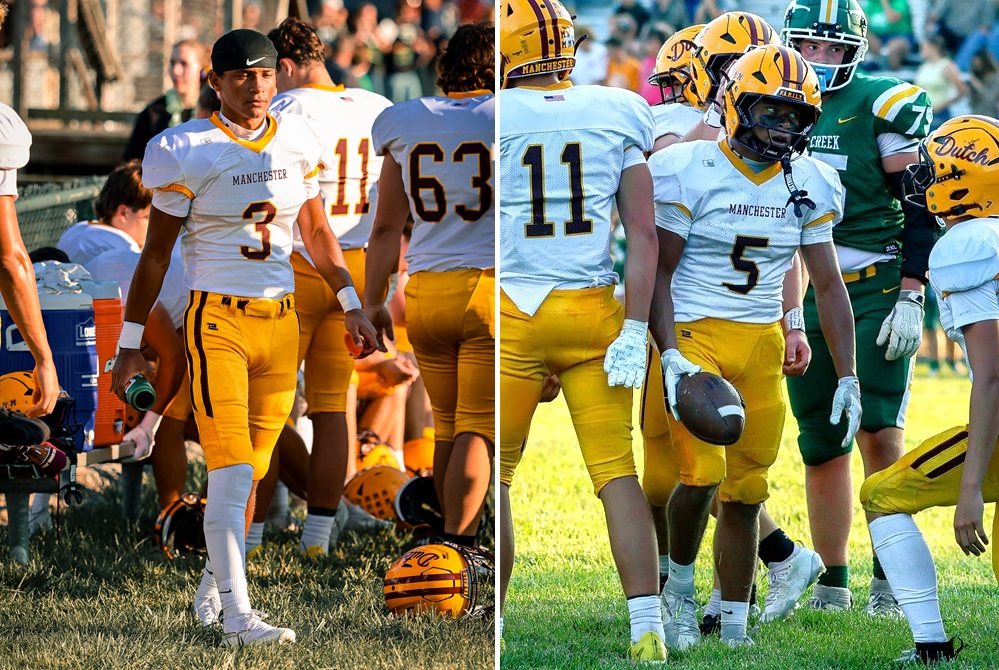
PHOTOS (Top) At left, Jayden Johnson, and right, twin Donte Johnson, were both 1,000-yard rushers for Manchester this season. (Photos by Tyler George).
Tales of the Tape from Bygone Days
September 10, 2014
By Rob Kaminski
MHSAA benchmarks editor
How’s this for a new reality/espionage TV series? Participants have just hours to exchange valuable video to counter-intelligence representatives at random drop points along state highways, then return to home base, study the footage and devise an action plan that same day.
Oh, and there are no cell phones or any other form of portable communication should plans go awry en route.
For longtime Escanaba High School football coach Dan Flynn, it’d be like watching reruns of his days as an assistant coach for the Eskymos. As one of the largest schools in the Upper Peninsula, Escanaba’s road through the MHSAA Playoffs almost always meant facing opponents from below the bridge, which made film exchange a challenge to say the least.
“I’ve logged thousands of miles, maybe more than anyone ever, exchanging film, tapes and DVDs with our opponents during the MHSAA Playoffs,” Flynn said.
“Being in Region 1 geographically, we knew we’d travel,” Flynn added. “And you couldn’t afford to just look at anyone and everyone that you might play. You had to do your homework to narrow down possible opponents if you wanted to go and scout.”
Today, with the MHSAA publishing Football Playoff Points on a weekly basis following Week 4, much of the guesswork as to potential first-round opponents has disappeared.
Additionally, most schools upload game footage to the web within 24 hours following each contest. On Selection Sunday, within minutes after a school’s Pre-District foe is announced, a coaching staff and players can be watching video of their opponent.
“We’d started calling coaches or they’d call me in Week 8 or 9, looking at possible matchups and also planning a place to meet to exchange film,” Flynn said.
Plans had to be firm and communications had to be clear, because once hitting the road, there was no way to contact one another.
“This was before cell phones,” Flynn explained. “I had one of first cell phones, which actually was an old bag phone. I’d accumulate outrageous rates for roaming charges going tower to tower.”
Old-school video exchange might be a thing of the past, but a generation of high school football coaches will never forget gas stations, fast-food joints and 24-hour stores nestled off exit ramps across Michigan.
“On that Sunday night, I’d get in the car, and typically drive to Gaylord, or maybe Grayling. In Gaylord it would be the McDonald’s. In Grayling, it’d be Glen’s Food Market. You’d try to arrange to meet at a place that was open 24 hours,” Flynn recalled. “I always got in the car understanding the meeting would be below the (Mackinac) Bridge. Sometimes we’d get lucky and the meeting place would be the Shell gas station just below the bridge on the Mackinaw City side.”
The 200-mile drive to Gaylord routinely took four hours. The further Escanaba advanced in the playoffs, the more times Flynn wore down the tread on his tires. He specifically recalls a hectic weekend in 1979, when Escanaba traveled to Lansing Sexton and defeated Livonia Stevenson in the MHSAA Semifinals to earn a berth in the Finals the following weekend vs. Detroit Catholic Central. Part of the reward for Flynn was another trip to McDonald’s.
“We came from behind in that Semifinal, and we were thrilled that we were going to the Finals. We got back home late Saturday night, then I got in the car the next morning to meet the Catholic Central coaches at 1 p.m.,” Flynn said.
“Coach (head coach Jerry) Cvengros had a meeting set for 5 or 6 that night. I made it back in time, but our guys were still feeling good about the win, so I suggested we hold off a day before showing them the CC film (16 mm film, by the way). Those guys were pretty good.”
Indeed they were, winning the Class A title the following weekend. The Eskymos, however, would return to the Final in 1981, winning the crown, 16-6 over Fraser, as Flynn no doubt logged more miles in preparation.
The most pressing concern today might be quality of the online video, lighting at the fields, or angle of the camera.
Back in the day, just getting a tape felt like victory.
“One year, I traveled all the way to the southeast part of the state, and the opposing coach simply wouldn’t exchange,” said Flynn, explaining that playoff film exchange at the time was only a recommendation, not a regulation. “I learned later that the coach had video of us from a friend who lived in Escanaba. I left on Saturday morning and came back Sunday night. We did eventually get some film later in the week. We lost by two points, but as coaches we didn’t make it a big vendetta and were up front with our kids.”
The MHSAA Representative Council, which included Flynn at the time, upgraded film exchange from a recommendation to a playoff policy in 1990, when schools were required to supply one another with the two most recent game films.
Even so, and as 16 mm film evolved to VHS tapes and then DVDs, coaching delegates still had to make itineraries for October and November weekends. Sometimes twice in the same weekend.
“Even with advancements in technology as we progressed from DVDs to digital, you still need people to operate the devices,” Flynn said. “I met another coach at the Shell station at the Bridge, but he said our software wasn’t compatible with theirs. I drove back the next day, pushed a button, and it worked. I drove all that way to push a button; 16 mm film would have been better.”
Today’s coaches might be a bit more well-versed in technology than those of Flynn’s era, and it’s a good thing. They likely need MapQuest and a GPS to traverse the regions in Northern Michigan that Flynn and his cohorts knew like the back of their hands.