

Finally on Field Together, Johnson Twins Form Prolific Pair in Manchester Backfield
By
Doug Donnelly
Special for MHSAA.com
November 11, 2026
When Donte Johnson was a freshman, he was called up to the Manchester varsity football team. At first, he was a fifth-quarter player, moving up from the junior varsity to also play one quarter in the varsity’s games. He eventually made the Flying Dutchman special teams lineup.
 Jayden Johnson, his twin brother, didn’t play varsity as a freshman, but stepped in as a sophomore when the projected Manchester starter at his position got hurt. Jayden responded with a great fall. Unfortunately, Donte missed that fall due to a knee injury suffered during basketball season.
As juniors, big things were expected from the duo, but injuries slowed Donte, and Jayden struggled as part of a very young Manchester team.
This season, seemingly out of nowhere, the two blossomed into the dynamic duo, both recording 1,000-yard rushing seasons for a 7-4 Manchester team that played in the Cascades Conference championship game and made the Division 8 playoffs. The trigger was a new offense installed in the offseason as the Flying Dutchmen went from the T formation to the single wing.
“I really liked the offense a lot more,” Jayden said. “I feel like it was meant for us. The T didn’t let our players use their full ability. With this team, this was perfect because we had a lot of speed.”
Donte agreed.
“I think it was interesting,” he said. “We knew we were going to run a different offense, but Coach really didn’t tell us until we went to the Olivet camp. I think it was the best change we could have done.”
Joshua Lindeman, who just completed his third season coaching the Flying Dutchmen, said seeing the Johnson twins together on the football field and playing at such a high level was great not only for the team, but for them as individuals as well.
“I think, because of some of the things they have gone through in the past, football and sports have become part of their identity,” Lindeman said. “To see them together, on the football field, finally, was a great thing to see. They couldn’t be more different, but they genuinely love each other and are great young men.”
The twins are from Manchester, where they have family, including grandparents. At a young age, they moved to northwest Tennessee. They returned to the Manchester area as fifth graders but had to reclassify as students and had different classmates from when they left.
“We had the choice of where we wanted to go to school, but we chose Manchester,” Jayden said. “It had always been home.”
Over the last 18 months, the two were adopted by their aunt, the sister of their mother.
“Sports has been their constant,” said Lindsey Beerens, their aunt. “It was a bad deal for them for a long time, but sports helped them. They moved around a lot when they were younger.
“This year, it was great to see them healthy and playing together. They are so supportive of one another.”
Lindeman said while the twins were both running backs, they couldn’t be more different off the field.
Donte, he said, is the one who talks more frequently, always with something on his mind.
“He is like the donkey from Shrek,” Lindeman said. “I’ve learned that is just who he is. He talks all of the time. It drives Jayden nuts.”
Jayden, on the other hand, is the more reserved of the two, but is also more open to talking about things he has gone through personally.
“If I had a dime for every time I had to tell those two to leave each other alone, I would be driving a much better car,” Lindeman said.
Ultimately, the two are great teammates – to each other and the rest of the team.
“One thing you will see, even though they can be bickering at each other at practice all week or in a game, when the other makes a play, the happiest guy on the field is the other one,” Lindeman said. “The celebration and joy they have over each other’s success is great. If you talk to them, like after Donte makes a good run, Jayden will say something like, ‘I’d (have) made it look better.’ But he has true joy in his heart and is happy for him.
“They are two competitive souls with each other.”
Jayden said Lindeman’s arrival helped spark a change in not only him but the team and community.
“There was a noticeable change,” he said. “I feel like he is pulling everyone together. We are one big family now. The community feels so much closer. Everyone is involved. We have so much support, dads from the community come out every Friday and help set up stuff.
“We have a motto – Family means Forget About Me, I Love You – and I think that pulls everyone together. It makes me want to work hard for everyone around me.”
Donte said he and his brother started playing tackle football at age 8 while they were in Tennessee. They play other sports – Jayden focuses on indoor track in the winter and outdoor track in the spring, and Donte is planning to play baseball this upcoming season – but football has been their main sport for as long as they can remember.
Lindeman said there was a time when he wasn’t sure Donte would play football again, which is one of the reasons this past season was so much fun.
“I watched film of him as a freshman and I thought, ‘There’s my starting quarterback for the next three years,’” Lindeman said. “Then, when I met him, he was hobbling around because of his knee. He sat on the couch in my office at one point and said he wasn’t going to play. When he came back and started playing, you could see his confidence. His whole personality started to shine.”
Together, the twins did more than just lead the Manchester football team to a great season. They lifted up everyone around them.
“They genuinely love each other,” Lindeman said. “It’s been special to watch how both of them were good for us this year because of what they’ve gone through. To watch both of them to do it together was very cool.”
 Doug Donnelly has served as a news and sports reporter at the Adrian Daily Telegram and the Monroe News for 30 years, including 10 years as city editor in Monroe. He's written a book on high school basketball in Monroe County and compiles record books for various schools in southeast Michigan. He is now publisher and editor of The Blissfield Advance, a weekly newspaper. E-mail him at [email protected] with story ideas for Jackson, Washtenaw, Hillsdale, Lenawee and Monroe counties.
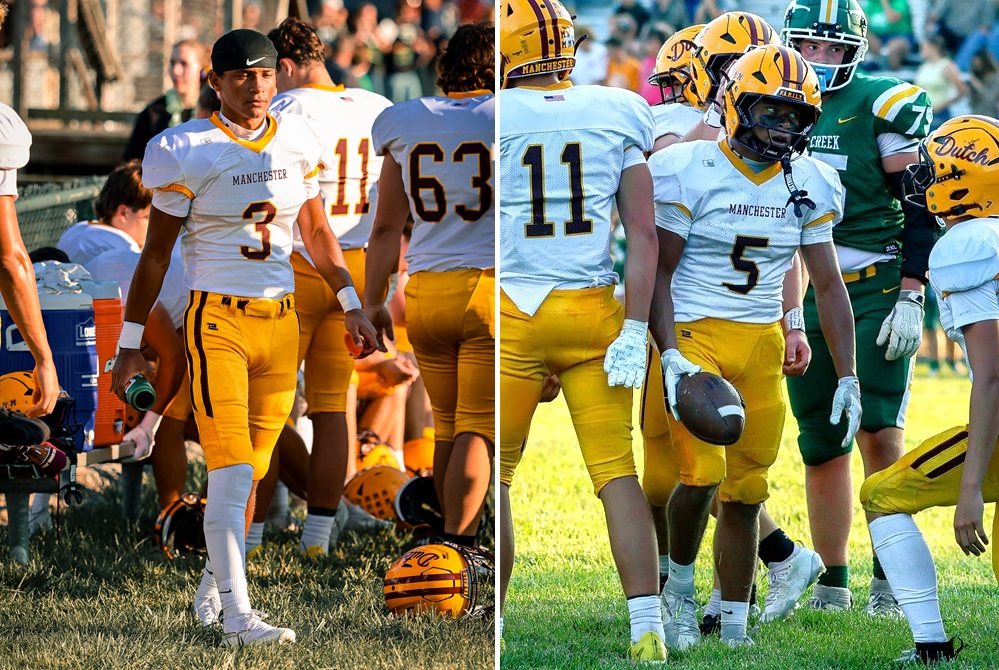
PHOTOS (Top) At left, Jayden Johnson, and right, twin Donte Johnson, were both 1,000-yard rushers for Manchester this season. (Photos by Tyler George).

Catch These New Rules as Fall Kicks Off
August 7, 2014
By Geoff Kimmerly
Second Half editor
The first practices of 2014-15 begin next week for approximately 110,000 student-athletes taking part in eight sports in which the Michigan High School Athletic Association sponsors postseason tournaments, with nearly 41,000 football players practicing under a new policy in that sport aimed at continuing to improve player safety.
The new practice policy was proposed by a Football Task Force made up of coaches, administrators and MHSAA staff which met during 2012 and 2013, and approved by the MHSAA’s Representative Council at its Winter Meeting on March 21.
The modifications are meant to promote heat acclimatization and limit helmet-to-helmet contact during practices. They include:
- During the first week of practice, only helmets are allowed the first two days, only shoulder pads may be added on the third and fourth days, and full pads may not be worn until the fifth day of team practice.
- Before the first regular-season game, schools may not schedule more than one “collision” practice in a day. A collision practice is defined as one in which there is live, game-speed, player-versus-player contact in pads involving any number of players.
- After the first regular-season game, teams may conduct no more than two collision practice days in any week, Monday through Sunday.
- No single football practice may exceed three hours, and the total practice time for days with multiple practice sessions may not exceed five hours. Neither strength/weight training activities nor video/classroom sessions are considered practice for the purposes of the three or five-hour limits.
Previously, schools were required to conduct at least three days of practice without pads before beginning contact. The change to four days for gradual addition of pads was added to assist athletes in acclimating to being physically active in hot weather. Guidelines reducing the amount of collision practice go hand in hand with rules changes that have been made to reduce helmet-to-helmet contact in game situations. The policies in detail can be found on the Football page of the MHSAA Website.
“We think these new policies, with respect to the number of collision practices there can be before the first game, and after the first game, really are where 85 to 90 percent of our coaches already were,” said John E. “Jack” Roberts, executive director of the MHSAA. “This new policy sends a signal to that 10 to 15 percent to get on board with the rest of us to make football just as safe as it can possibly be.”
Practice in football must begin on August 11 for all schools wishing to begin regular-season games the weekend of August 28-30. Schools must have 12 days of preseason practice at all levels before their first game, and those 12 days of practice may not occur before 16 calendar days.
Practice sessions for all other sports begin on Wednesday (August 13). In golf and tennis, competition may commence no earlier than after three separate days of team practice, and not before seven calendar days. The first day competition may take place in golf and tennis is August 20. In all other fall sports, contests can take place after seven days of practice for the team and not before nine calendar days. The first day competition may take place in cross country, tennis, soccer, swimming and diving, and volleyball is August 22.
Only one football date precedes Labor Day, and most varsity games will take place on Thursday, August 28, that week. Subvarsity competition may begin on Wednesday, August 27. In Week 1, 255 games will be played on Thursday, 53 contests will be played on Friday, and five games will be played on Saturday.
Continuing the focus on player safety, a number of rules changes were made in football for 2014:
- Rules were added restricting targeting of opponent and illegal helmet contact with defenseless players, with both resulting in 15-yard penalties. Targeting is defined as taking aim at an opponent with the helmet, forearm, hand, fist, elbow or shoulder to initiate contact above the shoulders and with an intent beyond making a legal tackle or block, or playing the ball. A defenseless player can be considered one no longer involved in a play, a runner whose progress has been stopped, a player focused on receiving a kick or a receiver who has given up on an errant pass, or a player already on the ground.
- Illegal contact to a quarterback now will be considered roughing the passer, and the offense will receive an automatic first down in addition to the previous 15 yards from the penalty.
- On kickoffs, the kicking team must have at least four players on either side of the kicker, and no kicking team players except for the kicker may line up more than five yards behind the free-kick line. These changes were made to improve safety by balancing the kicking formation and shortening the potential run-up by kicking team players heading down the field to tackle the ball carrier.
A number of significant rules changes will go into effect for other fall sports:
- In cross country, the ban on wearing jewelry has been lifted (and also for track and field in the spring). The National Federation of State High School Associations deemed the ban unnecessary in these two sports because there is little risk of injury with minimal contact between competitors. Elimination of the rule will allow officials to further focus on the competition.
- In soccer, Michigan has adopted the National Federation rule stating home teams must wear solid white jerseys and socks, with visiting teams in dark jerseys and socks (dark defined as any color contrasting white). Also, officials may now wear green and blue shirts in addition to red and black as alternates to the primary yellow shirt with black pinstripes.
- Also for soccer, both field players and goalkeepers must now leave the field when injured and the referee has stopped the clock. Previously, an injured goalkeeper was not required to leave the game when the referee stopped the clock; going forward, the keeper must be replaced.
- In swimming and diving, one change affects the beginning of races and another impacts a specific event. The use of starter’s pistols is now prohibited; starters must use an alternative sounding device to start races. Additionally, in the backstroke, a swimmer may not submerge his or her entire body after the start except for during turns. The swimmer must remain on or above the water surface on the finish, eliminating the abuse of submerging well before touching the wall. This change also applies to the finish of the backstroke leg of the individual medley.
The 2014 Fall campaign culminates with postseason tournaments beginning with the Upper Peninsula Girls Tennis Finals the week of Sept. 29, and wraps up with the 11-Player Football Playoff Finals on Nov. 28-29. Here is a complete list of fall tournament dates:
Cross Country:
U.P. Finals – Oct. 18
L.P. Regionals – Oct. 24 or 25
L.P. Finals – Nov. 1
11-Player Football:
Selection Sunday – Oct. 26
Pre-Districts – Oct. 31 or Nov. 1
District Finals – Nov. 7 or 8
Regional Finals – Nov. 14 or 15
Semifinals – Nov. 22
Finals – Nov. 28-29
8-Player Football:
Selection Sunday – Oct. 26
Regional Semifinals – Oct. 31 or Nov. 1
Regional Finals – Nov. 7 or 8
Semifinals – Nov. 15
Finals – Nov. 21
L.P. Girls Golf:
Regionals – Oct. 8 or 9 or 10 or 11
Finals – Oct. 17-18
Soccer:
Boys L.P. Districts – Oct. 13-18
Boys L.P. Regionals – Oct. 21-25
Boys L.P. Semifinals – Oct. 29
Boys L.P. Finals – Nov. 1
L.P. Girls Swimming & Diving
Diving Regionals – Nov. 13
Swimming/Diving Finals – Nov. 21-22
Tennis:
U.P. Girls Finals – Oct. 1 or 2 or 3 or 4
L.P. Boys Regionals – Oct. 9 or 10 or 11
L.P. Finals – Oct. 17-18
Girls Volleyball:
Districts – Nov. 3-8
Regionals – Nov. 11 & 13
Quarterfinals – Nov. 18
Semifinals – Nov. 20-21
Finals – Nov. 22
The MHSAA is a private, not-for-profit corporation of voluntary membership by more than 1,500 public and private senior high schools and junior high/middle schools which exists to develop common rules for athletic eligibility and competition. No government funds or tax dollars support the MHSAA, which was the first such association nationally to not accept membership dues or tournament entry fees from schools. Member schools which enforce these rules are permitted to participate in MHSAA tournaments, which attract more than 1.4 million spectators each year.