

Finally on Field Together, Johnson Twins Form Prolific Pair in Manchester Backfield
By
Doug Donnelly
Special for MHSAA.com
November 11, 2026
When Donte Johnson was a freshman, he was called up to the Manchester varsity football team. At first, he was a fifth-quarter player, moving up from the junior varsity to also play one quarter in the varsity’s games. He eventually made the Flying Dutchman special teams lineup.
 Jayden Johnson, his twin brother, didn’t play varsity as a freshman, but stepped in as a sophomore when the projected Manchester starter at his position got hurt. Jayden responded with a great fall. Unfortunately, Donte missed that fall due to a knee injury suffered during basketball season.
As juniors, big things were expected from the duo, but injuries slowed Donte, and Jayden struggled as part of a very young Manchester team.
This season, seemingly out of nowhere, the two blossomed into the dynamic duo, both recording 1,000-yard rushing seasons for a 7-4 Manchester team that played in the Cascades Conference championship game and made the Division 8 playoffs. The trigger was a new offense installed in the offseason as the Flying Dutchmen went from the T formation to the single wing.
“I really liked the offense a lot more,” Jayden said. “I feel like it was meant for us. The T didn’t let our players use their full ability. With this team, this was perfect because we had a lot of speed.”
Donte agreed.
“I think it was interesting,” he said. “We knew we were going to run a different offense, but Coach really didn’t tell us until we went to the Olivet camp. I think it was the best change we could have done.”
Joshua Lindeman, who just completed his third season coaching the Flying Dutchmen, said seeing the Johnson twins together on the football field and playing at such a high level was great not only for the team, but for them as individuals as well.
“I think, because of some of the things they have gone through in the past, football and sports have become part of their identity,” Lindeman said. “To see them together, on the football field, finally, was a great thing to see. They couldn’t be more different, but they genuinely love each other and are great young men.”
The twins are from Manchester, where they have family, including grandparents. At a young age, they moved to northwest Tennessee. They returned to the Manchester area as fifth graders but had to reclassify as students and had different classmates from when they left.
“We had the choice of where we wanted to go to school, but we chose Manchester,” Jayden said. “It had always been home.”
Over the last 18 months, the two were adopted by their aunt, the sister of their mother.
“Sports has been their constant,” said Lindsey Beerens, their aunt. “It was a bad deal for them for a long time, but sports helped them. They moved around a lot when they were younger.
“This year, it was great to see them healthy and playing together. They are so supportive of one another.”
Lindeman said while the twins were both running backs, they couldn’t be more different off the field.
Donte, he said, is the one who talks more frequently, always with something on his mind.
“He is like the donkey from Shrek,” Lindeman said. “I’ve learned that is just who he is. He talks all of the time. It drives Jayden nuts.”
Jayden, on the other hand, is the more reserved of the two, but is also more open to talking about things he has gone through personally.
“If I had a dime for every time I had to tell those two to leave each other alone, I would be driving a much better car,” Lindeman said.
Ultimately, the two are great teammates – to each other and the rest of the team.
“One thing you will see, even though they can be bickering at each other at practice all week or in a game, when the other makes a play, the happiest guy on the field is the other one,” Lindeman said. “The celebration and joy they have over each other’s success is great. If you talk to them, like after Donte makes a good run, Jayden will say something like, ‘I’d (have) made it look better.’ But he has true joy in his heart and is happy for him.
“They are two competitive souls with each other.”
Jayden said Lindeman’s arrival helped spark a change in not only him but the team and community.
“There was a noticeable change,” he said. “I feel like he is pulling everyone together. We are one big family now. The community feels so much closer. Everyone is involved. We have so much support, dads from the community come out every Friday and help set up stuff.
“We have a motto – Family means Forget About Me, I Love You – and I think that pulls everyone together. It makes me want to work hard for everyone around me.”
Donte said he and his brother started playing tackle football at age 8 while they were in Tennessee. They play other sports – Jayden focuses on indoor track in the winter and outdoor track in the spring, and Donte is planning to play baseball this upcoming season – but football has been their main sport for as long as they can remember.
Lindeman said there was a time when he wasn’t sure Donte would play football again, which is one of the reasons this past season was so much fun.
“I watched film of him as a freshman and I thought, ‘There’s my starting quarterback for the next three years,’” Lindeman said. “Then, when I met him, he was hobbling around because of his knee. He sat on the couch in my office at one point and said he wasn’t going to play. When he came back and started playing, you could see his confidence. His whole personality started to shine.”
Together, the twins did more than just lead the Manchester football team to a great season. They lifted up everyone around them.
“They genuinely love each other,” Lindeman said. “It’s been special to watch how both of them were good for us this year because of what they’ve gone through. To watch both of them to do it together was very cool.”
 Doug Donnelly has served as a news and sports reporter at the Adrian Daily Telegram and the Monroe News for 30 years, including 10 years as city editor in Monroe. He's written a book on high school basketball in Monroe County and compiles record books for various schools in southeast Michigan. He is now publisher and editor of The Blissfield Advance, a weekly newspaper. E-mail him at [email protected] with story ideas for Jackson, Washtenaw, Hillsdale, Lenawee and Monroe counties.
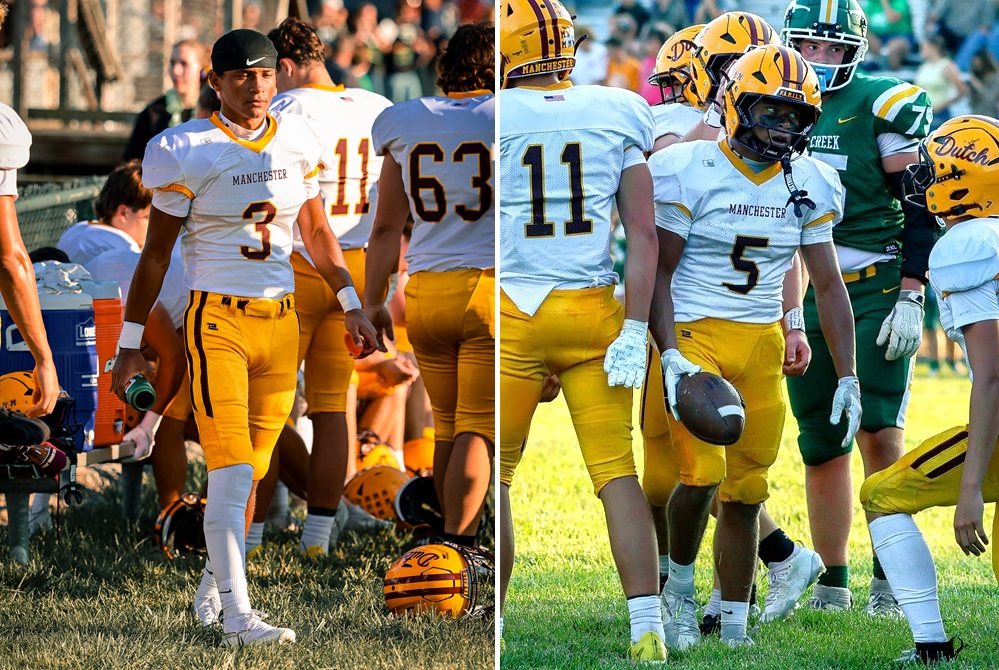
PHOTOS (Top) At left, Jayden Johnson, and right, twin Donte Johnson, were both 1,000-yard rushers for Manchester this season. (Photos by Tyler George).
Talking Practice: Texas, Illinois Revise Policies
December 20, 2013
By Rob Kaminski
MHSAA benchmarks editor
Coaches and players in Texas and Illinois adapted to new football practice limitations this fall, with the Texas policy focusing on contact, and the Illinois regulation emphasizing length of preseason practices.
Following are the main changes those states put in place heading into the 2013-14 season:
The University Interscholastic League, which governs school sports in Texas, put into writing that, “During the regular season and postseason, no football player is allowed to participate in more than ninety (90) minutes of full contact practice per week,” effective with the first day of practice this fall.
The complete policy follows:
For the purposes of the of rule, "full contact" is defined as football drills or live game simulations where "live action" occurs. Live action, as defined by USA Football, is contact at game speed where players execute full tackles at a competitive pace taking players to the ground. A team may continue to dress in full pads for practice, but may only participate in live action drills and game time simulations no more than ninety minutes per athlete per week. It is assumed that when players are in shells (shorts, shoulder pads, and helmets) no live action drills or simulations will occur. This rule is intended to limit live action drills and simulations and not the number of practices a team may participate in full pads. A team may participate in "air," "bags," "wrap," and "thud" drills and simulations at any point. These contact levels are defined below:
• Air - Players should run unopposed without bags or any opposition
• Bags - activity is executed against a bag, shield or pad to allow for a soft-contact surface, with or without the resistance of a teammate or coach standing behind the bag.
• Wrap - Drills run at full speed until contact, which is above the waist with the players remaining on their feet.
• Thud - Same as wrap but tempo is competitive with no pre-determined winner and the players are not tackling to the ground.
 The rule came to the UIL Legislative Council as a recommendation from the UIL Medical Advisory Committee, a permanent advisory committee to the Legislative Council which meets twice each year to discuss and review safety policies for UIL participants. The committee, which is made up of leading medical professionals in various specialties and includes representatives from the Texas High School Coaches Association, the Texas Girls Coaches Association, and the Texas State Athletic Trainer Association, unanimously recommended this limitation in full-contact football practice.
The rule formulates into a formal policy the existing actions of the majority of coaches across Texas, and most coaches have had to make few adjustments, if any. In fact, according to a story on statesman.com, the proposal caused more of an uproar on social media than from coaches.
“It’s not going to affect us in anyway,” Vandegrift HS coach Drew Sanders said in the story. “Most good coaches were way below that 90-minute amount already. Prior to legislation we still monitored it ourselves – the only change is now we have to keep up a log more publicly.”
Illinois put standards in place for its first 14 days of football practices, known as the state’s Preseason Football Acclimatization Practice Period. At the core of the policy is a three-hour practice limit for the first five days, during which teams can also conduct a one-hour walk-through.
 Teams must observe a minimum two hours rest between the practices and walk-throughs. Players may wear helmets only on the first two days, then helmets and shoulder pads for the next three. From days seven through 14 of the acclimatization period, schools may practice for a maximum of five hours per day, as long as that day is followed by a three-hour day, or an off day. During the five-hour days, no session can last more than three hours and must include a two-hour break between practices. Full pads may be worn for the final seven dates leading up to the first contest.
“This policy was the result of a collaborative effort between the IHSA Sports Medicine Advisory Committee and the Football Advisory Committee,” said SMAC committee member and University of Illinois Associate Professor of Orthopedic Surgery Dr. Preston M. Wolin. “The guidelines are based on the most recent scientific evidence, as well as the expertise of the coaches who will help implement them. Both committees believe the guidelines represent a significant positive contribution to the health of our athletes.”
“This new policy undoubtedly changes the way we, as coaches, approach preseason practice,” said Metamora HS coach Pat Ryan, who is a member of the FAC and a past President of the Illinois High School Football Coaches Association. “Coaches have to get more creative with when and how they schedule practices, as well what they do with their time. The proposals were strongly supported by both committees. It is a crucial final step to the process of being able to effectively prepare our teams in a safe manner. Change is always difficult, but the game is changing and we need to adapt to continue to put the safety of our players first.”
The IHSA offered multiple interactive online webinar meetings for high school coaches leading up to the start of practice where questions were answered, along with further clarifications on the policy and the science behind it.
“I think most coaches understood that changes were on the horizon,” said IHSA Executive Director Marty Hickman. “We wanted to be in a position to give our coaches as much information as possible to make sure they are comfortable with the new policy. Their input will be critical moving forward as we develop educational materials, like a best practices presentation. I commend our committees on a policy that is supported by medical experts, football coaches and school administrators.”