

Finally on Field Together, Johnson Twins Form Prolific Pair in Manchester Backfield
By
Doug Donnelly
Special for MHSAA.com
November 11, 2026
When Donte Johnson was a freshman, he was called up to the Manchester varsity football team. At first, he was a fifth-quarter player, moving up from the junior varsity to also play one quarter in the varsity’s games. He eventually made the Flying Dutchman special teams lineup.
 Jayden Johnson, his twin brother, didn’t play varsity as a freshman, but stepped in as a sophomore when the projected Manchester starter at his position got hurt. Jayden responded with a great fall. Unfortunately, Donte missed that fall due to a knee injury suffered during basketball season.
As juniors, big things were expected from the duo, but injuries slowed Donte, and Jayden struggled as part of a very young Manchester team.
This season, seemingly out of nowhere, the two blossomed into the dynamic duo, both recording 1,000-yard rushing seasons for a 7-4 Manchester team that played in the Cascades Conference championship game and made the Division 8 playoffs. The trigger was a new offense installed in the offseason as the Flying Dutchmen went from the T formation to the single wing.
“I really liked the offense a lot more,” Jayden said. “I feel like it was meant for us. The T didn’t let our players use their full ability. With this team, this was perfect because we had a lot of speed.”
Donte agreed.
“I think it was interesting,” he said. “We knew we were going to run a different offense, but Coach really didn’t tell us until we went to the Olivet camp. I think it was the best change we could have done.”
Joshua Lindeman, who just completed his third season coaching the Flying Dutchmen, said seeing the Johnson twins together on the football field and playing at such a high level was great not only for the team, but for them as individuals as well.
“I think, because of some of the things they have gone through in the past, football and sports have become part of their identity,” Lindeman said. “To see them together, on the football field, finally, was a great thing to see. They couldn’t be more different, but they genuinely love each other and are great young men.”
The twins are from Manchester, where they have family, including grandparents. At a young age, they moved to northwest Tennessee. They returned to the Manchester area as fifth graders but had to reclassify as students and had different classmates from when they left.
“We had the choice of where we wanted to go to school, but we chose Manchester,” Jayden said. “It had always been home.”
Over the last 18 months, the two were adopted by their aunt, the sister of their mother.
“Sports has been their constant,” said Lindsey Beerens, their aunt. “It was a bad deal for them for a long time, but sports helped them. They moved around a lot when they were younger.
“This year, it was great to see them healthy and playing together. They are so supportive of one another.”
Lindeman said while the twins were both running backs, they couldn’t be more different off the field.
Donte, he said, is the one who talks more frequently, always with something on his mind.
“He is like the donkey from Shrek,” Lindeman said. “I’ve learned that is just who he is. He talks all of the time. It drives Jayden nuts.”
Jayden, on the other hand, is the more reserved of the two, but is also more open to talking about things he has gone through personally.
“If I had a dime for every time I had to tell those two to leave each other alone, I would be driving a much better car,” Lindeman said.
Ultimately, the two are great teammates – to each other and the rest of the team.
“One thing you will see, even though they can be bickering at each other at practice all week or in a game, when the other makes a play, the happiest guy on the field is the other one,” Lindeman said. “The celebration and joy they have over each other’s success is great. If you talk to them, like after Donte makes a good run, Jayden will say something like, ‘I’d (have) made it look better.’ But he has true joy in his heart and is happy for him.
“They are two competitive souls with each other.”
Jayden said Lindeman’s arrival helped spark a change in not only him but the team and community.
“There was a noticeable change,” he said. “I feel like he is pulling everyone together. We are one big family now. The community feels so much closer. Everyone is involved. We have so much support, dads from the community come out every Friday and help set up stuff.
“We have a motto – Family means Forget About Me, I Love You – and I think that pulls everyone together. It makes me want to work hard for everyone around me.”
Donte said he and his brother started playing tackle football at age 8 while they were in Tennessee. They play other sports – Jayden focuses on indoor track in the winter and outdoor track in the spring, and Donte is planning to play baseball this upcoming season – but football has been their main sport for as long as they can remember.
Lindeman said there was a time when he wasn’t sure Donte would play football again, which is one of the reasons this past season was so much fun.
“I watched film of him as a freshman and I thought, ‘There’s my starting quarterback for the next three years,’” Lindeman said. “Then, when I met him, he was hobbling around because of his knee. He sat on the couch in my office at one point and said he wasn’t going to play. When he came back and started playing, you could see his confidence. His whole personality started to shine.”
Together, the twins did more than just lead the Manchester football team to a great season. They lifted up everyone around them.
“They genuinely love each other,” Lindeman said. “It’s been special to watch how both of them were good for us this year because of what they’ve gone through. To watch both of them to do it together was very cool.”
 Doug Donnelly has served as a news and sports reporter at the Adrian Daily Telegram and the Monroe News for 30 years, including 10 years as city editor in Monroe. He's written a book on high school basketball in Monroe County and compiles record books for various schools in southeast Michigan. He is now publisher and editor of The Blissfield Advance, a weekly newspaper. E-mail him at [email protected] with story ideas for Jackson, Washtenaw, Hillsdale, Lenawee and Monroe counties.
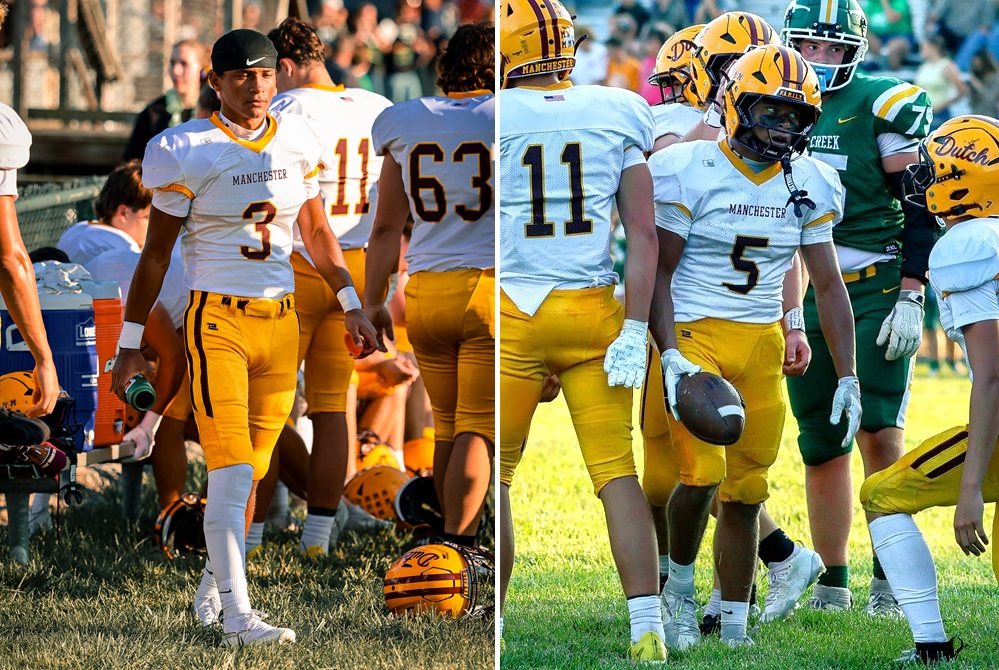
PHOTOS (Top) At left, Jayden Johnson, and right, twin Donte Johnson, were both 1,000-yard rushers for Manchester this season. (Photos by Tyler George).
Inside Selection Sunday: Mapnalysis 2012
October 24, 2012
By Geoff Kimmerly
Second Half editor
Between double checking data for more than a third of our 626 football teams, and creating 136 first-round games for our most popular tournament, the morning of MHSAA football "Selection Sunday" is both one of the most exciting and nerve-wracking of the school year.
So for those scratching their heads the last few days over how we picked the brackets this season, I offer one question and one warning:
How would you have done so differently?
And before you answer, remember that moving the position of one school affects at least seven more – if not all 32 in that division.
This was the second year I was involved in the football selection process, which while appearing simple on its face actually is layered with hours of discussions, calculations, checking and re-checking, and anything else we at the MHSAA can do to make sure we’ve created the best tournament possible.
Simply put, it’s more than just drawing circles and calling them good.
Below are a brief description of what we do, the history behind the process, and some challenges we face each time we draw these brackets – including some examples of our toughest this time around.
The process
Our past: The MHSAA playoff structure – with 256 teams in eight divisions, and six wins equaling an automatic berth – debuted in 1999. An 8-player tournament was added in 2011, resulting in nine champions total when November is done.
That’s a long way from our start. The first playoffs were conducted in 1975 with four champions. Four more football classes were added in 1990 for a total of eight champions each fall. Through 1998, only 128 teams made the postseason, based on their playoff point averages within regions (four for each class) that were drawn before the beginning of the season. The drawing of Districts and Regions after the end of the regular season did not begin until the most recent playoff expansion.
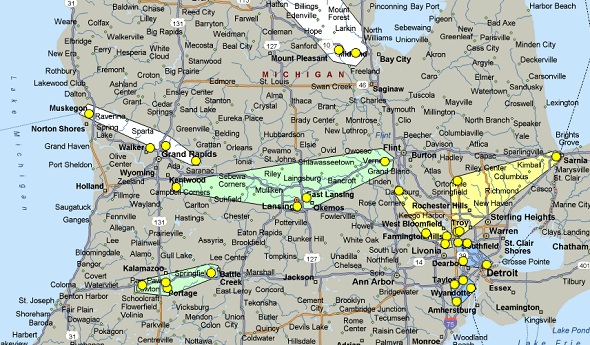
In early years of the current process (or until the middle of the last decade), lines were drawn by hand. Dots representing qualifying schools were pasted on maps, one map for each division, and those maps were then covered by plastic sheets. Districts and Regionals literally were drawn with dry-erase markers.
Our present: After a late Saturday night tracking scores, we file in as the sun rises Sunday morning for a final round of gathering results we may still need (which can include making a few early a.m. calls to athletic directors). Then comes re-checking and triple-checking of enrollments, co-ops, some records and more before the numbers are crunched and the field of 256 is set.
Those teams are then split into eight equal divisions based on enrollment, and their locations are marked on digital maps that are projected on wall-size screens and then discussed by nearly half of the MHSAA staff plus a representative from the Michigan High School Football Coaches Association. Only the locations themselves are marked (by yellow dots) – not records, playoff points averages or names of the schools or towns. In fact, mentions of those are strictly prohibited. Records and playoff points are not part of the criteria. Matchups, rivalries, previous playoff pairings, etc. also DO NOT come into play.
Geography rules: Drawing Districts and Regionals is all about location. Travel distance and ease DO come into play. Yes, ease is important. Schools near the same major highway might be further from each other in mileage than other options but have a better trip. A good example this year is in Division 6, which has seven teams in the U.P. and the northern Lower Peninsula. That meant Shelby needed to be included with those teams to make eight, and left Montague to a District that includes Hemlock – more than halfway across the Lower Peninsula. But at least, in this case, much of that trip will be on one roadway, M-46.
There is certainly conversation about every possible option. The staff splits into two groups, each handling four divisions (plus one of the groups handles 8-player too), and then the entire committee comes together to view all nine maps. There wasn’t one division where the group as a whole said, “That looks great, what’s next?”
Observations and answers
A different ballgame: I was asked whatever happened to Districts, meaning teams opening with opponents nearby. Remember that with eight divisions and 32 teams in each, the difference between maximum and minimum enrollments for each division is smaller than it used to be with just four classes, and the probability of finding two schools in the same division next door to each other is lower. This is especially true for our smaller schools, and those pairings are more spread out. Division 7 provides an excellent example. Opponents Dansville and Ottawa Lake Whiteford are 84 miles apart. But in another option considered, Dansville would’ve played Gobles – and those two are separated by 114 miles.
Points still matter: And that means strength of schedule is a big factor. After Districts are drawn, playoff point average determines the home team for those two games and Regionals as well. There are five Districts in which the team with the best or second-best record did not get home games because those teams’ playoff point averages ranked third among the four teams in those brackets. A number of other Districts have 8-1 teams playing at other 8-1 teams. It’s true: there are times a school can’t help the opponents it plays, because of league affiliation perhaps, and they have no control over how an opponent does the rest of the season. But a Class B team playing in a league with Class D schools can’t expect to compare averages well against teams in their division who face similarly-sized opponents during the regular season.
No boating: This didn’t come up last season, but did twice Sunday. We had to decide if it was a better trip for teams in the thumb to go around Saginaw Bay to play northern opponents, or instead send teams a little bit south of the thumb but with a straight shots north. As the bird flies, the thumb teams were closer in some cases. But I’ve never heard of a team hopping into a boat to get to a playoff game.
The fifth wheels: The toughest lines to draw are around areas with five schools in the same division. Remember, Districts come in fours, and one dot affects the rest. The Grand Rapids area gave us tough calls because of five teams in Divisions 2 and 4. The same was true in the southwest corner in Division 7 and the southeast corner in Division 6. No matter how we circled it, one of those teams got stuck with a longer trip. This time, that group included Caledonia, Grand Rapids South Christian, Blissfield and Gobles.
It’s easy to say certain areas of these maps should’ve been drawn differently. But again, keep in mind a statewide view.
Some of our pairings could create gigantic matchups earlier in the playoffs than those teams might like. But again, who is to decide which teams are the best and which matchups most “gigantic” before they prove it on the field? At least three teams touted during this fall as potentially the best in the state this season didn’t even win their conference titles.
And as I said in this analysis last year, determining the playoff schedule is just one step in many. Nine MHSAA champions must survive until the end, regardless of which opponents they face along the way.
Their journeys begin Friday.