

Finals Flashback: Remembering the '9s'
November 29, 2019
By Ron Pesch
Special for Second Half
This weekend’s MHSAA 11-Player Football Finals at Ford Field will conclude another decade for the most played and watched high school sport in Michigan.
We’ll roll into this year’s games remembering some decade-enders of the past from 1979, 1989, 1999 and 2009.
Redemption
The 1979 season marked the first playoff appearance for Norway, which had failed to qualify for the MHSAA postseason in 1975 and 1976 despite undefeated seasons.
However, the scoreless first half of the Knights’ Class D championship battle with Schoolcraft wasn’t proceeding as planned.
“We went into the locker room at halftime and made a few offensive changes,” said Norway coach Bob Giannunzio. “Our running game wasn’t working, so we decided we would pass more in the second half.”
The Norway defense forced six second-half turnovers that led to three touchdowns and a 21-6 win over Schoolcraft. Quarterback Chuck Soderlund connected on 6-of-14 passes for 110 yards including a 45-yard TD pass to Gregg Noordhoff to break the scoreless deadlock. Nordhoff added a second score from four yards out early in the in the fourth quarter for a 14-6 lead. Soderlund added a game-sealing TD on a QB sneak with 1:30 remaining.
It was the first of back-to-back titles for Giannunzio and the little Upper Peninsula school located near Iron Mountain. Since that season, Norway has advanced as far as the Semifinal round twice, in both 2002 and 2006
“We said if we ever got here we’d win it, said Giannunzio to the Detroit Free Press. “We wanted to start off right for the U.P. It’s a big burden playing for the whole Upper Peninsula.”
The Greatest
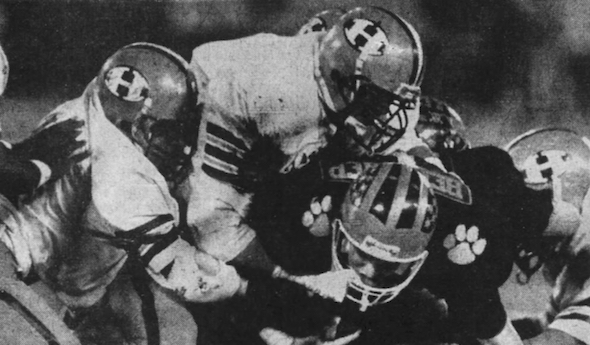
In Class B in 1989, Farmington Hills Harrison scored a 28-27 victory over DeWitt in what many still consider one of the greatest games of the MHSAA’s 45-year playoff history. The reigning Class B champion and top-ranked Hawks had their hands full. Tied 7-7 after one quarter, the Panthers grabbed a two-touchdown lead in the second quarter on 32-yard run by fullback John Tellford and a 35-yard pass play from Tellford to John Cowan. Harrison responded with a Matt Conley one-yard run to cut the margin to 21-14 at the half.
Hawks quarterback Mill Coleman knotted the score at 21-21 with a dazzling 16-yard run early in the fourth quarter, but DeWitt stormed back again driving 75 yards on 13 plays. The series was highlighted by tight end Dave Riker's 24-yard, one-handed catch to the Hawks’ 3-yard line. Two plays later, quarterback Chris Berkimer slipped over from the 1, and DeWitt again took the lead 27-21.
With 2:12 remaining and the ball at the Harrison 33, Coleman went to work. Three quick completions moved the ball to the DeWitt 16, and then Coleman let his legs do the rest. Following a Hawks timeout, Coleman dashed right for seven more yards to the Panthers’ 9. Facing a 2nd-and-3, Coleman dropped back to pass, escaped the rush at the DeWitt 17, then scampered up the middle and dove into the end zone for the tying points. Steve Hill added his fourth PAT of the game with 1:34 remaining for the final margin, then secured the victory with an interception on the next series.
Electrifying
Charles Rogers, perhaps the most electrifying high school receiver to ever touch the carpet at the Pontiac Silverdome, caught a single pass in the 1999 Division 2 title game, but he was the difference maker in Saginaw’s 14-7 win over Birmingham Brother Rice. The reception, defended by a single back, was a 60-yard touchdown reception from Brandon Cork on Saginaw’s first possession. Rogers broke a pair of tackles on the way to the end zone to open the scoring. The point-after attempt was blocked.
It was one of only six pass attempts by Saginaw on the day, and the only completion. But after that, as Mick McCabe of the Detroit Free Press wrote, “If Rogers would have gone up to the concourse for a hot dog, I’m sure a couple of Rice defensive backs would have been there to wipe the mustard off his chin.”
“He’s a big-time player, he should be in the NFL,” Rice coach Al Fracassa told McCabe. “He reminded me of Randy Moss. He’s always a threat just having him out there.”
A Saginaw fumble on the first play of the second half was recovered by Rice’s Tony Gioutsos at the Trojans’ 31. Eight plays later, Gioutsos scored from five yards out. Ross Ryan added the extra point for a 7-6 Rice lead.
Saginaw’s defense was aggressive, with constant pressure on Rice quarterback Mark Baker, sacking him twice while holding the Warriors to 78 yards rushing on 36 attempts.
Saginaw took advantage of the extra attention received by Rogers. Terry Jackson pounded out 106 yards on 18 carries, including 60 of Saginaw’s 84 yards on their game-winning drive in the fourth quarter. With Rogers drawing triple coverage, Jackson dashed opposite side for a 17-yard TD with 7:03 to play. Jackson also added the 2-point conversion for the game’s final margin.
A Wild Ride
Farmington Hills Harrison picked up its 10th state title with a 42-35 win over Grand Rapids Creston in a 1999 Division 3 championship game filled with wide-open play. Creston opened the title contest with a recovered onside kick and then drove 49 yards in five plays, ending with an Andrew Terry’s touchdown from a yard out. Harrison rebounded with a field goal, followed by a three-yard TD run by Kevin Woods off a pass interception for a 10-7 lead.
Creston responded with a four play, 79-yard touchdown drive that consumed a little over two minutes. Featuring a 41-yard pass play from QB Carlton Brewster to Lanard Latham near the end of the first quarter, the Polar Bears opened the second with a 25-yard run to the end zone by Terry. Odene Pringle’s extra point gave Creston a 14-10 lead.
Harrison then went 68 yards in six plays and under three minutes as Woods scored again from a yard out to regain the lead for his team 17-14.
The fireworks continued following another pass interception by the Hawks and another three-yard TD by Woods that upped the lead to 24-14. By halftime it was 27-21.
Harrison’s lead was short-lived as coach Charles “Sparky” McEwen’s Creston squad went 80 yards in 2:27 following the kickoff, capped by a Brewster to Latham 11-yard scoring strike. Pringle’s kick made it 28-27.
The Hawks responded on the next drive. It was 35-28 at the end for three quarters, then 42-28 when Woods scored again near the beginning of the fourth. In total, he would finish with 153 yards on 33 carries and four touchdowns, tying then-Final scoring marks for touchdowns and points.
Creston struck again with a 56-yard touchdown pass to Richard Gill from Brewster with 7:00 remaining to pull within a seven, 42-35. The Polar Bears regained the ball with 57 second remaining, but a final Hail Mary fell incomplete, ending one of the tournament’s most entertaining games.
Thriller
In 2007, the East Grand Rapids-Orchard Lake St. Mary’s championship battle was a 5 OT affair.
In 2009, it was again anybody’s guess who would emerge as the winner between the schools. The Pioneers entered undefeated, while Orchard Lake St. Mary’s carried four losses into the contest. They began the year with two defeats for the first time since 1991. The first was to this same East team, 21-7. Two others were to Division 1 Detroit Catholic Central, 27-0 and then 7-0.
The opening quarter of the Division 3 Final was scoreless. Orchard Lake opened the scoring early in the second. Quarterback Robert Bolden hit Gary Hunter for a 49-yard completion, and three plays later Bolden broke a pair of tackles to ramble across the goal line from 13 yards out. The Pioneers tied the game at 7-7 with 30 seconds remaining before the intermission, when 6-foot-7 Colin Voss caught a five-yard pass from Ryan Elble and snaked the last two yards into the end zone. St. Mary’s nearly answered in the time remaining as Hunter returned the kickoff 63 yards to the Pioneers’ 24. A false start penalty sent the ball back to the EGR 29, but then Bolden completed a pass to Allen Robinson for 28 yards to the Pioneers’ 1-yard line. Two rushing attempts by St. Mary’s were stopped at the goal line as time expired in the half, the last by Bolden that was ended by East’s Joshua Laarman.
Orchard Lake had opened a 21-17 lead with 9:12 remaining in the game following a three-yard TD by Cortez Riley and an extra point by Nathan Perry. With 4:01 left, that score still stood as the Pioneers took possession at their own 13 following an Eaglets punt. Kirk Spencer dashed for 38 yards to the Orchard Lake 49 on the first play. But with 2:49 remaining, East faced desperation at 4th-and-14. The ensuing pass, intended for Voss, slipped off his fingertips, but was caught by Spencer for a gain of 27 yards to the St. Mary’s 26. With 1:14 to play, Elble found Deon Jobe in the end zone from 15 yards out. Bobby Aardema’s kick gave East Grand Rapids a 24-21 lead.
“But it wasn’t quite over until we heard from Laarman and Spencer one more time,” wrote McCabe about play after the touchdown. “Bolden completed two passes to get to East’s 44 when he took off running. Earlier he scored on a breathtaking 83-yard keeper (giving St. Mary as 14-10 lead in the third quarter).
“The first thing Laarman thought of when he saw Bolden take off was: here we go again.”
Laarman caused a fumble on his attempted stop, and Spencer came up with the ball to seal victory. The win gave East Grand Rapids its fourth consecutive championship. East Grand Rapids would win five straight Division 3 titles between 2006 and 2010.
 Ron Pesch has taken an active role in researching the history of MHSAA events since 1985 and began writing for MHSAA Finals programs in 1986, adding additional features and "flashbacks" in 1992. He inherited the title of MHSAA historian from the late Dick Kishpaugh following the 1993-94 school year, and resides in Muskegon. Contact him at [email protected] with ideas for historical articles.
PHOTO: Farmington Hills Harrison scored late to edge DeWitt 28-27 in the 1989 Class B Final. (Photo courtesy of the Lansing State Journal.)
Many-Sport Standout Gash Closing High School Career with Repeat Title Pursuit
By
Keith Dunlap
Special for MHSAA.com
September 3, 2026
Gideon Gash said this fall is marking the end of an era for him athletically.
 Throughout his life, it didn’t seem to matter what the sport was, because Gash was playing it.
Whether it was soccer, basketball, lacrosse, football, or track & field, Gash sampled them all, and it didn’t stop when his high school career began.
Last year as a junior at Detroit Catholic Central, Gash continued to play several sports after being named all-state for football in the fall.
During the winter, he played on Catholic Central’s basketball team. In the spring, he decided to go out for track and thrived, finishing second in the 100-meter dash and winning the long jump at the Catholic High School League meet, and then taking third in the long jump at the Lower Peninsula Division 1 Finals.
Following that championship meet, Gash returned to the lacrosse team and suited up for the Shamrocks during the final week of the season, which culminated in a DCC Division 1 title. Gash had played lacrosse the previous spring as a sophomore, but decided to focus more on track as a junior.
“I worked out different muscles and different skills and just having that versatility helped me a lot throughout life,” Gash said. “Being able to do different things and learn faster and having to keep up with everyone in terms of basketball, lacrosse, in terms of just raw skills. That helped me a lot in terms of just being able to add to my bag and be the best I can.”
But now, Gash said his multi-sport playing days are all but over.
One of the premier college football recruits in the nation, the 6-foot-4, 210-pound Gash has committed to play at Texas Tech for now, although he recently said his recruitment is “not closed down,” according to an article on Rivals.com.
 Regardless of where he ends up, Gash said he plans on enrolling early and starting college in January, adding he made sure to accumulate enough class credits to be able to do so.
That means it’s football from here on out, and odds are he’s going to have a monster senior year for reigning Division 1 champion Catholic Central.
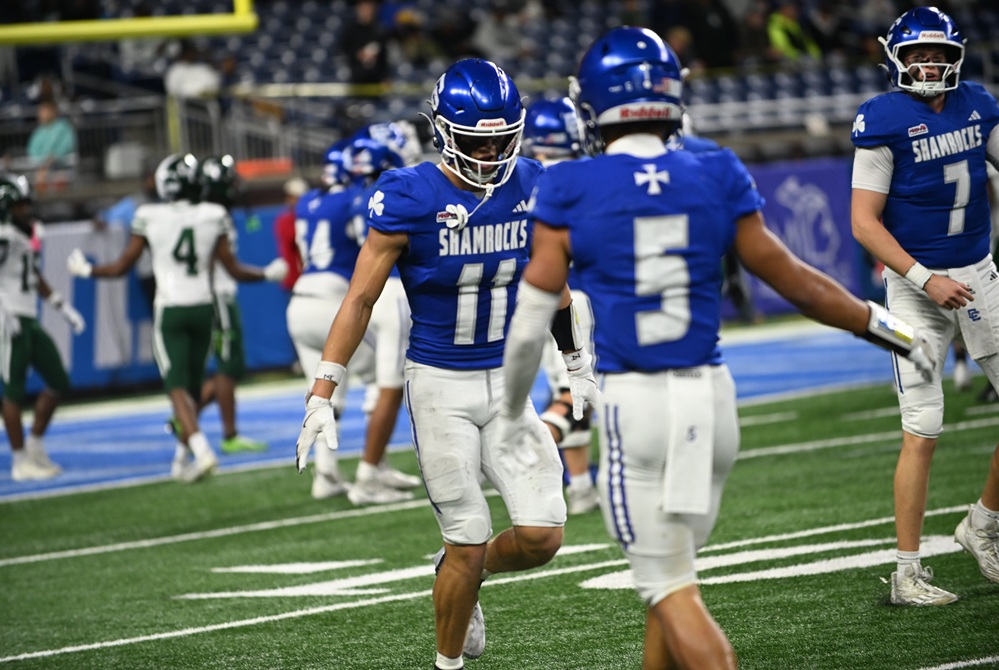
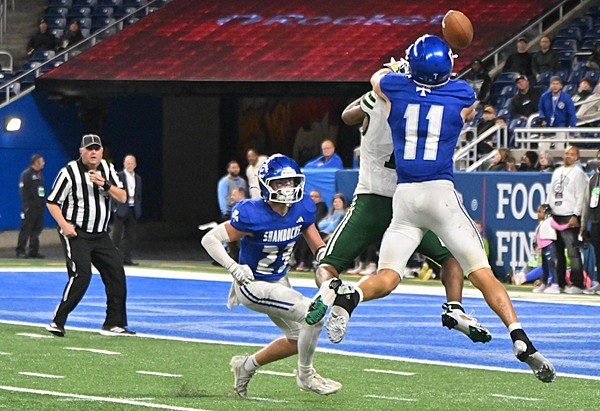
Last year, Gash was all-state in Division 1-2 as a lockdown defensive back, collecting 74 tackles and nine pass breakups. He also was a big-play threat as a wideout, catching three long touchdown passes for Catholic Central in a championship game win over Detroit Cass Tech at Ford Field.
There are times this season where Gash may never leave the field, given he will see lots of time as a dangerous punt returner. In a season-opening win over Clinton Township Chippewa Valley, Gash returned a punt 48 yards for a touchdown.
Playing so many sports throughout his life has shaped him into an all-around force on the football field and helped turn him into a dominating physical specimen.
Gash gained 10 pounds of muscle since last fall and going into his senior year is more chiseled and faster than he has ever been.
“He just loves competing,” Catholic Central football head coach Justin Cessante said. “When we compete and he works the way he does when nobody is watching, and he’s got his agility, his strength and his size, he’s a 10 times better player and athlete than he was last year. I think that attributes to doing all those different things.”
This is the first year Gash is not playing alongside his older brother, Samson, the 2025 Finals champion in the 100-meter dash and all-state wide receiver last fall who is a freshman at Michigan State.
Gideon Gash will certainly be counted on for veteran leadership since Catholic Central entered this season with only two returning starters, although there are several talented underclassmen already with Division I college scholarship offers who are expected to soon make names for themselves on the high school level.
While the next wave of great players is already coming for Catholic Central, it certainly will be hard to replace Gash and how he was able to excel at more than just football.
“I’m going to miss it,” Gash said. “I’ve been playing three sports my whole life, so I’m going to miss it a lot.”
 Keith Dunlap has served in Detroit-area sports media for more than two decades, including as a sportswriter at the Oakland Press from 2001-16 primarily covering high school sports but also college and professional teams. His bylines also have appeared in USA Today, the Washington Post, the Detroit Free Press, the Houston Chronicle and the Boston Globe. He served as the administrator for the Oakland Activities Association’s website from 2017-2020. Contact him at [email protected] with story ideas for Oakland, Macomb and Wayne counties.
PHOTOS (Top) Detroit Catholic Central’s Gideon Gash (11) is congratulated by brother Samson Gash after scoring during last season’s Division 1 Final. (Middle) Gash breaks up a pass during the win over Detroit Cass Tech.