

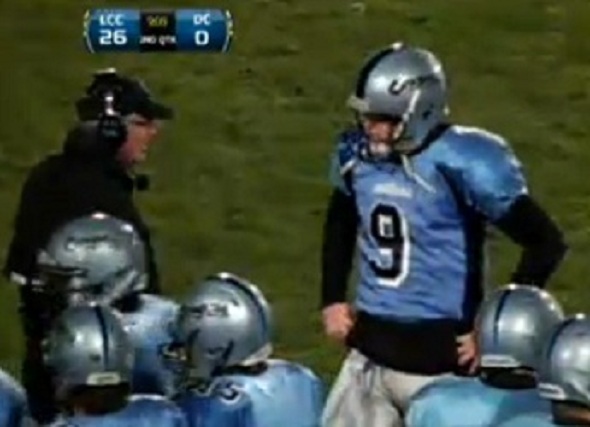
First and 20 for Lansing Catholic's Rush
December 16, 2011
If Lansing Catholic’s Cooper Rush would’ve thrown that late second-quarter pass just a litter farther Friday, his receiver probably would’ve had time to run under and catch it.
But it was hard for the Cougars’ senior quarterback to be disappointed. His first miss came after 20 straight completions to begin a 61-13 Division 5 Regional win over Dowagiac – and was one of three MHSAA records Rush set or tied on the night.
The 20 straight completions tied the mark set by Rockford’s Mike Segard in 1997. Rush also threw eight touchdown passes to set a record ahead of five who had thrown seven, a record seven TDs during the first half, and tied a record with five in the first quarter. And before leaving the game in the third quarter – after just 28 pass attempts – Rush had tossed for 510 yards to tie for third on that single-game list.
 This fall has been filled with wild passing totals by Rush, who has committed to sign with Central Michigan this winter. His 3,302 yards for the season are seventh on the MHSAA record list with a possible two games left to be played, and his 41 touchdown tosses are third. A three-year starter, he emerged as an all-state candidate last season. But he’s dwarfed that performance in helping Lansing Catholic to a 12-0 record heading into Saturday’s Semifinal against Grand Rapids West Catholic.
“We’ve improved greatly, especially this year from last year,” Rush said. “I’ve developed a lot more timing with all my receivers, with that extra year playing with each other. All my receivers know what I want, and I know what they want.
“(I tell them) never give up on a route. Trust it, and they know I’ll put it where they can catch it and make a play after the catch.”
Total, Rush finished Friday night 25 for 28 throwing the ball, and he connected with five receivers. Senior Matt Macksood caught 11 passes for 304 yards and four touchdowns – the yardage fourth on the MHSAA record list for one game, and the four scores one short of tying for first. (Click to see both players' entries in the MHSAA record book.)
And Rush was hardly just dumping off the ball. All but nine of his completions were for 10 yards or more, and eight went for at least 25 yards. Macksood and his receivers helped out with a few great catches. But most of the time, he and teammates Jack Swain, Connor Bartlett, Dan Liesman and Jim Maher simply had to snag what was thrown at them.
“Every time I dropped back, guys were wide open. It was pretty easy to hit wide-open receivers,” Rush said. “It was the same old (routes) they’ve run all year. They just ran them really crisp.”
Macksood also is rising on MHSAA record lists in a number of categories. He’s surpassed 1,400 receiving yards for the second straight season and is one of five receivers on the MHSAA list with at least 2,800 for his career. His 33 touchdown catches over the last two seasons puts him tied for sixth in that category.
Click to watch the replay of Friday's game online at FoxSportsDetroit.com.

Sweating the Small Stuff - #3
June 5, 2018
I’m sure it discouraged some of our state’s high school football coaches to learn that the Representative Council of the Michigan High School Athletic Association did not approve at its May 6-7 meeting what some people refer to as the “enhanced strength of schedule proposal” for determining 256 qualifiers to the MHSAA’s 11-player football playoffs.
There was desire among some Council members to appease those who keep trying to reduce the difficulties that a football tournament causes for regular season scheduling and conference affiliations. Others noted that the proposal, as presented, could cause as much harm to some schools and conferences as it would help others, that it did not solve the scheduling problem but shifted it.
During spirited discussion, some Council members resurrected two ideas that have been rejected previously, such as (1) doubling the playoffs once again (and shortening the regular season to eight games), and (2) coupling a six- or seven-win minimum with the revised strength of schedule criteria. The pros and cons of each idea flowed freely.
And therein is the problem. If one digs down into the details of proposals, both old and new, there are both positive and negative aspects apparent, both intended and unintended consequences likely.
There can be paralysis in analysis; but when we are dealing with more than 600 high school programs and a physically demanding sport with fewer regular-season contests permitted than in any other sport, one cannot be too careful. Eliminating one of just nine regular-season games? Increasing first-round tournament mismatches? Disadvantaging larger schools locked in leagues or areas of the state where smaller schools predominate? These are not minor matters.
And until there are sensible answers, these are not trivial questions.