

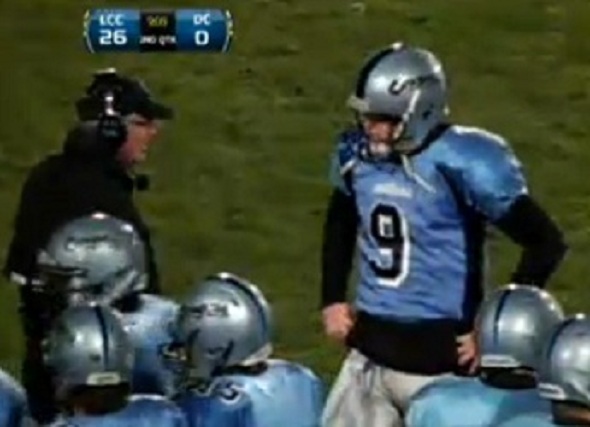
First and 20 for Lansing Catholic's Rush
December 16, 2011
If Lansing Catholic’s Cooper Rush would’ve thrown that late second-quarter pass just a litter farther Friday, his receiver probably would’ve had time to run under and catch it.
But it was hard for the Cougars’ senior quarterback to be disappointed. His first miss came after 20 straight completions to begin a 61-13 Division 5 Regional win over Dowagiac – and was one of three MHSAA records Rush set or tied on the night.
The 20 straight completions tied the mark set by Rockford’s Mike Segard in 1997. Rush also threw eight touchdown passes to set a record ahead of five who had thrown seven, a record seven TDs during the first half, and tied a record with five in the first quarter. And before leaving the game in the third quarter – after just 28 pass attempts – Rush had tossed for 510 yards to tie for third on that single-game list.
 This fall has been filled with wild passing totals by Rush, who has committed to sign with Central Michigan this winter. His 3,302 yards for the season are seventh on the MHSAA record list with a possible two games left to be played, and his 41 touchdown tosses are third. A three-year starter, he emerged as an all-state candidate last season. But he’s dwarfed that performance in helping Lansing Catholic to a 12-0 record heading into Saturday’s Semifinal against Grand Rapids West Catholic.
“We’ve improved greatly, especially this year from last year,” Rush said. “I’ve developed a lot more timing with all my receivers, with that extra year playing with each other. All my receivers know what I want, and I know what they want.
“(I tell them) never give up on a route. Trust it, and they know I’ll put it where they can catch it and make a play after the catch.”
Total, Rush finished Friday night 25 for 28 throwing the ball, and he connected with five receivers. Senior Matt Macksood caught 11 passes for 304 yards and four touchdowns – the yardage fourth on the MHSAA record list for one game, and the four scores one short of tying for first. (Click to see both players' entries in the MHSAA record book.)
And Rush was hardly just dumping off the ball. All but nine of his completions were for 10 yards or more, and eight went for at least 25 yards. Macksood and his receivers helped out with a few great catches. But most of the time, he and teammates Jack Swain, Connor Bartlett, Dan Liesman and Jim Maher simply had to snag what was thrown at them.
“Every time I dropped back, guys were wide open. It was pretty easy to hit wide-open receivers,” Rush said. “It was the same old (routes) they’ve run all year. They just ran them really crisp.”
Macksood also is rising on MHSAA record lists in a number of categories. He’s surpassed 1,400 receiving yards for the second straight season and is one of five receivers on the MHSAA list with at least 2,800 for his career. His 33 touchdown catches over the last two seasons puts him tied for sixth in that category.
Click to watch the replay of Friday's game online at FoxSportsDetroit.com.

Scheduling Controversy
November 14, 2017
A dozen years ago, I asked our counterpart organizations in other states if they scheduled their schools’ regular-season varsity football games. Very few did so.
More recently, I’ve realized that I didn’t ask enough questions. It turns out that few statewide high school associations tell schools who they play each week of the regular season. However, many more give schools the group of opponents they may schedule. They place schools in leagues and/or districts and/or regions and instruct schools to schedule from among those schools only or predominantly.
I have been waiting for the tipping point where a sufficient number of high schools in Michigan are sufficiently stressed over scheduling football games that they would turn to the MHSAA to solve the problem.
I’m anticipating this might occur first among schools playing 8-player football, and that success there will lead to our assistance for 11-player schools.
One approach – the simpler solution – would work like this:
-
All 8-player schools within the enrollment limit for the 8-player tournament would be placed in two divisions on the basis of enrollment in early March. About 32 schools in each, based on current participation.
-
At the same time, each division would be divided into four regions of about eight schools.
-
In April, the schools of each region would convene to schedule seven regular season games for each school.
-
Based on current numbers, schools would still have two open weeks to fill, if they wish, for games with schools in other regions or of the other division or in neighboring states.
A second option – the date-specific solution – would provide every school its weekly schedule for all nine dates, or weeks 1 through 8, or weeks 2 through 8, depending on local preferences. This would not be difficult in concept once there is agreement on what criteria would be used and what value each criterion would have.
For example, one important criterion would be similarity of enrollment; another of great value would be proximity. Perhaps league affiliation would be a factor with some value. Perhaps historic rivalries would be another factor with a value. Then the computer spits out schedules for each school for every week for two years, home and away.
I don’t campaign for this task because, frankly, it will produce complaints and controversy. But if this organization exists to serve, then this is a service that today’s chronic complaints tell us we should begin to provide soon.
I suggest we do this for 8-player football for the 2019 and 2020 seasons (with a paper trial run for 2018). If it proves successful, we could expand the service to 11-player schools as soon after as they are satisfied with our efforts for 8-player schools.