

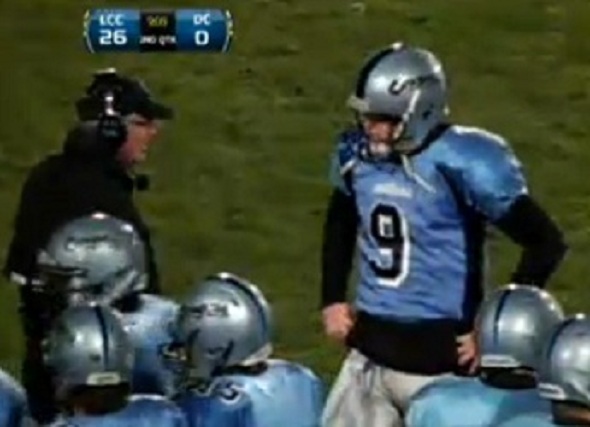
First and 20 for Lansing Catholic's Rush
December 16, 2011
If Lansing Catholic’s Cooper Rush would’ve thrown that late second-quarter pass just a litter farther Friday, his receiver probably would’ve had time to run under and catch it.
But it was hard for the Cougars’ senior quarterback to be disappointed. His first miss came after 20 straight completions to begin a 61-13 Division 5 Regional win over Dowagiac – and was one of three MHSAA records Rush set or tied on the night.
The 20 straight completions tied the mark set by Rockford’s Mike Segard in 1997. Rush also threw eight touchdown passes to set a record ahead of five who had thrown seven, a record seven TDs during the first half, and tied a record with five in the first quarter. And before leaving the game in the third quarter – after just 28 pass attempts – Rush had tossed for 510 yards to tie for third on that single-game list.
 This fall has been filled with wild passing totals by Rush, who has committed to sign with Central Michigan this winter. His 3,302 yards for the season are seventh on the MHSAA record list with a possible two games left to be played, and his 41 touchdown tosses are third. A three-year starter, he emerged as an all-state candidate last season. But he’s dwarfed that performance in helping Lansing Catholic to a 12-0 record heading into Saturday’s Semifinal against Grand Rapids West Catholic.
“We’ve improved greatly, especially this year from last year,” Rush said. “I’ve developed a lot more timing with all my receivers, with that extra year playing with each other. All my receivers know what I want, and I know what they want.
“(I tell them) never give up on a route. Trust it, and they know I’ll put it where they can catch it and make a play after the catch.”
Total, Rush finished Friday night 25 for 28 throwing the ball, and he connected with five receivers. Senior Matt Macksood caught 11 passes for 304 yards and four touchdowns – the yardage fourth on the MHSAA record list for one game, and the four scores one short of tying for first. (Click to see both players' entries in the MHSAA record book.)
And Rush was hardly just dumping off the ball. All but nine of his completions were for 10 yards or more, and eight went for at least 25 yards. Macksood and his receivers helped out with a few great catches. But most of the time, he and teammates Jack Swain, Connor Bartlett, Dan Liesman and Jim Maher simply had to snag what was thrown at them.
“Every time I dropped back, guys were wide open. It was pretty easy to hit wide-open receivers,” Rush said. “It was the same old (routes) they’ve run all year. They just ran them really crisp.”
Macksood also is rising on MHSAA record lists in a number of categories. He’s surpassed 1,400 receiving yards for the second straight season and is one of five receivers on the MHSAA list with at least 2,800 for his career. His 33 touchdown catches over the last two seasons puts him tied for sixth in that category.
Click to watch the replay of Friday's game online at FoxSportsDetroit.com.

#TBT: Searching for The Hinker Bell
September 28, 2017
By Geoff Kimmerly
Second Half editor
Menominee will host Escanaba on Friday in the 121st meeting between two of the Upper Peninsula’s largest high schools and proudest football programs – but with the trophy celebrating the game still missing after it first disappeared more than half a century ago.
The two teams from 1948-1962 played for the The Hinker Bell, a locomotive bell that hasn’t been seen since 1963.
A decade ago, Escanaba Daily Press sports editor (and now Second Half correspondent) Denny Grall wrote about a newfound search for The Hinker Bell. But the mystery continues, and Grall’s story below tells of many of the twists and turns that to that point that had come in trying to locate it.
ESCANABA — Another search is underway to find the Hinker Bell.
The former locomotive bell went to the winner of the Escanaba-Menominee football game for about 15 years but has been missing for more than 40 years. It came from a locomotive owned by the Bay de Noquet Company and used on the LS&I Railroad that operated in Delta and Menominee counties.
The locomotive was built in 1906 by Baldwin Locomotive Works in Philadelphia and the bell was believed to have been cast in the railroad foundry, according to a 1953 newspaper clipping.
In 1948, one of the locomotive owners presented the bell to his friend, John Hinker of Menominee, an ardent sports fan who donated materials for the press box at Menominee’s Walton Blesch Field.
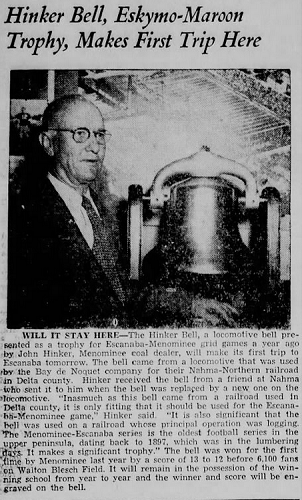 Hinker gave the bell to then Menominee coach Mickey McCormick and indicated proper use for the bell would be as an award for the gridiron rivalry.
Now Hinker’s great great nephew is trying to find the bell, which has not been seen since Escanaba’s current high school opened in 1963.
Tim Waters of Land O’ Lakes, Wis., who has launched the search, became interested by researching his family tree. “It is a big trophy (between 80 and 150 pounds by various estimates) and it is odd that it is missing,” Waters said in a recent telephone chat.
“One theory is that it is in somebody’s hunting camp or a home and they are using it as their own trophy,” said Waters.
“We have a pretty good investigation going on and all help is appreciated. If somebody does have it, we’re not looking to prosecute them. We’re just looking to get the darn thing back. Nobody will be in trouble.”
Waters refuted the old idea the bell was melted down. He has contacted numerous bell collectors, and they said a junk yard would have known it was worth a lot more than melted metal.
“The bell was not destroyed. We’ve come to that conclusion,” he said. “It was not put in a scrap yard.”
Waters contacted Coplan Iron and Metal of Escanaba and learned that bells were not melted or crushed and said the firm never accepted a bell with engravings matching the Hinker Bell.
Waters learned those businesses would sell them for the weight value to people who wanted them for yard ornaments/dinner bells, or to collectors.
“It is a treasure and it needs to be found,” said Waters.
Waters said the last known photo of the bell was with then EHS football coach Al Sigman and Esky players John Fisher and Phil Davidson in 1960. Escanaba beat Menominee from 1959-63 but could not find the bell in 1964 when the Maroons won. No one he has talked to remembers seeing the bell present at the first three games during the tenure of coach Jerry Cvengros.
The current Escanaba High School opened in 1963 and Bay de Noc Community College then occupied the old facility, which has since been demolished.
“Records indicate there was no report (of a missing bell) filed by Escanaba school district to the police department,” Waters said.
“The Hinker Bell is part of U.P. Michigan’s history, as is football and the railroads,” Waters said. “The people of Escanaba and Menominee deserve to have this trophy returned to their high schools.”
Waters, who has never seen an Escanaba or Menominee football game but is planning to rectify that omission this season, is hoping students at the two schools will join in the treasure hunt and talk about it with their parents and grandparents.
He has already contacted EHS athletic director Rob Ryan, who plans to thoroughly search the school basement.
He would like to find a photo of the bell to help collectors in their search. “Each bell was for a special locomotive,” said Waters.
“If they have a good picture we can pass it around and say we are looking for this bell. If they can pinpoint what this bell was on, they can help get the word out.”
He has also extended the search to the website at upfootball.com, which has generated interest but no bell. “If the bell is in the area still today, I don’t think it will take long to surface,” he said.
“If we don’t find this bell, we are going to try to make up a replacement as close as possible if the two schools are interested in that,” he said.
Waters is hoping that real estate agents, postal workers, delivery personnel, construction workers, etc., may have seen the bell during their travels and can help retrieve it.