

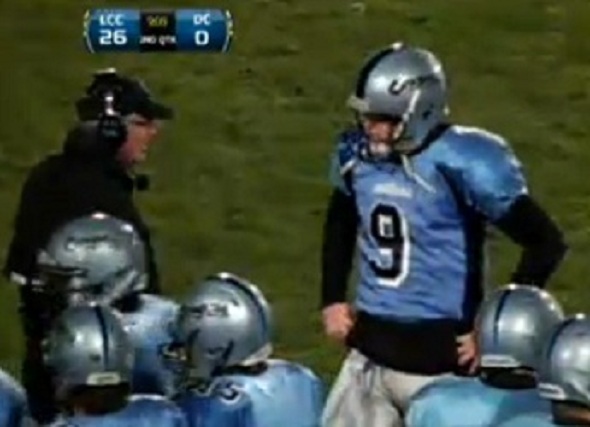
First and 20 for Lansing Catholic's Rush
December 16, 2011
If Lansing Catholic’s Cooper Rush would’ve thrown that late second-quarter pass just a litter farther Friday, his receiver probably would’ve had time to run under and catch it.
But it was hard for the Cougars’ senior quarterback to be disappointed. His first miss came after 20 straight completions to begin a 61-13 Division 5 Regional win over Dowagiac – and was one of three MHSAA records Rush set or tied on the night.
The 20 straight completions tied the mark set by Rockford’s Mike Segard in 1997. Rush also threw eight touchdown passes to set a record ahead of five who had thrown seven, a record seven TDs during the first half, and tied a record with five in the first quarter. And before leaving the game in the third quarter – after just 28 pass attempts – Rush had tossed for 510 yards to tie for third on that single-game list.
 This fall has been filled with wild passing totals by Rush, who has committed to sign with Central Michigan this winter. His 3,302 yards for the season are seventh on the MHSAA record list with a possible two games left to be played, and his 41 touchdown tosses are third. A three-year starter, he emerged as an all-state candidate last season. But he’s dwarfed that performance in helping Lansing Catholic to a 12-0 record heading into Saturday’s Semifinal against Grand Rapids West Catholic.
“We’ve improved greatly, especially this year from last year,” Rush said. “I’ve developed a lot more timing with all my receivers, with that extra year playing with each other. All my receivers know what I want, and I know what they want.
“(I tell them) never give up on a route. Trust it, and they know I’ll put it where they can catch it and make a play after the catch.”
Total, Rush finished Friday night 25 for 28 throwing the ball, and he connected with five receivers. Senior Matt Macksood caught 11 passes for 304 yards and four touchdowns – the yardage fourth on the MHSAA record list for one game, and the four scores one short of tying for first. (Click to see both players' entries in the MHSAA record book.)
And Rush was hardly just dumping off the ball. All but nine of his completions were for 10 yards or more, and eight went for at least 25 yards. Macksood and his receivers helped out with a few great catches. But most of the time, he and teammates Jack Swain, Connor Bartlett, Dan Liesman and Jim Maher simply had to snag what was thrown at them.
“Every time I dropped back, guys were wide open. It was pretty easy to hit wide-open receivers,” Rush said. “It was the same old (routes) they’ve run all year. They just ran them really crisp.”
Macksood also is rising on MHSAA record lists in a number of categories. He’s surpassed 1,400 receiving yards for the second straight season and is one of five receivers on the MHSAA list with at least 2,800 for his career. His 33 touchdown catches over the last two seasons puts him tied for sixth in that category.
Click to watch the replay of Friday's game online at FoxSportsDetroit.com.
MHSAA Opposes Big Ten Friday Football
November 2, 2016
By Geoff Kimmerly
Second Half editor
The executive director of the Michigan High School Athletic Association said today that he is “disappointed and disheartened” by the Big Ten Conference announcement that it will play and televise football games on Friday nights beginning with the 2017 season.
Friday night football remains one of the strongest and longest-standing traditions in high school athletics, and the MHSAA has fought since the start of this century to keep Friday nights sacred against the overstepping of college football and the damage televised Big Ten games are now expected to cause to attendance and media coverage of the sport at the high school level.
MHSAA Executive Director John E. “Jack” Roberts was contacted by both Big Ten Conference commissioner Jim Delany and Michigan State University athletic director Mark Hollis before the decision was announced. Roberts said he is appreciative of Michigan State and University of Michigan’s low tolerance to be included in this venture – at most, both will host a Thursday or Friday night game during Labor Day weekend and play one Friday night away game during the remainder of a season – but remains frustrated that similar respect for high school football was not shown by the conference as a whole.
Michigan State has played Friday night games during Labor Day weekend the last six seasons, hosting five and playing at Western Michigan University in 2015. However, most Michigan high school games continue to be scheduled and played on the Thursday before Labor Day, relieving holiday travel conflicts in most communities. University of Michigan did play on the Thursday before Labor Day at University of Utah in 2015, but has not played on a Friday night of Labor Day weekend this decade. The Wolverines are one of five Big Ten schools without a Friday night game in 2017.
“We are saddened by this decision. We had hoped that the Big Ten Conference would stay above this. We think this cheapens the Big Ten brand,” Roberts said. “Fans won’t like this. Recruits won’t like this. And high school football coaches won’t like this.
“We are grateful that Michigan State University and the University of Michigan are trying to minimize the effects of this decision by the Big Ten. But overall, this is just the latest step by major college athletics in the pursuit of cash that is just crushing high school sports.”
The MHSAA has shown its opposition to the use of Friday nights for televised collegiate football games for more than 15 years, dating back to 2001 when the NCAA lifted its restrictions on Friday night telecasts, which at first led to the broadcasting of “mid-major conference” games on the same night traditionally reserved for high school athletes.
The MHSAA launched in 2001 its “Save Our Friday Nights” campaign to emphasize the role that Friday night high school athletic events play in communities and to rally MHSAA member schools to contact NCAA member school football coaches, athletic directors and conference commissioners to voice their concerns.
In addition to causing lower attendance at events going up against Big Ten football games, Roberts anticipates that Friday night college games also will leave high school football as a secondary priority in many media markets. More than 80 radio stations statewide cover high school games regularly, but many also carry Michigan State or University of Michigan football. High school football could lose significant time on local TV highlights shows and in print and online coverage as well, as resources are diverted to cover a college game – potentially quieting significantly the positive buzz that comes from the typical high school football Friday night.
“Everyone knows that football is struggling right now,” Roberts said. “It’s getting a lot of bad publicity. Participation is declining. And now this; there couldn’t be worse timing.”
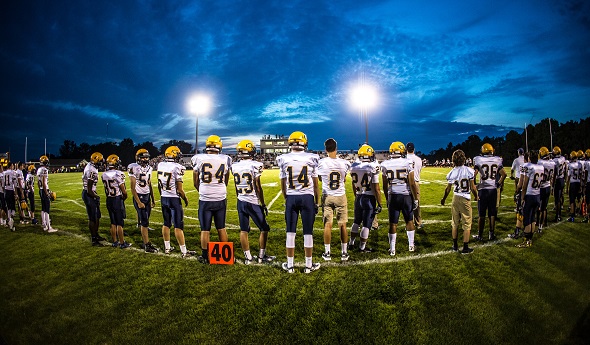
PHOTO: Grand Ledge takes on Okemos under the Friday night lights this season. (Click to see more from HighSchoolSportsScene.com.)