

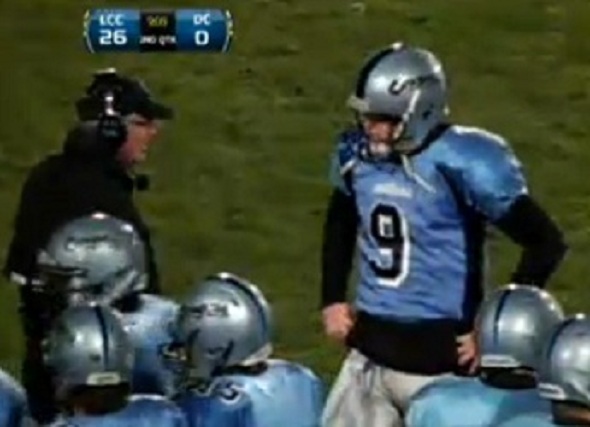
First and 20 for Lansing Catholic's Rush
December 16, 2011
If Lansing Catholic’s Cooper Rush would’ve thrown that late second-quarter pass just a litter farther Friday, his receiver probably would’ve had time to run under and catch it.
But it was hard for the Cougars’ senior quarterback to be disappointed. His first miss came after 20 straight completions to begin a 61-13 Division 5 Regional win over Dowagiac – and was one of three MHSAA records Rush set or tied on the night.
The 20 straight completions tied the mark set by Rockford’s Mike Segard in 1997. Rush also threw eight touchdown passes to set a record ahead of five who had thrown seven, a record seven TDs during the first half, and tied a record with five in the first quarter. And before leaving the game in the third quarter – after just 28 pass attempts – Rush had tossed for 510 yards to tie for third on that single-game list.
 This fall has been filled with wild passing totals by Rush, who has committed to sign with Central Michigan this winter. His 3,302 yards for the season are seventh on the MHSAA record list with a possible two games left to be played, and his 41 touchdown tosses are third. A three-year starter, he emerged as an all-state candidate last season. But he’s dwarfed that performance in helping Lansing Catholic to a 12-0 record heading into Saturday’s Semifinal against Grand Rapids West Catholic.
“We’ve improved greatly, especially this year from last year,” Rush said. “I’ve developed a lot more timing with all my receivers, with that extra year playing with each other. All my receivers know what I want, and I know what they want.
“(I tell them) never give up on a route. Trust it, and they know I’ll put it where they can catch it and make a play after the catch.”
Total, Rush finished Friday night 25 for 28 throwing the ball, and he connected with five receivers. Senior Matt Macksood caught 11 passes for 304 yards and four touchdowns – the yardage fourth on the MHSAA record list for one game, and the four scores one short of tying for first. (Click to see both players' entries in the MHSAA record book.)
And Rush was hardly just dumping off the ball. All but nine of his completions were for 10 yards or more, and eight went for at least 25 yards. Macksood and his receivers helped out with a few great catches. But most of the time, he and teammates Jack Swain, Connor Bartlett, Dan Liesman and Jim Maher simply had to snag what was thrown at them.
“Every time I dropped back, guys were wide open. It was pretty easy to hit wide-open receivers,” Rush said. “It was the same old (routes) they’ve run all year. They just ran them really crisp.”
Macksood also is rising on MHSAA record lists in a number of categories. He’s surpassed 1,400 receiving yards for the second straight season and is one of five receivers on the MHSAA list with at least 2,800 for his career. His 33 touchdown catches over the last two seasons puts him tied for sixth in that category.
Click to watch the replay of Friday's game online at FoxSportsDetroit.com.

Best Practices
June 28, 2016
Two-thirds of concussions reported in Michigan high school football last fall occurred in games. Even though there are at least five times more hours of exposure during practices than games, there are half as many concussions during practice, according to the mandated concussion reporting requirement of the Michigan High School Athletic Association that is unmatched in the country in terms of its depth and breadth for a statewide requirement.
Michigan was among the handful of states to restrict contact in practice, in 2014, a full season prior to recommendations from the National Federation of State High School Associations and later action by most other statewide associations.
Some of those statewide organizations continue to operate without limitation on contact in football practices, while their counterpart organizations in other states have gone so far as to limit contact to a certain number of minutes in a day and/or week.
Entering mostly uncharted waters for high school football in early 2014, an MHSAA task force recommended that the number of practices be limited where collisions between players could occur – no more than one per day during preseason, no more than two per week after the first game.
This change was embraced by this state’s football coaches association and adopted by the MHSAA Representative Council. All parties liked the ease of administration of this policy, and all distrusted the idea of limiting the number of minutes of contact during practices.
If there is a 30-minute limit on contact in a day or a 90-minute limit on contact in a week, is it the same 30-minute or 90-minute period for all players, even if many are not involved in one or more of the contact drills? Or does the limit apply to each player individually; and if so, how is that tracked, and by whom?
These and other questions made coaches and administrators question how effective a limit on minutes might really be. Nevertheless, a 90-minute per week limit during regular season has been made an MHSAA recommendation for the 2016 season. This will provide an opportunity to address and possibly answer some of the questions that have been raised.
The MHSAA will survey schools this fall about their practice plans and the actual time spent in contact drills by players, assessing how that differs according to offense, defense, player position and grade in school, and determining best practices for how to track player contact minutes.
When Michigan acted in 2014 to limit contact in practice, it was one of the first states to do so. As Michigan takes additional steps to limit contact in practice, it will be one of the first states to do so after researching the best ways to actually do it.