

Flag Waves for Record-Setting Hudson
November 24, 2015
By Ron Pesch
Special for Second Half
The story of little Hudson High School had captured the minds of many back in the fall of 1975, but perhaps none more so then the one belonging to filmmaker Steve Gebhardt.
The small town, located south of Jackson, boasted a population of about 2,600 at the time. Student enrollment placed its high school firmly as Class C in a four-tiered system used by the Michigan High School Athletic Association to determine placement in MHSAA postseason tournament play.
On a cold day in Mount Pleasant at Central Michigan University, Gebhardt and crew, armed with cameras, captured the action. It was the first Class C title game in the state’s long history of prep football. The game matching Hudson’s Straight T and Ishpeming’s Slot I offenses also would serve as the conclusion to something amazing.
After losing their season opener in 1968 to Blissfield, Coach Tom Saylor’s Tigers began a march unseen in state high school history. Hudson finished out that football season with eight straight victories, but could not be found among the four squads with a single defeat ranked in the Associated Press top 10 poll for Class C. That changed a year later, when Hudson posted nine straight wins. The 1969 AP poll found the Tigers in second place behind only Frankenmuth’s undefeated squad at season end.
 Nine dominating wins in 1970 brought the Tigers’ win streak to 26 straight. That Hudson squad, ranked among the best in school history, allowed a mere 24 points while scoring 372. Yet, again, the team landed in second place at the end of the year according to AP’s statewide panel, comprised of five members each from newspapers and radio/TV stations. According to the AP poll, Michigan’s Class C crown was instead awarded to a stellar Galesburg-Augusta team.
The 1971 season saw Hudson post a third consecutive 9-0 mark, and their 35th victory in a row, but again they finished the season as bridesmaids in the rankings behind North Muskegon. Tight wins in a pair of contests – an 8-0 victory over Harper Woods Lutheran East and a 6-0 defeat of Morenci in the traditional season finale – likely gave the nod to the Norseman, who had played only eight games that season.
With no control over the press polls, the Tigers coaching staff set its sights on another target – Michigan’s consecutive win streak of 44 gridiron games.
Hudson won the 1972 season opener against Blissfield, 16-3, and then rolled through its next six contests with relative ease. Game eight was against Homer, a team ranked among the top 10 in Class C all year. Suddenly, the streak was on the media’s radar.
“Little Hudson High Eyes 43rd in a Row” was the headline in the Detroit Free Press. “Winning streaks are made to be broken,” wrote the dean of state sports writers, Hal Schram. “Where will it end for little Hudson High?”
Saylor’s team trounced Homer 42-0 to ensure that the streak didn’t stop with the article.
Fittingly, the traditional season-ending battle with Morenci offered the chance to tie the state record for consecutive wins. As chance would have it, the Bulldogs held the long-standing mark in Michigan. Between 1948 and 1953, Morenci had posted 44 straight victories. The previous mark had been a 34-game winning streak by Detroit Catholic Central between 1936 and 1939.
Memories of the tight contest from 1971 were quickly forgotten as Hudson won easily, 42-0. With the victory, the Tigers were finally named Class C champs by the AP (but were still ranked second in Class C by United Press International), and Coach Tom Saylor was named AP Prep Coach of the Year.
A graduate of Deerfield High School in 1960, Saylor enrolled at Eastern Michigan University. At age 22 he accepted a teaching job at Hudson. After a year coaching the junior high team, and another as a junior varsity assistant, Saylor, was named varsity football coach in 1966 when Tiger coach Jack Zimmerman became principal at the Miller Building – the town’s elementary school.
The team became the record holder with a season opening 30-0 victory over Blissfield in 1973. However the streak was nearly ended by Manchester, a 6-0 win, in the season’s sixth game. Fullback Dan Bellfy scored the lone touchdown on a 4-yard run with 4:50 left in the first half.
“That was all the stubborn Tiger defense needed to work with,” noted the report in the Saturday, Oct. 20 edition of the Hillsdale Daily News. “Hudson coach Tom Saylor said, ‘Our defensive ends Don Hoover and Rick Beagle, did an outstanding job of pressuring (All-State quarterback Rick) Kennedy.’ (Dan) Mullaly came up with a big play as he intercepted a Kennedy pass at midfield with less than a minute left on the clock.”
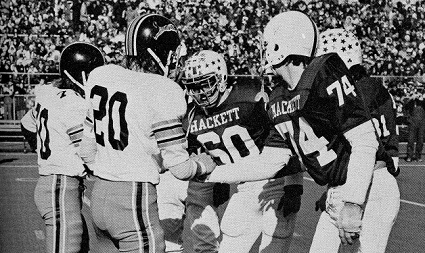 Breathing a sigh of relief, the Tigers again ended the year undefeated, extending the streak to 53 straight wins. Hudson High was named mythical Class C state champ by the AP, but again UPI downplayed the success. Undefeated St. Ignace from the Upper Peninsula was named UPI champ, with second place awarded to once beaten Kalamazoo Hackett. The panel of eight different high school coaches that voted each week in the UPI poll felt “that if there was a playoff annually and it had to meet Hackett and St. Ignace,” Hudson would fall despite its lengthy winning streak. So instead, the Tigers finished third in the UPI Class C prep rankings.
The 1974 team extended the streak to 62. Of course, with a huge target on its back, pressure mounted throughout the year.
“The much-publicized battle between the top-ranked Tigers and the fourth-ranked (Addison) Panthers was everything the 6,000 rain-drenched fans could hope for,” stated the Hillsdale Daily News. Trailing 13-0 early, and 21-20 with 10:08 left in the contest, Hudson rallied back with a touchdown by Greg Guitierrez with 4:48 left in the fourth quarter for a 26-21 victory at Hudson’s Thompson Field in week three. Schram later called the contest “Prep Game of the Year.”
Two weeks later, Mark Luma, a junior running back for the Tigers, scored on the last play of the game to give Hudson a 14-8 road win over Grass Lake to keep the streak alive.
Hudson led 16-14 at halftime of the season finale with Hillsdale, but both teams were unable to score in the final two quarters, and Hudson capped a sixth straight undefeated season with its third consecutive Class C title according to the Associated Press.
“I was born and educated in Cincinnati,” said Steve Gebhardt, discussing his interest in the high school team from southeastern Michigan. “I stumbled on an article in a Detroit newspaper talking about the Hudson streak and its potential to gain this record next year. It seemed prophetic and I bit.”
The record that caught Gebhardt’s eye was owned by Jefferson City, Missouri. Between 1958 and 1966, the Jays compiled 71 straight wins on the gridiron.
A 1955 graduate of Cincinnati’s Walnut Hills High School, Gebhardt “worked at an architectural engineering firm for three years before enrolling in the University of Cincinnati to study architecture, earning a bachelor’s degree in 1964 and a master’s degree in community planning in 1968,” recalled the New York Times. “While at school he became infatuated with film. He founded the film society, (and) began making his own experimental 16-millimeter films.”
In 1970, he was invited to New York to work for a friend, Jonas Mekas, an avant-garde cinema pioneer. By 1972, Gebhardt was working as resident filmmaker for Joko Films, owned by former Beatle John Lennon and wife Yoko Ono. It was followed by work filming the Rolling Stones in Texas during their Exile on Main St tour.
Shortly after the 1974 season, the Michigan High School Athletic Association announced plans to host a state championship series for football in Michigan in the fall of 1975. The 1974 season had been spent studying the plan. Deemed a success, the coming season would see four teams selected from each of the four classifications selected to compete in a two-round playoff. Teams winning round one would pair off in a championship round, with the winner of that game proclaimed a true state champion, based on competition.
With Hudson’s streak now at 62, another undefeated season would mean they would tie the national record. If the Tigers qualified for the planned playoffs, the team would have the chance to top the mark in the opening round.
Gebhardt made contact with Saylor and school officials about the possibility of capturing the chase for the record on film for a possible documentary. Approved, with a film crew assembled, they joined the team for much of the 1975 season, shooting game film both in town and on the road. They caught a team focused on disappointing no one, including Saylor, the coaching staff, family, friends and classmates. After a period of adjustment, the presence of the crew provided more inspiration not to lose.
Prior to the start of the season, Saylor spoke of his optimism with the press.
 ''This is the group of kids we've been waiting for since they were in junior high. They've lost only one game since junior high, that to Manchester when they were freshmen.” Saylor also spoke of the team’s depth, as well as his only concerns. "We have three complete backfields which we can use. We've got Dan Salamin back at quarterback, with Greg Gutierrez and Mark Luma back at halfback. I'm concerned about complacency. I'm concerned about keeping everybody happy.”
A dominating 32-0 win over Blissfield in the season opener highlighted the strength of the defense. In game two, Clinton put up a good fight at Thompson Field, scoring two third quarter touchdowns to pull within two points, 16-14, but ultimately fell 32-14 as Luma rushed for 152 yards and two touchdowns on 21 carries. With the victory, Hudson now was tied with Pittsfield, Illinois, for second place nationally for consecutive wins at 64. Immediately, the spotlight on Hudson grew.
“I get at least two calls a day from newspapers, no less,” said Saylor at the time.
Hoping to see a repeat of the 1974 thriller, another huge crowd showed up for the Addison game. Hudson won the contest, 28-6, but took a huge blow with the loss of Luma early in the contest with torn ligaments in a knee.
Manchester, in week six, put up a bit of a struggle, but was defeated 18-7. Win number 70 was a convincing shutout of Bronson, 30-0. That set the stage for the Hillsdale game and a chance to tie the Jefferson City record.
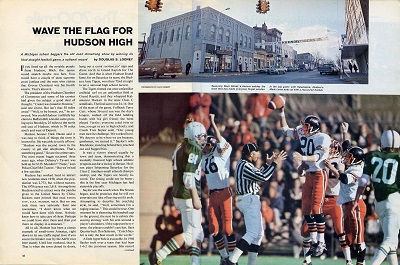
The possibility of tying the mark was mentioned to a national television audience by former Detroit Lion Alex Karras on ABC’s Monday Night Football telecast. People magazine and Sports Illustrated were preparing stories for publication (Click to read the Sports Illustrated article). A camera crew from CBS sports, filming a spot for the Today Show, as well as numerous newspaper reporters had come to town. Coach Saylor fielded calls and requests for interviews from scores of radio and TV stations and newspaper and magazine reporters.
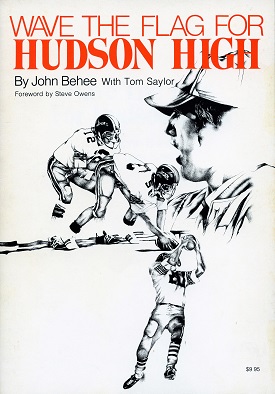
“The cheerleaders organized a special pep assembly, one that the community would never forget,” wrote John Behee in the book, Wave the Flag for Hudson High, detailing the streak. “Special invitations were extended to all of the 150 athletes who had played varsity football for Hudson High School during the eight-year victory string, to those who had performed as cheerleaders and to the parents of those players and cheerleaders.”
Telegrams from Jefferson City coach Pete Atkins and State of Michigan Governor William Milliken arrived before game time, wishing the team well. Luma, thought lost for the season, was cleared to play.
Ahead 11-0 at the half, the Tigers scored a 24-6 win over Class B Hillsdale to tie the mark. Writing for the Detroit News, Jerry Green recalled the theme song from an old radio adventure series, Jack Armstrong, All-American Boy, in his coverage of the game. The broadcast ran from 1933 to 1951.
"Wave the flag for Hudson High, boys, show them how we stand. Ever shall our team be champions, known through-out the land!"
“Jack Armstrong lives, a folk hero performing miracles … for Hudson High of course,” wrote Green. “He has gone into coaching and his name in true life is Tom Saylor.”
The only question that remained was whether playoff points would qualify the Tigers for the postseason. Based on strength of schedule and region, a loss by Allen Park Cabrini in its eighth and final week of football, and the upset of Traverse City St. Francis by Lansing Catholic Central in week nine improved the odds that the Tigers would earn a berth, but nothing was certain until final calculations by the MHSAA. The results were released late Sunday after the game.
According to the computer rankings, Hudson surpassed a 7-2 team from Flat Rock to represent Region II in the semifinal round of the postseason. They would play Region I’s Kalamazoo Hackett, once beaten during the regular season. The opportunity to capture the national record was scheduled for Saturday, Nov. 15 on the artificial turf of Houseman Field in Grand Rapids.
Again Gebhardt’s crew, along with 11,000 fans, caught the action. A fumble by Hackett on the first play from scrimmage was recovered by Hudson’s John Barrett and eight plays later, the Orange and Black were on the board. Gutierrez crashed through from the 1, followed by the 2-point conversion by Luma. The Tigers were up 24-6 at the half. Hackett scored midway through the third quarter to pull within 10, 24-14. From that point on, stellar defense on both sides defined the game. An interception by Hudson’s Tim Decker in the final minute of play sealed the win, and the country had a new record holder.
Congratulations flowed in from across America, and included a letter from President Gerald R. Ford, a former Michigan high school football player himself.
A week later, the ride ended in the state final game at Central Michigan University before a crowd of 7,000. Ishpeming opened up a 24-8 lead in the first quarter and downed the Tigers 38-22, grabbing the first MHSAA Class C title. The incredible streak was over. Gebhardt and his crew had captured grass roots America at its finest, including the storybook end.
“Mr. Steve Gebhardt,” wrote Behee, “who had shared intimately in the triumphs and heartbreaks of the 1975 football season was made an honorary 42nd member of the Hudson team and given a varsity letter for ‘guarding the water bucket.’”
The football team’s accomplishments continued to rack up honors. In January 1976, it was announced that Hudson would be honored with induction into the Michigan Sports Hall of Fame.
 “This marks the first time in the Hall’s 22-year history that a team is to be honored, and I doubt if it happens again in our time.” said Nick Kerbawy, a former general manager of the Detroit Lions and the Detroit Pistons, and the Hall of Fame’s commissioner. “Many teams in Michigan have won consecutive championships, but no team — amateur or professional — can match Hudson’s amazing record.”
In 1976, Hudson again went undefeated, but because of the quirks of the early playoff system, failed to qualify for the postseason. The streak of regular-season victories was extended to 81 before ending in 1977.
Gebhardt began work, cutting down the hundreds of hours of film for the documentary. However, financing the project became a challenge.
“There is a terrific show here,” he would say, years later, describing his passion project. “The story up to the preparation after the Bronson game is pretty well cut. It's the fact that the story really is in the next three weekends of games. … It's that material after the Bronson game #70 that needs editing. (That is) where the meat of the story lives.”
“In the mid-1970s Mr. Gebhardt moved to Los Angeles and worked as an architect,” noted the New York Times. “He returned to Cincinnati in 1989 and resumed his film career.”
For the talented cameraman and story teller, other projects surfaced. A documentary on Bill Monroe, the father of bluegrass music, was released in 1993. A trio of films, with ties to the life of 1960s cultural activist John Sinclair, were filmed, edited and prepared for release.
Gebhardt’s passion for the Hudson High project was re-ignited in 1997 when California’s Concord De La Salle High School eclipsed the national mark, and again in 2008 when inquiries about the film were received.
In 2010, when Hudson defeated Ishpeming for the MHSAA Division 7 championship in a rematch of the 1975 title game, Gebhardt traveled from Cincinnati to Detroit’s Ford Field to film the meeting for possible use in the project.
Sadly, time expired. In October of this year, at the age of 78, Gebhardt passed away.
“At his death, he was at work on ‘Hudson Tigers,’ a documentary he began in the mid-1970s about a high school football team in Hudson, Mich., that had won 72 straight games,” stated his New York Times obituary.
“There are a number of versions of The Hudson Tigers out there,” wrote Gebhardt back in 2008, in an effort to attract financing for the tale. “All are of low resolution … quite frankly there isn't anyone other than me who can or should complete this show. What do you think?”
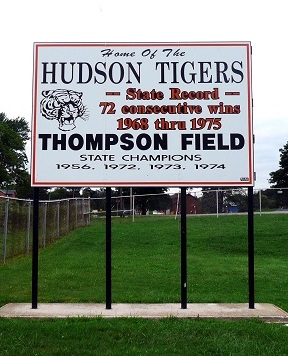
Despite a serious run at the mark by Ithaca High School, which assembled a 69-game streak that was ended by Monroe St. Mary Catholic Central in the 2014 Division 6 championship game, Hudson’s amazing feat of 72 straight remains the Michigan state record. So, too, stands the regular season mark of 81.
However, it remains to be seen if the work of a young filmmaker, on location 40 years ago to capture an amazing feat, ever sees the light of day. In this time of sports documentaries, will the flag for the Hudson High’s teams of 1968 to 1975 again be waved?
 Ron Pesch has taken an active role in researching the history of MHSAA events since 1985 and began writing for MHSAA Finals programs in 1986, adding additional features and "flashbacks" in 1992. He inherited the title of MHSAA historian from the late Dick Kishpaugh following the 1993-94 school year, and resides in Muskegon. Contact him at [email protected] with ideas for historical articles.
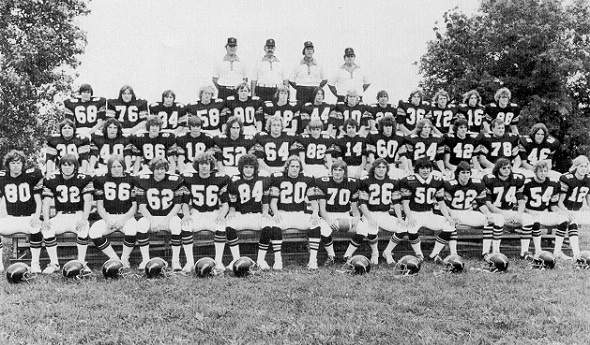
PHOTOS: (Top) The 1975 Hudson football team made the first MHSAA Playoffs; this is the team photo from the Finals program. (Top middle) John Behee wrote "Wave the Flag for Hudson High" about the record run. (Middle) Captains for Hudson, left, and Kalamazoo Hackett met at midfield before the 1975 Class C Semifinal. (Below middle) Sports Illustrated was among national media that wrote about the Tigers. (Below) A sign stands in Hudson saluting the success of the local football program. (Photos courtesy of Ron Pesch or taken from "Wave the Flag for Hudson High."
Drive for Detroit: Week 9 in Review
October 26, 2015
By Geoff Kimmerly
Second Half editor
Week 9 of the football regular season brings with it a Twitter feed full of gems like these:
Enjoy perfection? Northville finished 9-0 for the first time since 1961. Portland did so for the first time since 1969. Birmingham Groves posted its first flawless regular-season finish since 1978. For Buchanan, it was the first since 1988.
How about streaks? Rockford continued a 20-season playoff streak, and Stevensville Lakeshore clinched 18 years in a row heading to the postseason. And of course there was at least one stat line worth a double take – like Pewamo-Westphalia running back Jared Smith finishing the regular season with 2,065 rushing yards and 38 touchdowns for the undefeated Pirates.
Those are just highlights. As we begin to focus on the first week of the playoffs, let's not forget the rest of the best from the final week of the regular season.
Bay & Thumb
Fenton 30, Linden 27 (OT)
Fenton upped its Flint Metro League winning streak to 29 straight games and its league title streak to five seasons either sharing the championship or winning it outright thanks to this victory over second-place Linden. The Tigers ended the regular season at 8-1 while Linden is 7-2; Fenton’s lone loss came on opening night to Davison by three points. Click for more from the Flint Journal.
Also noted:
Freeland 42, Frankenmuth 7 – The Falcons (9-0) won the only matchup between undefeated teams in the state this weekend, but could see Frankenmuth (8-1) again in a Division 5 District Final.
Midland Dow 49, Midland 28 – The Chargers (8-1) won this crosstown rivalry game for the second straight season … and earned a rematch with the Chemics (7-2) in a Division 2 opener.
New Lothrop 41, Montrose 0 – The Hornets (9-0) completed their sixth straight undefeated regular season and in the process gave Montrose (5-4) a boost that helped the Rams into the playoffs as an at-large team.
Saginaw Swan Valley 28, Bay City John Glenn 21 – The Vikings (6-3) secured a fourth-straight playoff berth, but John Glenn (5-4) also made the postseason for a second straight season.
Greater Detroit
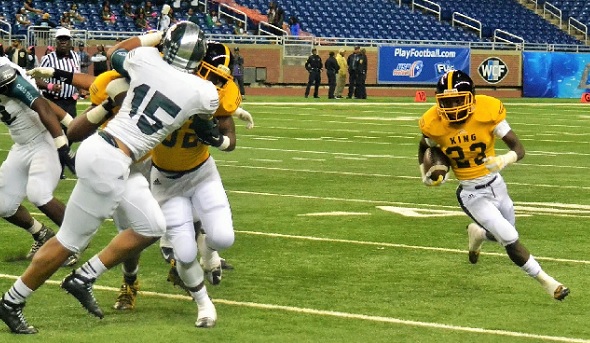
Detroit Martin Luther King 27, Detroit Cass Tech 25
It wouldn’t surprise many if both of these teams ended up back at Ford Field in five weeks playing for MHSAA titles in Division 2 and Division 1, respectively. This Detroit Public League Division I Final was their second matchup this season and both were decided by a field goal or less; King won the Sept. 25 meeting 31-28. The Crusaders (9-0) locked down Cass Tech’s passing game in this one, holding the Technicians (7-2) to their season low in points. Click for more from the Detroit Free Press.
Also noted:
Orchard Lake St. Mary's 38, Warren DeLaSalle 0 – The Eaglets (7-1) look like strong favorites in Division 3 after defeating reigning Division 2 champ DeLaSalle (6-3) big in the Prep Bowl to avenge their only loss this season.
Utica Eisenhower 17, Romeo 14 – The Eagles (6-3) are one of the state’s hottest teams, beating opponents the last three weeks that are a combined 21-6 including handing Romeo (8-1) its only loss.
Detroit Collegiate Prep 26, Detroit Central Collegiate 12 – The Colts (9-0) won the PSL Division II title game to register their first perfect regular season in at least 65 years; Central Collegiate (6-3) is headed to the playoffs for the second straight season after going 0-9 in 2013.
West Bloomfield 20, Farmington Hills Harrison 14 – The Lakers (9-0) tied their school record for wins set last season with their first perfect regular season since going 8-0 in 1960; Harrison (7-2) is headed back to the playoffs for the ninth time in 10 seasons.
Mid-Michigan
Lansing Catholic 35, Monroe St. Mary Catholic Central 10
Reigning Division 6 champion Monroe St. Mary (8-1) has looked ready for another run since putting up 62 points on Tecumseh on opening night, but Lansing Catholic (8-1) reminded the rest of Michigan it’s one of the dangerous teams in Division 5 by going on the road and handing the Falcons their first regular-season loss since 2013. The Cougars rattled off 28 unanswered points during the second half. Click for more from MLive-Lansing.
Also noted:
Portland 25, Marshall 16 – The Raiders finished 9-0 for the first time since 1969, which was a lot easier said than done considering Marshall (7-2) was one of five playoff teams on the schedule.
Harrison 40, Clare 20 – The Hornets (7-2) locked down second place in the Jack Pine Conference with their first win over Clare since 2010, and in the process kept the Pioneers (5-4) out of the playoffs for the first time since 2005.
Grand Ledge 42, Holt 0 – The Comets (9-0) completed their outright Capital Area Activities Conference Blue title, finished their third perfect regular season over the last eight and in the process kept rival Holt (5-4) from making the playoffs (although the Rams did improve from 3-6 a year ago).
Mount Pleasant Sacred Heart 13, Mendon 7 – The Irish (6-3) ran off six straight wins after opening 0-3 against teams that finished a combined 25-2 to return to the playoffs for the eighth straight season; Mendon (5-4) also earned its ninth straight postseason bid despite the loss and after starting 1-3.
Northern Lower Peninsula
Harbor Springs 22, Charlevoix 20
The winner was guaranteed a playoff spot. And Harbor Springs had plenty to celebrate with its move to 6-3 earning both the first playoff berth since 2000 but also its first winning record in 16 years. Senior Mitch Hoffman drilled a last-second field goal to put his team over the top – and keep the Red Rayders out of the playoffs as they did not end up with enough playoff points to qualify as an at-large team despite finishing 5-4. Click for more from the Petoskey News.
Also noted:
Boyne City 35, Grayling 20 – Boyne City may have finished behind Traverse City St. Francis in the Northern Michigan Football Conference Leaders standings, but beating third-place Grayling (6-3) helped the Vikings (8-1) secure up to two home playoff games – with St. Francis likely awaiting in the Regional Final.
Lake City 28, Newberry 21 – The Trojans made quite a bounce-back from last season’s 2-7 finish and beat two straight playoffs teams in Lincoln Alcona and Newberry (6-3) the last two weeks to get back to the playoffs at 5-4.
Oscoda 48, AuGres-Sims 22 – The Owls (6-3) also are back in the playoffs for the first time since 2000 after finishing the regular season with two straight wins.
Onekama 21, Frankfort 8 – Before last season, Onekama hadn’t beaten Frankfort since 1994; now, the Portagers (8-1) have won two straight over the Panthers (7-2) and could see them again in a Division 8 District Final.
Southeast & Border
Jackson 35, Jackson Lumen Christi 34 (OT)
This season just keeps getting better for Jackson. By moving to 7-2, the Vikings equaled their wins from 2010-2014 combined. And although they didn’t play most seasons in between, it’s worth noting this was Jackson’s first win over Lumen Christi since 1988 – and after 27, 29 and 34-point defeats to the Titans (6-3) the last three years. Click for more from the Jackson Citizen-Patriot.
Also noted:
Grass Lake 19, Union City 16 – The Warriors (5-4) survived a three-game losing streak midseason to earn an at-large playoff bid, and with this win knocked Union City (4-5) out of the running.
Clinton 36, Ottawa Lake Whiteford 18 – The Redskins (9-0) finished their fourth straight perfect regular season and fourth straight Tri-County Conference title by beating Whiteford (7-2), one of three other playoff teams from the league.
Manchester 45, Homer 38 – The Flying Dutchmen (8-1) claimed this meeting of first-place teams in the Cascades and Big 8 conferences for the second straight season, putting up a season high points total while also giving up their most this season to Homer (7-2).
Parma Western 28, Dexter 0 – After missing by a win twice over the last six seasons, Western (6-3) finally has its first MHSAA playoff berth thanks to two straight victories to close the regular season.
Southwest Corridor
Benton Harbor 29, Portage Northern 23 (OT)
Benton Harbor is one of the best stories of this season. The Tigers (5-4) didn’t win a game in 2013 or 2014 and went a combined 4-68 over the last eight seasons, but with a new coach and new athletic director posted their first winning season since 1989 – and earned their first playoff berth ever. It took this overtime win over Portage Northern (4-5), which hadn’t lost to Benton Harbor since 1996. Click for more from the St. Joseph Herald-Palladium.
Also noted:
Dowagiac 49, Paw Paw 46 – The Chieftains (6-3) reversed their record of a year ago but needed a second straight win by three points or fewer to return to the playoffs.
Constantine 21, Hartford 6 – The Falcons kept their playoff streak alive for a 17th straight season by bouncing back from a Week 8 loss to finish 5-4; Hartford also made the playoffs at 5-4.
St. Joseph 22, Portage Central 6 – The Bears (8-1) gained a share of the Southwestern Michigan Athletic Conference East title by breaking a three-year losing streak against the Mustangs (8-1).
Schoolcraft 41, Delton Kellogg 15 – The Eagles (9-0) finished a perfect regular season for the second time in four and won all but one of their games by at least 18 points; Delton (5-4) still made the playoffs for the first time since 2001 with its first winning record since 2009.
Upper Peninsula
Escanaba 18, Kingsford 14
Escanaba was riding high this fall after opening with two wins under a new coach. Then came four straight losses against a string of opponents that ended up including three playoff teams. But the Eskymos (5-4) didn’t fold, instead finishing with three wins including two over playoff teams to earn their first postseason berth since 2011. Kingsford (6-3) ended up with a home game this week despite the loss. Click for more from the Iron Mountain Daily News.
Also noted:
St. Ignace 14, Fowler 7 – The Saints (8-1) deserve a lot of credit for stacking their nonleague schedule with undefeated Ishpeming last week and annual Division 8 power Fowler (6-3).
Negaunee 35, Ishepming Westwood 0 – Westwood (5-4) claimed a playoff spot for a second straight season despite the loss, but Negaunee (7-2) hopes it regained some momentum after two straight defeats by a combined seven points.
Munising 41, L'Anse 8 – The reigning Division 8 runner-up Mustangs (7-2) bounced back from a Week 8 loss by ending the playoff hopes for L’Anse (5-4).
Lake Linden-Hubbell 34, Crystal Falls Forest Park 28 – The Lakes (9-0) broke a five-game losing streak against Forest Park (5-3) to finish perfect for the regular season for the first time since 2009 … and earn a rematch with Forest Park this week.
West Michigan
Rockford 28, Hudsonville 27
At stake Friday was a share of the Ottawa-Kent Conference Red title – four teams were tied for first place, guaranteeing multiple champions. But also at stake was Rockford’s 20-season playoff streak, the longest-running in Michigan and third-longest in MHSAA history. A blocked extra point by a back-up quarterback and a pair of field goals by the back-up kicker were among contributions that paid off nicely for the Rams (6-3), who could see Hudsonville (6-3) again in a Division 1 District Final. Click for more from the Grand Rapids Press.
Also noted:
Grandville 18, East Kentwood 8 – This decided the other half of the O-K Red title, with the Bulldogs (6-3) not only earning a share but posting a sixth win for the first time since 2006; East Kentwood also is 6-3 and gets also third-place Hudsonville in the playoffs.
Lowell 28, Grand Rapids Christian 14 – The Red Arrows (8-1) finished a perfect run in the O-K White for the second time in three seasons and won their fourth straight against the Eagles (5-4).
Grand Rapids Forest Hills Northern 26, Ada Forest Hills Eastern 24 – The Huskies (7-2) fell shy in the O-K Bronze after a 5-0 start, but forcing rival Forest Hills Eastern (8-1) to share the title probably lessened any lingering disappointment.
Big Rapids 20, Morley-Stanwood 10 – After seasons of three and one win over the last two, Big Rapids is back in the playoffs thanks to two straight wins, this one over a Mohawks team also 6-3.
8-Player
Battle Creek St. Philip 47, Lawrence 44
St. Philip (9-0) got the better of Lawrence for the first time in their last four meetings, handing those Tigers (7-2) their first in-state loss since 2013 and cementing the top spot overall in the 8-player tournament with the highest final playoff-point average. The two could meet again in a Regional Final next week. Click for more from the Battle Creek Enquirer.
Also noted:
Pickford 62, Onaway 28 – It was this simple: Pickford (6-3) won and got into the playoffs, and Onaway (5-4) fell out of the top 16 with the loss.
Morrice 58, Portland St. Patrick 42 – The Orioles (8-1) still aren't getting much mention as a contender, but they haven’t lost since falling to St. Philip on opening night and clinched the Central Michigan 8-Man League title with this win over the Shamrocks (6-3).
PHOTO: A Detroit Martin Luther King ball-carrier follows his blocker during the Crusaders' Detroit Public School League Division I championship win. (Photo courtesy of the Detroit Public School League.)