

Football: 8 is More than Enough
By
Geoff Kimmerly
MHSAA.com senior editor
November 18, 2011
Carsonville-Port Sanilac has been all in since the beginning of 8-player football as an MHSAA sport three seasons ago.
Rapid River made the switch just this season.
But heading into tonight's first-ever MHSAA Final for the sport, both programs can claim similar rewards from embracing this adjusted version of the state's most popular high school sport.
Despite small enrollments, they can still play the game. And although they've struggled at times in recent years, both teams are winning -- and reaping all of the community support and good vibes that come with success.
Both 11-1, Carsonville-Port Sanilac and Rapid River kick off for the championship at 7 p.m. at Northern Michigan's Superior Dome.
"We can't be happier to have the opportunity to play (8-player) this year. The added success has really brought our team together, and I hope it ends on a good note," Rapid River coach Steve Ostrenga said. "It's great for the kids and great for the community. You always talk about hard work. But when we were 1-8 ... the kids who have been through those tough times, I think they appreciate it more."
Both teams can value that statement.
Rapid River won one game each of the last two seasons and hadn't reached the playoffs since 2002. The school has roughly 120 students now -- 40-50 fewer than when it was having its last run of success near the end of the 1990s.
Carsonville-Port Sanilac went 0-9 before leading the charge into 8-player football in 2009. Although the Tigers had made the playoffs as recently as 2005, winning seasons for the team had been few and far between. But Carsonville-Port Sanilac went undefeated a year ago and beat Bellaire in an unofficial state "championship" game that matched the Tigers -- winners of the Mid-Michigan 8-man Football League -- against the winners of the Bridge-Alliance 8-man Conference.
"It's changed the whole culture of the school," said C-PS coach Tim Brabant, who is in his second season running the program and graduated from the school in 2006. "At first, a lot of people didn't buy into it. But as we went undefeated last year, and with what we've done this year, we've gotten complete community support and a buy-in across the board."
Recently, that's included 240 people showing up at last week's pancake breakfast to raise money for this weekend's trip to Marquette. Tigers supports also filled two fan buses headed to NMU.
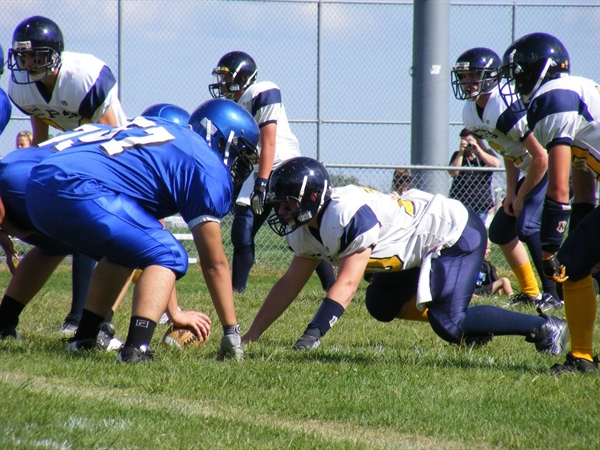
Both coaches also listed a similar adjustment teams that play 8-player football must make: Strong open-field tackling is a must.
Although the field is only 40 yards wide -- instead of the usual 53 -- having six fewer players on the field opens up the offense significantly. Rapid River has scored more than 60 points four times and Carsonville-Port Sanilac put up 70 and 91 in games this fall. Both average 51 points per contest. Ostrenga grew up in Menominee -- known for its single wing offense that doesn't use a quarterback -- but has embraced a spread passing attack that allows for opportunities all over the field.
Both teams suffered their only losses when their quarterbacks were injured briefly in September. Depth always is an issue when numbers are low.
That said, success in this version of the game has planted some roots for the future. C-PS had 50 players out for elementary teams this fall and hopes to have enough down the road for a full junior varsity. Rapid River thinks the move to 8-player will help it sustain the program despite enrollment losses of the last few years.
And the historical context of tonight's game is not lost on either team.
"They understand that. We were the first team in the state of Michigan to have a full 8-man roster," Brabant said. "A lot of people thought we were crazy. These kids understand what's at stake."
(Photo courtesy of Carsonville-Port Sanilac football program)
A Game for Every Fan: Week 8
October 15, 2015
By Geoff Kimmerly
Second Half editor
All but one of the top-billed games of this week’s statewide football preview will decide a league champion. There are great ones to watch, no matter where you call home.
At the same time, we’re turning an eye to the growing 11-player playoff field, which includes 109 teams with 86 more able to qualify with a win this weekend. For that reason, you’ll see below a few more games than usual featuring teams with three-loss records – because those teams’ seasons are on the line as they attempt to win out and guarantee a postseason spot.
Read on for games that could carry the most impact from every region of the state during Week 8. And remember to check MHSAA Score Center this weekend for results as they come in, updated standings and playoff-point averages.
Bay & Thumb
Algonac (7-0) at Richmond (6-1)
Algonac, 1-8 a year ago, can finish its first league title run since 1972 after clinching a share of the Blue Water Area Conference championship last week against previously-undefeated Almont. But don’t forget Richmond, a regular in this kind of game and a one-point loss to Almont from being undefeated. The Blue Devils would love to spoil the party; they beat Algonac 42-21 in 2014.
Others that caught my eye: Montrose (4-3) at Flint Beecher (5-1), New Lothrop (7-0) at Flint Hamady (6-1), Corunna (6-1) at Lake Fenton (4-3), Holly (4-3) at Swartz Creek (4-3).
Greater Detroit
Sterling Heights Stevenson (6-1) at Macomb Dakota (5-2)
The Macomb Area Conference Red race has been one of the state’s most exciting this season, with five of six teams in the league still in the hunt for a share of the title and for automatic playoff berths as well. These two carry one-win leads into this weekend’s final league games; both are 3-1, while Clinton Township Chippewa Valley, Utica Eisenhower and Warren Mott are all 2-2 in league play. Dakota has won the league three straight seasons, including last fall despite a 19-12 loss to Stevenson.
Others that caught my eye: St. Clair Shores South Lake (7-0) at Madison Heights Madison (6-1), Northville (7-0) at Plymouth (6-1), Hartland (5-2) at Walled Lake Western (7-0), Detroit Catholic Central (5-2) at Warren DeLaSalle (6-1).
Mid-Michigan
Fowler (6-1) at Pewamo-Westphalia (7-0)
This will be the 50th game between these neighbors and rivals, with Fowler holding a 27-22 advantage. This matchup has decided the last three Central Michigan Athletic Conference championships, with Fowler taking two of those three, and the Eagles hope to gain a share this time as P-W has a one-win edge with this the final week of the conference season. This has been a special one overall for the Pirates, who on opening night handed Madison Heights Madison its only loss and since have outscored six teams by a combined 340-27.
Others that caught my eye: Haslett (4-3) at Williamston (4-3), East Lansing (4-3) at Grand Ledge (7-0), Ann Arbor Gabriel Richard (4-3) at Lansing Catholic (6-1), Fruitport (4-3) at St. Johns (5-2).
Northern Lower Peninsula
Frankfort (6-1) at Charlevoix (5-2)
The Panthers will play the region’s game to watch for the second straight week, with both of these teams undefeated in the Northern Michigan Football League Legends division and Frankfort a half-win ahead in the standings with one more league game played. A conference title would be the Panthers’ first since 2008 and Charlevoix’s first since 2000 – and the Red Rayders won this matchup 27-6 a year ago.
Others that caught my eye: Hillman (6-1) at Whittemore-Prescott (4-3), Traverse City St. Francis (7-0) at Kalkaska (4-3), Lincoln Alcona (5-2) at Lake City (3-4), Maple City Glen Lake (4-3) at Kingsley (4-3).
Southeast & Border
Vandercook Lake (7-0) at Manchester (6-1)
The Cascades Conference championship is on the line with both teams undefeated in league play. Vandercook Lake has its most wins since 1996 and is chasing its first undefeated regular season since 1970 after surviving a three-point victory over Michigan Center last week. This is much more familiar territory for Manchester, which has won outright or shared the Cascades title the last three seasons.
Others that caught my eye: Ypsilanti Community (4-3) at Saline (7-0), Brooklyn Columbia Central (6-1) at Dundee (4-3), Ida (7-0) at Hillsdale (5-2), Holt (5-2) at Jackson (5-2).
Southwest Corridor
Buchanan (7-0) at Berrien Springs (7-0)
The victor will remain perfect and become the Berrien-Cass-St. Joseph Conference White champion. That should be enough to sell this tilt, but there are additional details of note. Berrien Springs finished second in the Wolverine B Conference West last season and has its most wins since 2011 with a shot at its best finish since 2004. Buchanan is coming off two losing seasons and has its most wins since 2012, when it won the Lakeland Conference. This also is the first game between the longtime rivals since 2011.
Others that caught my eye: Bridgman (6-1) at Niles Brandywine (5-2), Saugatuck (7-0) at Delton Kellogg (5-2), Watervliet (6-1) at Decatur (5-2), Battle Creek Lakeview (5-2) at St. Joseph (6-1).
Upper Peninsula
Ishpeming (6-0) at St. Ignace (7-0)
This game means nothing from a league race perspective and everything from a Peninsula pride point of view. St. Ignace locked up the Ski Valley Conference title with a perfect run it finished two weeks ago, while Ishpeming owns a share of the Mid-Peninsula Conference title and can finish the outright championship next week against two-win Gwinn. What makes this game intriguing is that Ishpeming hasn’t lost a regular-season game since Week 7 of 2012 and St. Ignace is perfect for the regular season since Week 9 of 2013 – and these two powers have played each other only once, in 1988.
Others that caught my eye: Munising (6-1) at Crystal Falls Forest Park (5-2), DeWitt (7-0) at Menominee (7-0), Sault Ste. Marie (5-2) at Escanaba (3-4), Hurley, Wis. (7-1) at Iron Mountain (4-3).
West Michigan
Muskegon (6-1) at Muskegon Mona Shores (7-0)
Before last season, when the Sailors won 48-27, they hadn’t beaten the Big Reds since 1982. Could they extend the streak to two? This latest chapter is at Mona Shores, the crowd should be huge, and the Sailors are reigning Division 2 runners-up and backed by a defense that hasn’t given up more than 14 points in a game while facing the likes of Fruitport, Rockford, Caledonia and Zeeland East. Then again, Muskegon remains what we’ve grown to expect – the Big Reds look like contenders to reach a fourth-straight MHSAA Final with wins over Grand Rapids Christian, East Grand Rapids and Zeeland East and the only loss to Detroit Catholic Central after Muskegon led by two touchdowns during the third quarter.
Others that caught my eye: Muskegon Oakridge (6-1) at Montague (7-0), East Grand Rapids (5-2) at Lowell (6-1), Remus Chippewa Hills (6-1) at Reed City (7-0), Cedar Springs (5-2) at Ada Forest Hills Eastern (7-0).
8-Player
Deckerville (6-1) at Peck (6-1)
Michigan’s thumb is a hub for 8-player football, thanks in large part to these two past MHSAA champions. Peck has a half-win lead over Deckerville in the North Central Thumb 8-Man League standings because it has played one more league game, but this likely will decide the championship. Deckerville hasn’t beaten the Pirates since its 2012 MHSAA title season, and would love to avenge last season’s 30-28 loss that gave Peck the league title.
Others that caught my eye: Battle Creek St. Philip (7-0) at Portland St. Patrick (6-1), Engadine (5-2) at Stephenson (5-2).
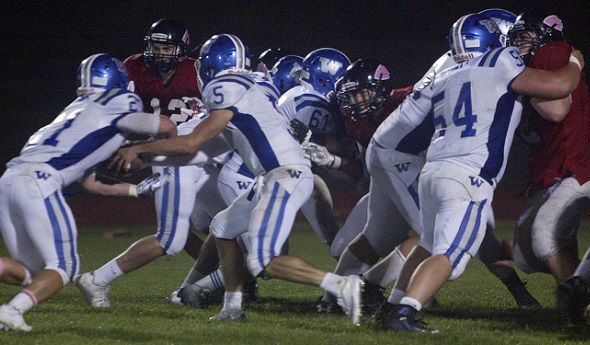
PHOTO: Walled Lake Western and Lowell, which faced off earlier this season, both face tough opponents in Week 8. (Click for more from HighSchoolSportsScene.com.)