

Football: 8 is More than Enough
By
Geoff Kimmerly
MHSAA.com senior editor
November 18, 2011
Carsonville-Port Sanilac has been all in since the beginning of 8-player football as an MHSAA sport three seasons ago.
Rapid River made the switch just this season.
But heading into tonight's first-ever MHSAA Final for the sport, both programs can claim similar rewards from embracing this adjusted version of the state's most popular high school sport.
Despite small enrollments, they can still play the game. And although they've struggled at times in recent years, both teams are winning -- and reaping all of the community support and good vibes that come with success.
Both 11-1, Carsonville-Port Sanilac and Rapid River kick off for the championship at 7 p.m. at Northern Michigan's Superior Dome.
"We can't be happier to have the opportunity to play (8-player) this year. The added success has really brought our team together, and I hope it ends on a good note," Rapid River coach Steve Ostrenga said. "It's great for the kids and great for the community. You always talk about hard work. But when we were 1-8 ... the kids who have been through those tough times, I think they appreciate it more."
Both teams can value that statement.
Rapid River won one game each of the last two seasons and hadn't reached the playoffs since 2002. The school has roughly 120 students now -- 40-50 fewer than when it was having its last run of success near the end of the 1990s.
Carsonville-Port Sanilac went 0-9 before leading the charge into 8-player football in 2009. Although the Tigers had made the playoffs as recently as 2005, winning seasons for the team had been few and far between. But Carsonville-Port Sanilac went undefeated a year ago and beat Bellaire in an unofficial state "championship" game that matched the Tigers -- winners of the Mid-Michigan 8-man Football League -- against the winners of the Bridge-Alliance 8-man Conference.
"It's changed the whole culture of the school," said C-PS coach Tim Brabant, who is in his second season running the program and graduated from the school in 2006. "At first, a lot of people didn't buy into it. But as we went undefeated last year, and with what we've done this year, we've gotten complete community support and a buy-in across the board."
Recently, that's included 240 people showing up at last week's pancake breakfast to raise money for this weekend's trip to Marquette. Tigers supports also filled two fan buses headed to NMU.
Both coaches also listed a similar adjustment teams that play 8-player football must make: Strong open-field tackling is a must.
Although the field is only 40 yards wide -- instead of the usual 53 -- having six fewer players on the field opens up the offense significantly. Rapid River has scored more than 60 points four times and Carsonville-Port Sanilac put up 70 and 91 in games this fall. Both average 51 points per contest. Ostrenga grew up in Menominee -- known for its single wing offense that doesn't use a quarterback -- but has embraced a spread passing attack that allows for opportunities all over the field.
Both teams suffered their only losses when their quarterbacks were injured briefly in September. Depth always is an issue when numbers are low.
That said, success in this version of the game has planted some roots for the future. C-PS had 50 players out for elementary teams this fall and hopes to have enough down the road for a full junior varsity. Rapid River thinks the move to 8-player will help it sustain the program despite enrollment losses of the last few years.
And the historical context of tonight's game is not lost on either team.
"They understand that. We were the first team in the state of Michigan to have a full 8-man roster," Brabant said. "A lot of people thought we were crazy. These kids understand what's at stake."
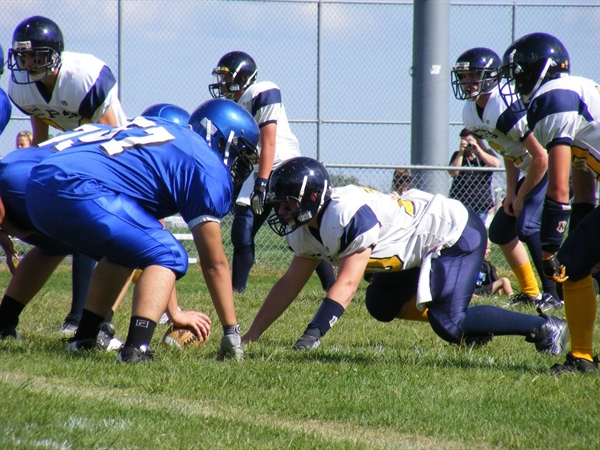
(Photo courtesy of Carsonville-Port Sanilac football program)
Forest Park Tradition Gains Another Title
November 18, 2017
By Geoff Kimmerly
Second Half editor
MARQUETTE – Fans wearing black and red chanted “U.P. Power” while their favorite team ran for nearly 500 yards without throwing a pass Saturday at the Superior Dome.
 This was Crystal Falls Forest Park football. And it didn’t matter how many players were on the field.
The Trojans, in their second season of 8-player, added a fourth MHSAA football championship running away early and often on the way to a 54-12 win in the inaugural 8-Player Division 2 Final.
The way Forest Park won, it could’ve been Ford Field or Pontiac Silverdome – where the Trojans made most of their first 13 championship game appearances. They gained an 8-Player Finals record 481 yards on 52 carries and set another record with eight rushing touchdowns.
The championship was the program's first since 2007.
“Last week, we watched 2007 states in our class, and (Saturday) was just like it,” Forest Park senior running back Connor Bortolini said. “We just stick to running the ball, and that’s what we do.
“The 2007 guys, some of them came up to us before the game, told us ‘Good luck.’ And now it’s our turn to do that.”
Senior Peter Ropiak had 275 yards and three touchdowns on the ground, sharing the backfield load with Bortolini, who totaled 196 yards and four rushing scores. Junior Calvin Post added the eighth rushing touchdown on a 1-yarder with 6:02 to play.
Bortolini scored the first just 1:47 into the game. Portland St. Patrick scored 1:26 later. And then the Trojans (10-2) put up the next 40 points, with Bortolini scoring four in a row total before Ropiak scored three consecutive.
The Trojans might have been the second or third best team in 8-player last season, but ran into Powers North Central in a Regional Final as North Central was finishing its second straight perfect season. Forest Park opened this fall 1-2, but then won its final nine games to return to the state’s elite.
“These kids don’t know the difference between 8-man and 11-man. They are out there competing. They’re out there being the best that they can be,” Trojans coach Dave Graff said. “For them to turn the page here, and do it in style where you have a sophomore middle linebacker who bench presses 115 pounds and runs a 5.5 40, a corner who’s 5-foot-5 and runs a 5-5 40. We’re doing it with people who are young, inexperienced, and yet they come out and get better every week. And they just have a new tradition, an 8-man tradition at Forest Park, and it’s good for them.”
Bortolini and Ropiak did their damage behind a line of junior guard Jacob Peterson, junior center Hal Hoenig, senior guard Robert Ponchaud and senior tight end Jonah Logan. All four weigh in between 205-240 pounds. St. Patrick has only one player tipping above 190.
 “They’ve got some big bodies and they’re pretty simple – they come downhill at you,” St. Patrick coach Patrick Russman said “It’s a great scheme for them. We’ve just got to work on getting a little bigger.”
And the Trojans’ defense cannot be forgotten. St. Patrick gained only 169 yards on 43 plays, and the 12 points were the second-fewest the team scored this season as the Shamrocks averaged 35 per game. The inability to move the ball on offense kept the pressure on the defense – a lot to manage against such a productive attack.
The Shamrocks (11-2) were playing for their first football championship since 1992 and in their first Final since 1997 after reaching the Semifinals for the third time since switching to 8-player in 2012. Their only other loss this fall was to Division 1 semifinalist Bellevue.
“Just being around these kids and the seniors especially, all of them, they’re such great leaders off the field. It’s going to carry over for us,” said Russman, also the school’s athletic director. “They’re really good football players on the field, obviously, but the things they’ve done off the field have just been life-changing for the coaches and kids around it.
“So you hope they continue all those things going into their next sports, and we’ll build on it next year.”
Junior Tanner Lawson threw for 125 yards and a touchdown for St. Patrick, connecting with senior Will Simon on a 19-yard score in the first quarter. Senior Isaiah Smith added a fourth-quarter 1-yard rushing touchdown. Smith had 13 tackles and Simon had 11, while junior linebacker Paul Cook added 10.
The MHSAA Playoffs are sponsored by the Michigan Army National Guard.
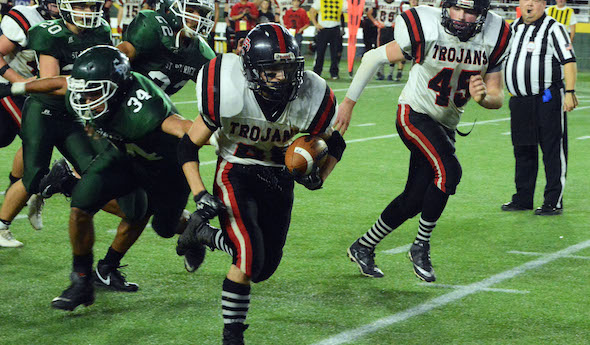
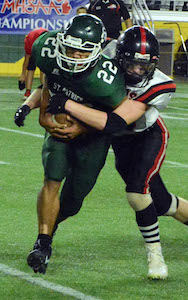
PHOTOS: (Top) Crystal Falls Forest Park’s Connor Bortolini charges toward the end zone for one of his four touchdowns Saturday. (Middle) A Trojans defender wraps up Portland St. Patrick’s Ned Smith. (Photos by John Johnson.)