


Football: Final Countdown
November 23, 2011
Ford Field, here we come.
The 37th MHSAA Football Finals need little more introduction than that. Over nearly four months, more than 600 teams were boiled down to 256, with that field then cut in half every week for a month as a fortunate few continued on in hopes of winning the top prize in Michigan high school football.
Sixteen weeks after practice began, 16 teams have that opportunity.
Eight championships will be won this weekend, four on Friday (Divisions 8, 6, 4 and 2) and four more Saturday. Mendon and Detroit Catholic Central both will attempt to win an 11th MHSAA championship to move into a third-place tie for the most football titles – and just two behind Farmington Hills Harrison. Then there are Detroit Cass Tech, Mount Pleasant and Pewamo-Westphalia, all making their first Finals appearances.
All eight games will be broadcast on Fox Sports Detroit Plus (click to find that channel in your area) or audio-only on the MHSAA Network web site. Tickets cost $10 and are good for all four games on one day. Click for a full schedule.
Here’s a look at all 16 finalists. (Rankings and all-state honors were voted upon by The Associated Press’ media panel. Statistics were provided by schools; those for Bloomfield Hills Brother Rice, Marine City, Lansing Catholic, Constantine, Ithaca, Mendon, Saginaw Nouvel and Fowler are through Semifinals, while the rest are through Regionals.)
DIVISION 1
DETROIT CASS TECH
Record/rank: 10-3, unranked
Coach: Thomas Wilcher, 14th season (93-53)
League finish: Tied for first in Detroit Public School League I
Championship history: Has never appeared in an MHSAA Final.
Best wins: 20-18 over Detroit Martin Luther King, 6-3 over No. 3 Utica Eisenhower (Semifinal), 6-0 over Warren DeLaSalle (Regional).
Players to watch: FB/LB Royce Jenkins-Stone, 6-1/215, sr.; WR/DB William Rembert, 6-0/175, sr.; WR/DB Terry Richardson, 5-9/162, sr.; FB/LB Laron Taylor, 6-1/215, sr.; WR/S Ruben Lile, 6-2, 180, sr.
Outlook: A defense giving up 9.5 points per game has gotten stingier as the season has gone on. Star power abounds: Jenkins-Stone and Richardson have committed to sign with Michigan this winter, Taylor and Lile will sign with Iowa and Rembert will sign with Buffalo. And junior receiver/defensive back Jordan Lewis might be the best of the next class. A point of concern might be that Cass Tech scored fewer than 10 points in six games. But if the Technicians can contain Detroit Catholic Central, they might be able to rely on a few big plays to score just enough.
DETROIT CATHOLIC CENTRAL
Record/rank: 12-1, No. 2
Coach: Tom Mach, 36th season (322-77)
League finish: Second in Detroit Catholic League Central
Championship history: 10 championships (most recently 2009), three runner-up finishes.
Best wins: 23-20 over No. 1 Rockford (Semifinal), 21-14 over No. 6 Canton (District), 56-6 over No. 7 Northville (Pre-District), 14-10 over Warren DeLaSalle, 21-19 over Division 2 No. 7 Bloomfield Hills Brother Rice, 21-7 over Division 3 No. 4 Orchard Lake St. Mary.
Players to watch: QB/DB Kyle Cooper, 6-7/215, sr. (56 for 104, 963 yards, nine TDs passing); OT/DT Matthew Godin, 6-5/270, sr.; RB/DE Wyatt Shallman, 6-3/260, jr. (73 carries, 397 yards, eight TDs rushing); TE/DE Matt Doneth, 6-5/245, sr. (12 receptions, 218 yards, four TDs).
Outlook: With a win Saturday, DCC would tie East Grand Rapids with the third-most MHSAA championships in the tournament’s 37-year history. The Shamrocks haven’t backed down from tough competition, with 10 games this season against teams that made the playoffs (not counting a game against an Ohio opponent). And just like for Saturday’s opponent, Cass Tech, defense has been key this fall – DCC is giving up just 8.9 points per game. Godin is a giant presence in the middle and will sign with Michigan. If the Final is as low-scoring as appears possible, keep an eye on this guy’s foot: Senior Alex Kozlowski made 43 of 47 extra-point attempts and averaged 42.8 yards per punt through the team’s first 12 games – and hit a 27-yard field goal that eventually pushed the Semifinal to overtime.
DIVISION 2
BLOOMFIELD HILLS BROTHER RICE
Record/rank: 9-4, tied for No. 7
Coach: Al Fracassa, 43rd season (404-115-7)
League finish: Fourth in Detroit Catholic League Central
Championship history: Six championships (most recently 2005), four runner-up finishes.
Best wins: 30-7 over No. 1 Farmington Hills Harrison (District), 27-26 (Quarterfinal) and 28-21 over Detroit Martin Luther King.
Players to watch: RB/DB Devin Church, 5-9/182, sr. (255 carries, 1,675 yards, 17 TDs rushing); DB James Hendrix, 6-0/180, sr. (52 tackles, five interceptions); LB/TE Jon Reschke, 6-2/223, jr. (130 tackles); OL Dylan Anderson, 6-5/270, sr.
Outlook: Rarely has a 5-4 qualifier advanced to an MHSAA Final – but Rice’s run also has been a little different than the norm. The Warriors played in a league with two more finalists (Detroit Catholic Central and Orchard Lake St. Mary), and despite finishing fourth in the Catholic League Central lost three league games by a combined four points. Passing might’ve taken over this sport at most contending schools, but the Warriors continue to win on the ground with more than 3,000 yards rushing to just 880 passing this fall. Church, who will sign with Northern Illinois, runs behind a line that averages a solid 245 pounds and is led by Anderson, a Central Michigan prospect.
LOWELL
Record/rank: 12-1, No. 2
Coach: Noel Dean, 16th season (161-28)
League finish: Second in Ottawa-Kent White
Championship history: Three championships (most recently 2009), one runner-up finish.
Best wins: 36-7 over No. 3 Muskegon (District), 42-35 (OT) over No. 9 Walled Lake Western (Semifinal), 28-7 over Division 1 No. 1 Rockford.
Players to watch: QB Gabe Dean, 5-10/195, sr. (114 for 179, 1,744 yards, 13 TDs passing; 333 carries, 1,722 yards, 25 TDs rushing); RB Josh Addington, 5-9/180, sr. (186 carries, 927 yards, 11 TDs rushing); WR/DB Blake Lyman, 5-10/170, sr. (28 receptions, 564 yards, four TDs; two interceptions).
Outlook: This will be Lowell’s third-straight MHSAA Finals appearance – the Red Arrows fell to Farmington Hills Harrison 38-28 last season after beating Inkster in the 2009 championship game. Dean ran the offense in the two previous finals as well and will cap a career that’s already put him among Lowell’s great quarterbacks. The Red Arrows' only loss was to Grand Rapids Christian, which entered the postseason ranked No. 1 in Division 3.
DIVISION 3
MOUNT PLEASANT
Record/rank: 13-0, No. 1
Coach: Jason McIntyre, sixth season (60-11)
League finish: First in Saginaw Valley League
Championship history: Has never appeared in an MHSAA Final.
Best wins: 38-37 over No. 9 East Grand Rapids (Quarterfinal), 21-7 over Division 2 No. 4 Midland.
Players to watch: WR/DB Colton Odykirk, 6-2/200, sr. (45 receptions, 684 yards, six TDs; 67 tackles); LB/TE Spencer Moran, 6-0/205, sr. (118 tackles); QB/DB Ryan Elliott, 5-10/175, sr. (119 for 192, 1,685 yards, 13 TDs passing); RB/DB Michael Tweh, 5-10/195, soph. (234 carries, 1,726 yards, 24 TDs rushing).
Outlook: The Oilers have improved from 11 to 12 to now 13 wins the last three seasons, respectively, and finally got past East Grand Rapids after falling to the Pioneers two of the last three seasons. Mount Pleasant has relied mostly on a tough running game on the way to averaging 40 points and 400 yards of total offense per contest. McIntyre, a 1995 Mount Pleasant graduate, has led the team to four conference and District titles in the last five seasons.
ORCHARD LAKE ST. MARY
Record/rank: 11-2, No. 4
Coach: George Porritt, 23rd season (204-57)
League finish: First in Detroit Catholic League Central
Championship history: Four championships (most recently 2000 in Division 4), five runner-up finishes.
Best wins: 14-10 over No. 3 Battle Creek Harper Creek (Semifinal), 14-13 over Division 1 No. 2 Detroit Catholic Central, 35-10 over Warren DeLaSalle, 10-9 over Division 2 No. 7 Bloomfield Hills Brother Rice, 35-0 over Division 5 No. 7 Grand Rapids West Catholic.
Players to watch: FB/LB Grant Niemiec, 6-0/210, jr. (188 carries, 1,099 yards, 15 TDs rushing); RB/OLB Spencer McInnis, 5-11/180, sr. (167 carries, 1,254 yards, 20 TDs rushing); TE/LB James Ross, 6-1/220, sr.
Outlook: The Eaglets have fallen in MHSAA Finals two straight seasons and three of the last four, all to East Grand Rapids – which didn’t advance this fall. St. Mary always is loaded with talent, but this might be one of the strongest of recent groups as evidenced by winning arguably the toughest league in the state while giving up only 11.6 points per game. Ross has committed to sign with Michigan this winter and is considered by many the top defensive player in the state. Niemiec and McInnis provide a great assist to the defense by allowing the team to eat up the clock – both are averaging at least 5.9 yards per carry.
DIVISION 4
MARINE CITY
Record/rank: 13-0, No. 1
Coach: Tony Scarcelli, seventh season (80-7)
League finish: First in Macomb Area Conference Gold
Championship history: Won championship in 2007.
Best wins: 15-7 over No. 5 Detroit Crockett (Regional), 55-31 over No. 6 Pontiac Notre Dame Prep (District), 45-21 over No. 8 Croswell-Lexington (Pre-District), 61-38 over No. 7 Marysville, 28-13 over Division 6 No. 10 Madison Heights Madison.
Players to watch: RB/DB Anthony Scarcelli, 6-0/190, sr. (178 carries, 1,804 yards, 32 TDs rushing; 16 receptions, 383 yards, six TDs receiving); RB Jaime Salisbury, 5-8/160, sr. (129 carries, 959 yards, 11 TDs rushing); DB/WR Jack Badovinac, 6-0/165, sr. (30 tackles, six interceptions); LB/WR Aaron Loconsole, 5-9/185, sr. (109 tackles, seven sacks)
Outlook: Tony Scarcelli can cap his Marine City career – he’s announced he’ll resign after this season – with a second MHSAA championship and celebration with his son Anthony, who will sign with Central Michigan this winter. Although the Mariners’ league didn’t provide a ton of challenges during the regular season, Marine City showed it’s worthy of that top ranking against one of the toughest playoff slates faced by a finalist this fall. From the interesting stats file: Marine City has outscored opponents 179-16 in the second quarter. Once the Mariners have gotten rolling, they’ve been nearly impossible to stop.
ZEELAND WEST
Record/rank: 13-0, No. 2
Coach: John Shillito, seventh season (64-16)
League finish: First in Ottawa-Kent Green
Championship history: Won championship in 2006.
Best wins: 43-21 over No. 4 Grand Rapids Catholic Central (District), 26-21 over Zeeland East.
Players to watch: FB/DB Brad Mesbergen, 5-7/155, sr. (74 carries, 849 yards, 11 TDs rushing); HB/DB Derek Postma, 5-11/185, sr. (130 carries, 1,014 yards, 19 TDs rushing); HB/DB Kyle Kujawa, 5-10/190, sr. (114 carries, 923 yards, 14 TDs).
Outlook: Although the Dux faced only three eventual playoff teams during the regular season, the rampage has continued during the postseason – Zeeland West has won its last four games by an average of 32 points per. The Dux have crushed opponents on the ground, running for more than 4,600 yards. Senior linebacker Josh Blanton has keyed a steady defense for two seasons, but was injured in the Semifinal and is questionable according to media reports. A win would be the 220th of Shillito’s career, which has seen him also lead Comstock Park, Muskegon Orchard View and East Kentwood over 28 seasons total.
DIVISION 5
FLINT POWERS CATHOLIC
Record/rank: 9-4, unranked
Coach: Bob Buckel, first season (9-4)
League finish: Second in Big Nine Conference
Championship history: Won Division 4 championship in 2005.
Best wins: 28-7 over No. 2 Millington (District), 27-10 over No. 4 Almont (Semifinal).
Players to watch: DT Danny O’Brien, 6-3/302, sr. (59 tackles, three sacks); QB Garrett Pougnet, 6-2/179, jr. (75 for 163, 1,131 yards, nine TDs passing; 154 carries, 818 yards, nine TDs rushing); DE Idris Hobdy, 6-1/212, sr. (41 tackles, five sacks, four fumble recoveries).
Outlook: Like Brother Rice above, Powers advanced to this weekend despite entering the playoffs 5-4 – after a 1-3 start. But the Chargers come in well-prepared after a tough league schedule against much larger schools, plus games against Division 7 No. 1 Saginaw Nouvel and this weekend’s opponent, Lansing Catholic (Powers lost that Week 2 game 37-17). Buckle has won 179 games over 29 seasons total, including successful stints at Otisville-Lakeville, Flushing and Birch Run. He was named Associated Press state Coach of the Year for his respective class at both Flushing and Birch Run. O’Brien will sign with Tennessee this winter.
LANSING CATHOLIC
Record/rank: 13-0, No. 1
Coach: Jim Ahern, third season (28-5)
League finish: First in Capital Area Activities Conference White
Championship history: Won Class C championship in 1985.
Best wins: 42-35 over No. 7 Grand Rapids West Catholic (Semifinal), 49-24 and 50-33 (District) over No. 3 Portland, 37-17 over Flint Powers, 21-19 over Division 6 No. 10 Madison Heights Madison.
Players to watch: QB Cooper Rush, 6-4/230, sr. (217 for 371, 3,714 yards, 45 TDs passing; 103 carries, 711 yards, 15 TDs rushing); WR/DB Matt Macksood, 6-0/170, sr. (88 receptions, 1,528 yards, 21 TDs receiving; 74 carries, 808 yards, 10 TDs rushing); RB/LB Dan Liesman, 6-3/225, sr. (99 tackles, 6.5 sacks).
Outlook: Rush and Macksood will graduate with their names all over the MHSAA record book for both single-season and career feats. Rush was named The Associated Press’ Division 5-6 Player of the Year on Wednesday and will sign with Central Michigan, while Macksood made the all-state team and is a threat to score every time he touches the ball. Two other receivers have at least 35 catches, and junior Jack Swain has scored 14 times. This could be a crowning achievement for Ahern, who is 225-133-6 in 35 seasons total, including 32 at Ithaca from 1972-2003.
DIVISION 6
CONSTANTINE
Record/rank: 11-2, unranked
Coach: Shawn Griffith, seventh season (71-14)
League finish: Tied for second in Kalamazoo Valley Association
Championship history: One championship (2004), two runner-up finishes.
Best wins: 42-25 over No. 5 Grass Lake (Regional), 45-44 over Ecorse (Semifinal), 28-21 and 37-30 (2 OT, District) over Schoolcraft.
Players to watch: RB/LB Payton White, 6-1/230, jr. (226 carries, 1,374 yards, 23 TDs rushing); Tommy Reed, 5-8/170, jr. (44 of 92, 787 yards, nine TDs passing; 108 carries, 504 yards, 10 TDs rushing); RB/LB Ben Mallo, 5-8/165, jr. (148 carries, 993 yards, 11 TDs rushing).
Outlook: Constantine has rolled since starting 1-2 and is perhaps most dangerous in a close game – the Falcons have won four of their last five by seven or fewer points. They’ve done it by running the ball behind big blockers like seniors Jacob Mechling (6-2/250), A.J. Cox (5-8/265) and Joe Wuthrich (5-11/240) for more than 3,900 yards. Those two losses were to Battle Creek Pennfield – No. 3 in Division 4 heading into the playoffs – and reigning Division 5 runner-up Olivet.
ITHACA
Record/rank: 13-0, No. 1
Coach: Terry Hessbrook, eighth season (72-17)
League finish: First in Tri-Valley Conference West
Championship history: Won championship in 2010.
Best wins: 28-13 over No. 2 Montrose (District), 22-19 over No. 7 Montague (Regional), 28-0 over No. 3 Iron Mountain (Semifinal).
Players to watch: QB/DB Travis Smith, 6-1/180, soph. (144 for 209, 2,011 yards, 22 TDs passing; 136 carries, 925 yards, 23 TDs rushing); RB/LB Garrett Miniard, 5-11/210, sr. (167 carries, 1,268 yards, 16 TDs rushing; 108 tackles); WR Charles Schnetzler, 6-2/190, sr. (58 receptions, 858 yards, 12 TDs receiving); LB Lucas Slater, 6-2/215, sr. (127 tackles).
Outlook: The Yellowjackets returned most of their starters from last season’s championship team and are hoping to finish undefeated for the second straight season. The most impressive part of this run has been how the team has worked through two new starters at quarterback – 2010 Finals hero Alex Niznak graduated in the spring, and his replacement David Brown was injured on opening night. Smith has starred since, but Brown, a senior, will still be one to watch Friday – a dynamic playmaker, he ran for 129 yards and three scores at quarterback on opening night, and had his best receiving game last week with five catches for 137 yards and two touchdowns. Miniard was named all-state as a linebacker, and also averages nearly eight yards per carry.
DIVISION 7
PEWAMO-WESTPHALIA
Record/rank: 13-0, No. 6
Coach: Brad Weber, fourth season (35-9)
League finish: First in Central Michigan Athletic Conference
Championship history: Has never appeared in an MHSAA Final.
Best wins: 22-14 over No. 3 Hudson (Semifinal); 15-14 over Division 8 No. 9 Fowler.
Players to watch: QB/CB Justin Thelen, 6-2/190, sr. (39 for 81, 814 yards, 12 TDs passing; 118 carries, 740 yards, 13 TDs rushing); TB/CB Alex Thelen, 5-7/150, sr. (231 carries, 1,650 yards, 23 TDs rushing); OL/LB Gavin Smith, 6-2/202, sr.
Outlook: P-W is one of two teams from the Central Michigan Athletic Conference that have reached Detroit this weekend. Although this will be the Pirates’ first Finals appearance, they have a proud history with 16 straight winning seasons and 13 playoff berths during that string. Although there are only nine seniors, the class is loaded with talent – Smith has earned all-state recognition multiple times, Alex Thelen is a two-time 1,000-yard rusher, and Justin Thelen moved from receiver to quarterback this fall and is a speedy two-way threat.
SAGINAW NOUVEL
Record/rank: 12-0, No. 1
Coach: Michael Boyd, 12th season (116-26)
League finish: Plays as an independent.
Championship history: Two championships (most recently 2007 in Division 6), two runner-up finishes.
Best wins: 55-14 over Flint Powers, 48-12 and 14-3 (Semifinal) over No. 4 Traverse City St. Francis, 28-0 over No. 7 Harbor Beach (Regional).
Players to watch: RB/DB Bennett Lewis, 5-9/181, sr. (173 carries, 1,877 yards, 31 TDs rushing); QB/DB Joseph Buchalski, 5-9/161, sr. (74 for 122, 1,345 yards, 16 TDs passing; 35 carries, 514 yards, four TDs rushing; 3 TDs receiving).
Outlook: Many eyes will be on Lewis, The Associated Press’ Division 7-8 Player of the Year. He’s the main reason Nouvel is playing for its third MHSAA championship in six seasons, although hardly the only one. The Panthers are giving up only 7.5 points per game despite a strong schedule against teams from all over the Lower Peninsula and parts of Canada. Five of six regular-season opponents (Nouvel played two Canadian teams) ended up making the playoffs, including Division 5 finalist Powers.
DIVISION 8
FOWLER
Record/rank: 11-2, Tied for No. 9
Coach: Craig Koenigsknecht, second season (20-3)
League finish: Third in Central Michigan Athletic Conference
Championship history: Four championships (most recently 1998 in Class D), two runner-up finishes.
Best wins: 45-8 over No. 4 St. Ignace La Salle (Semifinal), 24-21 over Mount Pleasant Sacred Heart (District), 34-18 over Beal City (Regional).
Players to watch: RB/LB Mitch Thelen, 5-11/185, sr. (149 carries, 1,379 yards, 17 TDs rushing), RB/LB Tyler Koenigsknecht, 5-8/175, jr. (195 carries, 1,433 yards, 13 TDs rushing; 134 tackles); OL/DE Cameron Bongard, 6-1/220, jr.
Outlook: Fowler had a few uncharacteristically tough years over the last decade, but won 11 games for the first time since 2002. Its losses were by a combined two points – and both to Division 6 teams, including finalist Pewamo-Westphalia. Tyler Koenigsknecht, Bongard and quarterback/cornerback Dustin Wirth are among a strong group of juniors who became starters last season and have helped bring the program back to elite status under Craig Koenigsknecht, who played on the 1993 championship team. Although the Eagles beat just one ranked team, they faced a number of larger schools plus 2010 Division 8 Semifinalist Fulton during the regular season, and Fulton again in the Pre-District.
MENDON
Record/rank: 13-0, Tied for No. 1
Coach: John Schwartz, 23rd season (236-39)
League finish: First in St. Joseph Valley League
Championship history: 10 championships (most recently 2007 in Division 7), one runner-up finish.
Best wins: 28-21 over co-No. 1 Muskegon Catholic Central (District), 35-10 over No. 8 Climax-Scotts (Regional), 34-13 over No. 3 New Lothrop (Semifinal), 56-7 over Mount Pleasant Sacred Heart.
Players to watch: RB/DB Tyler Harris, 5-6/140, jr. (212 carries, 1,776 yards, 32 TDs rushing); QB/DB Chance Nightingale, 6-1/180, sr. (42 for 77, 1,048 yards, 14 TDs passing; 98 carries, 993 yards, 20 TDs rushing); RB/LB Tanner Cook, 5-9/175, sr. (140 carries, 1,025 yards, 10 TDs rushing), LB/TE Cody Bingaman, 5-11/210, sr. (113 tackles, five TDs receiving).
Outlook: Mendon beat all of its regular-season opponents by at least 28 points, then took out two more top-three teams during the playoffs. Nightengale and Bingaman were named all-state earlier this week – Nightengale running an offense that averages 46 points per game, and Bingaman leading a defense giving up 7.5 per contest. With another championship.
PHOTO
Full speed ahead: Marine City and quarterback Adam Kroll hope to claim their second MHSAA championship in five seasons Friday against Zeeland West. (Photo courtesy of Port Huron Times-Herald.)
Drive for Detroit: Week 2 Preview
August 30, 2017
By Geoff Kimmerly
Second Half editor
The break was short for many teams heading into Week 2 of this football season.
 While last week’s openers were mostly split between Thursday and Friday, nearly all of Michigan’s teams will play this week’s games tonight in advance of the Labor Day holiday and start of school for many next Tuesday.
Below is our weekly look – powered by MI Student Aid – at some of the games to see no matter your neighborhood (relatively and regionally speaking) and includes games that will be played on Thursday, Friday and Saturday.
Remember, check out the MHSAA Score Center for the full schedule plus scores all three nights as they games are completed. A number of games also will be broadcast again this weekend, live, on MHSAA.tv.
Bay & Thumb
Almont (1-0) at Algonac (0-1), Thursday
After a couple of seasons at or near the top of Port Huron-area football, Algonac opened last week with a 42-6 loss to Marine City – its first non-Richmond regular-season defeat since 2014. Up next is Blue Water Area Conference rival Almont, no doubt aching to win big as well after taking four losses (two in the playoffs) from the Muskrats over the last two seasons. The Raiders are coming off a big win over 2016 playoff team Grosse Ile.
Others that caught my eye: THURSDAY Freeland (1-0) at Chesaning (1-0), Saginaw Heritage (1-0) at Flint Powers Catholic (1-0), Beaverton (1-0) at Harbor Beach (1-0), Lake Fenton (0-1) at Montrose (1-0).
Greater Detroit
Southfield Arts & Technology (0-1) at Clarkston (1-0), Friday
Southfield A&T came out on the losing end of arguably the most exciting game of opening weekend. But if its 56-54 triple-overtime defeat to powerful Davison told us anything, it’s that last year’s 8-4 finish could be just a start for the second-year program built from the former Southfield and Southfield-Lathrup. The Warriors beat Clarkston 24-18 a year ago, actually, but the Wolves appear in form already as well coming off a 42-7 win over Lapeer (27-5 over the last three seasons with two of those losses to Clarkston).
Others that caught my eye: THURSDAY Romeo (1-0) at Clinton Township Chippewa Valley (1-0), FRIDAY Toledo Whitmer, Ohio (1-0) at Detroit Catholic Central (1-0), East Kentwood (1-0) at Orchard Lake St. Mary's (0-1), Macomb Dakota (1-0) at Utica Eisenhower (1-0).
Mid-Michigan
Grand Ledge (1-0) at DeWitt (0-1), Thursday
The is the second year in a row the Lansing area’s most successful programs of the last decade have matched up (and the series will continue with DeWitt moving into the Capital Area Activities Conference Blue with Grand Ledge next fall). The Comets won last year’s meeting 28-21. Senior-dominated Grand Ledge impressed last week with a 41-14 win over Hudsonville, but a DeWitt team that put a number of new starters on the field last week also impressed coming back to nearly catch Grand Rapids Christian, on the road, before falling 38-30.
Others that caught my eye: THURSDAY Dearborn Divine Child (1-0) at East Lansing (1-0), Portland (1-0) at Lansing Sexton (1-0), Fulton (1-0) at Laingsburg (0-1), FRIDAY Beal City (1-0) at Clare (0-1).
Northern Lower Peninsula
Muskegon Catholic Central (0-0) at Frankfort (1-0), Friday
The anticipation for this one has been boiling over. Muskegon Catholic Central handed Frankfort its first and only loss last season, 35-0 in a Division 8 Regional Final at MCC on the way to winning a fourth straight MHSAA championship. The Panthers also got within 22-12 of MCC in a 2015 Regional Final, so there’s a nice build-up of history behind this meeting of small-school contenders. The Crusaders couldn’t lock down a Week 1 game this fall, so this is their season opener and the sophomore debut for heavily-followed quarterback Cameron Martinez. Frankfort did have a game in Week 1 and put up 70 points – its most in a game since 2004 – to down Manton by 30.
Others that caught my eye: THURSDAY St. Johns (0-1) at Cadillac (1-0), FRIDAY Newberry (1-0) at Gaylord St. Mary (1-0), Traverse City St. Francis (1-0) at Maple City Glen Lake (1-0), Escanaba (1-0) at Petoskey (0-1).
Southeast & Border
Pinckney (1-0) at Chelsea (1-0), Friday
Chelsea is 32-6 over its last three seasons and won all of its Southeastern Conference White games last season by at least 22 points. The Bulldogs will welcome Pinckney to the league Friday after the Pirates went 8-3 last season (their most wins since 1989) before coming over from the Kensington Lakes Activities Association West. Pinckney also had a coaching change in the offseason with defensive coordinator Rod Beaton getting a promotion, and his expertise will be especially handy this week. Chelsea 27 points last week on a Milan defense that gave up only 16 per game in 2016.
Others that caught my eye: THURSDAY New Haven (1-0) at Ida (1-0), Homer (1-0) at Concord (0-1), Petersburg-Summerfield (1-0) at Pittsford (1-0), FRIDAY Detroit Mumford (1-0) at Saline (0-1).
Southwest Corridor
Schoolcraft (1-0) at Berrien Springs (1-0), Thursday
Berrien Springs has been right on the verge of a big season over the last few, with three straight playoff appearances and a 17-5 record since the start of 2015. The Shamrocks looked ready to make this the year opening with a 53-0 win over Buchanan last week. But giving Schoolcraft its first regular season loss since 2014 would really make a statement. The Eagles are 20-2 going back to the start of 2015 and downed Fennville 41-0 to start this year’s campaign. If Schoolcraft comes through this one on top too, Berrien Springs still will have a few more opportunities to make noise – see Week 4 against Benton Harbor and Week 9 against Muskegon Oakridge.
Others that caught my eye: THURSDAY Coldwater (1-0) at Marshall (1-0), Battle Creek Central (0-1) at Portage Central (1-0), Paw Paw (1-0) at Sturgis (1-0), FRIDAY Grand Rapids South Christian (1-0) at Benton Harbor (0-1).
Upper Peninsula
Ishpeming (1-0) at Norway (1-0), Friday
The Hematites seem to be getting most of the tough ones out of the way early as they work back from last year’s 3-5 finish. Ishpeming started this fall by avenging a 2016 loss to Iron Mountain 34-7, and now comes Norway, which shut out the Hematites 14-0 last year. The slight difference this time is these teams are no longer in the same league, literally; the Knights left the Mid-Peninsula Conference for the Mid-Eastern Conference this season. They opened with a 34-7 nonleague win over Niagara (Wis.) after ending last fall as a District champ.
Others that caught my eye: THURSDAY Iron Mountain (0-1) at Gwinn (0-1), Calumet (1-0) at Negaunee (0-1), FRIDAY Traverse City Central (1-0) at Marquette (0-1), SATURDAY Munising (0-1) at St. Ignace (0-1).
West Michigan
Lowell (1-0) at Rockford (1-0), Friday
One of the best scheduling moves in the state in 2016 was the re-introduction of this matchup between two of the elite programs in all of the Grand Rapids area and statewide. Lowell won that first matchup since the end of a two-year series in 2011-12, 21-10, but it also was Rockford’s opener as it had to miss its Week 1 game last fall with a team-wide sickness. This time both teams have a win out of the way, and impressive ones on both sides. The Rams shut out Saline 14-0 to start, while the Red Arrows downed Warren DeLaSalle 36-6.
Others that caught my eye: THURSDAY Grand Rapids Christian (1-0) at Caledonia (1-0), Detroit Loyola (0-1) at Grand Rapids Catholic Central (1-0), Warren DeLaSalle (0-1) at Grandville (1-0), FRIDAY Muskegon Mona Shores (1-0) at Zeeland West (1-0).
8-Player
Crystal Falls Forest Park (0-1) at Powers North Central (1-0), Friday
At least the faces will look mostly different from those who more or less decided which was the best team in the Upper Peninsula (and arguably statewide) last season. Reigning two-time MHSAA champion North Central graduated the majority of its stars from the last two seasons including quarterback Jason Whitens, and Forest Park’s record-setting back Dan Nocerini is now playing at Michigan Tech. After losing only to North Central (twice) last season, the Trojans opened last week with a 38-36 defeat to Rapid River. But some of the same success could be brewing again for the Jets, who made it 27 straight victories with a 66-0 shutdown of Felch North Dickinson.
Others that caught my eye: THURSDAY Lawrence (1-0) at Deckerville (1-0), Mayville (1-0) at Morrice (1-0), North Adams-Jerome (1-0) at Battle Creek St. Philip (1-0), Wyoming Tri-unity Christian (0-1) at Suttons Bay (1-0).
Second Half’s weekly “Drive for Detroit” previews are powered by MI Student Aid, a part of the Student Financial Services Bureau located within the Michigan Department of Treasury. MI Student Aid encourages students to pursue postsecondary education by providing access to student financial resources and information, including various student financial assistance programs to help make college more affordable for Michigan students. MI Student Aid administers the state’s 529 savings programs (MET/MESP) and eight additional aid programs within its Student Scholarships and Grants division. Click for more information and connect with MI Student Aid on Facebook and Twitter @mistudentaid.
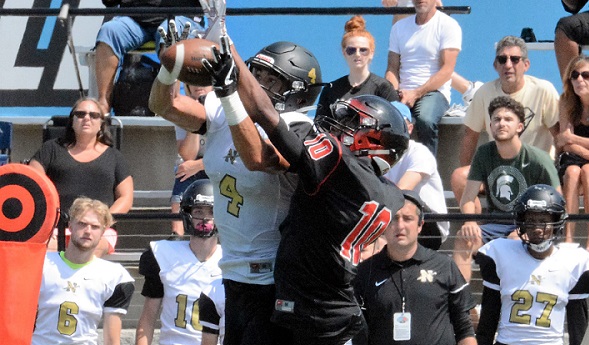
PHOTO: East Kentwood (with red trim) faces Orchard Lake St. Mary's this week after opening with a win against Harrison Township L'Anse Creuse. (Photo by John Johnson).