


Football Follies
October 7, 2014
Clarkston Surges by Kicking it Forward
By
Tom Markowski
Special for Second Half
October 27, 2016
CLARKSTON – Coach Kurt Richardson held a disdain for kickers. He didn’t trust them. He contends that a poor kicking game cost his Clarkston football team the 2000 Division 1 Semifinal, a 17-15 loss to eventual champion Grand Ledge.
 Three years before, Clarkston had lost one-point games to Rochester (20-19) and Troy (21-20) that cost the Wolves an opportunity to play in the playoffs. Again, the kicking game had let him down.
“We didn’t have kickers,” Richardson said. “We made kickers. We tried a soccer player once back then, and it didn’t work.”
Enter the Breen brothers, Andrew and Ryan. Andrew Breen was Clarkston’s kicker in 2003. Ryan Breen followed and was the kicker in 2005 and 2006. Maybe it’s a coincidence, but Clarkston hasn’t missed the playoffs since 2002. You won’t get Richardson to say that.
Andrew Breen went on to kick for Tiffin University (Ohio), and every place-kicker since has gone on to college as a kicker – including his brother, Ryan, who went to Penn State.
The others include Alex Barta, who went on to kick for the U.S. Naval Academy. Then there’s Shane Hynes, the place-kicker on the 2013 Division 1 championship team, who is currently Kent State’s place-kicker. Alex Kessman was the place-kicker on the 2014 Division 1 title team, and he’s at Pittsburgh after graduating from high school this past June.
Zach Mansour is Clarkston’s place-kicker this season. And although he hasn’t decided what college he will attend next year, rest assured Mansour will be on a roster somewhere, whether it’s at the Division I level or below.
“Andrew kind of broke up the ice,” Richardson said. “It’s made a big difference. What also comes out of making field goals and having good kickers is now we’re kicking the ball in the end zone and teams are starting from their 20.”
Ryan Breen doesn’t remember exactly when it happened, but his life changed when he was a freshman at Clarkston High.
Breen and his brother were soccer players throughout their childhood. Then his freshman year his brother was a senior and Clarkston’s kicker, and something clicked. Ryan was just having fun working with his brother, shagging footballs, when he got the urge to try it.
Something clicked for the Clarkston football program as well.
“Coach Kurt realized, after a while, that kicking is so much part of the game,” Ryan Breen said. “He started to trust me my junior and senior years. He’d been let down so much (by kickers). It’s frustrating.
“It opened his eyes that (Clarkston’s) kicking game could be so good.”
 Ryan gives credit to his brother for starting what has become a fraternity of kickers at Clarkston. And it continues today with Ryan Breen giving back – or paying it forward, if you will.
Clarkston is a sports-crazed community with football and basketball taking the lead. The fan support these teams receive is as fervent as any in the Detroit area. When an athlete experiences success at a school like this, often that person is motivated to give back. That’s what Breen has done.
“My brother kind of got me into it,” Ryan said. “We were athletes first. My freshman year I’d help him, chasing the footballs after he kicked them. I figured I’d do it for him. I never thought I’d kick. We never thought we’d kick.”
At first, his experience in college led Ryan to go back to Clarkston and share his expertise with the next kicker in line, Barta.
“I got with Alex and his dad,” Ryan said. “I tried to lend the knowledge I had.”
After coaching as a volunteer, Ryan came on staff at the junior varsity level for three seasons. He was there to start this season, but was forced to leave due to the time commitment he had with his business in Oakland County. He’s hoping that soon, perhaps in a year or so, his business will become less demanding and he’ll return to Richardson’s staff.
But he’s left his mark, and others have picked up his lead. Those who have followed, like Mansour, are reaping the benefits.
Mansour handles the place kicking and kickoff duties for Richardson, and he’s 5 of 7 on field goal tries with a long make of 45 yards. A junior, Jermaine Roemer, is the punter and, at this point, it appears he will replace Mansour as the team’s place-kicker next season.
“I was close with Shane (Hynes) and Alex (Kessman),” Mansour said. “I got a ton of knowledge from them. And Shane learned from Barta. I’m close with Jermaine. And Tristan Mattson is on (junior varsity). I’ll be working with him after the season.
“We’ve gotten so good with our kicking. It puts us ahead of other teams. When I worked with Shane and Alex, they were brutally honest. They’ll break you down. They yelled at me. It’s not to hurt your feelings. It’s all for the game.
“Paying it forward? It’s kind of my job. Jermaine and I developed a good relationship. We’ve had that reputation of having good kickers, and we want to keep it that way.”
 Tom Markowski is a columnist and directs website coverage for the State Champs! Sports Network. He previously covered primarily high school sports for the The Detroit News from 1984-2014, focusing on the Detroit area and contributing to statewide coverage of football and basketball. Contact him at [email protected] with story ideas for Oakland, Macomb and Wayne counties.
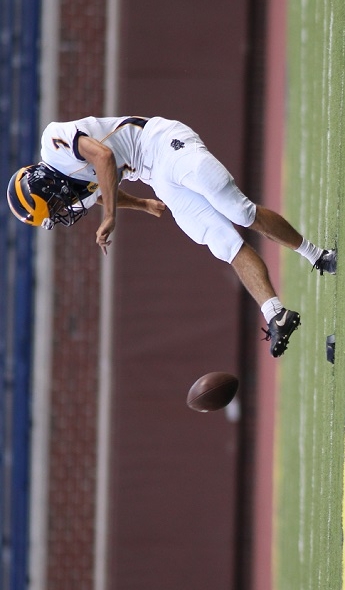
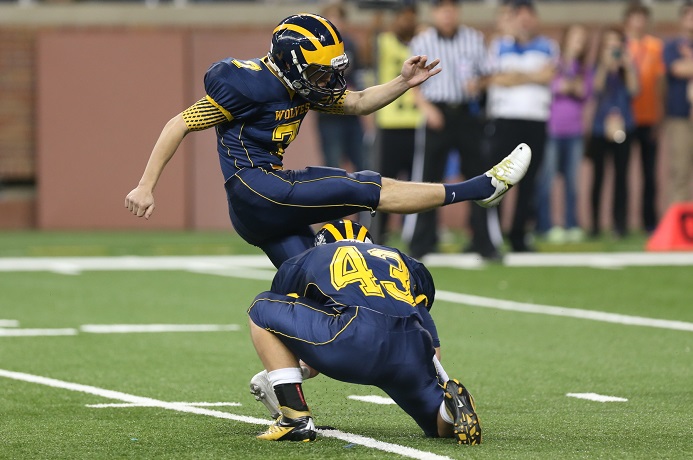
PHOTOS: (Top) Zach Mansour kicks off Clarkston's season against Lapeer on Aug. 26 at Michigan Stadium. (Middle) Shane Hynes follows through on a kick during the 2013 Division 1 Final at Ford Field. (Click to see more of top photo from HighSchoolSportsScene.com.)