Football Kicks Off Again, 129 Years Later
By
Ron Pesch
MHSAA historian
August 25, 2017
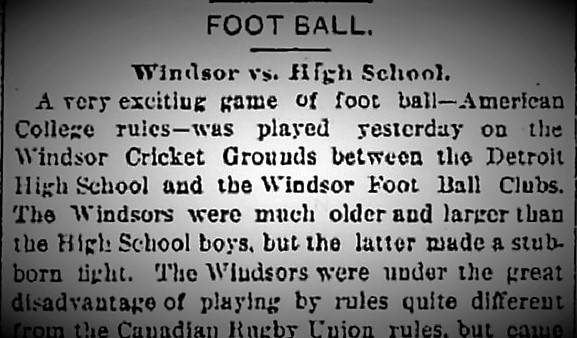
Buried in the text on the fourth page of the Saturday, October 27, 1888, Detroit Free Press is a single, concise sentence bearing a minimum amount of detail.
“The Windsor foot ball team will play the Detroit High School team this afternoon at 3.”
To date, this is the earliest account of a Michigan high school playing the game of “foot ball.”
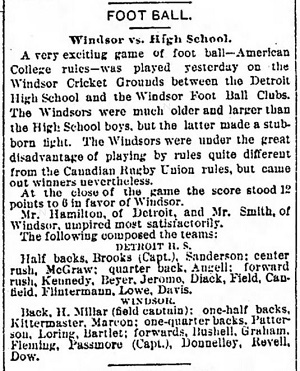
The following day’s paper provides only a few more details. The game was played on the Windsor Cricket Grounds. Despite the great disadvantage of playing under “American Football rules … quite different from the Canadian Rugby Union rules …” the “older and larger” Windsors won the contest, 12-6. Rosters for each squad were provided.
 Under American rules of the time, a touchdown was worth four points, with a conversion kick following a touchdown worth two additional points. At the time, a field goal counted for five points and a safety was worth two. The teams, however, may have agreed to a different scoring system before the contest.
Was this the first football game for a Michigan high school? That’s unlikely, but it is certainly among the earliest published accounts involving a prep game in the state.
It’s a fair assumption that foot ball, or some version of the game, was being played in neighborhoods before that time, at least based on the following statement found in the Jackson Citizen Patriot, dated June 18, 1867. Only days before, Dorrance & Goodwin’s, a store on Main Street in Jackson, had placed advertisements in the newspaper’s classifieds noting the pending arrival of this new product.
“Foot Ball – The pastime was inaugurated on our streets yesterday. Three or four balls were kept in motion all day on Main street alone. It affords no little amusement to the little boys, and is certainly a healthy exercise for the larger ones. It’s all right as long as no windows are broken or horses scared. Both calamities were barely escaped scores of times during the day.”
Rutgers and Princeton are credited with playing the first college football game in 1869. A decade later, in 1879, the University of Michigan established a football team.
Detroit High School played a number of games in 1888, besides the Windsor match, including a contest with the Tappen School from the Corktown area of Detroit. Played at the Detroit Athletic Club grounds on the afternoon of Thursday November 15, a final score was not mentioned in the following day’s Free Press.
For those unfamiliar with the sport, an account of the University of Michigan versus Detroit Athletic Club contest that appeared in the November 18 Free Press served as a fine introduction to the game, and the determination behind securing “possession of a leather-covered foot ball.”
“It was very interesting to see one speedy young man, after a desperate struggle in which the spectators fully expected to see him lose an arm or a leg, get away from his captors and start like a deer, with eight or ten of the opposite side in full pursuit. He is overtaken and the leader of the pursuing party springs upon the back of the man with the inflated trophy, bearing him to the ground with a dull thud … It is also an inspiring sight to see a fleet-footed player seize the ball and run at full speed in the direction of the goal of his opponents. Then a wing-footed opponent cuts across to intercept him, makes a flying leap, grasps the fugitive around the neck or waist and both go to grass with a suddenness and velocity that transforms them into human wheels …
 “While one unaccustomed to foot ball will naturally be startled by some of the acrobatic feats, still it is impossible to watch the game for any length of time without a tingling of the blood and holding of the breath. It is most intensely exciting, continuous in action and replete with fine points of play.
“It may be explained that the goals in a foot ball game are set at a distance of 330 feet from each other. The goal is made by placing two pieces of scantling twenty feet long upright in the ground, eighteen and one-half feet apart. Another piece runs midway horizontally between the uprights, and the ball must go over the horizontal piece and between the uprights to count a goal. There are eleven men on each side and the object is, of course, to get the ball through the goal of the other. The time of game is an hour and a half each side playing forty-five minutes from each goal, with an intermission of ten minutes between halves.”
A player who ran over an opponent’s goal line, “with the ball and touched it down” was then entitled to “bring the ball in front of the goal and attempt to kick it through”…
Among those playing for the Athletic Club squad that day was “little Hugh Brooks (captain) of the high school team.” Eligibility rules for players would evolve over time.
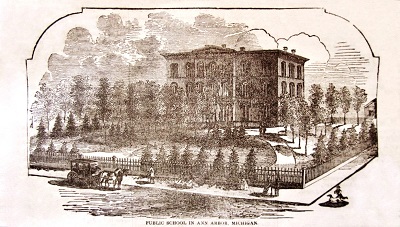
On Saturday, November 24, Detroit High School squared off for the first of two contests with Ann Arbor High School, this one at the Detroit Athletic Club grounds. Admission to the 2:45 p.m. contests was 25 cents. A crowd of around 300 watched “an exciting illustration of how Rugby foot ball is played. The exhibition by the Ann Arbor boys was considerably better than that of the Detroiters,” noted the Free Press, “the result of that being that Detroit’s banners have been kicked into the dust.”
Ann Arbor returned home with a 12-0 victory.
A second game with Ann Arbor was quickly scheduled.
In between, on Thursday, November 29, the Detroit High School squad played the Athletic Club before a crowd of about 200.
 “While the Athletics won by 12 to 0, still their playing was very loose, probably the result of over confidence. The Athletics will have to rid themselves of this by Saturday or the Albions will make short work of them.”
A large crowd gathered in the drizzling rain in Ann Arbor on Saturday, December 8, for what appears to be the final contest of the 1888 season for the high school teams of Detroit and Ann Arbor.
“It was a fine game. (Captain) Brooks, McGraw and Wisner, for Detroit, and Jewett, Diggert, Dupont, and Rathbone for Ann Arbor, made fine plays for their respective sides.” The result was an 8 to 2 win, and redemption, for the Detroit squad.
Today, 129 years later, “football” has seen wild expansion, numerous rule changes, and huge advancement in equipment worn when compared to those pioneer days of the sport. In 2017, more than 1 million individuals will suit up for high school teams across the United States. In Michigan alone, more than 36,000 participate in prep football.
And our state’s original programs live on. On Friday, Detroit Central opened its season with a win over Detroit Loyola. Ann Arbor High School, renamed Ann Arbor Pioneer in the late 1960s, fell in its Friday opener to Muskegon.
Welcome to another season of America’s favorite pastime.
 Ron Pesch has taken an active role in researching the history of MHSAA events since 1985 and began writing for MHSAA Finals programs in 1986, adding additional features and "flashbacks" in 1992. He inherited the title of MHSAA historian from the late Dick Kishpaugh following the 1993-94 school year, and resides in Muskegon. Contact him at [email protected] with ideas for historical articles.
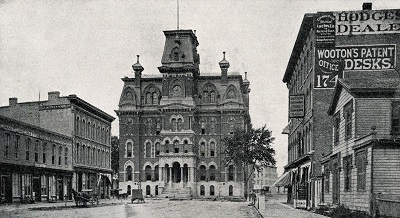
PHOTOS: (Top) The Detroit Free Press included brief coverage of the first "reported" game on Oct. 28, 1888. (Middle) When Michigan’s state government moved from Detroit to Lansing in 1847, the old Capitol building was re-opened as the Detroit’s first city high school in 1863. To better accommodate Detroit’s growing population, the old two-story structure was remodeled into a four-story building, unrecognizable to most. The school served the city well until January 1893, when it burned to the ground. (Below) Erected in 1856 at the cost of $27,000, Ann Arbor High School at State and Huron (now site of the North Quad of the University of Michigan) was destroyed by fire in 1904. (Photos courtesy of Ron Pesch.)
Students Make Championship Calls
By
John Johnson
MHSAA Communications Director emeritus
December 16, 2013
It’s a great thrill each Thanksgiving weekend for those schools that make the trip to the Finals of the MHSAA Football Playoffs at Ford Field.
For the players, they get to occupy the same space as some of their professional favorites did just hours earlier… names like Calvin Johnson and Matthew Stafford … Joe Buck, Troy Aikman and Pam Oliver.
Buck, Aikman and Oliver?!!?!?
Joining the 16 schools playing the games this year were about 70 students from five other schools getting the experience of a lifetime on their own Ford Field trip as they got insights into the world of professional sports broadcasting.
The newly-founded Student Broadcast Foundation and the MHSAA partnered to provide the same kind of access the media covering the Finals get – and then some. Students visited various parts of Ford Field, including touring the Game Creek Video FX remote television facilities – the same production unit used for the Detroit Lions-Green Bay Packers contest on Thanksgiving Day, which will also originate FOX Sports’ Super Bowl XLVIII coverage at MetLife Stadium in East Rutherford, N.J., in February.
Some of the students were able to meet with media in attendance at the Finals to have their pictures taken and ask questions about careers in sports broadcasting and journalism.
Students, faculty advisors and parent-chaperones from the following schools took part in the experience: Cedar Springs, Davison, Detroit U- D Jesuit, Hillman, Warren DeLaSalle, Birmingham Brother Rice, Montrose and Detroit Catholic Central. Cedar Springs had the largest contingent with 28 students, with a parent covering the travel expenses for the group. Its experience is recapped in this embedded video.
"The whole experience at Ford Field was tremendous for our CSTV students,” said Justin Harnden, a teacher from Cedar Springs. “They were welcomed by the Student Broadcast Foundation, MHSAA, and Ford Field with open arms. Every student that attended had nothing but great things to say about everything. Seeing first-hand what it takes to put on such a big event will truly be beneficial to us as we all go forward in making our program better.”
Hillman had the second largest group with 17 students out of a student body of 151 from this school in Montmorency County, about 35 miles west of Alpena. “Absolutely outstanding job by your kids. You all made the best of your opportunity. Way to go! Your program just woke up a lot of people,” Hillman school board president Brad McLaren said in a text after the event to instructor Erin Brege.
Other videos were produced by students from Davison, Hillman and Montrose, and links to their productions are shown below. You can check out photos from the activities by visiting the Student Broadcasting Foundation’s Facebook page. Also, click to see videos shot by Davison and Montrose that now appear at MHSAA.TV.
“In the many years that Tom Skinner, Ken Kolb and I have been involved with broadcasting high school sports on radio and cable TV, this year’s Football Finals weekend was the most inspiring, satisfying, fun weekend working with these talented students and their dedicated instructors,” said Thom Lengyel, one of the founders of the Student Broadcast Foundation, a private non-profit organization.
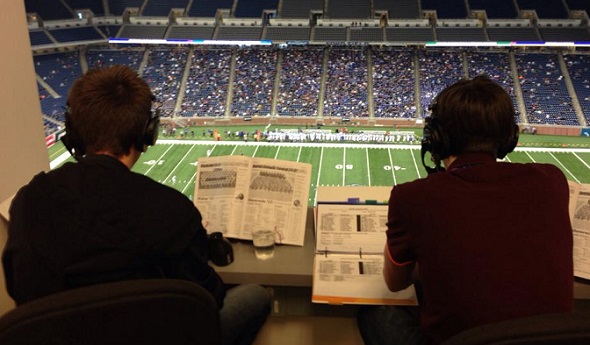
Students from the participating schools also took part in calling the action of the eight championship games on the MHSAANetwork.com website, where an average of 250 people clicked in per contest. Calling the games were:
- Cedar Springs - Kyle Maka, Kody Hall, Alex Hughes (Division 1)
- Davison - Shawn Bednard, Chris Jared, Brandon Snyder (Division 7)
- Detroit U-D Jesuit - Jack Sznewjas, Chris Houle (Division 8)
- Hillman – Mike Klein, Kyle McLaren, Noah Allen, Bubba Banks (Division 4)
- Warren DeLaSalle - Brendan Johnson, Jake O'Donnell (Division 2)
- Birmingham Brother Rice – Miles Hampton, Jeremy Otto - Mentor (Division 6)
- Detroit Catholic Central – Joesph Trojniak, Adam Abraham - Mentor (Division 5)
Several of the schools involved also are part of the MHSAA’s Student Broadcast Program, which produced nearly 1,000 events during the fall sports season for the MHSAA.TV Website.
Read more about Hillman's experience here in reports from the Alpena News and WBKB-TV. And read on for a report on Cedar Springs' experience by student reporter Kendra Coons.
C.S.T.V. Production Program “Hits it out of the park” at Ford Field
Change.
It’s a word that many people don’t deal with well. In this case, it was for the better at Cedar Springs High School.
In 2012, drama teacher, Justin Harnden took over the television program at CSHS. The second he took it over many changes were made to the C.S.T.V. program. The program bought brand new cameras, computers, TVs, and much more. He started working on getting his students to film sporting events, work on Public Service Announcements, capture the latest news in the school; and for the biggest change, start announcing play-by-play.
“We are here to put out more than just news for our school and community. We are doing sports, award shows, graduation, Red Flannel things, and much more. We are destined for great things,” expressed Harnden.
With one year under his belt, Harnden started to submit C.S.T.V.’s work to the MHSAA. After the fall season of 2013, Thom Lengyel and Ken Kolb, who are a part of the Student Broadcast Foundation, heard C.S.T.V. production students Kyle Maka and Kody Hall perform play-by-play for one of Cedar Springs’ football games. After listening to the both of them, Lengyel contacted Harnden and offered for Maka, Hall, and the rest of the class to come down to Ford Field. Lengyel explained to Harnden that the trip to Ford Field would give the class a chance to receive a behind-the-scenes look at what goes on during a broadcast and give Maka and Hall a chance to call the Division 1 championship high school football game.
On Saturday, Nov. 30 the C.S.T.V. Production program traveled out of their little town of Cedar Springs, Michigan, to face the big town of Detroit, Michigan. The day started out with the students boarding the bus at 8:15 am for a three-hour drive to the east side of the state. Once the students stepped off the bus they received their press passes. This gave them full access to walk out onto the field and sit in press row. Once the class arrived at Ford Field, they traveled up to the seventh floor to meet Lengyel. Lengyel then introduced the class to Kolb, showed them where Fox Sports does all of their announcing, and showed them where press row was located. After all of that was done, it was time for Maka and Hall to announce play-by-play for the Division 1 championship. Another member of C.S.T.V. also received a chance to announce play-by-play for the game, Alex Hughes.
Coming from a town with an estimated 3,500 people, the three boys were not used to a big stage. A lot of the community would annually attend our high school football games, but nothing to the caliber of what the three boys were about to announce.
“Doing the play-by-play was just amazing. I felt on top of the world. It was the best experience of my life,” commented Maka.
“It was honestly a feeling that I've never felt before ... It almost didn't seem real at first, but once I opened up (to) the environment I had an amazing time,” stated Hughes.
While the three boys were announcing play-by-play, the rest of the class received the opportunity to walk onto the field and sit in press row. After the game the students received the chance to walk through the Fox Sports trailers. These trailers are where all of the action happens. Being able to walk through these trailers was a once-in-a-lifetime experience for the C.S.T.V program.
“I thought looking around the Fox Sports Detroit mobile studio was eye opening. Seeing two of the three trucks that will handle all the production aspects of the Super Bowl was really great. We were able to see all that goes on in that setting, and we were amazed by it,” explains Harnden.
“Getting to tour Fox Sports was crazy because normally the behind the scenes work isn't seen at all, so that opportunity was perfect for the class,” said Hall.
After the students toured the buses, they all headed back up to the seventh floor to grab their things, say their goodbyes, and thank Lengyel and Kolb for the opportunity. Right before the class got ready to leave Lengyel had a few words to say to the class. He told the class how well they were behaved and how well the three boys did at calling the game.
“Getting those compliments from someone who has been in the business for so long was quite overwhelming, especially for myself not knowing much about football and (it) being the first time doing commentary,” said Hughes.
“(I had) a sense of joy and pride. I was so glad that somebody of his job caliber enjoyed how we did,” added Hall.
“When Thom gave us those compliments, I just could not stop smiling. When Thom said that we were just as good on our fourth game as those who have been calling games for four years, (it) just made me believe that this is something I can really do for the rest of my life. I hope that dream comes true,” commented Maka.
Not only did Lengyel and the rest of the class believe they did a great job, Maka, Hughes, and Hall’s teacher also believed they did exceptionally.
“I thought Kyle, Kody, and Alex did a great job. This was only the fourth game that they have called and they went above and beyond our expectations. Everyone involved with the production was impressed with what they did,” stated Harnden.
The students were able to take away many things from traveling to Ford Field. Going behind the scenes of Fox Sports is something not many people get a chance to say that they did. The class and Harden believe it was very beneficial to be able to participate in an experience like this.
“The students were exposed to a lot of aspects within media production. From press row, to the Fox Sports Detroit mobile studio, calling the game on the radio, and being allowed to see every aspect of a big stadium production really was eye opening,” explained Harnden.
The experience of traveling to Ford Field was definitely an experience that none of the class members will ever forget. Not only did they have a blast, but they learned a ton too.
“I definitely think that the trip benefited the class because we (were all able) to see things about professional broadcasting that most people can't. (Also) we (were able) to learn what it takes to make a professional broadcast,” says Maka.
The day after the program traveled to Ford Field, Lengyel emailed Harnden about C.S.T.V. Production and his view on their performance.
“... During the broadcast I knew that they were doing a good job,” expressed Thom. “So I wanted to listen to their broadcast when I got home. I could not put the mp3 player down. I did not pause it until halftime. For their fifth broadcast, listening to their preparation come out in the broadcast, changed my opinion to: THEY HIT IT OUT OF THE PARK.”
Lengyel has been in the business for many years. Having a compliment like that from a man with so much experience really hit home for the C.S.T.V. Production program.
If you would like to see what C.S.T.V. is all about, like us on Facebook, “CSTV”, follow us on Twitter “@CedarSpringsTV”, visit our website, “www.cedarspringstv.com” and make sure to watch our newscasts and listen for our play-by-play on MHSAA.TV.
C.S.T.V. Production truly wants to thank the Student Broadcast Foundation for the opportunity it was given. And a special thanks to Lengyel and Kolb for selecting C.S.T.V. and helping with advancing the program to the next level.
Hughes stated, “I can't thank the Student Broadcast Foundation and the MHSAA enough for letting our class have the opportunity to go to Ford Field and experience everything that we did. I would also like to thank our teacher Justin Harnden for turning around our TV Pro program. … Lastly, I would like to thank our class for always being there for one another and making this year memorable.”
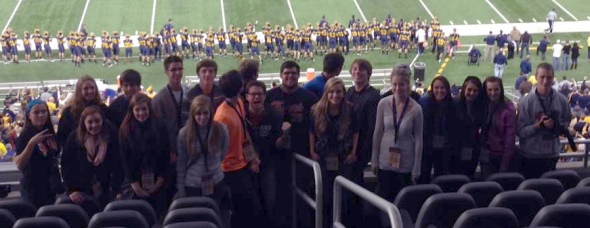
PHOTOS: (Top) Two students call a game during the MHSAA Football Finals. (Below) Some of the students who visited Ford Field pose during a championship game. (Photos courtesy of the School Broadcast Foundation.)