

Football Kicks Off Again, 129 Years Later
By
Ron Pesch
MHSAA historian
August 25, 2017
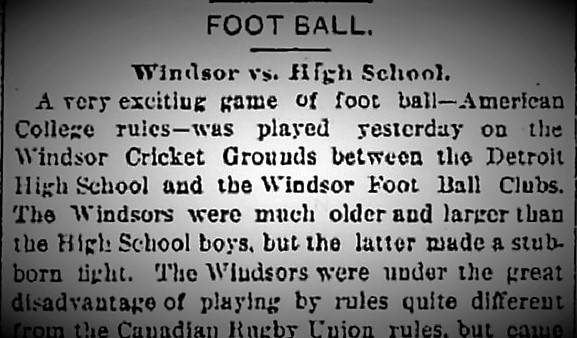
Buried in the text on the fourth page of the Saturday, October 27, 1888, Detroit Free Press is a single, concise sentence bearing a minimum amount of detail.
“The Windsor foot ball team will play the Detroit High School team this afternoon at 3.”
To date, this is the earliest account of a Michigan high school playing the game of “foot ball.”
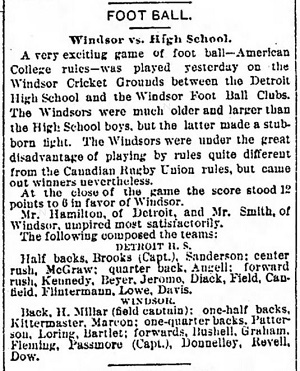
The following day’s paper provides only a few more details. The game was played on the Windsor Cricket Grounds. Despite the great disadvantage of playing under “American Football rules … quite different from the Canadian Rugby Union rules …” the “older and larger” Windsors won the contest, 12-6. Rosters for each squad were provided.
 Under American rules of the time, a touchdown was worth four points, with a conversion kick following a touchdown worth two additional points. At the time, a field goal counted for five points and a safety was worth two. The teams, however, may have agreed to a different scoring system before the contest.
Was this the first football game for a Michigan high school? That’s unlikely, but it is certainly among the earliest published accounts involving a prep game in the state.
It’s a fair assumption that foot ball, or some version of the game, was being played in neighborhoods before that time, at least based on the following statement found in the Jackson Citizen Patriot, dated June 18, 1867. Only days before, Dorrance & Goodwin’s, a store on Main Street in Jackson, had placed advertisements in the newspaper’s classifieds noting the pending arrival of this new product.
“Foot Ball – The pastime was inaugurated on our streets yesterday. Three or four balls were kept in motion all day on Main street alone. It affords no little amusement to the little boys, and is certainly a healthy exercise for the larger ones. It’s all right as long as no windows are broken or horses scared. Both calamities were barely escaped scores of times during the day.”
Rutgers and Princeton are credited with playing the first college football game in 1869. A decade later, in 1879, the University of Michigan established a football team.
Detroit High School played a number of games in 1888, besides the Windsor match, including a contest with the Tappen School from the Corktown area of Detroit. Played at the Detroit Athletic Club grounds on the afternoon of Thursday November 15, a final score was not mentioned in the following day’s Free Press.
For those unfamiliar with the sport, an account of the University of Michigan versus Detroit Athletic Club contest that appeared in the November 18 Free Press served as a fine introduction to the game, and the determination behind securing “possession of a leather-covered foot ball.”
“It was very interesting to see one speedy young man, after a desperate struggle in which the spectators fully expected to see him lose an arm or a leg, get away from his captors and start like a deer, with eight or ten of the opposite side in full pursuit. He is overtaken and the leader of the pursuing party springs upon the back of the man with the inflated trophy, bearing him to the ground with a dull thud … It is also an inspiring sight to see a fleet-footed player seize the ball and run at full speed in the direction of the goal of his opponents. Then a wing-footed opponent cuts across to intercept him, makes a flying leap, grasps the fugitive around the neck or waist and both go to grass with a suddenness and velocity that transforms them into human wheels …
 “While one unaccustomed to foot ball will naturally be startled by some of the acrobatic feats, still it is impossible to watch the game for any length of time without a tingling of the blood and holding of the breath. It is most intensely exciting, continuous in action and replete with fine points of play.
“It may be explained that the goals in a foot ball game are set at a distance of 330 feet from each other. The goal is made by placing two pieces of scantling twenty feet long upright in the ground, eighteen and one-half feet apart. Another piece runs midway horizontally between the uprights, and the ball must go over the horizontal piece and between the uprights to count a goal. There are eleven men on each side and the object is, of course, to get the ball through the goal of the other. The time of game is an hour and a half each side playing forty-five minutes from each goal, with an intermission of ten minutes between halves.”
A player who ran over an opponent’s goal line, “with the ball and touched it down” was then entitled to “bring the ball in front of the goal and attempt to kick it through”…
Among those playing for the Athletic Club squad that day was “little Hugh Brooks (captain) of the high school team.” Eligibility rules for players would evolve over time.
On Saturday, November 24, Detroit High School squared off for the first of two contests with Ann Arbor High School, this one at the Detroit Athletic Club grounds. Admission to the 2:45 p.m. contests was 25 cents. A crowd of around 300 watched “an exciting illustration of how Rugby foot ball is played. The exhibition by the Ann Arbor boys was considerably better than that of the Detroiters,” noted the Free Press, “the result of that being that Detroit’s banners have been kicked into the dust.”
Ann Arbor returned home with a 12-0 victory.
A second game with Ann Arbor was quickly scheduled.
In between, on Thursday, November 29, the Detroit High School squad played the Athletic Club before a crowd of about 200.
 “While the Athletics won by 12 to 0, still their playing was very loose, probably the result of over confidence. The Athletics will have to rid themselves of this by Saturday or the Albions will make short work of them.”
A large crowd gathered in the drizzling rain in Ann Arbor on Saturday, December 8, for what appears to be the final contest of the 1888 season for the high school teams of Detroit and Ann Arbor.
“It was a fine game. (Captain) Brooks, McGraw and Wisner, for Detroit, and Jewett, Diggert, Dupont, and Rathbone for Ann Arbor, made fine plays for their respective sides.” The result was an 8 to 2 win, and redemption, for the Detroit squad.
Today, 129 years later, “football” has seen wild expansion, numerous rule changes, and huge advancement in equipment worn when compared to those pioneer days of the sport. In 2017, more than 1 million individuals will suit up for high school teams across the United States. In Michigan alone, more than 36,000 participate in prep football.
And our state’s original programs live on. On Friday, Detroit Central opened its season with a win over Detroit Loyola. Ann Arbor High School, renamed Ann Arbor Pioneer in the late 1960s, fell in its Friday opener to Muskegon.
Welcome to another season of America’s favorite pastime.
 Ron Pesch has taken an active role in researching the history of MHSAA events since 1985 and began writing for MHSAA Finals programs in 1986, adding additional features and "flashbacks" in 1992. He inherited the title of MHSAA historian from the late Dick Kishpaugh following the 1993-94 school year, and resides in Muskegon. Contact him at [email protected] with ideas for historical articles.
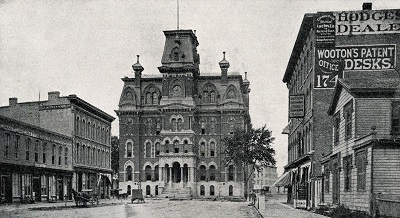
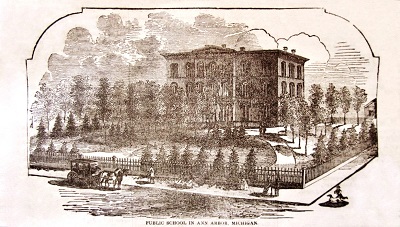
PHOTOS: (Top) The Detroit Free Press included brief coverage of the first "reported" game on Oct. 28, 1888. (Middle) When Michigan’s state government moved from Detroit to Lansing in 1847, the old Capitol building was re-opened as the Detroit’s first city high school in 1863. To better accommodate Detroit’s growing population, the old two-story structure was remodeled into a four-story building, unrecognizable to most. The school served the city well until January 1893, when it burned to the ground. (Below) Erected in 1856 at the cost of $27,000, Ann Arbor High School at State and Huron (now site of the North Quad of the University of Michigan) was destroyed by fire in 1904. (Photos courtesy of Ron Pesch.)
Drive for Detroit: 11-Player Semis Preview
November 16, 2018
By Geoff Kimmerly
Second Half editor
This season’s “Drive for Detroit” is in its final stretch as 32 teams prepare to play in 11-Player Semifinals on Saturday.
 And there are plenty in the mix for the first time, or the first time in a while.
Of those 32, only 11 made it this far a year ago – and we’re guaranteed at least three new champions next week at Ford Field.
As always, we encourage you to bundle up and grab a seat in the stands. But if you’d rather watch from the comforts of home, this weekend we again will have all 16 Semifinals available, either on FOXSportsDetroit.com or MHSAA.tv. (Click for the full schedule.)
All games are 1 p.m. Saturday. “Drive for Detroit” is powered by MI Student Aid
Division 1
Clarkston (10-2) vs. Saline (11-1) at Okemos
The reigning Division 1 champion Wolves have given up a combined 13 points over three playoff games, and 6-foot-5, 270-pound sophomore Rocco Spindler is among the leading tacklers with 76 from his defensive tackle spot. Saline has been similarly stifling giving up 26 points total in its playoff wins and has a reliable runner in senior Brendan Munday (1,160 yards/ 14 TDs rushing).
Belleville (12-0) vs. Clinton Township Chippewa Valley (12-0) at Troy Athens
Belleville built on its second straight perfect regular season by making the Semifinals for the first time with a sophomore, Christian Dhue-Reid, running the show at quarterback. Chippewa Valley’s first Semifinal run since 2003 has been keyed in part by senior signal-caller Tommy Schuster (1,480 yards/21 TDs passing).
Division 2
Midland (9-3) vs. Muskegon Mona Shores (11-1) at Grand Ledge
Mona Shores’ only loss this fall came to Division 3 contender Muskegon, and senior running back/linebacker Sincere Dent (1,228 yards/24 TDs rushing, 8.8 yards per carry) is among the standouts leading the way. Senior running back/linebacker Christian Gordon (1,408/20/7.2) provides similar impact for Midland.
Birmingham Groves (10-2) vs. Warren DeLaSalle (10-2) at Hazel Park
Junior quarterback Markis Alexander (1,337 yards/13 TDs passing) has Groves on a 10-game winning streak and playing its second Semifinal in three seasons. Reigning Division 2 champion Warren DeLaSalle has locked down its three playoff opponents to a combined 20 points. Senior Evan Vaillancourt scored in last year’s Final and leads the team with 576 yards and 12 TDs rushing.
 Division 3
Zeeland East (11-1) vs. Muskegon (12-0) at Grand Haven
The reigning Division 3 champion Big Reds have marched again with junior quarterback Cameron Martinez (2,177 yards/33 TDs rushing, 610 yards/11 TDs passing) taking over where last year’s star La’Darius Jefferson left off. But Zeeland East hardly can be overlooked; the Chix are playing in their first Semifinal since 1989 (which was prior to the opening of Zeeland West) and with their only loss by four to reigning Division 4 champion Grand Rapids Catholic Central. Senior quarterback Gabe Taylor and senior running back Joshua Fusco have combined to run for 3,162 yards.
Detroit Martin Luther King (10-2) vs. DeWitt (12-0) at Brighton
King senior quarterback Dequan Finn is considered one of the state’s most unstoppable with 1,086 yards and 19 touchdowns rushing and 1,787 yards and 20 TDs passing. The Crusaders are playing in their fourth straight Semifinal, with the last three in Division 2. DeWitt emerged from its third straight Regional Final to make the Semifinals for the first time since 2013. Senior quarterback Blake Gatfield has thrown for 1,226 yards and 14 scores and is the team’s second-leading rusher with 503 yards plus 12 scores.
Division 4
Grand Rapids Catholic Central (11-1) vs. Edwardsburg (12-0) at Vicksburg
This is a rematch of last season’s championship game, won by GRCC 42-31. Edwardsburg will look to avenge with senior fullback Caden Goggins (1,185 yards/20 TDs rushing) pacing the Eddies’ powerful run-based attack. Many names are different for GRCC, which has lost only to Division 1 contender Saline. Senior quarterback Joe Collins has stepped in with 2,215 yards and 27 touchdowns through the air.
Chelsea (9-3) vs. Williamston (10-2) at Walled Lake Northern
Both have navigated some close ones this run, with Chelsea winning two playoff games by seven points apiece and Williamston with one seven-pointer. Chelsea is back in the Semifinals for the first time since 2015, with senior quarterback Quinn Starkey throwing for 2,091 yards and 22 touchdowns. Williamston is returning to the Semifinals for the first time since 2010. Hornets senior quarterback Austin Stiffler has been nearly identically effective, throwing for 2,181 yards and 22 scores.
Division 5
Hudsonville Unity Christian (10-2) vs. Saginaw Swan Valley (12-0) at Greenville
Last year’s Division 5 runner-up Swan Valley is coming off its closest game this season, a 36-28 win over Reed City, a win which also was its first decided by single digits since Week 1. Senior quarterback Alex Fries ran the show last season as well, and he’s thrown for 1,547 yards and 22 touchdowns. Unity Christian is playing for its first trip to the Finals and relies on a rushing attack that’s gained more than 3,700 yards. Junior Hayden Large has gained 1,143 of them and run for 12 scores.
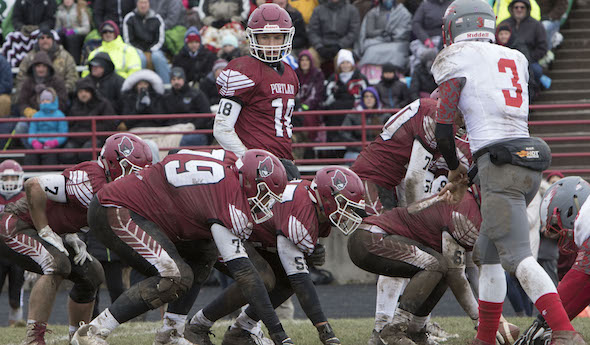
Marine City (10-2) vs. Portland (12-0) at Howell
Portland’s strength has been a defense giving up 7.7 points per game, but the Raiders are also coming off one of their highest-scoring outputs in a 40-6 win over Frankenmuth in the Regional Final. Senior Jacob Veale leads the strong ground attack with 1,505 yards and 24 touchdowns. Marine City chews up yards on the ground as well with junior Aren Sopfe (1,087 yards/14 TDs) and senior Jack Kretzschmar (901/11) carrying the load. The Mariners have had two of their four highest-scoring games over the last two weeks.
Division 6
Montague (10-2) vs. Traverse City St. Francis (12-0) at Mount Pleasant
These two have combined for an 82-11 record over the last four seasons, and both are seeking to make the Finals for the first time since 2009. Senior Bryce Stark has shouldered much of the rushing load for Montague with 1,422 yards and 24 touchdowns. Senior Danny Passinault leads a similarly strong run attack for the Gladiators with 1,201 yards and 18 scores.
Montrose (10-2) vs. Jackson Lumen Christi (11-0) at Novi
The Rams are seeking to reach their first championship game since 2002 and will take on the reigning Division 6 champion Titans with a balanced attack led by senior Devante Bedford (1,617 yards/26 TDs rushing) and sophomore quarterback Bobby Skinner (1,431/20 passing). Lumen Christi still does what it’s done to win the last two championships and three over the last decade – combine tough defense with a dominating rush attack, led this season by senior Nick Thomas (1,634 yards/29 TDs).
Division 7
New Lothrop (11-1) vs. Lake City (12-0) at Clare
Fresh off eliminating two-time Division 7 champion Pewamo-Westphalia, New Lothrop takes on another undefeated contender in Lake City. Junior quarterback Avery Moore is dangerous in multiple ways with 1,375 yards and 20 touchdowns rushing and 1,452 yards and 20 more scores passing for the Hornets. Lake City, which fell to P-W in a Semifinal a year ago, has already outscored last year’s team and is giving up half as many points through just one fewer game. Lake City also has a multi-talented quarterback – senior Matt Holt has run for 1,496 yards and 18 scores and thrown for 1,550 yards and 17 TDs.
Cassopolis (12-0) vs. Madison Heights Madison (12-0) at Jackson
One of the state’s most impressive defenses from Cassopolis will take on a high-flying offense from Madison. The Rangers are outscoring opponents by an average of 46-4, with senior running back Tyrese Hunt-Thompson the team’s leading rusher (859 yards/19 TDs) and receiver (314/6). Madison’s average margin of victory is a little less at 39-9 but has come mostly against much larger schools. Senior quarterback Austin Brown has thrown for 1,766 yards and 21 scores and run for 1,696/29.
Division 8
Breckenridge (12-0) vs. Harbor Beach (11-1) at Chesaning
The Huskies have stretched their best season ever to their first Semifinal with a stalwart defense giving up four points per game. Senior dual threat quarterback Carter Staley leads with 926 yards and 10 touchdowns passing and also a team-best 882 yards rushing with 12 scores on the ground. Harbor Beach is back in the Semifinals for the fourth time this decade coming off its third shutout in five weeks. Junior running back/linebacker Devin Pfaff is key on both sides of the ball, rushing for a team-high 1,234 yards and 20 scores.
Holton (8-4) vs. Reading (12-0) at Battle Creek Harper Creek
Holton’s memorable run began after the team lost its last three regular-season games but made the playoffs as an additional qualifier. After reaching the postseason for the first time since 2007, the Red Devils have won their first District and Regional titles. Senior Aaron Herron has run for 1,548 yards and 19 touchdowns. Next up is Reading, coming off its sixth shutout of the season and averaging 50 points per game. Senior fullback Ethan LoPresto is tough to bring down; he’s averaging 12.6 yards per carry with 2,209 plus 26 TDs total on the ground.
Second Half’s weekly “Drive for Detroit” previews and reviews are powered by MI Student Aid, a part of the Student Financial Services Bureau located within the Michigan Department of Treasury. MI Student Aid encourages students to pursue postsecondary education by providing access to student financial resources and information, including various student financial assistance programs to help make college more affordable for Michigan students. MI Student Aid administers the state’s 529 savings programs (MET/MESP) and eight additional aid programs within its Student Scholarships and Grants division. Click for more information and connect with MI Student Aid on Facebook and Twitter @mistudentaid.
PHOTO: Portland's offense lines up during last week's Division 5 Regional Final win over Frankenmuth. (Click to see more from HighSchoolSportsScene.com.)