

Football Kicks Off Again, 129 Years Later
By
Ron Pesch
MHSAA historian
August 25, 2017
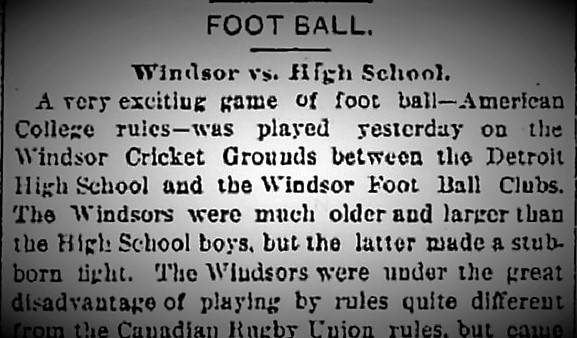
Buried in the text on the fourth page of the Saturday, October 27, 1888, Detroit Free Press is a single, concise sentence bearing a minimum amount of detail.
“The Windsor foot ball team will play the Detroit High School team this afternoon at 3.”
To date, this is the earliest account of a Michigan high school playing the game of “foot ball.”
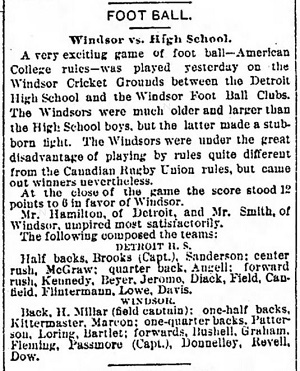
The following day’s paper provides only a few more details. The game was played on the Windsor Cricket Grounds. Despite the great disadvantage of playing under “American Football rules … quite different from the Canadian Rugby Union rules …” the “older and larger” Windsors won the contest, 12-6. Rosters for each squad were provided.
 Under American rules of the time, a touchdown was worth four points, with a conversion kick following a touchdown worth two additional points. At the time, a field goal counted for five points and a safety was worth two. The teams, however, may have agreed to a different scoring system before the contest.
Was this the first football game for a Michigan high school? That’s unlikely, but it is certainly among the earliest published accounts involving a prep game in the state.
It’s a fair assumption that foot ball, or some version of the game, was being played in neighborhoods before that time, at least based on the following statement found in the Jackson Citizen Patriot, dated June 18, 1867. Only days before, Dorrance & Goodwin’s, a store on Main Street in Jackson, had placed advertisements in the newspaper’s classifieds noting the pending arrival of this new product.
“Foot Ball – The pastime was inaugurated on our streets yesterday. Three or four balls were kept in motion all day on Main street alone. It affords no little amusement to the little boys, and is certainly a healthy exercise for the larger ones. It’s all right as long as no windows are broken or horses scared. Both calamities were barely escaped scores of times during the day.”
Rutgers and Princeton are credited with playing the first college football game in 1869. A decade later, in 1879, the University of Michigan established a football team.
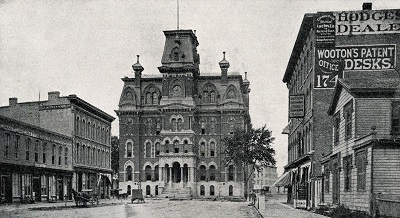
Detroit High School played a number of games in 1888, besides the Windsor match, including a contest with the Tappen School from the Corktown area of Detroit. Played at the Detroit Athletic Club grounds on the afternoon of Thursday November 15, a final score was not mentioned in the following day’s Free Press.
For those unfamiliar with the sport, an account of the University of Michigan versus Detroit Athletic Club contest that appeared in the November 18 Free Press served as a fine introduction to the game, and the determination behind securing “possession of a leather-covered foot ball.”
“It was very interesting to see one speedy young man, after a desperate struggle in which the spectators fully expected to see him lose an arm or a leg, get away from his captors and start like a deer, with eight or ten of the opposite side in full pursuit. He is overtaken and the leader of the pursuing party springs upon the back of the man with the inflated trophy, bearing him to the ground with a dull thud … It is also an inspiring sight to see a fleet-footed player seize the ball and run at full speed in the direction of the goal of his opponents. Then a wing-footed opponent cuts across to intercept him, makes a flying leap, grasps the fugitive around the neck or waist and both go to grass with a suddenness and velocity that transforms them into human wheels …
 “While one unaccustomed to foot ball will naturally be startled by some of the acrobatic feats, still it is impossible to watch the game for any length of time without a tingling of the blood and holding of the breath. It is most intensely exciting, continuous in action and replete with fine points of play.
“It may be explained that the goals in a foot ball game are set at a distance of 330 feet from each other. The goal is made by placing two pieces of scantling twenty feet long upright in the ground, eighteen and one-half feet apart. Another piece runs midway horizontally between the uprights, and the ball must go over the horizontal piece and between the uprights to count a goal. There are eleven men on each side and the object is, of course, to get the ball through the goal of the other. The time of game is an hour and a half each side playing forty-five minutes from each goal, with an intermission of ten minutes between halves.”
A player who ran over an opponent’s goal line, “with the ball and touched it down” was then entitled to “bring the ball in front of the goal and attempt to kick it through”…
Among those playing for the Athletic Club squad that day was “little Hugh Brooks (captain) of the high school team.” Eligibility rules for players would evolve over time.
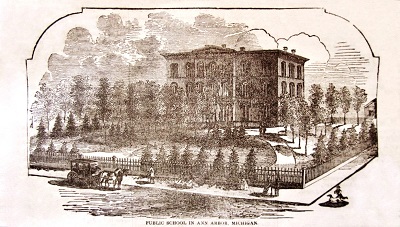
On Saturday, November 24, Detroit High School squared off for the first of two contests with Ann Arbor High School, this one at the Detroit Athletic Club grounds. Admission to the 2:45 p.m. contests was 25 cents. A crowd of around 300 watched “an exciting illustration of how Rugby foot ball is played. The exhibition by the Ann Arbor boys was considerably better than that of the Detroiters,” noted the Free Press, “the result of that being that Detroit’s banners have been kicked into the dust.”
Ann Arbor returned home with a 12-0 victory.
A second game with Ann Arbor was quickly scheduled.
In between, on Thursday, November 29, the Detroit High School squad played the Athletic Club before a crowd of about 200.
 “While the Athletics won by 12 to 0, still their playing was very loose, probably the result of over confidence. The Athletics will have to rid themselves of this by Saturday or the Albions will make short work of them.”
A large crowd gathered in the drizzling rain in Ann Arbor on Saturday, December 8, for what appears to be the final contest of the 1888 season for the high school teams of Detroit and Ann Arbor.
“It was a fine game. (Captain) Brooks, McGraw and Wisner, for Detroit, and Jewett, Diggert, Dupont, and Rathbone for Ann Arbor, made fine plays for their respective sides.” The result was an 8 to 2 win, and redemption, for the Detroit squad.
Today, 129 years later, “football” has seen wild expansion, numerous rule changes, and huge advancement in equipment worn when compared to those pioneer days of the sport. In 2017, more than 1 million individuals will suit up for high school teams across the United States. In Michigan alone, more than 36,000 participate in prep football.
And our state’s original programs live on. On Friday, Detroit Central opened its season with a win over Detroit Loyola. Ann Arbor High School, renamed Ann Arbor Pioneer in the late 1960s, fell in its Friday opener to Muskegon.
Welcome to another season of America’s favorite pastime.
 Ron Pesch has taken an active role in researching the history of MHSAA events since 1985 and began writing for MHSAA Finals programs in 1986, adding additional features and "flashbacks" in 1992. He inherited the title of MHSAA historian from the late Dick Kishpaugh following the 1993-94 school year, and resides in Muskegon. Contact him at [email protected] with ideas for historical articles.
PHOTOS: (Top) The Detroit Free Press included brief coverage of the first "reported" game on Oct. 28, 1888. (Middle) When Michigan’s state government moved from Detroit to Lansing in 1847, the old Capitol building was re-opened as the Detroit’s first city high school in 1863. To better accommodate Detroit’s growing population, the old two-story structure was remodeled into a four-story building, unrecognizable to most. The school served the city well until January 1893, when it burned to the ground. (Below) Erected in 1856 at the cost of $27,000, Ann Arbor High School at State and Huron (now site of the North Quad of the University of Michigan) was destroyed by fire in 1904. (Photos courtesy of Ron Pesch.)
Writer-Turned-Coach Enjoys Debut
November 3, 2016
By Dennis Grall
Special for Second Half
ESCANABA — Sam Eggleston has seen high school football from two drastically different viewpoints. Now, even though he is an unpaid volunteer, he enjoys being on the sideline as a coach.
 Eggleston just completed his first season as a high school head coach, with Eben Superior Central winning its final three games to finish 4-5 in 8-player football. The Cougars were among the first teams in the state to join the 8-player format in 2010, their first year of football.
Eggleston was a sportswriter before becoming a coach, giving him different perspectives to watching the same event.
The 1998 Rock Mid Peninsula High School graduate worked at newspapers in Escanaba, Kenai, Alaska; Northville and Novi, and Marquette before becoming a freelance writer and website blog editor in 2008. He started the writing phase of his career in 2000 with the Daily Press in Escanaba, under my direction.
He served as a volunteer assistant football coach in Northville, then moved back to the Upper Peninsula and became a volunteer coach at his alma mater in 2011 when the Wolverines went to 8-player football. He joined Superior Central in 2014 and spent two seasons as a volunteer aide until landing the head job just two weeks before the 2016 preseason began.
“In both careers … you took a shot on me and I ran with it, and the same with coaching; they gave me a shot and I’ve run with it as best I can,” he said.
In addition to his unpaid position at Superior Central, in rural Alger County, Eggleston is responsible for fundraising for the self-funded football program, a major priority for his offseason.
“My coaching is over (for the season) now and the majority of my time will be spent on raising funds so we can get new helmets, get new pads to replace ones that are broke, spending money we don’t have so we’ve got to make that up now,” he said. “We have to win now to have successful fundraisers.”
As a sportswriter, Eggleston would simply switch gears and move on to coverage of the next athletic season, for instance once fall sports moved into winter. He also never had to worry about how coaches managed off-field X’s and O’s once their seasons concluded.
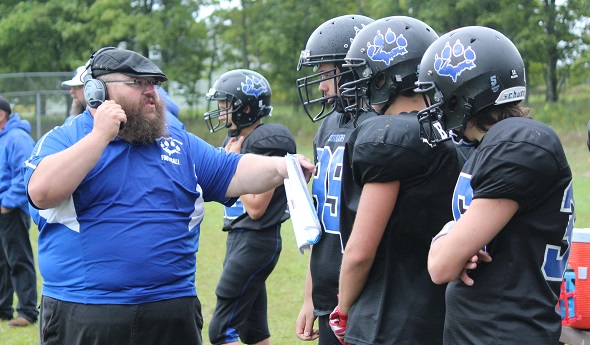
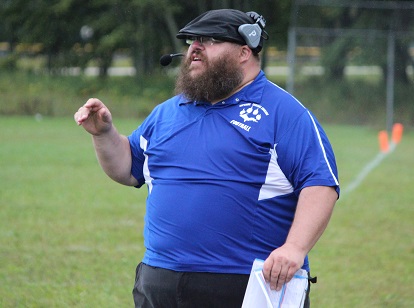
Life was totally different as a reporter. “I had a different approach, different viewpoint, different mindset to a game as a writer,” said Eggleston, who still has the heft of when he was a lineman but now looks like a lumberjack with his bushy beard and build.
“Now I have to worry about every kid and every position,” he said. “Sometimes I don’t even see the end result of the play because I’m watching the line play. I don’t even know how well my running back did until I see where they moved the stick.”
He may also be working on an injured player while the game goes on, trying to make play calls and other decisions at the same time.
As a sportswriter, he would be jotting down notes between plays or perhaps checking the result of a picture he took of the previous snap, totally unaware the coach was monitoring several assignments.
“I look back at the writer I was and as a coach now, and I would hate the type of writer I was,” he said.
Eggleston would analyze why a coach would switch to running a sweep rather than the counter that had been working, all while the coach may be working on an injured player that caused a change in offensive plans.
“As a writer I never had the insight to see everything. I just saw the overall game and kept track of every yard,” he said. “As a coach I can’t even tell if the play went five yards because I have three plays stacked up as the game goes on.”
While he was writing sports in the metro Detroit area, his weekly paper often covered games also being covered by the Detroit Free Press or the Oakland Press, with those stories appearing the next day. Eggleston’s story would appear maybe five days later, after everyone knew what happened.
 “I had to come in with a different angle. I tried to be a little more analytical and focus on strategy versus the flourish and try to get the meat of the game rather than get to the flowery parts,” he recalled. “I tried to take a different approach and make my stuff more interesting.”
His style apparently worked as the paper received several journalism awards and subscriptions remained strong.
Writing also provided some interesting backdrops. He had to use small charter planes to see some games in Alaska, or get to Nome to handle features about the Iditarod sled dog race.
He recalls covering a high school hockey game on an outdoor rink in Alaska and said “it was the first time I saw wind shear affect a hockey game.”
Eggleston also covered a football game where a kicker booted the ball off the uprights, then off a fence, and it bounced into the ocean in Homer.
He reported on a murder trial at that paper, where he would work the news desk in the morning, take time off and then handle sports at night. “It was super stressful,” he said.
Now walking the sidelines as a coach, he said “it definitely does feel like I’ve seen both sides of the coin, and I understand both sides of them better.”
He remembers just giving “little more rounded answers and (to) give both sides of the story” in postgame interviews. “A lot of coaches give canned answers. I try to be a little more in-depth and help try to write the story.”
In his early days as a sportswriter, he said “I would see the game unfold and see the pressures and why a coach would make a decision to go for it (on fourth down). I was a bit more critical of the coach and their decision,” he said, adding “I would probably have been a little more biting about it when I wrote the story.”
He admits in those days “I thought I knew everything there was to know about football. I played it,” he said. “I always approached the game like I was the professional and knew everything about the game. Now as a coach there are a host of responsibilities during every game. I am in completely different waters now. The hardest thing is keeping the kids pointed in the right direction as things go wrong.
“You’ve got the entire team and you’ve got to keep moving in a positive direction, keep the focus going forward. Forget the last play and work on the next one and get the kids to buy into that philosophy.”
He also compares his first writing assignment at the Daily Press with his first game this season at Ontonagon. “I did a (men’s baseball) story about the Escanaba Polecats, and you read my first line and said, ‘Did Yoda write this?’ I thought, oh my God, I don’t know what I’m doing.”
The Cougars lost their opener this fall 36-8, and Eggleston said “after being an assistant for four years, I still wasn’t prepared going into that Ontonagon game. We lost, and as I look back, if we played them right now I think we would beat them.
“I had no clue coming into that first game and didn’t have any idea how to get us back on track.”
He eventually figured enough out to finish 4-5 and found plenty of ways to enjoy being a coach.
Eggleston tries to eat lunch with his players every day, and he pays for his own meal.
“I want a family environment there; we all sit at the same table,” he said. “What I get back is relationships I never had before. I feel like I have 21 kids, and I love every minute of it.”
 Denny Grall retired in 2012 after 39 years at the Escanaba Daily Press and four at the Green Bay Press-Gazette, plus 15 months for WLST radio in Escanaba; he served as the Daily Press sports editor from 1970-80 and again from 1984-2012. Grall was inducted into the Upper Peninsula Sports Hall of Fame in 2002 and serves as its executive secretary. E-mail him at [email protected] with story ideas for the Upper Peninsula.
PHOTOS: (Top) Eben Junction Superior Central football coach Sam Eggleston speaks with some of his players during a game this season. (Middle) Eggleston monitors the action on the field. (Photos by Dennis Grall.)