

Football to Move to Spring for 2020-21
August 14, 2020
By Geoff Kimmerly
Second Half editor
The Representative Council of the Michigan High School Athletic Association today announced it will move the 2020 Fall football season to Spring 2021, due to football’s higher risk for spreading COVID-19, with the rest of Fall sports proceeding as scheduled.
The football season switch was made based on consultation with state health department officials and after surveying MHSAA member high schools on their progress and preferences after the first four days of practice. Football is considered a high-risk sport for potential spread of the COVID-19 virus because of its level of player-to-player contact.
A total of 34,219 student-athletes played football at MHSAA member schools during the 2019 season. A total of 520 11-player teams and 83 8-player teams were anticipated during late summer to play football this fall season.
“At the end of the day, we did everything we could to find a path forward for football this fall,” MHSAA Executive Director Mark Uyl said. “But while continuing to connect with the Governor’s office, state health department officials, our member schools’ personnel and the Council, there is just too much uncertainty and too many unknowns to play football this fall.
“No one is willing to take the risk of COVID being passed on because of a high-risk sport. Decisions have to be made on our other sports as well, but none of those carry the same close, consistent, and face-to-face contact as football.”
The MHSAA announced July 17 it would proceed this school year with its traditional calendar beginning with Fall sports but with enhanced precautions to help limit the spread of COVID-19. At that time, the MHSAA also stated it would move football, and other Fall sports seasons, to the spring of 2021 if they were deemed unsafe to proceed when originally scheduled. Football was allowed to begin practice, with helmets but no other padding, on Aug. 10.
Volleyball and soccer are considered moderate-risk for virus spread, while cross country, golf, tennis and swimming & diving are considered low-risk. Cross Country, Lower Peninsula girls golf and boys tennis and Upper Peninsula girls tennis began practice Aug. 12; golf and tennis teams may begin competing Aug. 19, and cross country teams may begin competing Aug. 21.
Volleyball, boys soccer and Lower Peninsula girls swimming & diving also began practice Aug. 12, and competition guidelines for those sports will be announced Aug. 19. Schools in regions under Phase 4 of the MI Safe Start Plan remain unable to play volleyball or swim/dive indoors due to governmental restrictions. Further guidance from Governor Gretchen Whitmer’s office is expected in the near future regarding these indoor facilities.
Details for the spring football season including a specific schedule and format will be announced over the next few months. The MHSAA will be working to limit overlap of spring football and the traditional Spring sport seasons.
“While this is tremendously disappointing, we will do everything possible to provide the best possible experience in the spring while adding football into the calendar,” Uyl said.
The MHSAA is a private, not-for-profit corporation of voluntary membership by more than 1,500 public and private senior high schools and junior high/middle schools which exists to develop common rules for athletic eligibility and competition. No government funds or tax dollars support the MHSAA, which was the first such association nationally to not accept membership dues or tournament entry fees from schools. Member schools which enforce these rules are permitted to participate in MHSAA tournaments, which attract more than 1.4 million spectators each year.
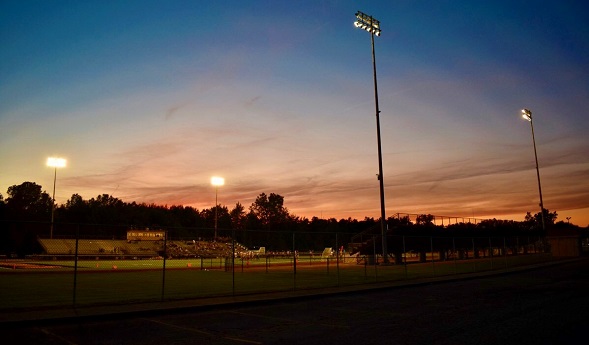
PHOTO by Robert Batzloff.

NFHS Voice: Football Continues to Thrive
September 25, 2019
By Karissa Niehoff
NFHS Executive Director
When the annual High School Athletics Participation Survey was released by the National Federation of State High School Associations (NFHS) in August, many headlines across the country focused on the drop in the number of boys playing 11-player football. After all, the report showed 30,829 fewer participants than the year before. However, perhaps the most important number was overlooked – 14,247.
Yes, 14,247, the number of high schools with 11-player football teams. While there was a slight decline in the number of participants in many states, the number of schools sponsoring the sport was the highest in five years. In fact, the number of schools last year with 11-player teams has only been topped twice in the survey’s history – 14,262 in 2013-14 and 14,279 in 2010-11.
In addition, smaller schools in some states have shifted to 6-player, 8-player and 9-player football and have had good responses. The survey indicates an additional 156 schools and 1,594 participants involved in these alternate forms of the sport; and, in the past 10 years, participation by girls in 11-player football has doubled, with more than 2,400 participants this past year.
These numbers express the desire by high schools to keep alive one of the oldest and most treasured traditions in our nation – Friday Night Football Under the Lights. Although there are many options today for the entertainment dollar, nothing surpasses supporting the local high school football team on Friday nights. The No. 1 fan base in America? The answer is that number again – 14,247.
In Week 2 of the National Football League season, just under 1.1 million fans attended the 16 games. While impressive, it doesn’t come close to the number of fans who watched high school football during the corresponding week. It’s all in that number – 14,247.
With approximately 7,123 games every Friday night (14,247 divided by 2), and with a conservative estimate of 1,000 fans per game, there are more than 7 million fans in high school football stadiums every week. An unofficial attendance survey conducted by the NFHS in 2011 indicated about 165 million fans attended high school football games during that season, which included up to five weeks of playoffs and a weekly average of 11 million fans. Either way, the number of fans at high school football games dwarfs the numbers attending professional football games.
Early season crowds have been strong in many areas of the country with terrific fall weather – filled by current and former students; parents, grandparents and friends of players on the team; and longtime fans and supporters in the community. Unlike crowds at the college and professional levels where fans have little, if any, identity with the players, there is a connection between the players and fans at the high school level.
With concussion protocols and laws in place in every state, with a reduction in contact levels before the season and during practices, and with teaching of proper tackling skills at lower levels, we believe people, including parents of high school student-athletes, are seeing and believing that the sport of football at the high school level is as safe as it ever has been.
We urge you to support your local high school football team this Friday night.
Dr. Karissa L. Niehoff is in her second year as executive director of the National Federation of State High School Associations (NFHS) in Indianapolis, Indiana. She is the first female to head the national leadership organization for high school athletics and performing arts activities and the sixth full-time executive director of the NFHS, which celebrated its 100th year of service during the 2018-19 school year. She previously was executive director of the Connecticut Association of Schools-Connecticut Interscholastic Athletic Conference for seven years.