


Football Playoffs: Finals in Review (with videos)
November 28, 2011
Game over. But what a way to finish.
How should we end a four-month MHSAA football season? With 26 hours worth of Finals over the course of two days, viewable from the comfy confines of Detroit's Ford Field.
Following are my final takes from our Finals weekend. Click on the headers below to see our coverage from each game, and check out the videos for a taste of some of the weekend's hoopla.
The first video was done by Potterville grad and MHSAA Scholar-Athlete award winner Sam Davis, and has at least a couple of us ready to put our helmets back on and hit the field. The other is a slice from one of the most raucous student sections from the weekend.
1st and 10
5 and 4 to No. 1: Bloomfield Hills Brother Rice and Flint Powers Catholic weren’t the first teams to reach Finals with a 5-4 record entering the postseason. But both doing so and winning speaks loudly not just of their respective talents, but also on the gains each made by playing tough opponents. Both came out of tough leagues – Brother Rice was one of three finalists from the Detroit Catholic League Central, and Powers played much larger schools in the Big Nine. Both also played and lost to eventual MHSAA champions during the regular season – Brother Rice against Division 3 winner Orchard Lake St. Mary, and Powers against Division 7 champ Saginaw Nouvel.
Like a rock – or Stone: Detroit Cass Tech linebacker/fullback Royce Jenkins-Stone might’ve been the most impressive all-around player from the weekend. The 6-foot-1, 215-pound Michigan prospect ran for 65 yards and had seven tackles – numbers that don’t stick out. But he scored on a 32-yard run, a three-yard pass and a 36-yard interception return.
Just the beginning: Technicians freshman quarterback Jayru Campbell will be in the statewide lens for the next three seasons after throwing for 240 yards and five touchdowns in the Final. He’s 6-3 and 170 pounds, and easily blended in among his star-studded teammates in just his first year of high school. He’ll also have junior Jordan Lewis (four catches, 89 yards, TD) to throw to for another year.
Good company: Brother Rice’s Devin Church was the other individual performer who seemed to wow the media crowd most with his Finals performance. He capped a 900-yard playoffs with 244 and three touchdowns – and drew comparisons from Lowell coach Noel Dean to past star backs like Kevin Grady and T.J. Duckett. Church will sign with Northern Illinois this winter.
Making tracks: Talk about a running attack, Orchard Lake St. Mary’s came within eight yards of putting three backs over 100 each in its Final. The Eaglets ran for 479 yards total – falling just 53 short of the MHSAA Finals record book minimum. Spencer McInnis ran for 214 yards and three scores, while Grant Niemiec and Parker McInnis both ran for 96 yards and a touchdown.
Rough and rumble: Zeeland West’s physicality in the Division 4 game was simply stifling. Keep in mind the Dux were without all-state linebacker Josh Blanton because of an injury. Then note that the team had just eight players weighing 200 pounds or more – and only three between 250-275. Zeeland West ran for 288 yards, but more impressively held Marine City to 79.
Charging forward: The weekend’s biggest stunner had to be Flint Powers over Lansing Catholic, for a number of reasons. Powers entered the postseason 5-4 (see above), Lansing Catholic was 9-0. The Cougars had beaten the Chargers 37-17 in Week 2. Lansing Catholic was ranked No. 1 by The Associated Press, while Powers was unranked.
Just the beginning, part II: Ithaca sophomore quarterback Travis Smith is another who will be watched closely after a big-time Ford Field debut. He threw for 299 yards and a touchdown and ran for another score in the Yellowjackets’ Division 6 win. Ithaca will graduate a lot in the spring. But the 6-1, 180-pound Smith provides the base needed for a quick rebuild.
Backing it up: Saginaw Nouvel’s Bennett Lewis was another player as good as advertised to those who hadn’t seen him play this season. He ran for 200 yards and five touchdowns in a half in Division 7, using both speed and muscle to make his way. At 5-foot-9 and 181 pounds, the Division 7-8 AP Player of the Year is getting some Division I looks and is at least a high Division II prospect.
Consistently contending: Here’s an idea why Mendon’s is such an impressive machine – eight of John Schwartz’s assistant coaches also played for him. The ninth, Bob Critz, has been at Schwartz’s side since the latter took over the program in 1989. During the post-championship press conference, Schwartz revealed that he’d had cancer surgery in June and his assistants ran the program through all of the summer prep.
Numbers game
55,360 – Number of fans who attended the 2011 Finals. The total was slightly higher Friday than Saturday.
5 – Number of touchdown passes by Cass Tech’s Campbell and number of rushing scores by Nouvel’s Lewis. Both tied MHSAA Finals records.
56 – Number of points scored by both Saginaw Nouvel (Division 7) and Flint Powers (Division 5) to set the Finals record for most in a championship game. Nouvel scored all of its points in the first half. Both games ended with scores of 56-26 -- and oddly, no other MHSAA game ended with that score this season.
413 – Total yards by Powers junior quarterback Garrett Pougnet, just 13 shy of the MHSAA Finals record set by Holland Christian quarterback A.J. Westendorp in the 2008 Division 4 Final.
97 – Distance in yards of Zeeland West senior Brad Mesbergen’s Finals record kickoff return in the Division 4 Final.
Link up
MHSAA.tv: See full postgame press conferences (and field interviews after the Divisions 3 and 4 Finals).
Fox Sports Detroit: Dan Dickerson and John Wangler wrap the two days of finals.

MHSA(Q&)A: Menominee football coach Ken Hofer
June 28, 2012
By Brian Spencer
Second Half
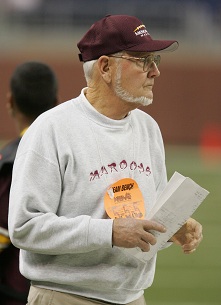
Ken Hofer has been nothing short of legendary during more than three decades as Menominee’s head football coach -- a tenure that came to an end earlier this month when he announced his retirement.
In 41 seasons -- including his first two, at Stephenson -- he won three MHSAA championships (1998, 2006, and 2007) and built a record of 342-136-3. He is one of nine coaches in MHSAA football history with at least 300 wins.
He guided more than a thousand athletes, and that influence extended to league rival Kingsford -- where his son Chris Hofer is the football coach. Ken also is known statewide as the guru of the single wing offense, a rarely-used but for the Maroons frequently unstoppable attack that does not utilize a traditional quarterback.
Hofer is a member of the Michigan High School Football Coaches Association and Upper Peninsula Sports Halls of Fame. He also served as the Menominee athletic director, principal, and assistant principal. He grew up in Stephenson, where he was an all-stater in football and track and field, and later competed in both sports at the University of Wisconsin.
Did you always want to become a football coach?
I was predicted to be a coach somewhere in our (Stephenson) annual (yearbook). So I suppose I was always predetermined to coach. However, before coaching I was in the service as a Lieutenant and spent two years in Germany. After Germany, I spent another five years working for Wilson Sporting Goods before I finally came back in 1964 to coach football and teach social studies for Stephenson.
How did you decide it was time to hang up the whistle?
Well, I’m 77 years old, so age was definitely a determinant. The biggest factor was that as much as my mind said I could continue, my body said “slow down.” So I guess age and my inability to continually go full throttle and stay energetic helped me make my decision.
In your 45 seasons, what is the most helpful piece of advice you are going to take away?
The best advice I will take away is to treat young people the way I like to be treated.
 What do you plan to do with your free time, now that your schedule has opened up slightly?
I am going to try and catch up on stuff that should have been done a long time ago. I’m sure that my wife will give me plenty of stuff to do, too. I also want to try to travel more and visit my kids. I now have a grandson who will be playing for Kingsford, so I will become a fan of my grandson’s at his Kingsford games.
Now that your grandson and son both have affiliations with Kingsford, will you become a Kingsford man?
No (chuckling), I will cheer for my son and grandson, but I will forever be connected with Menominee and Stephenson.
What was it like to be recognized by both the Michigan High School Football Coaches Association and Upper Peninsula Sports Halls of Fame?
It was like a utopia for coaching. When your peers give that honor it is a pretty special time. As a coach you don’t strive for that kind of accolade; however, it is definitely a special honor to receive.
What has been, in your opinion, your greatest achievement as Menominee’s head football coach?
My greatest achievement will always be working with younger people; I think that is the most important thing that most coaches would like to have, is the ability to stay young by working with these young men. You don’t always have to win to have that experience. Winning on the field doesn’t always correlate winning in other aspects of your life.
What advice can you give aspiring or current coaches who look to share similar successes as a head coach?
The biggest thing is to make sure that you treat the players like you like to be treated. Using that approach will get a great response.
Of your 300-plus career wins, is there any one that you find particularly special?
I always found that whenever I could beat Kingsford when my son was coaching (he said, followed by a bellowing laugh). My son Chris will like that one.
There are so many that I consider to be special. There were a ton of close games, too many to count. Two years ago, we had one of those close games where we played Morley-Stanwood, and won 41-40 in overtime (in a 2010 Regional Final). The young men played very hard. It was very special.
Do you think that your son will follow in your footsteps and coach for 45-plus seasons?
I think Chris has that type of coaching in his blood. He’s struggling physically with a knee injury; however he has a coaching mind that is as strong as ever. I think he’ll coach until he won’t be able to.