


Football Playoffs: Finals in Review (with videos)
November 28, 2011
Game over. But what a way to finish.
How should we end a four-month MHSAA football season? With 26 hours worth of Finals over the course of two days, viewable from the comfy confines of Detroit's Ford Field.
Following are my final takes from our Finals weekend. Click on the headers below to see our coverage from each game, and check out the videos for a taste of some of the weekend's hoopla.
The first video was done by Potterville grad and MHSAA Scholar-Athlete award winner Sam Davis, and has at least a couple of us ready to put our helmets back on and hit the field. The other is a slice from one of the most raucous student sections from the weekend.
1st and 10
5 and 4 to No. 1: Bloomfield Hills Brother Rice and Flint Powers Catholic weren’t the first teams to reach Finals with a 5-4 record entering the postseason. But both doing so and winning speaks loudly not just of their respective talents, but also on the gains each made by playing tough opponents. Both came out of tough leagues – Brother Rice was one of three finalists from the Detroit Catholic League Central, and Powers played much larger schools in the Big Nine. Both also played and lost to eventual MHSAA champions during the regular season – Brother Rice against Division 3 winner Orchard Lake St. Mary, and Powers against Division 7 champ Saginaw Nouvel.
Like a rock – or Stone: Detroit Cass Tech linebacker/fullback Royce Jenkins-Stone might’ve been the most impressive all-around player from the weekend. The 6-foot-1, 215-pound Michigan prospect ran for 65 yards and had seven tackles – numbers that don’t stick out. But he scored on a 32-yard run, a three-yard pass and a 36-yard interception return.
Just the beginning: Technicians freshman quarterback Jayru Campbell will be in the statewide lens for the next three seasons after throwing for 240 yards and five touchdowns in the Final. He’s 6-3 and 170 pounds, and easily blended in among his star-studded teammates in just his first year of high school. He’ll also have junior Jordan Lewis (four catches, 89 yards, TD) to throw to for another year.
Good company: Brother Rice’s Devin Church was the other individual performer who seemed to wow the media crowd most with his Finals performance. He capped a 900-yard playoffs with 244 and three touchdowns – and drew comparisons from Lowell coach Noel Dean to past star backs like Kevin Grady and T.J. Duckett. Church will sign with Northern Illinois this winter.
Making tracks: Talk about a running attack, Orchard Lake St. Mary’s came within eight yards of putting three backs over 100 each in its Final. The Eaglets ran for 479 yards total – falling just 53 short of the MHSAA Finals record book minimum. Spencer McInnis ran for 214 yards and three scores, while Grant Niemiec and Parker McInnis both ran for 96 yards and a touchdown.
Rough and rumble: Zeeland West’s physicality in the Division 4 game was simply stifling. Keep in mind the Dux were without all-state linebacker Josh Blanton because of an injury. Then note that the team had just eight players weighing 200 pounds or more – and only three between 250-275. Zeeland West ran for 288 yards, but more impressively held Marine City to 79.
Charging forward: The weekend’s biggest stunner had to be Flint Powers over Lansing Catholic, for a number of reasons. Powers entered the postseason 5-4 (see above), Lansing Catholic was 9-0. The Cougars had beaten the Chargers 37-17 in Week 2. Lansing Catholic was ranked No. 1 by The Associated Press, while Powers was unranked.
Just the beginning, part II: Ithaca sophomore quarterback Travis Smith is another who will be watched closely after a big-time Ford Field debut. He threw for 299 yards and a touchdown and ran for another score in the Yellowjackets’ Division 6 win. Ithaca will graduate a lot in the spring. But the 6-1, 180-pound Smith provides the base needed for a quick rebuild.
Backing it up: Saginaw Nouvel’s Bennett Lewis was another player as good as advertised to those who hadn’t seen him play this season. He ran for 200 yards and five touchdowns in a half in Division 7, using both speed and muscle to make his way. At 5-foot-9 and 181 pounds, the Division 7-8 AP Player of the Year is getting some Division I looks and is at least a high Division II prospect.
Consistently contending: Here’s an idea why Mendon’s is such an impressive machine – eight of John Schwartz’s assistant coaches also played for him. The ninth, Bob Critz, has been at Schwartz’s side since the latter took over the program in 1989. During the post-championship press conference, Schwartz revealed that he’d had cancer surgery in June and his assistants ran the program through all of the summer prep.
Numbers game
55,360 – Number of fans who attended the 2011 Finals. The total was slightly higher Friday than Saturday.
5 – Number of touchdown passes by Cass Tech’s Campbell and number of rushing scores by Nouvel’s Lewis. Both tied MHSAA Finals records.
56 – Number of points scored by both Saginaw Nouvel (Division 7) and Flint Powers (Division 5) to set the Finals record for most in a championship game. Nouvel scored all of its points in the first half. Both games ended with scores of 56-26 -- and oddly, no other MHSAA game ended with that score this season.
413 – Total yards by Powers junior quarterback Garrett Pougnet, just 13 shy of the MHSAA Finals record set by Holland Christian quarterback A.J. Westendorp in the 2008 Division 4 Final.
97 – Distance in yards of Zeeland West senior Brad Mesbergen’s Finals record kickoff return in the Division 4 Final.
Link up
MHSAA.tv: See full postgame press conferences (and field interviews after the Divisions 3 and 4 Finals).
Fox Sports Detroit: Dan Dickerson and John Wangler wrap the two days of finals.
Michigan's Football Past: A Must Read
By
Ron Pesch
MHSAA historian
September 27, 2016
By Ron Pesch
Special for Second Half
This week, the contents of my mailbox reminded me about one of my favorite items to collect – booklets and programs celebrating the history of Michigan high school football.
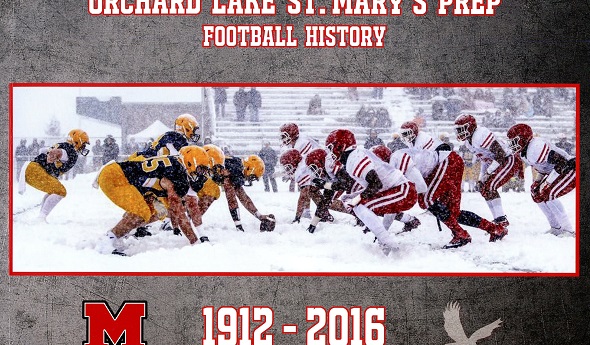
Contained within was the 2016 edition of the book, “Orchard Lake St. Mary’s Prep Football History.” Featuring a glorious image on the cover, it’s a delight to flip through. Rob Goddard and crew are to be commended on the fantastic job they’ve done with this 104-page chronicle.
The package recalled the first in my collection – a publication I helped create.
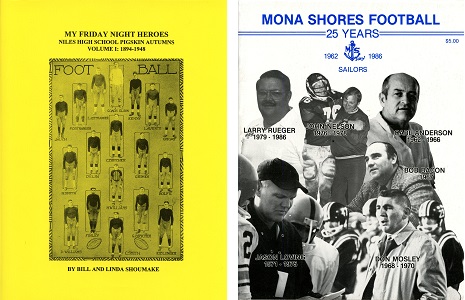
The 25-year celebration of Muskegon Mona Shores football was a modest piece, created before the days of desktop publishing. Because I had assembled the scores of the district’s games, I approached the school and found an individual willing to take a chance. Jerry Fitzpatrick, Sailors athletic director at the time, approved the idea of a booklet celebrating the school’s Silver Football Anniversary.
With gusto, we tapped into a host of resources and dove into digging out photos and details designed to capture everything we could on the years 1962 through 1985, with room for fans to collect details on the coming season. We even included a page on cheerleaders and Homecoming Kings and Queens in hopes of broadening our market.
My second acquisition was a document on Battle Creek Central football, created by MHSAA historian Dick Kishpaugh. It totaled 42 pages in length and included most everything there was to know about the Bearcats, Kishpaugh’s alma mater.
A souvenir football program celebrating Kalamazoo Central’s history followed, also heavily influenced by the work of Kishpaugh. A 60-year history of all sports at Gaylord St. Mary soon landed in my hands, passed on to me by sportswriter and historian Jay Soderberg, editor of the publication. A history of little Grant High School football, published, I believe, in 1979, was the next to arrive.
 In 1993, I partnered with baseball historian Marc Okkonen to produce “100 Years of Muskegon Big Red Football 1895-1994,” a 90-page history of our alma mater. That publication was marketed by the school’s Athletic Foundation as a fundraiser and sold well. To my delight, it seemed to spark the publication by a number of other districts of their football histories. Grand Haven and Escanaba followed a similar format and were both quick to market. Each book also celebrated a centennial of gridiron action. Other publications began to surface.
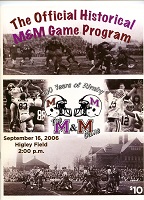
Riding a string of gridiron championships, Farmington Hills Harrison produced a 108-page program, highlighting the accomplishments from their 25-year football history, in 1994. Additional histories from Cadillac, Frankenmuth, Lowell, Negaunee, Boyne City, Niles, Sturgis and Traverse City appeared, some focused on football, others on all sports. So too did one highlighting the Centennial football game between Saginaw and Saginaw Arthur Hill, as did one a few years later celebrating the M & M game, among the nation’s oldest cross-border battles staged between Menominee and Marinette, Wisconsin.
But since then, things seem to have fallen silent. I believe a lengthy history on Grand Rapids Catholic Central made it to press, although I don’t possess a copy. I’ve seen, but have yet to acquire, a football booklet on Sparta High School football.
Do others exist? Enquiring minds want to know.
 During the gap, John Hulsebus has created, and continues to maintain and enhance a dream website, Michigan-football.com, containing an exhaustive collection of scores, season win-loss marks and records versus opponents for games played since 1950. The site lists schools, past and present for every high school in the state. Like many, I reference it often. Yet, for many schools in the state, that means as many as 55 years of gridiron action remains unrecorded.
Also missing are the stories that sit behind the scores: the players, the coaches, the drama, the locals and pageantry of a Friday night or a Saturday afternoon at the stadium. In the meantime, scrapbooks containing news clippings, game programs, and photographs, once prepared for our fathers, grandfathers and great-grandfathers, gather dust or disappear.
Tell me please, we haven’t forgotten to capture those details from our past?
 Ron Pesch has taken an active role in researching the history of MHSAA events since 1985 and began writing for MHSAA Finals programs in 1986, adding additional features and "flashbacks" in 1992. He inherited the title of MHSAA historian from the late Dick Kishpaugh following the 1993-94 school year, and resides in Muskegon. Contact him at [email protected] with ideas for historical articles.
PHOTOS: (Top) Orchard Lake St. Mary's annually produces an updated history of the school's football program. (Middle) Niles and Muskegon Mona Shores are among other programs that have documented their histories in book form. (Below) The program for the 100th game between Menominee and Marinette, Wis., was a keeper as well.