


Football Scheduling
December 23, 2014
The major complaint about the MHSAA Football Playoffs is not that too few teams qualify or too many, or that a five-week playoff is too long or should become six weeks, or that some worthy teams miss out while some less worthy teams get in. No; most people find a five-week, 11-player tournament after a nine-game regular season is the best that our late start to fall classes and our early start to winter weather will allow us in Michigan.
Many people appreciate being able to complete our 14-week season in the warmth of Ford Field on the Friday and Saturday of Thanksgiving weekend. Most people think that nearly 45 percent of 11-player schools is a sufficient tournament field. Many people like the excitement that the six-win threshold creates for teams that had been eliminated earlier from league championships.
The most serious and legitimate complaint about the season-ending playoffs is the stress it has placed on conferences and the struggles many schools have in building nine-game regular-season schedules. Some critics want to mess with the Football Playoffs because of the mess they believe it makes for regular-season schedulers.
Having the MHSAA provide every school a nine-game regular season schedule of the most nearby teams of the most nearly equal enrollments would shift scheduling headaches from the local level to the MHSAA.
I’m not suggesting that this solution to local problems doesn’t create new, large headaches for the MHSAA. But in fact, that is the tradition of school sports: when an issue is large enough in scope and common enough among member schools, the state high school association is asked to be the problem-solver. That’s how we got transfer rules, defined sports seasons and competitive cheer tournaments, for example. Just about every policy and procedure and program of the MHSAA arises from a common local problem looking for a statewide solution.
The 2014 Update Meeting Opinion Poll indicates that 70 percent of responding administrators do not favor the solution of the MHSAA making all schools’ regular-season varsity football schedules. Maybe the question should be narrowed to having the MHSAA complete member schools’ non-conference scheduling.
Meanwhile, we will keep watching as high school associations in other states move to statewide scheduling. For if scheduling is the problem, then scheduling itself needs to be the focus of the solution.
1st & Goal: 2021 Playoff Week 1 Preview
By
Geoff Kimmerly
MHSAA.com senior editor
October 28, 2021
From an up-close point of view, at just more than half of Michigan’s football-playing high schools, three months of football season ended last weekend.
 But from a mile-high perspective, 20 teams have played just slightly more than half their games this fall – and 288 begin this weekend with the opportunity to add onto their seasons and finish among that fortunate few.
Playoffs begin Friday with District Semifinals in 11-player and Regional Semifinals in 8-Player – click here for the full schedule for each division. More than 100 of the 144 total playoff football games will be broadcast on MHSAA.tv, with Clinton Township Chippewa Valley at Troy appearing on the Bally Sports Detroit primary channel tonight – click for more on how to watch.
Below are glances at games that especially pop off the page in every division. (Games are Friday unless noted.)
11-Player Division 1
Howell (7-2) at Hartland (7-2)
The co-champions in the Kensington Lakes Activities Association West meet again, after Hartland won the regular-season matchup 29-7 on Oct. 1. Those remain the most points given up by a Highlanders defense allowing an average of 11.9 per game, while the Eagles’ defense finished the regular season giving up an average of just 9.6 (and only five per game not counting a 46-9 Week 9 loss to No. 6 Belleville). This time Howell will have running back August Johanningsmeier, a Western Michigan recruit, who didn’t play during the first meeting.
Keep an eye on these FRIDAY Clinton Township Chippewa Valley (6-3) at Troy (8-1), Ann Arbor Huron (8-1) at Belleville (8-1), Detroit Cass Tech (6-3) at Dearborn Fordson (7-2), Lapeer (7-2) at Rochester Adams (9-0).
11-Player Division 2
Muskegon Mona Shores (7-2) at Grand Rapids Forest Hills Central (8-1)
Two-time reigning Division 2 champion Mona Shores is facing a playoff road that may not include a home game. But while that adds to the challenge, the Sailors are plenty familiar with elite opponents – their losses this fall were to Division 3 top-ranked Detroit Martin Luther King and No. 5 Muskegon High. This week’s trip is especially intriguing, however – Forest Hills Central barely fell to Shores 28-25 during the last year’s playoffs and by just six points in a 2018 playoff matchup, and won their 2017 postseason meeting. The Rangers’ only loss this fall was early by four points to Division 1 No. 4 Grand Blanc.
Keep an eye on these FRIDAY Dexter (5-4) at Battle Creek Lakeview (6-3), Port Huron (6-3) at Port Huron Northern (7-2), Bay City Western (7-2) at Midland Dow (6-3), East Lansing (6-3) at Milford (7-2).
11-Player Division 3
River Rouge (6-2) at Harper Woods (7-2)
These are familiar opponents with this their eighth meeting over the last 14 seasons, including as members together of the Michigan Metro Athletic Conference Blue from 2017-19. River Rouge has won the last five of those matchups and is continuing to build on a decade as a Finals contender as it looks to return to Ford Field for the third-straight season. But Harper Woods has been climbing. Two of those losses to Rouge in the MMAC Blue were league title deciders, and the Pioneers have made the playoffs four straight seasons (including all-in 2020) with their lone defeats this fall to Division 2 top-ranked Warren De La Salle Collegiate and Division 3 qualifier Orchard Lake St. Mary’s.
Keep an eye on these FRIDAY Marquette (7-2) at Mount Pleasant (9-0), Orchard Lake St. Mary’s (5-4) at Flint Kearsley (6-3), Warren Fitzgerald (8-1) at Detroit Martin Luther King (8-1), Riverview (9-0) at Allen Park (7-2).
11-Player Division 4
Whitehall (7-2) at Sparta (7-2)
The Spartans somewhat quietly put together a fourth-straight winning season with their two defeats this fall coming over the first three weeks and by a combined eight points. The first of those losses was opening night to Muskegon Oakridge, 22-21, which went on to defeat and then share the West Michigan Conference championship with Whitehall. The Vikings are coming off a 10-point loss at 8-1 Reed City, but can boast wins over Montague and Kalamazoo United to go with their league title share.
Keep an eye on these FRIDAY Spring Lake (6-3) at Grand Rapids Christian (6-3), Goodrich (7-2) at Freeland (8-1), Pontiac Notre Dame Prep (7-2) at Croswell-Lexington (8-1). SATURDAY Detroit Country Day (5-3) at Redford Union (8-1).
11-Player Division 5
Comstock Park (9-0) at Grand Rapids West Catholic (8-1)
Houseman Field will host one of the most intriguing matchups statewide regardless of division. Both teams have four wins over others in these playoffs. Comstock Park bounced way back this fall from three straight one or two-win seasons to finish ahead of Sparta (see above) in winning the Ottawa-Kent Conference Silver title. The Panthers are plenty familiar with West Catholic after losing to the Falcons in last season’s playoffs and playing them either as part of the same league or nonconference the 12 seasons prior. West Catholic’s only loss this fall was to eventual O-K Blue champion Hudsonville Unity Christian, and the Falcons handed Division 7 contender Muskegon Catholic Central its lone loss.
Keep an eye on these FRIDAY Clare (6-3) at Gladwin (9-0), Kingsford (6-3) at Kingsley (8-1), Olivet (7-2) at Williamston (6-3), Corunna (5-4) at Flint Powers Catholic (3-6).
11-Player Division 6
Michigan Center (8-1) at Jonesville (9-0)
This is a rematch of last season’s District Final won by Michigan Center 28-22, and they just missed seeing each other in the Big 8/Cascades crossovers of this year’s Week 9. Jonesville won the Big 8 Conference this fall, and then edged Cascades champion Addison 20-14 last Saturday in the Comets’ only game this season closer than 16 points. Michigan Center was second in the Cascades after a one-point Week 4 loss to Addison, but since the Cardinals have shined in close games winning three by eight points of fewer.
Keep an eye on these FRIDAY Calumet (7-2) at Menominee (5-4), Boyne City (8-1) at Grayling (7-2), Erie Mason (5-4) at Ida (7-2), Detroit Pershing (5-4) at Detroit Southeastern (6-3).
11-Player Division 7
Elkton-Pigeon-Bay Port Laker (7-2) at Reese (8-1)
All three co-champions of the Greater Thumb Conference West play in the same District, and these two are meeting again after Reese won the Week 7 matchup 27-18. The Rockets are enjoying their first winning season since 2013, losing only to Bad Axe – the third co-champion in the GTC West. Laker has enjoyed more recent success, with this its sixth-straight playoff appearance. The Lakers edged Bad Axe by a point Week 8 to create the shared league title. Bad Axe travels to Hemlock on the other side of the District bracket.
Keep an eye on these FRIDAY New Lothrop (6-3) at Montrose (7-2), Lutheran Westland (8-1) at Monroe St. Mary Catholic Central (8-1), Bad Axe (7-2) at Hemlock (5-4). SATURDAY East Jordan (7-2) at Ishpeming Westwood (8-1).
11-Player Division 8
Centreville (7-2) at Addison (8-1)
Four of the top 14 teams in Division 8 playoff points are in the same District (Reading and Hudson are on the other side). Addison entered as the No. 3 team and Centreville is No. 10 and also the reigning Division 8 champion. As noted above, Addison’s lone loss came last week to Division 6 No. 11 Jonesville, and Centreville’s defeats came to a pair of Division 7 teams including No. 6 Muskegon Catholic Central. Both are league champions and have put up similar numbers overall this fall – but the difference may be found when Addison is on offense (averaging 43.8 points per game, but 48 not counting the Jonesville loss) and Centreville is on D (12 points allowed per game, but only 8.6 after opening night.)
Keep an eye on these FRIDAY Fowler (6-3) at Flint Beecher (4-5), Reading (6-3) at Hudson (9-0). SATURDAY Bark River-Harris (6-3) at Beal City (8-1), Frankfort (6-3) at Iron Mountain (6-3).
8-Player Division 1
Rogers City (8-1) at Indian River Inland Lakes (9-0)
Inland Lakes dove into 8-player last season with great success, and Rogers City is following the same path in its first season this fall while the Bulldogs have been even better in their encore. Inland Lakes reached the Division 1 Semifinals in 2020 and is coming off its closest game of this season, a 14-point win over Gaylord St. Mary. Rogers City is coming off its defeat – 44-36 to Newberry – but didn’t give up a point in September and won its first three games of October against teams sitting now at .500 or better.
Keep an eye on these FRIDAY Rudyard (7-2) at Munising (7-2), Tekonsha (7-2) at Martin (9-0). SATURDAY Britton Deerfield (8-1) at Deckerville (7-1).
8-Player Division 2
Colon (8-1) at Portland St. Patrick (9-0), Saturday
These have been two of the most dominating 8-player programs in the state over the last four years, with Portland St. Patrick defeating the Magi 44-34 last season in a Regional Final on the way to the Shamrocks finishing Division 2 runners-up for the third time in four seasons. Colon was the Division 1 champion in 2019, and its only other losses over the last two seasons were to reigning Division 1 champion and current favorite Adrian Lenawee Christian. Portland St. Patrick long has thrived offensively, scoring 43.6 points per game this fall, while Colon has established itself as a defensive juggernaut over the last three seasons and has given up 11 points per game with five shutouts.
Keep an eye on these FRIDAY Mio (6-3) at Hillman (6-3), Mount Pleasant Sacred Heart (7-2) at Kinde North Huron (9-0). SATURDAY Crystal Falls Forest Park (7-2) at Lake Linden-Hubbell (7-2).
Second Half’s weekly “1st & Goal” previews and reviews are powered by MI Student Aid, a part of the Office of Postsecondary Financial Planning located within the Michigan Department of Treasury. MI Student Aid encourages students to pursue postsecondary education by providing access to student financial resources and information. MI Student Aid administers the state’s 529 college savings programs (MET/MESP), as well as scholarship and grant programs that help make college Accessible, Affordable and Attainable for you. Connect with MI Student Aid at www.michigan.gov/mistudentaid and find more information on Facebook and Twitter @mistudentaid.
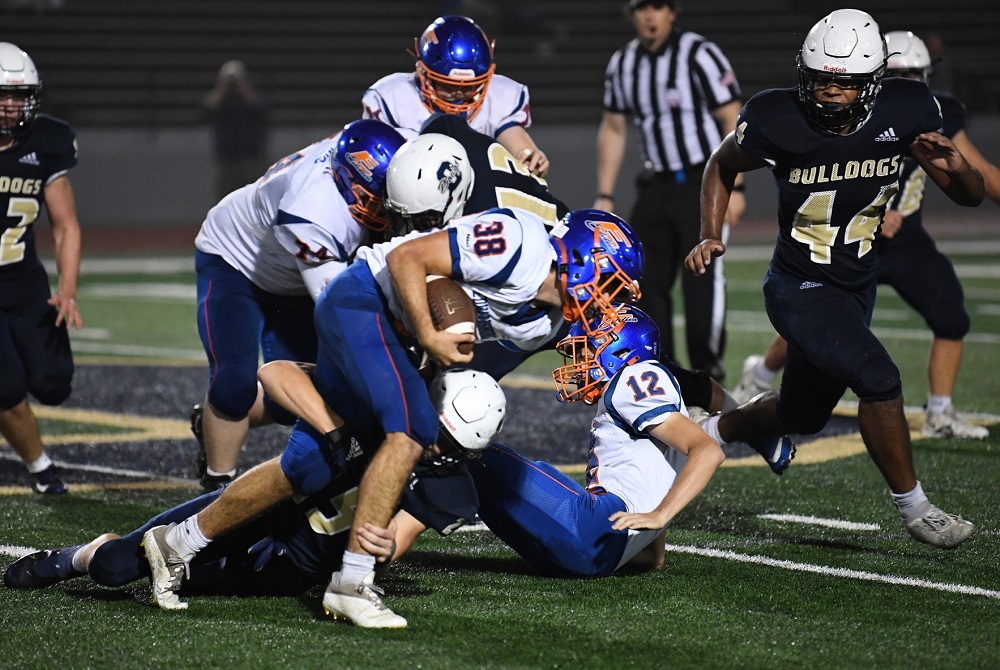
PHOTO Edwardsburg, here on offense against Otsego, brings a 9-0 record into the Division 4 playoffs. (Photo by Gary Shook.)