

Football Teams Mourn, Regroup, Remember
By
Tom Markowski
Special for Second Half
September 2, 2015
CLINTON TOWNSHIP – A rash of deaths of high school football players in Macomb County and elsewhere in the Detroit area has shaken those communities and the football programs within them.
Three football players at Clinton Township Chippewa Valley have died in the past 16 months. This past May, two players from Sterling Heights Stevenson and one from Utica Ford died in a horrific automobile crash at Stoney Creek Metro Park. Another football player at Southfield High drowned in a swimming pool shortly before the start of practice last month.
 One player at Chippewa Valley died of cancer, another died from injuries suffered as the result of an accident that took place in a home and the third died Aug. 5, five days before the first official day of practice, in an all-terrain vehicle crash that took place in the northeast region of the Lower Peninsula.
Chippewa Valley coach Scott Merchant played for coach Al Fracassa at Birmingham Brother Rice and then went on to play at Albion College before becoming a coach. Merchant remains shaken by the tragic events that have befallen his program.
In addition to the deaths of his players, two parents of former players, one only 46 years old, died during this time frame.
“They don’t give out manuals for this,” Merchant said. “It’s taken a lot out of me, personally. I don’t know. I’ve spent so much time away from my family, going to hospitals, going to funeral homes. You’re talking about young people’s lives here.
”I don’t know. I go to church. I believe in God. He has a plan. It’s hard to look a 16- or 17-year-old in their eyes and make sense of it all.”
Coaches coach, but there is so much more they are asked to do. They are expected to be mentors. They are often expected to be father figures. Sometimes they act as counselors, even if it isn’t in their job description. Perhaps most importantly they are leaders. They instruct their coaches and give them responsibilities. Players follow their directives and look to them for guidance.
On top of this, coaches are expected to be successful on the field. And a vast majority accept these responsibilities and a modest financial reward with a smile.
But when one of their players dies while still in high school, coaches must also remain emotionally strong for those who are too young to comprehend the finality.
Words of encouragement and a strong embrace can go a long way in times of trouble.
“We tell them, we’re here for you,” Merchant said. “We love you. We’re all hurting. We tell them there are two options. You can quit and be miserable. Or you can get off the ground and keep their memory alive.”
Nick Ureel was a senior at Chippewa Valley when he died of cancer in April 2014. Ureel played football his first two years but the cancer, which began in his testicles, prevented him from playing his junior and senior years.
Alex Mackmin was 16 years old when he died this May. He played on the junior varsity as a sophomore last season.
Merchant held workouts on Aug. 3 and 4 before letting his players go and enjoy the final few days before the start of practice Aug. 10. Duncan Blair, a senior who would compete for a starting position at linebacker, travelled north on vacation. He died while riding a four-wheel off-road vehicle that struck a tree.
 Coincidentally the Mackmin and Blair families attended the same church in Utica. Both funerals were held at that church.
Blair’s parents rode the fan bus to Wayne State University for Chippewa Valley’s opener against Lake Orion. Rhys Blair runs the concession stand at Chippewa Valley.
The circumstances were much different for the players who died in the crash in early May in northern Macomb County – but it was no less tragic.
Jonathan Manolios and Emanuel Malaj from Stevenson and Michael Wells from Utica Ford were killed in a car crash. All three played varsity football as juniors in 2014. Two other high school students were injured in the crash and both survived. All five were 17 years old at the time of the crash.
Last season was Kevin Frederick’s first as head coach at Stevenson. He was the former head coach at Whittemore-Prescott.
Frederick had never dealt with anything like this before.
“It was devastating,” he said. “We had a meeting with the kids at school and discussed why it happened. There were grief counselors available. I did meet with some of the parents. Some reached out and said their son wasn’t handling it well.
“We warned our kids not to go on social media after. People forget (the students) were very young. There were some very unkind things said on social media. Alcohol was involved. Their mistake cost them their lives. We tell them to think before you get into a car. Think before you take a drink.
“Scott’s circumstances were different. Kids act in a way … it costs them dearly. Some walk away and grow. This time they didn’t walk away.”
Chippewa Valley and Stevenson are members of the Macomb Area Conference Red, and the teams will play Sept. 11 at Stevenson. Both coaches say they will do something to remember those who died.
Chippewa Valley opens its home season a week later against Warren Cousino. Merchant said his players will wear black jerseys instead of their traditional red to remember those who died.
“Football isn’t an escape,” Merchant said. “It’s a distraction. It takes your mind off of it, but it really doesn’t. We have pictures of all three (students) in our locker room. They are there to remind us.”
 Tom Markowski is a columnist and directs website coverage for the State Champs! Sports Network. He previously covered primarily high school sports for the The Detroit News from 1984-2014, focusing on the Detroit area but also contributing to statewide coverage of football and basketball. Contact him at [email protected] with story ideas for Oakland, Macomb and Wayne counties.
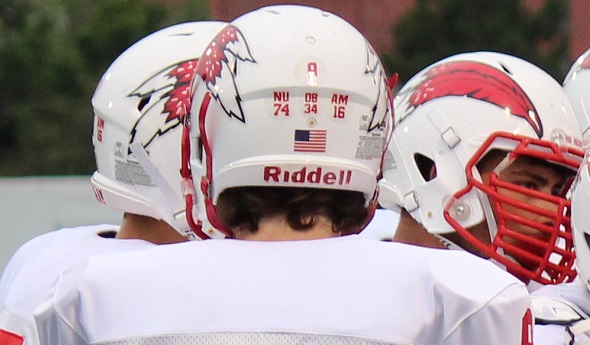
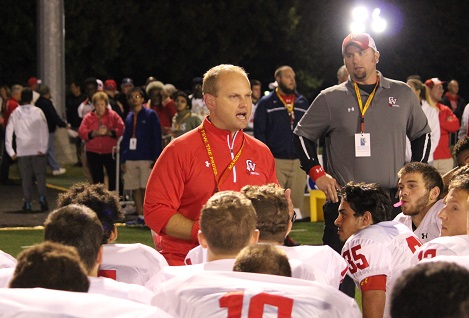
PHOTOS: (Top) Chippewa Valley players are wearing the numbers of three deceased teammates on the backs of their helmets this season. (Middle) Coach Scott Merchant addresses his players after last week's win against Lake Orion at Wayne State University.
Drive for Detroit: Week 9 in Review
October 29, 2013
By Geoff Kimmerly
Second Half editor
Three months ago, more than 600 MHSAA football teams began this season with expectations. During the last nine weeks, many were realized.
So before diving full on into the playoffs, let’s take a few minutes to review the last of those regular-season feats.
Here’s a look at the Week 9 edition of our most significant results from every corner of Michigan:
Greater Detroit and Southeast
Detroit Cass Tech 20, Detroit Martin Luther King 14
Revenge belongs to Cass Tech, which fell to King in last season’s Detroit Public School League semifinals but handed the Crusaders (7-1) their first loss in this fall’s championship game. As expected, this turned into the closest either has played since the early weeks of this season. And it likely served as final preparation as both now pursue MHSAA championships and a PSL first – Cass Tech (9-0) is in Division 1 and King Division 2 for the playoffs, and there have never been multiple PSL MHSAA champs in the same season. Click to read more from the Detroit Free Press.
Also noted:
Clarkston 20, Southfield 10: Clarkston (8-1) won this clash of Oakland Activities Association champions and looks like an MHSAA Division 1 contender; Southfield (7-2) also looks good to make a Division 2 run.
Birmingham Brother Rice 20, Detroit Catholic Central 7: Both losses for DCC (7-2) this fall have come to Brother Rice (9-0) – this one in the Catholic League Central Prep Bowl.
Detroit U-D Jesuit 20, Birmingham Seaholm 17: The Cubs (5-4) broke a three-game losing streak to finish with a winning regular-season record for the first time since 2002 and earn their first playoff berth since 2001 – and did so by handing the first loss this season to OOA Blue champion Seaholm (8-1).
Northville 38, Walled Lake Western 31 (OT): Northville (8-1) has won 21 of its last 22 Kensington Lakes Activities Association games, but this overall KLAA championship game win caps what could be the team’s most impressive recent run. Western (8-1) could see the Mustangs again if both win their playoff openers.
Thumb and Bay
Lapeer West 14, Fenton 13
The final Lapeer West (7-2) football team claimed a share of the Flint Metro League title thanks to this win that included a blocked extra point. West, which will combine with Lapeer East next summer, ended Fenton’s 19-game league winning streak, although the Tigers (8-1) did also earn a share of the league title. Click to read more from the Flint Journal.
Also noted:
Clare 24, Sanford Meridian 13: Clare (7-2) started slowly with two losses this fall, but that didn’t change much in the Jack Pine Conference as the Pioneers ran their league winning streak to 26 and league title streak to seven straight; Sanford Meridian (7-2) is another of three teams from the conference that made the playoffs.
Montrose 37, Lake Fenton 0: Make that 20 straight Genesee Area Conference Red wins for Montrose (9-0) which claimed the title again by beating second-place Lake Fenton (7-2).
New Lothrop 47, Pewamo-Westphalia 33: The GAC Blue switched up its scheduling format this fall specifically so teams could face some tough nonleague opponents – and New Lothrop (9-0) took advantage of the opportunity and dealt P-W (8-1) its first loss.
Flint Carman-Ainsworth 42, Davison 0: After finishing second in the Saginaw Valley Association South last season, Carman-Ainsworth (8-1) moved up to first this fall thanks to this win over second-place Davison (4-5).
West Michigan
Muskegon 20, Muskegon Reeths-Puffer 7
These teams were tied for first in the O-K Black entering this matchup, and this was the closest game between the two since 2005 – although Muskegon ran its winning streak over Reeths-Puffer to 10 straight and will see the Rockets (7-2) again in this weekend’s Division 2 District opener. The victory clinched for the Big Reds (8-1) their first league title since 2008. Click to read more from the Muskegon Chronicle.
Also noted:
Grand Rapids West Catholic 21, Ada Forest Hills Eastern 20: The reigning MHSAA Division 5 runner-up Falcons (5-4) were able to earn a share of the O-K Bronze title and a playoff berth with this one-point edging of Forest Hills Eastern (4-5).
Grand Rapids Catholic Central 36, Grand Rapids Ottawa Hills 6: Both entered 5-3, with GRCC getting the necessary sixth win to make the playoffs and Ottawa Hills finishing 5-4 and missing out on an at-large bid.
Saugatuck 58, Gobles 13: The Indians (8-1) claimed the Southwestern Athletic Conference North title outright and made the playoffs for the fifth time in six seasons; Gobles (5-4) fell just short of its third straight postseason appearance.
Spring Lake 27, Shelby 0: The Lakers (8-1) followed up winning the Lakes 8 Conference title by handing the lone loss this fall to West Michigan Conference champion Shelby (8-1).
Southwest and Border
Watervliet 54, Lawton 20
The tie-breaker goes to Watervliet after these teams split the SAC South title last season. This is the fifth straight year that one of these two won the league championship. The Panthers are a combined 25-2 over the last three regular seasons, with this their first perfect run since 1999. Click to read more from the Kalamazoo Gazette.
Also noted:
Edwardsburg 56, Paw Paw 48: In arguably the best matchup in the state this week that didn't decide a league champion, the Eddies (9-0), winners of the Wolverine B West, handed the first loss to Wolverine B East champ Paw Paw (8-1)
Battle Creek St. Philip 54, Lawrence 50: These might be two of the top four 8-player teams in the state, and St. Philip (9-0) would host Lawrence (6-2) next week if both win their playoff openers.
Coldwater 54, Marshall 27: Not only did Coldwater gain toward its first playoff berth ever, but the Cardinals (5-4) also guaranteed their first winning regular season since 1989.
Hillsdale 42, Dundee 7: Hillsdale, Hudson and Ida all split the title in the competitive Lenawee County Activities Association, but this win also earned the Hornets (6-3) a spot in the playoffs while likely keeping the Vikings (5-4) out.
Lower Up North
Grayling 51, Boyne City 13
For the second straight season these Lake Michigan Conference rivals came into their Week 9 matchup undefeated, and for the second straight season Grayling came away a big winner and league champ. In fact, the Vikings are 33-3 over their last four regular seasons. Click to read more from the Traverse City Record-Eagle.
Also noted:
Lincoln Alcona 50, Mio 12: Alcona (9-0) won big in this matchup of champions from the North Star League, although Mio (7-2) also will continue on to the playoffs –
for the 13th straight season.
Cadillac 14, Traverse City Central 7: The Vikings (9-0) clinched the Big North Conference title outright and finished perfect for the regular season for the first time since 2000, while keeping Traverse City Central (5-4) from gaining a playoff berth.
Elk Rapids 13, Kalkaska 12: The Elks (6-3) squeezed back into the playoffs for the first time since 2010, and Kalkaska (6-3) will continue as well for the second straight season.
Ogemaw Heights 13, Petoskey 12: One point got Ogemaw Heights (6-3) into the playoffs and kept Petoskey (5-4) out.
Upper Peninsula
Menominee 51, Marquette 7
Menominee secured its fifth straight season with at least nine wins and first perfect regular season since its last MHSAA title-winning fall in 2007. The Maroons scored 51 straight points on Marquette, which also made the playoffs at 5-3 but had to settle for a tie for second place in the Greater Northern UP Conference behind the Maroons (9-0). Click to read more from the Marquette Mining Journal.
Also noted:
Houghton 26, Hancock 22: The Gremlins (6-3) pushed past their rivals from across the Portage River to earn a playoff bid and win the Copper Bowl; Hancock finished 3-6 for the third straight season.
Kingsford 28, Escanaba 21: Kingsford (7-2) beat its traditional Week 9 opponent Eskymos (3-6) for the 14th straight season.
Munising 17, L'Anse 10: Munising (6-3) got back into the playoffs after missing last season, and impressively with a win over a L’Anse (7-2) team that hadn’t lost since Week 2.
Powers North Central 27, Stephenson 22: The Jets (7-2) ended a four-year losing streak to Stephenson (4-5), and in doing so kept the Eagles out of the playoffs.
Mid-Michigan
Holt 45, Grand Ledge 30
Holt’s playoff hopes took a big hit with a 13-point loss to Jackson in Week 8, but the Rams (5-4) rebounded against the rival Comets (4-5) in a must-win game for both. Holt did get in – after Grand Ledge’s Week 9 win kept the Rams out in 2012 – and also ended up in second place in the Capital Area Activities Conference Blue. Click to read more from the Lansing State Journal.
Also noted:
Grass Lake 17, Homer 14: Grass Lake (8-1) looks playoff-ready emerging from a strong Cascades Conference and then beating Homer (8-1) in the showcase game of the crossover series with the Big 8.
Eaton Rapids 41, Owosso 21: The Greyhounds (5-3) finished with their first winning regular season since 1993 – and thanks in part to beating Owosso (1-8), earned their first playoff berth as well.
Jackson Lumen Christi 42, Howell 35: After a Week 9 loss to Howell kept Lumen Christi (9-0) from an undefeated regular season in 2012, the Titans held off the Highlanders (5-4) in a game Howell needed to win to make the playoffs.
Ionia 20, Lake Odessa Lakewood 13: The Bulldogs (7-2) are back in the playoffs for the first time since 2006 and finished off the regular season by edging the rival Vikings (0-9).
Trophy Games
Each week the MHSAA highlights trophy games from around the state. Here are two in addition to the Copper Bowl mentioned above:
Little Brown Jug: Newberry vs. Sault Ste. Marie. This is the longest-running of the Little Brown Jug games in Michigan. Final: Sault Ste. Marie 41, Newberry 6.
Firefighter's Trumpet: Bay City Western vs. Bay City Central. The trophy for this matchup was created in 1990 but disappeared after the 2003 game until this fall. Final: Central 43, Western 20.
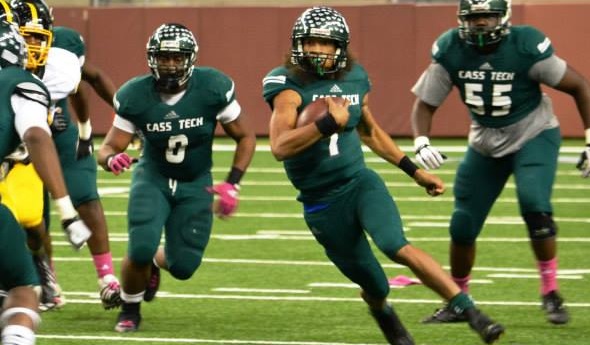
PHOTO: Detroit Cass Tech quarterback Jayru Campbell eludes the Detroit Martin Luther King defense during the PSL championship game. (Photo courtesy of the Detroit Public School League.)