

Football Teams Mourn, Regroup, Remember
By
Tom Markowski
Special for Second Half
September 2, 2015
CLINTON TOWNSHIP – A rash of deaths of high school football players in Macomb County and elsewhere in the Detroit area has shaken those communities and the football programs within them.
Three football players at Clinton Township Chippewa Valley have died in the past 16 months. This past May, two players from Sterling Heights Stevenson and one from Utica Ford died in a horrific automobile crash at Stoney Creek Metro Park. Another football player at Southfield High drowned in a swimming pool shortly before the start of practice last month.
 One player at Chippewa Valley died of cancer, another died from injuries suffered as the result of an accident that took place in a home and the third died Aug. 5, five days before the first official day of practice, in an all-terrain vehicle crash that took place in the northeast region of the Lower Peninsula.
Chippewa Valley coach Scott Merchant played for coach Al Fracassa at Birmingham Brother Rice and then went on to play at Albion College before becoming a coach. Merchant remains shaken by the tragic events that have befallen his program.
In addition to the deaths of his players, two parents of former players, one only 46 years old, died during this time frame.
“They don’t give out manuals for this,” Merchant said. “It’s taken a lot out of me, personally. I don’t know. I’ve spent so much time away from my family, going to hospitals, going to funeral homes. You’re talking about young people’s lives here.
”I don’t know. I go to church. I believe in God. He has a plan. It’s hard to look a 16- or 17-year-old in their eyes and make sense of it all.”
Coaches coach, but there is so much more they are asked to do. They are expected to be mentors. They are often expected to be father figures. Sometimes they act as counselors, even if it isn’t in their job description. Perhaps most importantly they are leaders. They instruct their coaches and give them responsibilities. Players follow their directives and look to them for guidance.
On top of this, coaches are expected to be successful on the field. And a vast majority accept these responsibilities and a modest financial reward with a smile.
But when one of their players dies while still in high school, coaches must also remain emotionally strong for those who are too young to comprehend the finality.
Words of encouragement and a strong embrace can go a long way in times of trouble.
“We tell them, we’re here for you,” Merchant said. “We love you. We’re all hurting. We tell them there are two options. You can quit and be miserable. Or you can get off the ground and keep their memory alive.”
Nick Ureel was a senior at Chippewa Valley when he died of cancer in April 2014. Ureel played football his first two years but the cancer, which began in his testicles, prevented him from playing his junior and senior years.
Alex Mackmin was 16 years old when he died this May. He played on the junior varsity as a sophomore last season.
Merchant held workouts on Aug. 3 and 4 before letting his players go and enjoy the final few days before the start of practice Aug. 10. Duncan Blair, a senior who would compete for a starting position at linebacker, travelled north on vacation. He died while riding a four-wheel off-road vehicle that struck a tree.
 Coincidentally the Mackmin and Blair families attended the same church in Utica. Both funerals were held at that church.
Blair’s parents rode the fan bus to Wayne State University for Chippewa Valley’s opener against Lake Orion. Rhys Blair runs the concession stand at Chippewa Valley.
The circumstances were much different for the players who died in the crash in early May in northern Macomb County – but it was no less tragic.
Jonathan Manolios and Emanuel Malaj from Stevenson and Michael Wells from Utica Ford were killed in a car crash. All three played varsity football as juniors in 2014. Two other high school students were injured in the crash and both survived. All five were 17 years old at the time of the crash.
Last season was Kevin Frederick’s first as head coach at Stevenson. He was the former head coach at Whittemore-Prescott.
Frederick had never dealt with anything like this before.
“It was devastating,” he said. “We had a meeting with the kids at school and discussed why it happened. There were grief counselors available. I did meet with some of the parents. Some reached out and said their son wasn’t handling it well.
“We warned our kids not to go on social media after. People forget (the students) were very young. There were some very unkind things said on social media. Alcohol was involved. Their mistake cost them their lives. We tell them to think before you get into a car. Think before you take a drink.
“Scott’s circumstances were different. Kids act in a way … it costs them dearly. Some walk away and grow. This time they didn’t walk away.”
Chippewa Valley and Stevenson are members of the Macomb Area Conference Red, and the teams will play Sept. 11 at Stevenson. Both coaches say they will do something to remember those who died.
Chippewa Valley opens its home season a week later against Warren Cousino. Merchant said his players will wear black jerseys instead of their traditional red to remember those who died.
“Football isn’t an escape,” Merchant said. “It’s a distraction. It takes your mind off of it, but it really doesn’t. We have pictures of all three (students) in our locker room. They are there to remind us.”
 Tom Markowski is a columnist and directs website coverage for the State Champs! Sports Network. He previously covered primarily high school sports for the The Detroit News from 1984-2014, focusing on the Detroit area but also contributing to statewide coverage of football and basketball. Contact him at [email protected] with story ideas for Oakland, Macomb and Wayne counties.
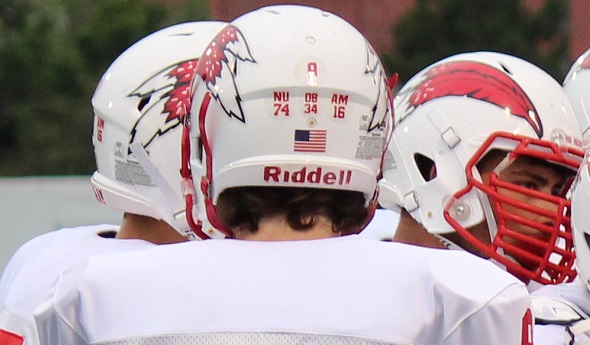
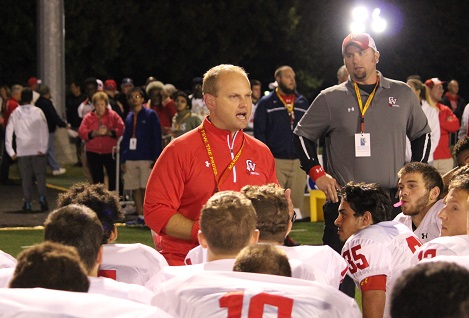
PHOTOS: (Top) Chippewa Valley players are wearing the numbers of three deceased teammates on the backs of their helmets this season. (Middle) Coach Scott Merchant addresses his players after last week's win against Lake Orion at Wayne State University.
A Game for Every Fan - District Openers
October 25, 2012
By Geoff Kimmerly
Second Half editor
What started as more than 600 MHSAA football teams is down to a mere 272.
And eight are no doubt enjoying a whirlwind this week they've never experienced before.
Detroit Consortium, Detroit East English, Grand Rapids Northview, Mayville, Saginaw Valley Lutheran, South Lyon East, Swartz Creek and Walled Lake Northern will make their first playoff appearances this weekend. Only East English can claim to know what that's like, with the first-year school made up mostly of students who formerly attended now-closed Detroit Crockett and Finney.
In case you're wondering, that leaves 30 schools that have never made the MHSAA playoffs. But this week is about those still alive -- and 136 games that will be played all over the state.
See below for a few of the most intriguing matchups from each division. Visit the MHSAA Score Center all weekend for updated scores and standings, and if you're not attending a game tonight, make sure to check in at FoxSportsDetroit.com for one of four live-streamed contests: Lapeer West at DeWitt, Farmington Hills Harrison at Fenton, Leslie at Portland and Howell at Walled Lake Northern.
Division 1
Detroit Catholic Central (5-4) at Hartland (8-1)
To no one’s surprise, reigning MHSAA runner-up Detroit Catholic Central made the playoffs at 5-4, thanks to its tough schedule and high playoff point average. The Shamrocks have reached the postseason 16 of the last 18 seasons. Hartland is back for the third time in five – and coming off a league title, can also tie its school record for wins set in 2008.
Others that caught my eye: Grand Ledge (7-2) at Holland West Ottawa (7-2), Livonia Stevenson (6-3) at Livonia Churchill (9-0), Canton (6-3) at Plymouth (7-2), Dearborn (6-3) at Dearborn Fordson (7-2).
Division 2
Birmingham Brother Rice (7-2) at Port Huron (7-2)
The reigning MHSAA runner-up in this division, Brother Rice didn’t make last week’s Catholic League Prep Bowl but has been considered among the state’s handful of elite teams since the first week of practice. Port Huron hasn’t gotten nearly the same hype, but won two playoff games last season and is led by quarterback Mark Chapman – who has committed to sign with Central Michigan this winter.
Others that caught my eye: Wyandotte Roosevelt (8-1) at Brownstown Woodhaven (8-1), Detroit Martin Luther King (6-3) at Southfield (6-3), Portage Central (6-3) at Portage Northern (7-2), Grand Rapids Northview (7-2) at Lowell (7-2).
Division 3
Zeeland West (6-3) at Zeeland East (9-0)
It’s hard to believe it’s been two months since these two squared off for what ended up a 60-52 East win. The Chix have continued to rise, and now look like the favorite in Division 3 after downing Muskegon by a point last week. But West – last season’s Division 4 champion – knows a few things about winning in the playoffs, and would love nothing better than to end its rival’s season abruptly.
Others that caught my eye: Carleton Airport (6-3) at Milan (9-0), Marysville (6-3) at Detroit East English (7-2), Charlotte (6-3) at Battle Creek Harper Creek (7-2), Fruitport (8-1) at Grand Rapids Christian (8-1).
Division 4
Williamston (6-3) at Marshall (6-3), Saturday
It hasn’t been long enough for Williamston supporters to forget the 2009 District Final between these two, a 27-26 Marshall win after which the Redhawks went on to win the Division 4 championship. The Hornets advanced to the Final the next season before falling by four to Grand Rapids Catholic Central. Both won to set up this week’s opportunity – the Redhawks their last two games and Williamston its last three.
Others that caught my eye: Otsego (6-3) at Dowagiac (9-0), Comstock Park (8-1) at Allendale (8-1), Saginaw Valley Lutheran (6-3) at Saginaw Swan Valley (7-2), Richmond (6-3) at Marine City (8-1).
Division 5
Leslie (8-1) at Portland (8-1)
Both have become staples of the postseason – Leslie is in the playoffs for the ninth time in 13 seasons and Portland for the 10th straight. The difference for the Blackhawks is those previous appearances, including a run to Ford Field in 2008, came in Division 6. Portland is arguably more used to this level of competition – and has wins over Division 3 playoff teams Owosso, DeWitt and Charlotte this fall.
Others that caught my eye: Lake Fenton (7-2) at Jackson Lumen Christi (8-1), Buchanan (7-2) at Muskegon Oakridge (9-0), Grand Rapids West Catholic (6-3) at Hopkins (9-0), Carrollton (8-1) at Frankenmuth (9-0).
Division 6
Detroit Consortium (6-3) at Madison Heights Madison (8-1)
In its fourth season, Consortium earned its first winning record and first playoff berth. The Cougars earned the opportunity to face Madison, a playoff veteran with eight straight appearances and four straight seasons with at least eight wins. The Eagles built their record against a number of much larger schools, with their only loss by three to Warren Fitzgerald way back on Aug. 31.
Others that caught my eye: Maple City Glen Lake (8-1) at Boyne City (8-1), Montague (8-1) at Hemlock (8-1), Constantine (7-2) at Watervliet (8-1), Michigan Center (8-1) at Grass Lake (8-1).
Division 7
Royal Oak Shrine (5-4) vs. Detroit Loyola (9-0), Saturday at U-D Jesuit
It’s easy to predict Loyola will finish this season with a championship after advancing to the Regional round in 2011 and running all over everyone but Catholic League rival Waterford Our Lady this fall (the Bulldogs beat the Lakers by only 10). Shrine lost to Loyola 51-20 just two weeks ago – but the Knights closed with a shutout of playoff qualifier Grosse Pointe Woods University Liggett and could make this rematch much closer.
Others that caught my eye: Union City (6-3) at Pewamo-Westphalia (6-3), Bridgman (6-3) at Lawton (8-1), Dansville (7-2) at Ottawa Lake Whiteford (8-1), Flint Hamady (6-3) at Burton Bendle (7-2).
Division 8
St. Joseph Lake Michigan Catholic (7-1) at Climax-Scotts (9-0)
A win would give Climax-Scotts its fourth straight 10-win season and ninth over the last decade – and only Bellevue got within 20 points of the Panthers during the regular season. But Lake Michigan Catholic quietly has made the playoffs three straight years, and actually has eight wins this fall – it beat rival Michigan Lutheran in an 8-player game that did not count toward its 11-player playoff point average.
Others that caught my eye: Bessemer (6-2) at Felch North Dickinson (8-0), Pittsford (7-2) at Waterford Our Lady (7-2), Stephenson (7-2) at Pickford (7-2), Crystal Falls Forest Park (7-2) at L’Anse (7-2).
8-player
Akron-Fairgrove (7-2) at Owendale-Gagetown (7-2)
These two have been rivals going back to nearly their beginnings on the football field and long before they became 8-player programs in 2009. Both play in the Mid-Michigan 8-Man League, and this is the third time they’ll play each other this season. And there’s some intrigue in that – Owendale-Gagetown won the first game, but Akron-Fairgrove won the second, which counted toward the league standings and eventually gave the Vikings the championship.
Others that caught my eye: Waldron (6-3) at Battle Creek St. Philip (6-3), Eben Junction Superior Central (6-2) at Rapid River (7-2).
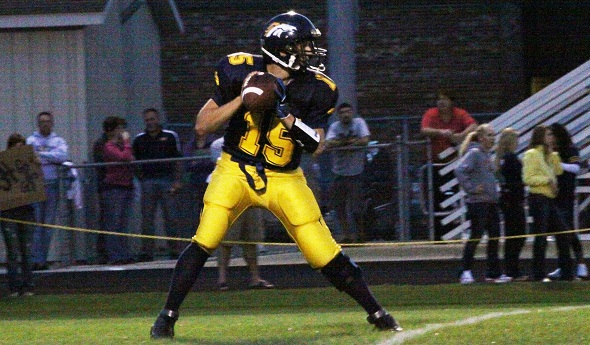
PHOTO: Saginaw Valley Lutheran quarterback Logan Gatza drops back to pass against Ithaca on Sept. 7. (Click to see more from HighSchoolSportsScene.com)