


Football’s Future
March 20, 2012
Many folks, including me, will too often focus on the destination more than the trip. More on results than process. The end more than the means.
This is epidemic in sports, on all levels. There’s so much focus on the postseason that it overshadows the regular season.
In contrast, in educational athletics, we are supposed to hold to the principle that opportunities for teaching and learning are as plentiful, maybe more so, in regular season as in tournaments, at subvarsity levels as at varsity, during practices as during games.
This disease affects football as much as any high school sport. There’s been too much focus on the end of the season – playoffs. Postseason tournaments have been the demise of many great Thanksgiving Day high school football classics across the country. Playoffs continue to ruin rivalries and collapse conferences nationwide.
And, disturbingly, the focus on the end of the season misses what is most wrong with football, and may be most threatening to its future. It’s practice. Specifically, what’s allowed during preseason practice and then at practice throughout the season.
We can predict that, in high school football’s future, two-a-day practices will be fewer, practice hours will be shorter and activities will be different. Among proposals we will be presented (and should seriously consider) will be:
If this all sounds silly or radical, remember that the NCAA and NFL are already making such changes. NFL players face contact in practice on only 14 days during a 17-week regular season. Meanwhile, many high school coaches have kids knocking heads and bruising bodies two to four days a week, all season long. Giving critics the impression that interscholastic football for teens is more brutal than the higher levels of football for grown men. Inviting interference from people who think they know better.
Actually, we know better; and we need to do better. Soon.
Remington's 'All-State' Remains in Play
By
Ron Pesch
MHSAA historian
October 28, 2016
Unfortunately, or perhaps fittingly, Richard E. Remington’s time on earth ended during football season.
Age 69 at the time of his passing, Remington was well-known as one of Michigan’s best football referees, at both the high school and college level. But for tens of thousands of high school football fans, players and parents, he was once best-known as the father of the Michigan All-State football team.
 Now some might argue that there were others before. Indeed, “all-state” or “all-scholastic” teams go back nearly to the start of prep football in Michigan. From the beginning, fans have wanted to identify the state’s and the nation’s most talented athletes.
However, most of those selections were made by a local newspaper writer, or perhaps a high school coach. Usually, they were built around the finest players seen among opponents, and featured a more-than-healthy dose of local athletes. Coach “Bull” Green of Saginaw High named four from Saginaw and one from Saginaw Arthur Hill among his 1907 All-State eleven. In 1912, William H. Stocking, coach of Detroit Central, named an 11-member “all-scholastic” team that included four ballplayers from his own Detroit Central squad. Across the state that same year, Louis Gudelsky, coach of Muskegon’s high-scoring team, included four MHS players among his All-State selections.
Remington began officiating high school games before graduation from the University of Michigan in 1910. Born in Auburn, N.Y., he was educated as a civil engineer. But it was his interest in high school athletics that led him to a career in education. In 1912 and 1913, he guided Orchard Lake St. Mary’s through its first two seasons of football. Next came work at Detroit Eastern (now Detroit Martin Luther King), where he served as an assistant coach in multiple sports in 1914 before taking over as head coach of the school’s football and baseball teams in 1915. With the opening of Detroit Northeastern in 1917, Remington again changed schools when he was named director of athletics for the Green and Brown.
By then, he was recognized as one of the state’s finest officials. Of the opinion that “schoolboy athletes didn’t receive sufficient recognition,” Remington picked his first All-State squad in 1917 for the Detroit News, adding a paragraph on each describing his assessment of the athlete. Who better than an impartial judge – a referee – to select an all-state squad?
 Remington’s article announcing his picks included his summation on the top team he had seen on the year, (in this case, Scott High of Toledo, Ohio) and his first-team selections, including player weights. While no second team was named, he did include a brief “honorable mention” list, noting “no team is stronger than its substitutes.”
He also admitted the possible shortfall of his choices.
“I have refereed behind the majority of the larger teams, and if there is some one man in a smaller team deserving of especial mention whom I have left off, I am indeed sorry. I base my conclusions on what I have seen right on the field, close to the boys, and at that angle one has a little better view point than from the stands or coaches benches.”
Discussing the team named by Remington, C.D. McNamee, editor and publisher of the Muskegon Chronicle, wrote, “The selections of the Detroit tutor are by far the best of any made this fall by various writers and officials.”
Despite an influenza pandemic sweeping the nation in 1918 that affected the number of games played, Remington was one of the few to name an All-State squad that fall. This time around, he added a second team, and also called out six other players for special mention.
Remington’s writing was unique, in depth, and captured the public’s attention. His selections included fewer clusters from a single school.
Within the write-up of his 1919 team, again published by the News, he singled out Lansing Central quarterback Don Graham (who had also appeared among his 1918 selections) and called him “the brainiest high school player in Michigan.” As such, Graham was named captain of Remington’s mythical squad.
Those selections did create a stir, at least in one part of the state.
“R.E. Remington, Detroit, who selected the Detroit News “all-state” prep school football team, probably is unaware of the fact that Cloverland – the upper peninsula – is part of Michigan,” stated a column that appeared in the Ironwood Daily Globe. “Mr. Remington knows considerable about the southern half of the state, but his education is bounded by Lakes Michigan and Huron.” The author noted that only six cities were represented on the Detroit official’s first team: Lansing, Kalamazoo, Grand Rapids, Ann Arbor, Detroit and Muskegon.
“‘As a center,’ says Mr. Remington, ‘B. Springsteen (Detroit Northwestern) is without peer in the state.’ Mebbe, but that’s coming strong, unless Remington saw Umnus of Menominee. No all-state quarterback could be selected fairly without consideration of ‘Bud’ Finch of Escanaba.”
Of course, similar sentiments would be repeated often in the years that followed, as fans, coaches and writers felt slighted when a favorite athlete from a school was ignored.
Remington moved away from coaching football, when his employment led him to Detroit Northwestern in the fall of 1919. However, he did coach basketball there until early in 1922.
 “Everyone was sorry to see Richard E. Remington forced to resign as basketball coach,” it was noted in the school yearbook that spring. “Mr. Remington’s ill health lost Northwestern a fine basketball coach. As a coach few surpassed him.”
He did recover from health issues, and would continue to serve as a mathematics instructor at Northwestern. Athletics continued to fill his weekends as he was in constant demand as an official at both the college and prep level.
In 1920, the National Federation of State High School Athletic Associations was formed. The Roaring Twenties saw explosive growth in sports coverage across media, and that became a major reason for men to purchase newspapers. Interscholastic sports and the heroic accomplishments of local “boys” were highlighted in the local newspaper and saved in scrapbooks. Civic pride meant great joy when a local earned recognition in one of the statewide papers.
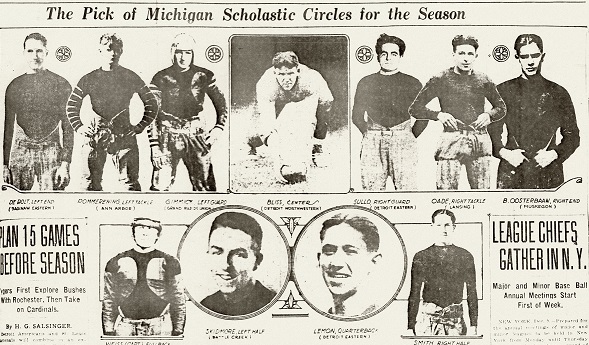
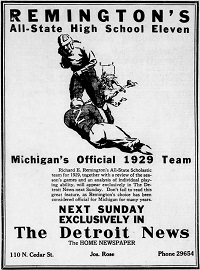
As the circulation and marketing departments recognized the value, advertisements in a variety of newspapers began to highlight the release of Remington’s teams as a reason to pick up a copy of the News from a local newsstand across the state. By 1922, Remington’s prep all-state selections were viewed as the ultimate achievement for a gridiron athlete and took on status as official. Individual photos of each of the first team selections were featured in a near half-page layout in the News that season.
Remington’s 1923 edition added a third team, and his Honorable Mention picks swelled to 31 players across all positions. That same fall, Remington named an “All-Time, All-State High School Team, highlighting players from as far back as 1911. His 22 picks, spread over a first and second team, included 10 from Detroit high schools. Hindsight, as is said, is 20/20, and Remington’s choices were, no doubt, influenced by play at the college level.
But one thing no one could argue – it certainly made for great press.
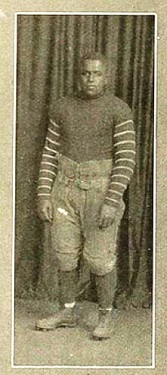 When Michigan State athletic director Ralph H. Young invited Remington and his all-state selections to East Lansing to attend the Spartans’ annual football bust banquet in 1924, the Remington stamp-of-approval only grew in value. Among the athletes selected that year was Russell Becks (Tackle, 5-foot-9, 190 pounds), likely the first African-American to be named first-team all-state in Michigan, although this fact was not mentioned in Remington’s write-up. He now relied on personal observation and, with the aid of some 20 men, had “access files, reports and data on every boy” playing high school football in classes ‘A’ and ‘B’ in Michigan.
Other papers published All-State selections. Since these were the days of mid-September starts to the season and Thanksgiving Day games between prep rivals, All-State teams generally received publication in late November and into December. Remington’s selections traditionally were the last announced.
The Detroit Free Press decided to fight fire with fire, and in 1926 hired George M. Lawton, another well-respected football official, to select its all-state team. One of the greatest punters ever developed at the University of Michigan, Lawton also had served as head coach at the University of Detroit in 1913 and 1914. A year before, Lawton and two other well-respected football officials, J.J. Ritter and Wit Duncan, selected an All-State squad for the Detroit Times, a Michigan tabloid-style newspaper.
In 1927, Lawton’s All-State selections were invited to attend the University of Michigan Club of Detroit’s annual Football Bust at the Statler Hotel in early December.
Edgy design and elaborate layouts announcing the All-State teams were a sight to behold in the Detroit publications in the coming years as the newspapers battled for readers.
“By the early 1930s, high school coaches were torn between the welcome impact and adverse effects of newspaper publicity,” notes Michael Oriard in his book, King Football. “While it helped to boost attendance and gate receipts, the added attention could also negatively affect the impressionable boys who played the game.”
As the battle for recognition raged, high schools across the state engaged Remington’s crew to insure area athletes were seen by the referee.
Remington continued with detailed analysis of his first-team selections, adding players’ heights and ages to his reports. In his write-up on the 1933 team, he noted weekly reports from 112 scouts from around the state had helped him in making selections. In the write-up accompanying his selections that appeared in the Free Press, Lawton thanked numerous football coaches and officials for assisting him with compiling his 1933 team. In both cases, the list of Honorable Mentions continued to expand.
Criticism still rained down.
“Remington names 33 men for his first, second and third teams, and then proceeds to give honorable mention to nearly 200 other high school players,” reported the Ironwood Daily Globe in mid-December of 1936. “The designation ‘all-state team’ is a misnomer, however, for out of all that crew of gridders not one has been selected from a high school north of the Straits of Mackinac.”
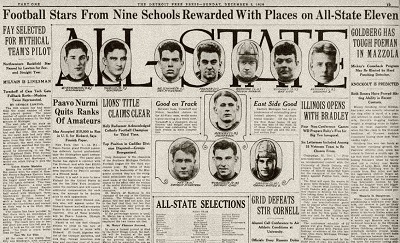 For unexplained reasons, in 1938, Lawton separated from the Free Press. He would die five years later at age 55.
Remington also separated from the News that year without explanation. Both papers continued selecting All-State squads, using in-house writers.
Yet the Remington tradition of selecting teams continued, with the announcement of his picks now occurring exclusively at the MSC football banquet. They were eagerly anticipated. Invitations to the event were sent to prep players across the state. In nearly all cases, “an invitation to a high school boy usually means a selection on at least the honorable mention list.”
“A crowd of 700 grid fans, alumni, students, players and sportswriters from throughout the state including 212 high school players” attended the Saturday, Dec. 10 banquet at the M.S.C. gymnasium. Remington’s selections were carried in a variety of newspapers including, for the first time, the Detroit Free Press.
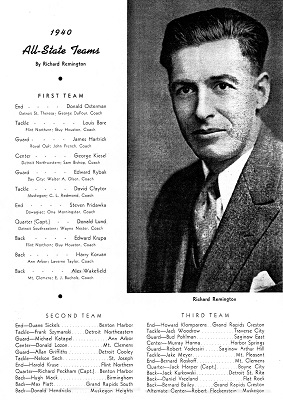
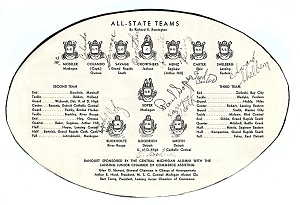
The same arrangement with Michigan State took place in 1939. In 1940, the banquet program included a large photo of Richard Remington, next to his first, second and third-team selections. It would be Remington’s last All-State squad.
In 1941, the annual prep selections presented at the Michigan State banquet were chosen by the Michigan Officials Association.
The change, announced in late November by John H. Kobs of the Association, indicated that 200 ballots were mailed to member officials, and that players would be selected based on the returns.
 Writing in his “Sports Patter” column in the Benton Harbor News-Palladium, sports editor Nort Baser celebrated the change.
“The conductor of this Patter has an idea the new order will be welcomed especially by the boosters of high school football as played in southwestern Michigan. … Since that team released at the Spartan banquet has been looked upon by many as being more or less official, we in this section of the state have always deplored the fact that a Detroit newspaper man should be the sole judge of the state’s talent.”
The void was filled by The Associated Press, who with the help of “a blue ribbon jury of sports editors of Associated Press newspapers, reflecting the opinions of their staffs, and 50 widely known coaches and officials,” selected its first All-State team. Following the formula established by Remington nearly 20 years before, the AP named first, second and third All-State squads, as well as a host of Honorable Mentions for recognition. Ironically, Watson Spoelstra, the AP writer who penned the column that accompanied the 1941 list, would later work as a sportswriter for the News for nearly 40 years.
Remington remained active into the 1940s as a college referee, frequently officiating MSC games. Slowly, his name faded from the sports spotlight. In 1952, AP writer Harry Stapler mentioned his name in his article on the season’s all-state selections:
“This is the 12th annual team picked by the Associated Press. The AP took over the job of picking all-state teams in 1941 when Dick Remington, widely known official and coach, retired from the job of picking what were considered the official all-state teams.”
Remington continued to work as a mathematics instructor at Detroit Northwestern until retirement in 1956. He died a year later, in late October at age 69, survived by his wife Ruth, three sons and two daughters.
His obituary, carried by some papers, did celebrate his contribution to Michigan prep sports. Perhaps more importantly, the die cast years ago by Remington, with slight modification, is still used by the Detroit papers and The Associated Press in honoring prep football’s finest athletes – the ultimate tribute to Remington’s lifetime of work.
 Ron Pesch has taken an active role in researching the history of MHSAA events since 1985 and began writing for MHSAA Finals programs in 1986, adding additional features and "flashbacks" in 1992. He inherited the title of MHSAA historian from the late Dick Kishpaugh following the 1993-94 school year, and resides in Muskegon. Contact him at [email protected] with ideas for historical articles.
PHOTOS: (Top) Richard Remington's 1922 "All-State Team," selected for the Detroit News. (Top middle) A 1929 ad for Remington's team ran in the Lansing State Journal. (Middle) Ann Arbor all-stater Russell Becks. (Middle below) George M. Lawton's 1928 team for the Detroit Free Press. (Below) Remington's "All-State" selections, as shown in the program for Michigan State's 17th annual football banquet. (Photos collected by Ron Pesch.)