


Football’s Future
March 20, 2012
Many folks, including me, will too often focus on the destination more than the trip. More on results than process. The end more than the means.
This is epidemic in sports, on all levels. There’s so much focus on the postseason that it overshadows the regular season.
In contrast, in educational athletics, we are supposed to hold to the principle that opportunities for teaching and learning are as plentiful, maybe more so, in regular season as in tournaments, at subvarsity levels as at varsity, during practices as during games.
This disease affects football as much as any high school sport. There’s been too much focus on the end of the season – playoffs. Postseason tournaments have been the demise of many great Thanksgiving Day high school football classics across the country. Playoffs continue to ruin rivalries and collapse conferences nationwide.
And, disturbingly, the focus on the end of the season misses what is most wrong with football, and may be most threatening to its future. It’s practice. Specifically, what’s allowed during preseason practice and then at practice throughout the season.
We can predict that, in high school football’s future, two-a-day practices will be fewer, practice hours will be shorter and activities will be different. Among proposals we will be presented (and should seriously consider) will be:
If this all sounds silly or radical, remember that the NCAA and NFL are already making such changes. NFL players face contact in practice on only 14 days during a 17-week regular season. Meanwhile, many high school coaches have kids knocking heads and bruising bodies two to four days a week, all season long. Giving critics the impression that interscholastic football for teens is more brutal than the higher levels of football for grown men. Inviting interference from people who think they know better.
Actually, we know better; and we need to do better. Soon.
Drive for Detroit: Week 1 in Review
August 31, 2015
By Geoff Kimmerly
Second Half editor
Another MHSAA football season began this weekend. Where do we begin ...
The two longest active winning streaks in Michigan came to an end. Three Detroit Public School League teams beat opponents that finished 2014 playing at Ford Field. And that's just the start.
See below for five of the most significant results to come from each of eight regions around the state, plus three 8-player games that could mean much as the season unfolds.
Bay & Thumb
Bad Axe 20, Harbor Beach 6
Bad Axe last beat Harbor Beach in 2009 – and then lost the last five season openers to the Pirates by a combined score of 242-0. But the Hatchets made the playoffs last season for the first time since 2001, and now can claim giving Harbor Beach only its second regular-season loss since the start of the 2011 season. Click for more from the Huron Daily Tribune.
Also noted:
Algonac 19, Marine City 18 – The Muskrats had one win a year ago and had dropped 15 straight to Marine City, which finished its typical 10-1 in 2014.
Davison 29, Fenton 26 – The Cardinals opened 1-0 for the first time since 2012 and after falling to Fenton 35-0 only a year ago.
Ortonville-Brandon 11, Goodrich 10 – Zach Clements’ 37-yard field goal with two seconds left avenged last season’s 33-7 opening-night loss to the Martians.
Richmond 20, Marysville 12 – The Blue Devils ran their streak to three straight wins over Marysville, last season’s District Final opponent; this time they were inspired by co-coach John Kocher, who is undergoing treatment for cancer.
Greater Detroit
Macomb Dakota 35, Clarkston 10
Over two weeks, the three longest winning streaks in Michigan football have ended. Ithaca (69) and Ishpeming (33) saw theirs come to a close at last season’s MHSAA Finals, and Clarkston’s 27-game streak was stopped by a Dakota team that nearly broke it last season before it really got rolling when the Wolves won by three on opening night. Running back Kaiser Carleton ran for 207 yards and three touchdowns for the Cougars, who are playing this season for a 15th-straight playoff berth. Click for more from the Macomb Daily.
Also noted:
Detroit Catholic Central 15, Muskegon 12 – Last season’s 4-5 finish became a little more of a distant memory as the Shamrocks edged the reigning Division 3 runner-up.
Detroit Martin Luther King 12, Warren DeLaSalle 10 – The Crusaders opened a season filled with high expectations by beginning to meet them in downing last fall’s Division 2 champion.
Detroit Renaissance 22, Lansing Sexton 14 – The Phoenix earned its first opening-night win since 2008 against the rebuilt but still reigning Division 4 runners-up Big Reds.
Walled Lake Western 42, Lowell 40 – Western’s massive road win came down to the final minutes and made the Red Arrows 0-1 for the first time since 1993.
Mid-Michigan
Pewamo-Westphalia 26, Madison Heights Madison 25 (OT)
These two combined for a 19-6 record, two District titles and a Regional championship a year ago, when Madison opened with an 18-6 win over the Pirates. But this one went to P-W when it chose to go for two points instead of one after an overtime touchdown and standout running back Jared Smith finished the game with a conversion. Click for more from the Ionia Sentinel-Standard.
Also noted:
Jackson Lumen Christi 22, Grand Rapids West Catholic 21 – Two squads met after graduating their stars from a year ago and played to a classic that resulted in the end of West Catholic’s 23-game winning streak.
Charlotte 38, Ionia 35 – Another last-second field goal gave the Orioles revenge for last season’s 28-0 first-game loss to the Bulldogs.
Ithaca 42, Clare 14 – The Yellowjackets started a new winning streak by making it two straight on opening night over the reigning Jack Pine Conference champ.
Beal City 28, Mount Pleasant Sacred Heart 6 – This was much closer than the final score for most of the game, and much closer than 36 and 61-point wins for Beal City over the Irish the last two seasons.
Northern Lower Peninsula
Boyne City 38, Mendon 14
Coming off its first MHSAA Semifinal run since 2001, Boyne City faced the test of replacing a number of top contributors and opening against another small-school program that annually reloads. So far, so good as the Ramblers ran for more than 300 yards and scored 38 of the game’s final 45 points after giving up the game’s first score. Click for more from the Petoskey News.
Also noted:
Big Rapids 17, Cadillac 14 (2 OT) – The Cardinals couldn’t have picked a tougher opponent than Cadillac (20-2 the last two seasons) to begin a bounce-back from its 4-14 finish over the last two years.
Lake City 33, Harrison 32 (OT) – The Trojans enjoyed a dramatic finish coming off their first losing season since 2008 and a 28-0 loss to Harrison in last year’s opener.
Rogers City 14, AuGres-Sims 8 – The Hurons have improved their win total each of the last three seasons and took a nice step toward continuing by avenging last season’s 28-14 loss to the Wolverines.
Gaylord 49, Cheboygan 0 – The Blue Devils finished 5-4 a year ago after going 1-4 over their final five games; consider this another start on their pursuit of a first playoff berth since 2005.
Southwest Corridor
Battle Creek Lakeview 12, Portage Northern 6
The stakes weren’t as high this time after the teams met for a District championship last season – when Lakeview was victorious as well, 21-0. But the Spartans were able to further venge a 28-24 loss to Portage Northern on opening night of 2014, stopping the Huskies as they drove to tie the score midway through the fourth quarter. Click for more from the Battle Creek Enquirer.
Also noted:
Stevensville Lakeshore 34, Battle Creek Central 26 – The result was the same, and the game still close, although not decided in as intriguing a way as Lakeshore’s 2-0 win over Central on a safety a year ago.
Cassopolis 35, Niles Brandywine 8 – They’re in different divisions of the Berrien-Cass-St. Joseph Conference this season, but the Rangers still no doubt enjoyed avenging last season’s 27-26 loss.
Plainwell 32, Three Rivers 21 – It ended a lot closer than last season’s 34-0 Plainwell win, but remained an important victory over another playoff team from a year ago.
South Haven 30, Sturgis 25 – The Rams are 1-0 after opening night for the first time since 2007.
Southeast & Border
Monroe St. Mary Catholic Central 62, Tecumseh 39
The reigning Division 6 champion Falcons opened coach Adam Kipf’s era with a dominating performance reminiscent of predecessor Jack Giarmo’s hard-running teams. SMCC rushed for more than 450 yards to down Tecumseh, a Division 3 playoff qualifier in 2014. Click to read more from the Monroe Evening News.
Also noted:
Jackson 40, Ann Arbor Huron 7 – The Vikings’ equaled last season’s win total with its most points in a game since Week 8 of 2013 and after scoring only 122 total in 2014.
Saline 37, Rockford 24 – Reigning Division 1 runner-up Saline may indeed be the state’s best team, and this only furthered that argument.
Clinton 20, Manchester 19 – The Redskins made it 28 straight regular-season wins by just edging a Manchester team that finished 8-2 a year ago.
Howell 28, Monroe 14 – The Highlanders haven’t made the playoffs since 2012 but got off to the right start avenging last season’s 21-14 loss to Monroe, a playoff team three of the last four years.
Upper Peninsula
Bark River-Harris 14, Crystal Falls Forest Park 13
The Broncos burst back into the Upper Peninsula’s elite going 8-3 last season and making the playoffs for the first time since 2009, but two of those losses were to Forest Park – including 36-12 in the District Final. Any time these days that the Trojans lose short of Ford Field, it sends a little shockwave through the U.P. – and they haven’t started a season 0-1 since 2004, although they finished that season in the Division 8 championship game. Click for more from the Escanaba Daily Press.
Also noted:
Munising 12, Iron River West Iron County 6 – These teams combined to go 21-3 last season, but this round goes to Munising after West Iron beat the Mustangs in the last two openers.
L’Anse 8, Houghton 6 – The Purple Hornets took a step back last season after two straight playoff appearances, but hope a second-straight two-point win over Houghton points them back in the winning direction.
Ishpeming 14, Iron Mountain 7 – This annual opening-night battle returned to its usual level of competitiveness after Ishpeming had shut out the Mountaineers 106-0 over the last three seasons.
Menominee 49, Marinette, Wis. 21 – Chapter 109 of Michigan’s longest interstate rivalry went to the Maroons, who lead the series 52-50-7.
West Michigan
Muskegon Oakridge 45, Muskegon Catholic Central 26
Oakridge is coming off a 10th-straight playoff appearance, so its ending of MCC’s 26-game winning streak doesn’t seem like a complete shocker. But the Eagles still should receive plenty of credit for loading up the nonleague slate like perhaps no team in MHSAA history, with two straight games against reigning champions – MCC won Division 8 a year ago and Detroit Loyola, next week’s opponent, won Division 7. Click for more from the Muskegon Chronicle.
Also noted:
East Grand Rapids 28, Grand Rapids Catholic Central 14 – The Pioneers made it three wins in four seasons in one of the state’s most anticipated openers between previous year’s playoff teams.
Saugatuck 43, Constantine 40 – After just missing the playoffs last season at 5-4, Saugatuck started this fall by edging a powerhouse that hasn’t missed the postseason since 1990.
East Kentwood 35, Farmington Hills Harrison 28 – There’s little better to start the season than an opener between cross-state contenders like this one between teams that went a combined 21-5 last fall, and this result tells plenty of reason why.
Grand Rapids Christian 32, Grand Rapids South Christian 28 – The Eagles survived their closest of a six-game opening night winning streak against the Sailors.
8-player
Kinde-North Huron 54, Carsonville-Port Sanilac 14
Kinde-North Huron fell back to 2-7 last season after two playoff seasons including a run to the MHSAA Semifinals in 2013, and scored only 122 points total in 2014. But this win could be the sign of better times this fall; the Warriors were 1-3 overall against CPS since moving to 8-player, and lost 13-12 to the Tigers a year ago. Click for more from the Huron Daily Tribune.
Also noted:
Rapid River 26, Onaway 12 – Onaway, playing its first game after switching from 11-player, gave the Rockets a rare close regular-season game.
Webberville 40, Dryden 38 – The Spartans scored eight fewer points than against Dryden a year ago, but gave up 48 fewer than in the 2014 86-48 opening-night loss.
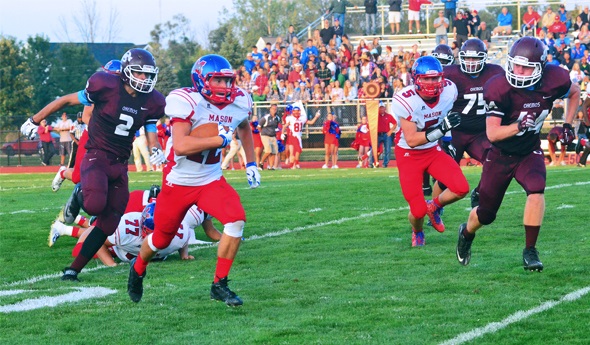
PHOTO: Mason opened with a 56-30 win over Okemos after falling to the rival Chieftains 28-14 a year ago.