


Football’s Future
March 20, 2012
Many folks, including me, will too often focus on the destination more than the trip. More on results than process. The end more than the means.
This is epidemic in sports, on all levels. There’s so much focus on the postseason that it overshadows the regular season.
In contrast, in educational athletics, we are supposed to hold to the principle that opportunities for teaching and learning are as plentiful, maybe more so, in regular season as in tournaments, at subvarsity levels as at varsity, during practices as during games.
This disease affects football as much as any high school sport. There’s been too much focus on the end of the season – playoffs. Postseason tournaments have been the demise of many great Thanksgiving Day high school football classics across the country. Playoffs continue to ruin rivalries and collapse conferences nationwide.
And, disturbingly, the focus on the end of the season misses what is most wrong with football, and may be most threatening to its future. It’s practice. Specifically, what’s allowed during preseason practice and then at practice throughout the season.
We can predict that, in high school football’s future, two-a-day practices will be fewer, practice hours will be shorter and activities will be different. Among proposals we will be presented (and should seriously consider) will be:
If this all sounds silly or radical, remember that the NCAA and NFL are already making such changes. NFL players face contact in practice on only 14 days during a 17-week regular season. Meanwhile, many high school coaches have kids knocking heads and bruising bodies two to four days a week, all season long. Giving critics the impression that interscholastic football for teens is more brutal than the higher levels of football for grown men. Inviting interference from people who think they know better.
Actually, we know better; and we need to do better. Soon.
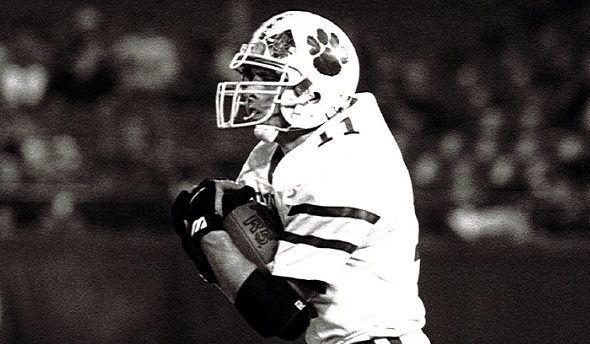
Moment: 100-Yard TD Lifts Pennfield
September 17, 2020
By John Johnson
MHSAA Director of Broadcast Properties
NOTE: This week we begin a series of MHSAA Moments from Football Playoff Finals of years past. Over the coming weeks, we’ll offer video highlights including some of the longest plays and game-deciding moments from 1988 to the present.
In high school football, there are only two plays where you can score a 100-yard touchdown – both by the defense bringing the ball out of the end zone on a turnover.
For Battle Creek Pennfield in the 1991 Class CC Football Playoff Final at the Pontiac Silverdome, such a big defensive play got the Panthers out of the hole in a 14-8 victory over Negaunee.
A bad snap on a Pennfield punt resulted in a safety for a 2-0 Miners lead in the first quarter, and they had driven into the red zone after the ensuing free kick. But on a fourth-down play, the Cereal City contingent came up big.
Negaunee quarterback Ron Logan rolled left and threw to the end zone, where Pennfield linebacker Jason Livengood stepped in front of the intended receiver for the interception. Two yards deep in the end zone, Livengood found an alley and was off to the races for a 100-yard return. (High school statistics rules do not count end zone yardage.)
“I couldn’t believe it,” Livengood told the Battle Creek Enquirer after the game. “All I had to do was fake one guy and then it was open the rest of the way.”
The big play steadied the Panthers after their shaky start.
“It showed us we could do something,” running back Jim Martens told the Enquirer. “We needed a stop and we got more than that. We got six points.”
Still, the Panthers had to come up with a big drive in the third quarter – 67 yards in 17 plays taking 9:58 off the clock, with three fourth-down conversions – to take the lead to stay on Martens’ five-yard scoring run.
Negaunee mounted a drive from its own 37 to the Pennfield 18 during the final two minutes of the game. But after they completed a pass to the 11, the clock ran out on the Miners.