


Football’s Future
March 20, 2012
Many folks, including me, will too often focus on the destination more than the trip. More on results than process. The end more than the means.
This is epidemic in sports, on all levels. There’s so much focus on the postseason that it overshadows the regular season.
In contrast, in educational athletics, we are supposed to hold to the principle that opportunities for teaching and learning are as plentiful, maybe more so, in regular season as in tournaments, at subvarsity levels as at varsity, during practices as during games.
This disease affects football as much as any high school sport. There’s been too much focus on the end of the season – playoffs. Postseason tournaments have been the demise of many great Thanksgiving Day high school football classics across the country. Playoffs continue to ruin rivalries and collapse conferences nationwide.
And, disturbingly, the focus on the end of the season misses what is most wrong with football, and may be most threatening to its future. It’s practice. Specifically, what’s allowed during preseason practice and then at practice throughout the season.
We can predict that, in high school football’s future, two-a-day practices will be fewer, practice hours will be shorter and activities will be different. Among proposals we will be presented (and should seriously consider) will be:
If this all sounds silly or radical, remember that the NCAA and NFL are already making such changes. NFL players face contact in practice on only 14 days during a 17-week regular season. Meanwhile, many high school coaches have kids knocking heads and bruising bodies two to four days a week, all season long. Giving critics the impression that interscholastic football for teens is more brutal than the higher levels of football for grown men. Inviting interference from people who think they know better.
Actually, we know better; and we need to do better. Soon.
March to Marquette: 8-Player Preview
By
Geoff Kimmerly
MHSAA.com senior editor
November 13, 2018
The following statement is both rare and thrilling to announce:
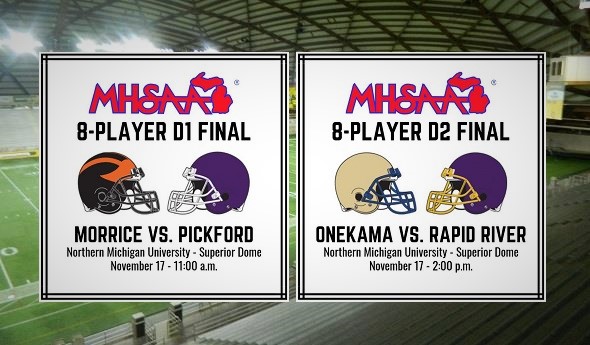
We are guaranteed Saturday to celebrate two first-time MHSAA champions at the 8-Player Football Finals at Northern Michigan University’s Superior Dome.
In fact, three of Saturday’s four finalists will be playing in their first championship game. Both Division 1 contenders – Morrice and Pickford – are making their first trips past the Semifinals. In Division 2, Rapid River is a two-time runner-up and Onekama another first-time finalist.
Kickoff for the Division 1 game is 11 a.m., with the Division 2 game following at 2 p.m. Tickets cost $10 and one is good for admittance to both games. Both games also will be broadcast live on FOXSportsDetroit.com and the FOX Sports app, and replayed on FOX Sports Detroit’s primary channel on Nov. 20 – Division 1 at 8 p.m. and Division 2 at 11 p.m. Audio of both games will be streamed live on MHSAANetwork.com.
Below is a look at all four finalists. Team “rankings” are based on their playoff-point averages heading into the postseason.
 Division 1
MORRICE
Record/rank: 12-0, No. 4
Coach: Kendall Crockett, fifth season (41-14)
League finish: First in North Central Thumb League Red
Championship history: Has never played in an MHSAA Final.
Best wins: 40-8 over No. 5 Colon in Semifinal, 44-14 over No. 2 Wyoming Tri-unity Christian in Regional Final, 34-14 over No. 8 Deckerville, 40-0 over Division 2 No. 5 Mount Pleasant Sacred Heart.
Players to watch: QB Hunter Nowak 5-11/164 sr. (1,922 yards/33 TDs rushing, 529 yards/8 TDs passing), RB/LB Austin Edington 5-9/152, sr. (851 yards/15 TDs rushing, 313 yards/4 TDs receiving; 54 tackles), OG/NG Sam Koresky 5-7/170 sr. (68 tackles, 13 tackles for loss, 10 sacks), FB/LB Connor Lucas, 5-10/180 sr. (91 tackles, 16.5 tackles for loss).
Outlook: Morrice had an often-solid 11-player program before switching to 8-player in 2014, and has since become elite. The Orioles are a combined 21-2 over the last two seasons and have allowed only 62 points this fall over 11 games (one win was a forefeit) – with six straight shutouts from Weeks 5-10. Junior defensive back Shane Cole with seven interceptions leads an opportunistic unit that is enjoying nearly three turnovers per game. Nowak made the all-state team as a junior and will enter the record book with 232 points and counting this fall.
PICKFORD
Record/rank: 12-0, No. 1
Coach: Josh Rader, 16th season (99-53)
League finish: First in Great Lakes Conference East
Championship history: Has never played in an MHSAA Final.
Best wins: 50-20 over No. 3 AuGres-Sims in Semifinal, 48-42 over No. 7 Suttons Bay in Regional Final, 52-7 over Division 2 No. 2 Engadine, 58-12 over Division 2 No. 7 Rapid River.
Players to watch: QB/LB Jimmy Storey, 6-0/180 jr. (1,638 yards/30 TDs passing, 920 yards/18 TDs rushing; 89 tackles, 3 interceptions); RB/DB Stephen LaMothe, 5-9/165 jr. (913 yards/15 TDs rushing; 4 interceptions); RB Matt Bush, 5-10/170 jr. (786 yards/10 TDs rushing; 62 tackles); SE/DE Nick Edington, 6-8/220, jr. (836 yards/16 TDs receiving; 46 tackles).
Outlook: Pickford also has been on the cusp of this opportunity, emerging from a third-straight Semifinal appearance to make the championship game for the first time. The Panthers are a combined 39-7 since switching to 8-player four seasons ago, and the dominance should continue as only two of this year’s players are seniors (although both start). Storey guides an offense averaging 54 points per game that hasn’t slowed in the playoffs with 51, 48 and 50 in its three postseason wins. Juniors Isaiah May (96 tackles) and Sam Burton (67 tackles/12 sacks) are two more impact players.
 Division 2
ONEKAMA
Record/rank: 10-2, No. 4
Coach: John Neph, second season (19-4)
League finish: Third in Midwest Central Michigan Conference West
Championship history: Has never played in an MHSAA Final.
Best wins: 28-14 over No. 10 Portland St. Patrick in Semifinal, 52-0 over No. 8 Brethren in Regional Final, 22-6 (Pre-Regional) and 30-0 over No. 12 Marion.
Players to watch: HB/LB Ben Acton, 6-2/175 sr. (726 yards/7 TDs rushing, 241 yards/2 TDs receiving); QB/DB Luke Mauntler (5-8/145) jr. (659 yards/9 TDs passing, 433 yards/6 TDs rushing); HB/LB Aaron Powers, 6-0/175 jr. (625 yards/11 TDs rushing); WR/DB Ben Johnson, 6-0/150, sr. (6 interceptions).
Outlook: The Portagers navigated a tough league finishing behind two Division 1 playoff teams and just ahead of reigning Division 1 champion Central Lake before opening up their longest postseason run ever. Onekama is another 8-player success story at 19-4 over the last two seasons after a solid recent run in 11-player as well. The numbers above might seem modest, but the team played only 10 games on the field as two wins came by forfeit. Not modest is the defense’s giving up only 8.1 points per game, with the team’s two losses by a mere seven points combined.
RAPID RIVER
Record/rank: 9-3, No. 7
Coach: Steve Ostrenga, 20th season (109-82)
League finish: Third in Great Lakes Conference East
Championship history: 8-Player (one division) runner-up 2011, 2013.
Best wins: 36-30 (Semifinal) and 28-20 over No. 16 Cedarville, 40-34 over No. 14 Crystal Falls Forest Park in Regional Final, 20-18 over No. 2 Engadine in Pre-Regional.
Players to watch: RB/S Tyler Sundling, 5-11/170, jr. (1,252 yards/16 TDs rushing, 504 yards/7 TDs receiving); QB/S Brent Lundquist, 6-3/180 sr. (1,424 yards/21 TDs passing); RB/LB Azariah Hernandez, 5-6/135, jr. (870 yards/11 TDs rushing); RB/DL Gunner Larson, 6-1/240 sr. (945 yards/8 TDs rushing).
Outlook: Rapid River has developed one of the strongest 8-player traditions during this first decade of the format in Michigan, appearing in the inaugural championship game and now heading for its third Finals. The Rockets held off league rival Cedarville for a second time last week after upsetting GLC East runner-up Engadine in the playoff opener and just two weeks after losing that matchup by 18. If this game is close, Rapid River can dig deep – five wins are by eight points or fewer. Senior Nate Olson is another two-way starter and the leading receiver with 685 yards and eight scores on 26 catches.