

Fresh Off Newfound Spring Swing, Tabron Remains Driver of Cass Tech Title Hopes
By
Keith Dunlap
Special for MHSAA.com
August 20, 2026
DETROIT — One of the country’s top football recruits in the Class of 2028, Detroit Cass Tech junior quarterback Donald Tabron pursued a newfound passion this spring even while zigzagging across the country on recruiting visits to prominent college football programs.
 When he wasn’t busy with school studies, recruiting trips or football training, Tabron happily was a member of Cass Tech’s boys golf team, building on a love for that sport he developed the previous spring as he was winding down his freshman year of high school.
Tabron said one of his football teammates who was also on the golf team introduced him to a golf simulator at the school, and the seed was planted.
“We got down and hit golf balls in the simulator,” Tabron said. “We did that the last few weeks of the school year. He was like, ‘You have a pretty decent swing. I’ll get you with our golf coach,’ So I got with Coach Mike (Schuchard). I love Coach Mike. He helped me out during that summer, giving me lessons once a week. I went to Five Iron Golf and those indoor simulators on Sundays and just suddenly was getting better. I got my first set of clubs.”
Tabron liked golf so much that he decided to not participate on the track & field team at Cass Tech, where he shined in the high jump as a freshman.
In fairness, his busy schedule of football recruiting trips also played a factor in not going out for track. But he made time for golf, finishing up by competing in his team’s Regional tournament in May.
There are physical characteristics of playing golf that Tabron said should help him in football, such as similar torso turning and strength needed to both swing a golf club and throw a football. But it’s the mental side of golf that he feels will make him a better quarterback.
“A lot of times in football you may take a bad hit or make a bad play, and in golf you may hit a bad shot,” Tabron said. “It’s how you rebound from that. As a quarterback, you have to be able to stay cool, calm and collected. You can’t get too over your head or too low. That’s the same for golf.”
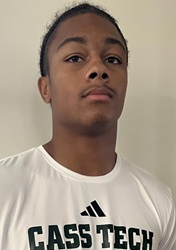 There haven’t been too many lows for Tabron during what already has been an accomplished high school football career – and he still has two years left.
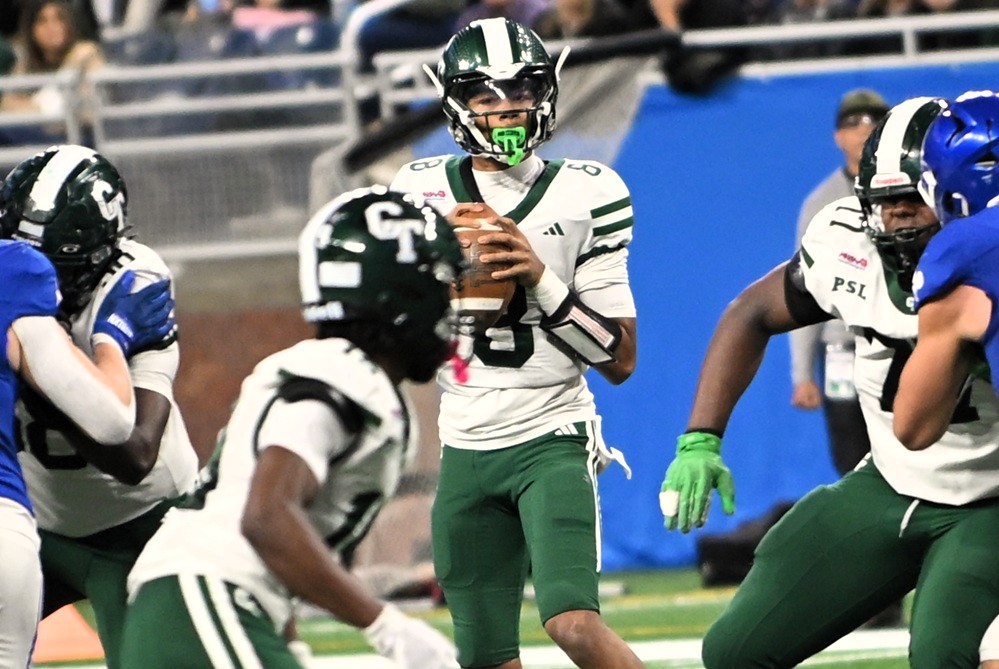
As a freshman two years ago, Tabron was the starter for Cass Tech’s team that won the Division 1 championship, and he helped lead the Technicians to an unbeaten record last year before a loss to Detroit Catholic Central in the title game.
This year as a junior, particularly with Mr. Football Award winner C.J. Sadler graduated, it is fully Tabron’s offense and his team.
“I’m going to be like the offensive coordinator on the field, but you can only work as good as the surrounding cast,” Tabron said. “That’s how it’s going to be for us. I’ll be like the coach and leader on the field, but I can’t do it without them.”
Tabron got his start in football much earlier in life than golf, as a toddler, mainly because his father, Donald Tabron Jr., played collegiately at Northwood.
A right-handed thrower, Tabron made an immediate impact once he got to high school, earning the starting quarterback job, and after initial lumps, guided Cass Tech to that Division 1 championship. Tabron finished 15 of 20 passing with three touchdowns that day at Ford Field, and from there college scouts started drooling.
The 6-foot-3 Tabron committed to Texas A&M on Saturday, and this spring was quite a whirlwind with recruiting trips across the country including to Oregon, USC, Texas A&M, LSU, Ohio State and many others.
Tabron didn’t measure how many miles he traveled, but he did become quite an expert on the quality of airports in various cities.
“My mom was like, ‘Not many kids can say how good or bad airports are at 17 years old,” Tabron said. “I’m definitely blessed and grateful for the opportunity to go to all these places.”
He likely won’t go on more recruiting visits now that he is committed. But if he does, one big request from Tabron will be to check out the university’s golf course.
“I actually talked about it with a few coaches because a lot of college coaches play golf,” he said. “(They say) ‘Next time you come down, get on the range here or get on the course where the golf team practices at.’ It’s definitely been a conversation.”
 Keith Dunlap has served in Detroit-area sports media for more than two decades, including as a sportswriter at the Oakland Press from 2001-16 primarily covering high school sports but also college and professional teams. His bylines also have appeared in USA Today, the Washington Post, the Detroit Free Press, the Houston Chronicle and the Boston Globe. He served as the administrator for the Oakland Activities Association’s website from 2017-2020. Contact him at [email protected] with story ideas for Oakland, Macomb and Wayne counties.
PHOTO (Top) Cass Tech quarterback Donald Tabron (8) drops back to pass during last season’s Division 1 Final, moments before throwing for a big gain that set up the team’s first touchdown.

Sweating the Small Stuff - #3
June 5, 2018
I’m sure it discouraged some of our state’s high school football coaches to learn that the Representative Council of the Michigan High School Athletic Association did not approve at its May 6-7 meeting what some people refer to as the “enhanced strength of schedule proposal” for determining 256 qualifiers to the MHSAA’s 11-player football playoffs.
There was desire among some Council members to appease those who keep trying to reduce the difficulties that a football tournament causes for regular season scheduling and conference affiliations. Others noted that the proposal, as presented, could cause as much harm to some schools and conferences as it would help others, that it did not solve the scheduling problem but shifted it.
During spirited discussion, some Council members resurrected two ideas that have been rejected previously, such as (1) doubling the playoffs once again (and shortening the regular season to eight games), and (2) coupling a six- or seven-win minimum with the revised strength of schedule criteria. The pros and cons of each idea flowed freely.
And therein is the problem. If one digs down into the details of proposals, both old and new, there are both positive and negative aspects apparent, both intended and unintended consequences likely.
There can be paralysis in analysis; but when we are dealing with more than 600 high school programs and a physically demanding sport with fewer regular-season contests permitted than in any other sport, one cannot be too careful. Eliminating one of just nine regular-season games? Increasing first-round tournament mismatches? Disadvantaging larger schools locked in leagues or areas of the state where smaller schools predominate? These are not minor matters.
And until there are sensible answers, these are not trivial questions.