

Friendships Bind Long-Ago Champions
By
Ron Pesch
MHSAA historian
August 28, 2015
Twenty-five years ago, the story of Permian Panthers of Odessa, Texas, was famously told in the book Friday Night Lights written by H.G. Bissinger.
The author recently reunited with various team members as he recalled the book’s silver anniversary in an article for the August 3, 2015, issue of Sports Illustrated.
“It took me about 10 to 15 years of working in different groups, different places, different environments, to finally come to the conclusion that I’m not gonna have a group of coworkers and teammates like I had then,” said Jerrod McDougal, recalling his days playing high school football for the Panthers.
That same feeling is certainly shared by groups of former gridders around the state of Michigan.
A chance meeting led me to breakfast with one such group. The members of Grand Rapids Central's 1947 mythical football state champions gather at a Russ’ restaurant in Grand Rapids on a Monday each month.
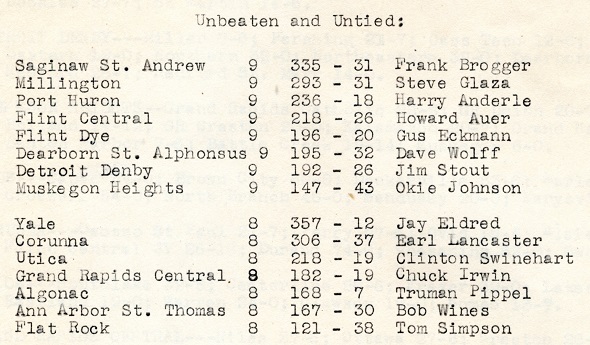
Central was one of 17 football squads in the state spread across four classifications who could call themselves state champions after that season. Back in those days, the Michigan High School Athletic Association did not sponsor a football playoff, so any team with an unblemished win-loss record could lay claim to the crown. With eight wins and no losses or ties, The Hilltoppers, as they were then known, did exactly that.
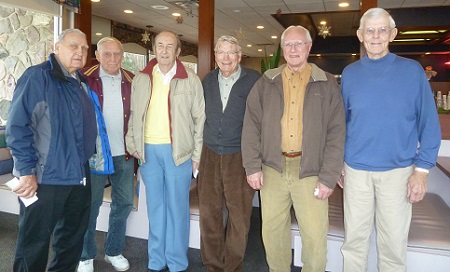 Nearly 70 years later, Don Hill can recall the circumstances of all 19 points allowed by the defense that season. The team remembered its coach, Chuck Irwin, who would go on to become Grand Valley State University’s first athletic director, and the days when summer conditioning wasn't 7 on 7 camps, but rather throwing a football around an empty lot, or a city park.
When I noted that Muskegon Heights’ Tigers also laid claim to the state crown that year, I was quickly reminded that both teams had defeated Holland High that season, but that Central had vanquished the Dutchmen 14-0, while the Tigers struggled to defeat Holland 14-12.
For the record, most newspaper writers gave the nod to both Flint Central and Muskegon Heights as the best in the state that season. Orville Peterson recalled that Flint Central had beaten an undefeated but once-tied Flint Northern team to end the year. That was indeed the case, as Coach Harold Auer's Indians downed coach Guy Houston's Vikings 20-6 on Thanksgiving Day at historic Atwood Stadium.
During the Grand Rapids Central gathering, a pair of restaurant patrons, who could overhear our conversation, wandered over to the table to congratulate the teammates on their accomplishment and to share a few memories of their own covering the value of prep sports in a proper education.
Similar gatherings are quite common across the state.
Each fall, the “Leather Helmets Club,” comprised of football players from Muskegon High School gather for a catered dinner at a rental hall on the shores of Muskegon Lake.
“The 1950 season was the first year that the Big Reds moved from leather helmets to plastic,” recalled Bob Ludwig, now 87 yards old and a member of the 1944 mythical state champions. “We started the Leather Helmet about 25 years ago with 65 guys.”
Ray Carlson, who served as starting quarterback for Muskegon’s mythical state champions back in 1940, still can recall the season.
“It was the year the district installed lights at Hackley Stadium,” said Carlson. “That’s when most of the games were moved from Saturday afternoon to Friday night.”
For many years, the event was a perch fry, but as time marched steadily on, the task became too challenging for this collection of gridiron greats from Big Reds teams, as membership in the club has shrunk to 25. The group will again gather in the fall, and debate inviting members from the 1950s to the gathering to expand membership.
Sometimes, such reunions are single one-time events. In 1993, Ann Arbor High School’s team from 50 years back collected to celebrate its 1943 mythical state crown. In 2013, the 1973 Saginaw Arthur Hill team, undefeated and unscored upon over the season, gathered.
Pat Brady graduated in 1950 from Saginaw St. Andrews. For three seasons – 1948, 1949 and 1950 – the Bulldogs lay claim to mythical state titles in Class C. Over the span, the team racked up 27 straight victories.
“We had a pretty good group of kids,” said Brady recalling the days. “Frank Brogger was our coach, and he made sure we took on a good schedule. We played schools in Flint, Detroit, Saginaw, Bay City and Jackson. We played Sunday evenings at our own field. They really took care of that field. During the week, we practiced in the cinders behind the field. On Saturdays we would go through things on the field in our socks.”
Induction into the Saginaw County Hall of Fame in 2005 led to regular gatherings by team members. A group of seven and another former player from Saginaw St. Peter and Paul meets for coffee at an area McDonald’s at least twice a week.
“He was a rival back then, but we’re friends now,” added Brady, laughing. “We’ve lost a lot of the guys; we’re all in our 80s now. Still, it’s a lot of fun to get together and talk about old times and new times.”
“Whether you play in front of a crowd of 900 or 19,000, the experience of high school football is unlike any other,” noted Bissinger in Sports Illustrated, recalling something shared across state lines and across generations.
The beauty of high school competition is found in the friendships made that last a lifetime.
 Ron Pesch has taken an active role in researching the history of MHSAA events since 1985 and began writing for MHSAA Finals programs in 1986, adding additional features and "flashbacks" in 1992. He inherited the title of MHSAA historian from the late Dick Kishpaugh following the 1993-94 school year, and resides in Muskegon. Contact him at [email protected] with ideas for historical articles.
PHOTOS: (Top) A report from Pesch's wealth of documents shows most of the undefeated football teams at the end of the 1947 season. (Middle) The Grand Rapids Central group stands together after a gathering last December, from left: Tony Krenselewski, Orville Peterson, Don Hill, Bud Hall, Herb Carpenter, Gordon Osmun and Floyd Hall.
A Game for Every Fan: 11-Player Semis
November 22, 2013
By Geoff Kimmerly
Second Half editor
There are probably only a few surprises left as MHSAA 11-player football teams head into the second-to-last weekend of the season.
But there is plenty for us to tell about the 32 teams that have made it to Saturday's Semifinals.
See below for details on all 16 games, including some of the stories behind their runs and the players to watch for each.
All will be played Saturday. Click for a full schedule including times, and make sure to follow @MHSAA on Twitter for in-game updates all day Saturday.
Division 1
Flint Carman-Ainsworth (11-1) vs. Clarkston (11-1) at Lake Orion
Carman-Ainsworth is headed to its first Semifinal thanks in part to a defense allowing only nine points a game, but also on the legs of dynamic playmaker Jevonte Alexander. The senior quarterback/receiver/defensive back has run for 901 yards and nine touchdowns, thrown for 390 yards and five scores and returned two interceptions, a kickoff and a punt for scores as well. Clarkston has made four Semifinals over the last 15 seasons, but is playing for its first championship game berth. Balance has been key – junior quarterback D.J. Zezula has thrown for 2,156 yards and 17 scores and senior running back Ian Eriksen has run for 1,055 yards and 19 touchdowns.
Detroit Catholic Central (10-2) vs. Detroit Cass Tech (12-0) at Troy Athens
This is a rematch of the last two Division 1 championship games – both Cass Tech wins. Familiar faces will abound for those who saw those matchups. Cass Tech has some of the state’s top playmakers in quarterback Jayru Campbell, running backs Michael Weber and Deon Drake and receiver Damon Webb. Seniors Zach Bock and Dylan Roney are two-way standouts in the DCC backfield and on defense. Senior Connor Holton sees the ball most, with 975 of the team’s 3,107 rushing yards plus 11 scores.
Division 2
Muskegon (11-1) vs. Portage Central (12-0) at East Kentwood
The reigning runner-up Big Reds certainly have more experience at this stage as they hope to play for a fourth MHSAA title over the last decade. Senior quarterback Deshaun Thrower has been magnificent in keeping them in the hunt running for 1,575 yards and 24 touchdowns and throwing for 1,110 yards and 12 scores. Portage Central would be a deserving finalist as well; the Mustangs are scoring 43 points per game during their best season ever and first run to the Semifinals since 1977. A pair of senior running backs has carried the team to more than 4,000 yards rushing – Jerrod Davis has gained 1,586 yards with 26 touchdowns on the ground and Jacob Allan has run for 1,367 yards and 21 scores.
Birmingham Brother Rice (12-0) vs. Detroit Martin Luther King (10-1) at Wayne State University
This might beat out Cass Tech/DCC as the most anticipated Semifinal in the Greater Detroit area. Brother Rice is the reigning Division 2 champion and has been challenged only a few times during the final two months of longtime coach Al Fracassa’s final season after earning three wins by nine or fewer points during the first five weeks of the fall. Junior quarterback Alex Malzone is one of the most exciting at his position in the state, with 2,339 yards and 19 TDs through the air. Detroit King is having its best season since winning the MHSAA title in 2007 and has two of the state’s top two-way standouts in Avonte Maddox and Jalen Embry.
Division 3
Zeeland West (11-1) vs. Stevensville Lakeshore (9-3) at Vicksburg
Up in Division 3 for the second straight season, Zeeland West is in position to reach Ford Field for the second time in three years after winning Division 4 in 2011. The Dux grind down opponents with the run, rushing for 4,739 yards this season led by senior Danny Bauder’s 1,585 yards and 26 touchdowns on the ground. Lakeshore will be playing its fourth Semifinal seeking its first trip to an MHSAA championship game and is battle-tested against a strong league that includes Division 2 semifinalist Portage Central. Senior quarterback Mike Adams leads the way with 1,032 yards and 18 touchdowns running and 888 yards and 14 scores through the air.
DeWitt (12-0) vs. St. Clair (11-1) at Goodrich
The stories of these two vary considerably despite their similar successes this fall. St. Clair is making its first Semifinal trip, while DeWitt is playing in its ninth over the last 13 seasons and seeking its first trip to the Finals since 2004. Where they are alike is in their offensive prowess – both are led by strong dual-threat quarterbacks who direct strong rushing attacks. St. Clair senior quarterback Jared Tobey has run for 1,327 yards and 22 touchdowns and thrown for 886 yards and 16 touchdowns, with senior running back Bo Meldrum adding another 1,310 yards and 13 scores on the ground. DeWitt junior quarterback Jake Johnson missed time with an injury but has returned and total thrown for 1,644 yards and 28 scores and run for 471 more yards. Junior running back Ben Heinritz is averaging 8.8 yards per carry in gaining 1,291 total with 15 scores on the ground.
Division 4
Comstock Park (12-0) vs. Grand Rapids South Christian (11-1) at Rockford
South Christian junior quarterback Jon Wassink missed out on last season’s championship game win because of an injury, but he’s come back to lead another surge with 2,507 yards and 22 touchdowns passing and 1,002 yards and 20 touchdowns rushing. Junior running back Geff Plasman has added another 1,091 yards and 14 scores to the running attack. Comstock Park is in its third straight Semifinal, having fallen in the last two to the eventual MHSAA champion. But this also is the first the Panthers have entered undefeated, with a good deal of credit going to sophomore quarterback Pat Naughton (2,233 yards, 15 TDs passing) and senior running back Jake Bush (1,361 yards and 24 TDs rushing, 467 yards and four TDs receiving).
Lansing Sexton (12-0) vs. Marine City (11-1) at Ortonville Brandon
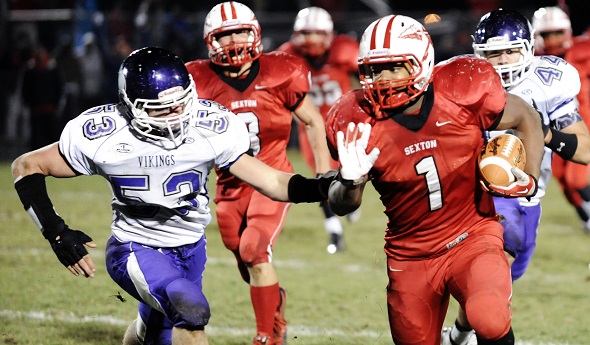
Sexton’s best season ever now will include its first Semifinal since 1989. The defense has been impressive against a tough set of opponents, giving up only 11.3 points per game. But the speedy offense has been equally difficult to stop keyed by an incredible group of junior playmakers – quarterback Malik Mack has thrown for 1,552 yards and 15 touchdowns, running back Avonte’ Bell has run for 1,033 yards and 18 scores and running back JaVon Wray has rushed for 1,222 yards and 18 scores (although Wray missed the Regional Final with an injury). This will be Marine City’s fourth Semifinal in seven seasons, and the Mariners come in with a similar attack. Junior quarterback Alex Merchant has thrown for 1,582 yards and 15 scores, while senior running back Tait Sapienza has run for 1,077 yards and junior Jarrett Mathison has run for 1,068.
Division 5
Menominee (12-0) vs. Muskegon Oakridge (11-1) at Northern Michigan University
An 18-year playoff streak has been capped by Menominee’s best run since winning its last MHSAA title in 2007. The Maroons’ always-prolific offense has been its best ever with a school-record 572 points, led by junior quarterback Justin Brilinski (1,073 yards/13 TDs rushing, 1,330 yards/13 TDs passing). Oakridge is looking to return to the Finals for the first time since its last championship in 2008 and despite losing its leading runner Dan Shoop for the playoffs with an injury. Senior quarterback Austin Wright has run for 894 yards and seven scores and thrown for 1,499 yards and 22 touchdowns.
Grand Rapids West Catholic (8-4) vs. Livonia Clarenceville (12-0) at Battle Creek Harper Creek
After just missing on last season’s Division 5 championship – losing 12-9 to Portland in the Final – West Catholic nearly missed the playoffs at 5-4 and made it only after a one-point win in Week 9. But back are senior running back Andy Corey (713 yards, 13 TDs rushing) and junior quarterback Travis Russell (518 yards/9 TDs rushing, 2,177 yards/18 TDs passing) to try to finish what they started a year ago. Standing in the way is Clarenceville’s first Semifinalist team since 2001. The Trojans are giving up only 11.9 points per game while riding the attack led by junior quarterback Jacob Kubiak (1,230 yards/16 TDs passing) and senior running back Jalen Bryant (1,199 yards/14 TDs rushing).
Division 6
Ithaca (12-0) vs. Montrose (12-0) at Midland
This is the fourth season in a row these two have met in the playoffs, and Ithaca is hoping for the same result as it goes for its fourth straight MHSAA title at 55th straight win. Senior quarterback Travis Smith has been incredible in trying to get his team back to Detroit with 2,773 yards and 35 touchdowns passing (completing 73 percent of his throws) and 475 yards and nine scores rushing. Montrose is keyed by a talented quarterback as well – senior Riley Warren has run for 730 yards and 10 scores and thrown for 1,485 yards and 19 touchdowns, with senior Malik Taylor catching 14 scoring passes and gaining 1,049 receiving yards (plus 782 yards and 11 TDs rushing). But senior Tyler Doyle might be the key to keeping Ithaca’s offense off the field. He’s run for 1,166 yards and 17 scores.
Shelby (11-1) vs. Clinton (12-0) at Middleville Thornapple-Kellogg
Shelby bounced back quickly from its lone loss, in Week 9, to reach its second straight Semifinal. Clinton is in its first since 1990, and both are seeking their first championship game berth. Shelby will try to get there in part with two senior running backs averaging more than 10 yards per carry – Devin Mussell has gained 1,223 yards and 17 touchdowns total on the ground, and Tony Guerra has added 961 yards and 12 scores. Clinton’s backfield is similarly loaded; senior Collin Poore has run for 1,509 yards and 18 touchdowns, while junior quarterback T.J. Baker has thrown for 1,868 yards and 23 scores and run for 641 yards and 16 TDs. The leading receiver is sophomore fullback Mathew Sexton with 33 catches for 1,059 yards (32.1 yards per catch) and 15 scores.
Division 7
Ishpeming (12-0) vs. Harbor Beach (11-1) at Northern Michigan University
This is a matchup of last season’s champion, Ishpeming, against reigning Division 8 champ Harbor Beach. They have just one loss between them this fall, but the Pirates fell only to Division 5 Semifinalist Menominee. Harbor Beach senior quarterback Eli Kraft caught plenty of eyes during last season’s run and has followed up with 1,248 yards and 24 touchdowns rushing and 1,770 yards and 19 scores passing while also starring at linebacker. Ishpeming senior quarterback Alex Briones made a similar impression last fall, and during this regular season he ran for 814 yards and 13 scores and threw for 1,050 yards and 13 scores without an interception.
Homer (11-0) vs. Detroit Loyola (12-0) at Chelsea
It’s tough for any MHSAA finalist to bounce back like Loyola has after losing its two best players from last season’s runner-up team. But the Bulldogs have been even more impressive with wins over Detroit Country Day and Detroit East English among others. Loyola is still running strong, with junior Marvin Campbell gaining 1,262 of the team’s 3,553 rushing yards. Homer has advanced to its first Semifinal by outscoring opponents on average 27-5 during the first half with perhaps the most balanced offense left in the playoffs. Homer has run for 2,051 yards and thrown for 2,374, led by seniors Chaz Hopkins (1,400 yards/21 TDs rushing) and quarterback Alex White (2,333 yards/30 TDs passing).
Division 8
Crystal Falls Forest Park (12-0) vs. Beal City (12-0) at Northern Michigan University
The Trojans had to survive some close calls to reach their eighth Semifinal in 10 seasons, but few statewide are more familiar with the pressure that goes along with this late date on calendar. One of those that does understand is Beal City, last season’s Division 8 runner-up, which is making its fifth Semifinal appearance in seven seasons. Forest Park junior running back Lee Graff is in the mold of the team’s typical load carrier with 1,401 yards and 29 touchdowns rushing as one of two backs averaging at least eight yards per carry. But a defense giving up 9.9 points per game must lock down the second-highest scoring offense in MHSAA history. The Aggies are averaging 57.6 points per game on the strength of a running game that’s gained more than 3,500 yards and is led by seniors Ty Rollin (1,140 yards/23 TDs rushing) and Hayden Huber (813 yards/19 TDs).
Muskegon Catholic Central (10-2) vs. New Lothrop (12-0) at Greenville
This will be, incredibly, Muskegon Catholic Central’s 18th Semifinal appearance over the 39 years of the playoffs, and the Crusaders are playing for their first trip to Detroit since 2008. Rather, they are running for the Finals led by junior quarterback Nick Holt (1,051 yards/21 TDs rushing, 777 yards/10 TDs passing) and senior Alex Lewandoski (1,068 yards/18 TDs rushing). This will be New Lothrop’s third Semifinal in eight seasons, and the Hornets prepared for this type of game by loading their nonleague schedule with the likes of Traverse City St. Francis and Pewamo-Westphalia. Senior Amari Coleman might be the most dangerous offensive player on the field – he’s averaging 19.4 yards per carry (for 987 with 18 TDs) and 16.1 per catch, and also has returned five punts and a kickoff for scores.
PHOTO: Lansing Sexton’s Avonte’ Bell turns the corner while a Saginaw Swan Valley defender gives chase during last week’s Regional Final win over the Vikings. (Click to see more from HighSchoolSportsScene.com.)