

A Game for Every Fan: 11-Player Semis
November 21, 2014
By Geoff Kimmerly
Second Half editor
This season's MHSAA football playoffs have featured their share of the unpredictable, to say the least – down to snow-driven changes we've made to the schedule as recently as Friday afternoon.
But on the field, this set of matchups as a whole could be the most competitive we've seen in some time. And we're all excited to let the games begin.
See below for brief previews of all 16 Semifinals. All are set for 1 p.m. Saturday unless noted; the only Friday game is Munising vs. Beal City at the Superior Dome.
All 16 games will be streamed live either as part of the FoxSportsDetroit.com Prep Zone or MHSAA.tv. Venue changes have led to some adjustments, so make sure to click here for up-to-date information as we receive it and links to watch.
 DIVISION 1
East Kentwood (11-1) vs. Clarkston (12-0) at Brighton High School
East Kentwood’s best season since 2002 has come down to a face-off with reigning champion Clarkston. The Falcons could work to control tempo with a rushing game averaging 235 yards per game. But they’re also giving up 204 yards rushing per game – good news for Clarkston junior running back Nolan Eriksen, who has run for 1,239 yards and 18 touchdowns, and senior quarterback D.J. Zezula (745 yards and 12 TDs rushing to go with 1,930 yards and 18 TDs passing.
Saline (11-1) vs. Detroit Cass Tech (12-0) at Troy Athens High School
Saline carries an 11-game winning streak into its first Semifinal; the Hornets’ only loss came on opening night, by three, to Division 2 semifinalist Muskegon Mona Shores. They’ve drawn tournament veteran Cass Tech, playing a Semifinal for the fifth straight season and led by arguably the best player in the state in senior running back Mike Weber. He’s committed to the University of Michigan and has run for 2,050 yards and 28 touchdowns, with 404 yards in last week’s Regional Final.
 DIVISION 2
Muskegon Mona Shores (11-1) vs. Farmington Hills Harrison (10-2) at Howell High School
Two years ago, Mona Shores had never made the playoffs. Two years later, it might be the favorite in Division 2 thanks in part to senior quarterback Tyree Jackson (2,213 yards and 23 TDs passing, 773 yards and 14 TDs rushing). Harrison is much more familiar with this stage; this is its first Semifinal since 2010, when it went on to claim the most recent of an MHSAA-best 13 football championships. Among those lining up across Jackson will be Hawks senior linebacker Michael Ojemudia, who will be key also in stopping a rushing game with more than 3,000 yards this fall.
Southfield (9-3) vs. Warren DeLaSalle (9-3) at Novi High School
Both of these are considered small surprises that have picked up big wins on the way – Southfield over Detroit Martin Luther King in their playoff opener and DeLaSalle over three-time reigning champion Birmingham Brother Rice last week. But both rosters are filled with dynamic difference-makers. Southfield senior defensive back Dior Johnson is committed to Wake Forest University, and receiver/defensive back Ray Buford is committed to Minnesota University. DeLaSalle senior defensive linemen Khary Harris (6-foot-3/234 pounds) and Mike Danna (6-3/233) key a front that is giving up a meager 73 yards rushing per game.
 DIVISION 3
Muskegon (11-1) vs. Zeeland West (12-0) at Greenville High School
Muskegon was Division 2 runner-up the last two seasons, and West is the reigning champ in Division 3. These two might be least affected by crummy weather than any others Saturday. Muskegon can ride the running of senior back Caleb Washington (1,422 yards, 14 TDs) and senior quarterback Shawn Pfenning (466/14). West has accumulated an incredible 4,870 rushing yards through its devastating T offense, led by senior Nick Jasch (1,366 yards, 25 TDs) and junior Darius Perisee (1,276/20).
Orchard Lake St. Mary's (12-2) vs. New Boston Huron (11-1) at Dearborn High School
The Eaglets are two close losses to Brother Rice from perfection and fitting their usual mold with another dominating pair of running backs, this season juniors Brandon Adams (1,251 yards, 15 TDs) and Justin Myrick (969/10), and a big-time defensive back in Michigan State University recruit Tyson Smith. Huron is a new arrival in the Semifinals but carries impressive credentials. The Chiefs’ lone loss was to Division 6 semifinalist Monroe St. Mary Catholic Central, in Week 3, and junior quarterback Matt Hartwick is a handful with 1,265 yards and 15 TDs rushing and 1,052 yards and 11 TDs passing.
 DIVISION 4
Grand Rapids South Christian (10-2) vs. Edwardsburg (11-1) at Jackson High School, 3 p.m.
The Sailors are working for a third-straight championship game appearance after winning Division 4 in 2012 and falling to Marine City in last year’s Final. They’ve been uncommonly balanced (2,482 rushing yards, 2,277 passing), as characterized by standout senior quarterback Jon Wassink (1,078 yards, 16 TDs rushing; 2,169 yards, 23 TDs passing). Edwardsburg is easier to read but no easier to stop. The Eddies have run for 4,346 yards to 683 passing, led by sophomore Isaiah Miller (1,485 yards, 22 TDs) and senior Dustin Vires (1,267/17).
Lansing Sexton (12-0) vs. Detroit Country Day (8-4) at Fenton High School
This ties the longest playoff run for Lansing Sexton, which is relying on a talented group of seniors that has carried the Big Reds to a 24-1 record over the last two seasons and just missed making last year's Final. Quarterback Malik Mack has thrown for 1,418 yards and 17 touchdowns – 11 to senior Rayshawn Wilborn – and seniors JaVon Wray and Avonte’ Bell have combined to run for 2,582 yards. Country Day made the playoffs as an at-large qualifier but is only two seasons off an MHSAA title. A player to watch is senior running back Jacob Hill, who has eight touchdowns rushing, three receiving, another on a kickoff return and one more off an interception.
 DIVISION 5
Menominee (12-0) vs. Grand Rapids West Catholic (12-0) at Northern Michigan University Superior Dome, 11 a.m
This is a rematch of last season’s championship game, a 27-14 West Catholic win. The scenario is a bit reversed this time, with West Catholic making the trip north but with an even more impressive body of work than in 2013. Senior quarterback Travis Russell is back and has thrown for 1,976 yards and 30 touchdowns and run for 1,274 yards and 20 scores. Similarly, Menominee also returns its top offensive player, senior back Justin Brilinski, who has run for 1,515 yards and 23 TDs and thrown for 1,686 yards and 18 scores.
Lansing Catholic (12-0) vs. Almont (12-0) at Brighton High School, 4:30 p.m.
This should be a battle of styles. Lansing Catholic will look to make its second championship game in four seasons keyed by the high-scoring heroics of 6-7, 230-pound junior quarterback Tony Poljan, who has thrown for 2,405 yards and 32 touchdowns and run for 871 yards and 20 scores. Almont is much more traditional offensively, eating up yards with senior running back Mike Couch (1,230 yards, 25 TDs) and junior running back Nick Baker (1,228/19). And the defense has been one of the state’s most impressive giving up only 68 points and 1,420 yards.
 DIVISION 6
Boyne City (12-0) vs. Ithaca (12-0) at Midland Community Stadium, 2 p.m.
Ithaca last week survived perhaps its greatest scare during a national-best 68-game winning streak, trailing Madison Heights Madison into the fourth quarter before scoring three times over the final seven minutes. The team has only four seniors, but as usual is led by an all-state caliber quarterback in junior Jake Smith (1,830 yards, 25 TDs passing, 1,247 yards, 17 TDs rushing). Boyne City is the next with a chance to making history by ending some, and returns to the Semifinals for the first time since another 12-0 start in 2001. The Ramblers probably won’t add to their total of six shutouts, but could slow the Yellowjackets more than most.
Grand Rapids NorthPointe Christian (11-1) vs. Monroe St. Mary Catholic Central (11-1) at Battle Creek Harper Creek High School
NorthPointe Christian has seemingly gained steam as it’s built its best season of a seven-year football history; the Mustangs have actually increased their scoring average during the playoffs four points per game to just more than 42. Senior quarterback Luke VanDyke (1,143 yards/15 TDs passing, 561/13 rushing) and senior running back Kenny Willekes (1,194 yards/15 TDs rushing) are responsible for much of that firepower. But St. Mary has eliminated two previously-undefeated teams the last two weeks and tripped up only against Lansing Catholic, in Week 9. Junior Justin Carrabino (1,268 yards, 12 TDs) is one of three backs who have run for at least 800 yards and 12 scores.
 DIVISION 7
Ishpeming (11-0) vs. Saginaw Michigan Lutheran Seminary (11-1) at the Superior Dome, 2 p.m.
The key to two-time reigning champion Ishpeming adding to its 32-game winning streak could be stopping the multiple offensive threats of Seminary, which has scored more than 400 points for the first time since 1995. Senior running back Owen Heyn is averaging 8.4 yards per carry and has run for 12 scores, and senior quarterback Nathanael Lindloff has thrown for 1,515 yards and 25 TDs – including 11 to sophomore Casey Williams, who also has run for seven, scored twice on kickoff returns, twice on punt returns and once off an interception. Junior Ozzy Corp has stepped in strongly at quarterback this season for Ishpeming after the graduation of standout Alex Briones, running for 15 touchdowns and throwing for six more through the regular season.
Pewamo-Westphalia (10-2) vs. Detroit Loyola (12-0) at Jackson High School, 11 a.m.
Loyola has fallen to Ishpeming in the last two Division 7 Finals, but appears to have taken its game to another level with no opponent getting within 28 points including previously-undefeated New Lothrop last week. Senior Marvin Campbell is the top running back again, this fall rushing for 1,639 yards and 28 touchdowns with senior Mideyin Wilson following with 925 yards and 13 scores. But P-W is not unfamiliar with this level, making its third Semifinal appearance in four seasons and with a star in the making carrying the load. Sophomore Jared Smith has run for 2,033 yards and 27 touchdowns, averaging 11 yards per carry.
 DIVISION 8
Munising (11-1) vs. Beal City (10-2) at the Superior Dome, 7 p.m. Friday
Munising passed tests against previously-undefeated St. Ignace and powerful Crystal Falls Forest Park the last two weeks, but now must defeat reigning runner-up Beal City to extend its best season since 1980. The Mustangs have the firepower with senior Garrett Blank running for 1,849 yards and 28 touchdowns and senior quarterback Austin Kelto throwing for 18 scores – with no interceptions. Beal City has advanced to the last two Division 8 Finals and is looking to return with a mostly new group, although it impressed again last week in shutting out a potent Baldwin offense.
Muskegon Catholic Central (12-0) vs. Harbor Beach (12-0) at Alma College
No one has been expected to stop reigning champion MCC this fall; a number of the biggest contributors from 2013 are leading the way again, including senior running back Tommy Scott (1,691 yards, 29 TDs rushing) and senior quarterback Nick Holt (859/15). But Harbor Beach has been considered one of the candidates to have a shot. The Pirates are back in a Semifinal for the third straight season and won the championship in 2012 before moving into Division 7 for 2013. Waterford Our Lady two weeks ago is the only opponent to score more than seven points this season, and Harbor Beach doesn’t allow many chances with seniors Austin Seltz (1,243 yards/23 TDs) and Josh Schelke (1,219/23) dominating the run game.
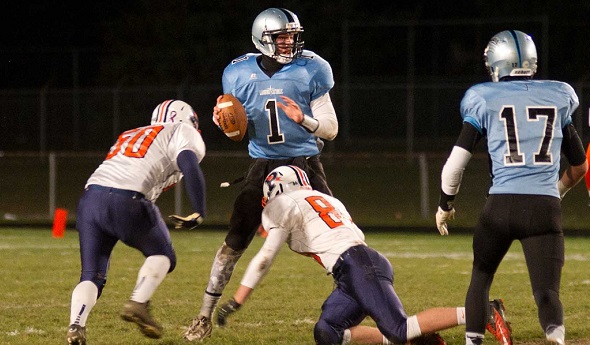
PHOTO: Lansing Catholic quarterback Tony Poljan scans the field during last week's Division 5 Regional Final win over Flint Powers Catholic. (Click to see more from HighSchoolSportsScene.com.)
Performance: Cass Tech's Rodney Hall
December 1, 2016
 Rodney Hall
Detroit Cass Tech senior – Football
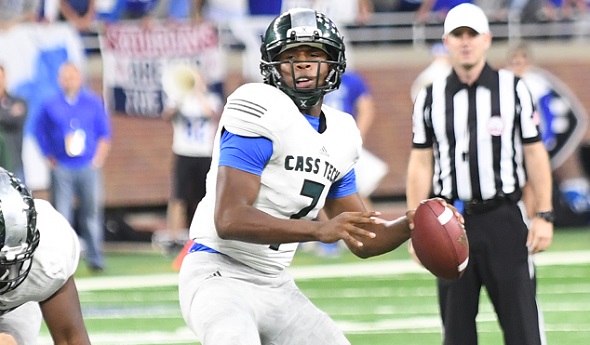
A year ago, Hall’s junior season ended on the Ford Field sideline, watching Cass Tech fall 41-27 to Romeo in the Division 1 Final after he suffered a lower leg injury two weeks before. But he came back this season fueled by championship motivation, and made it pay off. Hall threw for 220 yards and an MHSAA Finals record-tying five touchdown passes to lead the Technicians to a 49-20 win over Detroit Catholic Central in the Division 1 Final on Saturday and earn the Michigan National Guard “Performance of the Week.”
Hall started a pair of playoff games as a freshman before taking over the varsity fulltime in 2014 and leading Cass Tech to a 12-1 record. The Technicians were a combined 36-3 under him the last three seasons and scored a program-record 619 points (44.2 per game) this fall. The 6-foot-2, 210-pound signal-caller completed 10 of 18 passes in the Final and also ran for 58 yards on only seven carries. He finished this season 142 of 238 passing for 2,535 yards and 28 touchdowns, after a junior season when he threw for 2,232 yards and 20 touchdowns and ran for 1,053 yards and 14 scores.
 After admitting Saturday to being a little timid to run at the start of the fall, and with a steel plate still in his ankle, Hall ran for a combined 253 yards and three touchdowns over his final three playoff games. He has committed to sign to play football at Northern Illinois University but said he’s unsure which course of study he’ll pursue. MLive-Detroit reported Hall carries a 3.4 grade-point average in its feature on the Technicians standout as one of 10 finalists for MLive’s High School Football Player of the Year award.
Coach Thomas Wilcher said: Let's say it like this: He lost one game his first year, two games his second year, zero games his third year. That's enough said. ... I think the most important thing about Rodney Hall is you have to look at his stats. He has phenomenal stats. He has a phenomenal win-loss record. I haven't been around anything like that before. I just look at his game – (he's) the gamer. He's always bringing back a victory. We went down to the wire several times, and it was all about him. And I just told him this week, 'Look, I don't need you to run the ball. All I want you to do is throw the ball. You should throw the ball for over 300 yards.’ That’s it. And I told him, just stick with the game plan; no running. And I just kept telling the offensive coordinator, don't let him run. Let him throw it. That's it."
Performance Point: “Just to be able to make it back to this point and play in this game, I was just excited to come play, and glad we won,” Hall said. “The offense was clicking, and guys were open. They did the rest. I just put it to them. … (At last season’s Final) I was crying. I was hurt that I couldn't be out there to help my teammates. I wanted (this year) bad. We made history at Cass because I think we’re the first team to go 14-0 and win the state championship. We just wanted to win this game because we’ve been losing ever since we came into high school. We have a lot of wins, but we’ve been coming up short for the last three years – and it’s great to come out with the championship this year.”
Learning to run again: “I came in (to this season), I was a little timid to run, actually. I didn't want to get hurt again and miss this opportunity. Coach, he's been pressing me to run all year, and when I finally do, I get positive yards.”
 Star among the stars: “Quarterback is simple. You just have to keep everybody on the right track and make sure teammates don’t get down when we get behind. The last two weeks we’ve been losing, and I just remind my guys, ‘Come on, we can win this. We’re going to go back and score.’ Just remind them to keep scoring, remind the defense we’re going to keep getting stops, and just keep everybody’s heads up.”
Pass is present: “This year, I’ve been a way better passer. Because all offseason, I haven’t been able to run. I’ve just been working the pocket, making sure I’m looking at everything, making sure I’m reading the defense better. And I’ve had a better passing year this year, I believe.”
Leaving a legacy: “I just can’t believe it’s over with. I just want people to know I was a guy to go out there and give it all I’ve got. Just sell out for the team, and that’s what you should do – and you’ll end up a champion.”
- Geoff Kimmerly, Second Half editor
Every week during the 2016-17 school year, Second Half and the Michigan National Guard will recognize a “Performance of the Week" from among the MHSAA's 750 member high schools.
The Michigan Army National Guard provides trained and ready forces in support of the National Military Strategy, and responds as needed to state, local, and regional emergencies to ensure peace, order, and public safety. The Guard adds value to our communities through continuous interaction. National Guard soldiers are part of the local community. Guardsmen typically train one weekend per month and two weeks in the summer. This training maintains readiness when needed, be it either to defend our nation's freedom or protect lives and property of Michigan citizens during a local natural disaster.
Previous 2016-17 honorees:
Nov. 24: Ally Cummings, Novi volleyball – Read
Nov. 17: Chloe Idoni, Fenton volleyball – Read
Nov. 10: Adelyn Ackley, Hart cross country – Read
Nov. 3: Casey Kirkbride, Mattawan soccer – Read
Oct. 27: Colton Yesney, Negaunee cross country – Read
Oct. 20: Varun Shanker, Midland Dow tennis – Read
Oct. 13: Anne Forsyth, Ann Arbor Pioneer cross country – Read
Oct. 6: Shuaib Aljabaly, Coldwater cross country – Read
Sept. 29: Taylor Seaman, Brighton swimming & diving – Read
Sept. 22: Maggie Farrell, Battle Creek Lakeview cross country – Read
Sept. 15: Franki Strefling, Buchanan volleyball – Read
Sept. 8: Noah Jacobs, Corunna cross country – Read
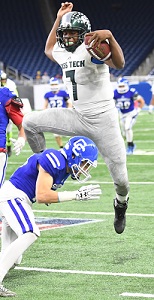
PHOTOS: (Top) Detroit Cass Tech's Rodney Hall prepares to unload a pass during Saturday's Division 1 Final at Ford Field. (Middle) Hall hurdles a would-be Detroit Catholic Central tackler.