

A Game for Every Fan: 11-Player Semis
November 20, 2015
By Geoff Kimmerly
Second Half editor
Rain, sleet, or a few inches inches of snow, we expect to know our 16 11-player football finalists by the end of Saturday afternoon.
But even fans of the college football games being played this weekend should make sure to have MHSAA.tv and FoxSportsDetroit.com playing on their computers, tablets or smartphones, as the 16 MHSAA Semifinals should produce at least a few classics.
See below for a brief breakdown of all 16 games, and watch all 16 live by clicking the links above beginning at 1 p.m.
Division 1
Romeo (11-1) vs. Grand Ledge (12-0) at Brighton
The Comets are attempting to make their first MHSAA Final since winning Division 1 in 2000 and after scoring 33 unanswered fourth-quarter points last week to beat Rockford. Grand Ledge has nearly 3,800 yards of offense this fall, with senior running backs Ba Blamo (993 yards/18 touchdowns rushing) and Caden Evert (543/15) carrying much of the load but sophomore quarterback Nolan Bird (1,445 yards/15 TDs passing) also progressing quickly. This is Romeo’s first Semifinal since 1992, and has come after advancing through arguably the toughest road in the tournament – reigning champion Clarkston, undefeated Lapeer and Detroit Catholic Central. Senior quarterback Paul Hurley completed more than two-thirds of his passes for 953 yards and 18 touchdowns through the regular season, and senior Bradley Tanner had scored 19 touchdowns through nine games.
Detroit Cass Tech (10-2) vs. Canton (10-2) at Troy Athens
Playing its sixth straight Semifinal, Cass Tech is looking to get back to the Division 1 championship game for the first time since 2012. The Technicians’ only losses were to Division 2 contender Detroit Martin Luther King – although this game certainly will be a test with play-making quarterback Rodney Hall reportedly out Saturday with an ankle injury. Canton might be a surprise to make it this far, but left no doubt in downing undefeated and 2014 runner-up Saline 27-7 in the Regional Final. The Chiefs have reached this round for the first time since 2006 after rebounding from a pair of consecutive losses midseason and on a rushing attack that has gained 4,388 yards – including 2,184 with 27 touchdowns by junior Markus Sanders.
Division 2
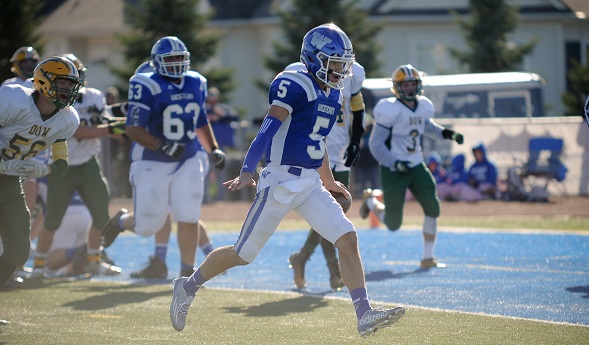
Walled Lake Western (12-0) vs. Lowell (11-1) at Alma College
These two met in one of the most exciting games of opening weekend, with Walled Lake Western coming away with a 42-40 victory. The Warriors are trying to reach their first MHSAA Final since 1999 and will follow senior quarterback Kyle Thomas, who has thrown for 2,154 yards and 24 touchdowns and run for 743 yards and 10 scores. Lowell hasn’t lost again, instead rolling up more than 5,500 yards in total offense with no other opponent coming within 14 points. The Red Arrows too are led by a dynamic dual-threat quarterback; senior Ryan Stevens has thrown for 2,230 yards and 28 TDs and run for 872 yards and 13 scores.
Detroit Martin Luther King (12-0) vs. Livonia Franklin (9-3) at Dearborn
King is playing in its third MHSAA Semifinal in five seasons, but looking to return to Finals weekend for the first time since the perfect run in 2007. The Crusaders are loaded with offensive standouts who have drawn statewide attention all season – notably, senior running back Martell Pettaway (1,180 yards/14 touchdowns rushing through nine games), senior quarterback Armani Posey (1,319 yards/12 TDs passing) and senior receiver Donnie Corley (858 yards/9 TDs receiving). Franklin was on no one’s Semifinal radar after a 2-3 start, but has won seven straight to make its first Semifinal since winning the first Class A title in 1975. Senior quarterback Denzel Adams (1,623 yards/23 touchdowns) and junior running back Jacob Clark (1,446 yards/15 TDs) have combined for more than 3,000 of the team’s 4,545 yards on the ground, and Adams also has thrown for 1,029 yards and 13 scores.
Division 3
Orchard Lake St. Mary’s (10-1) vs. East Grand Rapids (9-3) at Howell
Reigning champion St. Mary’s is playing to make its fifth MHSAA Final in six seasons and has outscored its first three playoff opponents by a combined 160-35. Running back Justin Myrick (1,049 yards/13 touchdowns rushing) and quarterback Brendan Tabone (1,020 yards/5 TDs passing) have led the way for the second straight season. East Grand Rapids hasn’t played a game of this magnitude since ending a string of six straight Semifinals in 2011. The Pioneers haven’t given up a point in two weeks and only 14 over the last month, and on offense ride the legs of senior running Bryce Henkey (1,152 yards/20 touchdowns rushing through the District Final).
Chelsea (11-1) vs. Coldwater (12-0) at Jackson
This will be the first Semifinal for an otherwise annually successful Chelsea program. The Bulldogs can make their first championship game and break the team record for wins with one more. They had a string of five straight shutouts during the first half of this season and have given up only 34 points total during the playoffs. Junior quarterback Jack Bush has thrown for 1,603 yards and 14 touchdowns and run for eight more scores. Coldwater also is playing in its first Semifinal – it made the playoffs for the first time only two seasons ago – and hasn’t let an opponent within 14 points since Week 2. The Cardinals have thrown for only 250 yards – because they’ve run for 4,261, with junior Sam DeMeester (1,154 yards/14 TDs), senior Spencer Burns (1,120 yards/17 TDs) and senior Luke Beckhusen (1,107 yards/12 TDs) all crossing the 1,000-yard rushing milestone.
Division 4
Zeeland West (12-0) vs. Ada Forest Hills Eastern (11-1) at East Kentwood
West has won 36 of its last 37 games, with that lone defeat in a Semifinal a year ago. The secret to the Dux’ success hasn’t been a surprise for a while; they run, run and run some more. Senior fullback Darius Perisee leads the rush this time with 1,796 yards and 28 touchdowns. Forest Hills Eastern is a field goal from perfection during its most successful season, which will now include its first Semifinal. The Hawks take a more balanced approach on offense, led by senior quarterback Jack Clark (1,932 yards/22 touchdowns passing, 752 yards/19 touchdowns rushing).
Detroit Country Day (11-1) vs. Flint Powers Catholic (10-2) at West Bloomfield
Country Day is playing in its third Semifinal in four seasons and seeking to return to Ford Field for the first time since 2012. The Yellowjackets’ only loss was Week 2 to Detroit U-D Jesuit; they’ve given up only 45 points total over the last 10 weeks and 75 for the season. Junior quarterback Steve Mann is the player to watch on offense, with 1,369 yards and 18 touchdowns through the air and six more scores on the ground. Powers is trying to get back to Ford Field for the first time since 2011 led by a similarly stellar defense giving up only nine points per game. Like that championship team, the Chargers are keyed on offense by a dangerous dual threat quarterback in senior Noah Sargent, who has run for 941 yards and 14 touchdowns and thrown for 1,466 yards and 17 scores.
Division 5
Lansing Catholic (11-1) vs. Grand Rapids West Catholic (10-2) at Greenville
This is a rematch of last season’s MHSAA Division 5 Final, a 24-20 West Catholic win. The Falcons have played in four of the last five championship games and five straight Semifinals. This year’s leaders have different names, but similar impact. Senior Denny Alt has run for 1,291 yards and 17 touchdowns, and sophomore Gaetano Vallone stepped in at quarterback and has thrown for 2,347 yards and 26 scores while running for 738 yards and 10 TDs. A return to Ford Field would be Lansing Catholic’s third in five seasons, and senior quarterback Tony Poljan would love another chance to lead his team to the school’s first title since 1985; he’s thrown for 1,746 yards and 14 touchdowns and run for 1,156 yards and 24 scores.
River Rouge (11-1) vs. Ida (12-0) at Novi
River Rouge will play in its first Semifinal, the next step of a successful run of six straight playoff appearances. The Panthers are four points from perfection this fall and have tied a team record for wins led by a pair of 1,000-yard rushers including senior quarterback Antoine Burgess (1,040 yards/11 touchdowns rushing, 1,270 yards/24 TDs passing). Ida also will play in its first Semifinal after winning 10 of 12 games by at least 10 points. The Bluestreaks have thrown only 36 passes because they’ve run for 4,247 yards. Senior Eric Bugg has 1,865 yards and 32 touchdowns on the ground, and junior Nick Levicki has totaled 1,328 yards and 17 scores.
Division 6
Ithaca (12-0) vs. Traverse City St. Francis (12-0) at Clare
The senior-laden Yellowjackets have been playing all season for an opportunity to return to Ford Field after watching their 69-game winning streak come to an end in last season’s Final. Ithaca’s roster is loaded with players who have started at least two seasons including senior quarterback Jake Smith, who has run for 1,485 yards and 29 touchdowns and thrown for 1,162 yards and 22 scores. St. Francis is back in the Semifinals for the first time since 2009. The Gladiators have given up only 75 points against a strong schedule, a solid complement to an offense that’s run for 3753 yards and 61 touchdowns led by senior Joe Trucco (1,207 yards).
Clinton (12-0) vs. Grand Rapids NorthPointe Christian (12-0) at Battle Creek Harper Creek
Clinton’s lineup of defeated playoff opponents rivals Romeo’s in Division 1 – reigning champion Monroe St. Mary Catholic Central, plus Madison Heights Madison and Jackson Lumen Christi. The Redskins are looking to reach Ford Field for the second time in three seasons. Senior running back/linebacker Mathew Sexton has run for 2,065 yards and 33 touchdowns and also scored twice each on kickoff and punt returns. NorthPointe Christian has made its second straight Semifinal after surviving two straight games decided by three points or fewer. The Mustangs will attempt to lock down Clinton like it did their opponents Weeks 2-9, when they didn’t give up more than eight points in a game.
Division 7
New Lothrop (12-0) vs. Ishpeming (11-0) at Northern Michigan University
Ishpeming is trying to add to its streak of three straight MHSAA Finals appearances, while New Lothrop is trying to get back for the first time since 2006 after one of the most impressive regular-season runs in MHSAA history. The Hornets haven’t lost a regular-season game since 2009, but also haven’t made it past the Semifinals during that run. Junior quarterback Erik Birchmeier leads the way with 1,330 yards and 24 touchdowns rushing and 905 yards and 12 touchdowns passing. Ishpeming fell in last season’s Final after two straight wins in 2012 and 2013, but senior quarterback Ozzy Corp is back for another try and has thrown for 1,047 yards and seven scores while also leading the team in rushing with 644 yards and seven scores. The defense has been arguably the most impressive of the tean's recent run, giving up only 85 points in 11 games.
Detroit Loyola (10-2) vs. Pewamo-Westphalia (12-0) at Fenton
Loyola is playing to make its fourth straight MHSAA Final as well, and also with a different cast than in past seasons. The Bulldogs have thrown only 75 passes this season because they’ve run for 3,870 yards; three players could end up over 1,000 yards rushing, although leading rusher and freshman fullback D’Anthony Robinson was injured Week 9 and isn’t expected to return Saturday. Senior quarterback Blaine Woodland has run for 891 yards and 19 touchdowns and averages 13.9 yards per carry. Pewamo-Westphalia’s famed rushing attack will face its toughest test as it runs to return to Ford Field for the first time since 2011. Junior Jared Smith broke the MHSAA single-season rushing touchdown record last week and now has 50 this fall, and with 2,908 yards needs only 55 more to break the single-season rushing record.
Division 8
Muskegon Catholic Central (9-2) vs. St. Ignace (11-1) at Traverse City’s Thirlby Field
MCC’s two-season title streak looked to be over after graduating a number of significant contributors in the spring. Instead, the Crusaders will play in their fourth straight Semifinal. Junior LaTommy Scott is the program’s next great running back; he’s gained 1,089 yards and 16 touchdowns. St. Ignace is playing in its third Semifinal in five seasons hoping to make its first championship game since 1985. The Saints have gained nearly 4,700 yards keyed by senior quarterback Gage Kreski. He’s run for 851 yards and 13 touchdowns and thrown for 1,235 and 16.
Ottawa Lake Whiteford (10-2) vs. Waterford Our Lady (12-0) at Hazel Park
Whiteford has reached 10 wins and a Semifinal for the first time by avenging a regular-season loss, then beating a second rival from its conference, and then downing undefeated Climax-Scotts. A cast of running backs has contributed to more than 3,000 yards rushing, while sophomore quarterback Thomas Eitniear has thrown for 1,030 yards and 14 scores. Our Lady has returned to the form of its successful past with its first Semifinal berth since 2006. Seniors Clay and Devin Senerius are a dynamite receiving combo; Clay has thrown for 2,688 yards and 32 scores, and Devin has caught 61 passes for 1,213 yards and 11 scores.
PHOTO: Walled Lake Western quarterback Kyle Thomas (5) runs toward the end zone during last week's Regional Final win over Midland Dow. (Click for more from HighSchoolSportsScene.com.)
Forgotten Series Named 1st Grid Champs
November 29, 2016
By Ron Pesch
Special for Second Half
“In the first decade of this century, there were some very, very unsavory things going on in high school sports," said MHSAA sports historian Dick Kishpaugh back in 1999. "Though teams used school names as if they represented their high schools, schools didn't set policy, players did. … Serious injuries were common, gamblers arranged games, and shady recruiting practices were the norm.”
On March 31, 1899, at the Michigan State Teachers’ Association meeting hosted in Ypsilanti, discussion took place about a proposal that had been put forth by some high schools. The request was to form a statewide “conference with a view to arranging (a) series of base and football games between those schools which adopt the rules.”
Speaking in 1907, Herbert W. “Buck” Read, a coach at Kalamazoo Central High School (and later head basketball coach at modern-day Western Michigan University) recalled the purpose of the plan was “to do away with the chaotic state of affairs then existing in high school football circles” as teams and communities jockeyed for superiority and arranged games that did little more than create an “opportunity to those of betting proclivities.”
The proposal advanced to the Association’s High School Athletic Committee. There, a plan was formed for a playoff system designed to identify a state football champion. The system would be governed by the Committee and run by the Interscholastic Department of the University of Michigan Athletic Association. The playoffs would then culminate with a championship game played at the university on Thanksgiving Day.
By late summer, it was decided to broach the subject with Michigan’s schools.
As Lewis L. Forsythe noted in his book, “Athletics in Michigan High Schools: The First Hundred Years,” the prosperity of the Technological Revolution, combined with the fact athletics were achieving new popularity in colleges and schools, helped propel expansion of athletic activities across the nation.
At the time, there were 165 high schools in incorporated cities and villages with populations of 1,000 or more scattered across Michigan. Only 72 enrolled more than 100 students (including girls).
A League is formed
Letters were sent to state high schools, offering application for membership in this new Michigan Interscholastic Athletic League. While a number of schools opted to remain independent, by deadline, there were 42 teams accepted into the “Interscholastic.”
 The state was divided into six geographical “sections” and “sectional” games were arranged by the league, designed to allow for sectional championship contests to be scheduled for Nov. 9. District championship title games, designed to produce a Western division and an Eastern division champion, were scheduled for Nov. 23. The state title game between east and west was then scheduled for Thanksgiving Day at the University of Michigan’s Regents Field.
Complications quickly surfaced. Transportation at the time was primarily by rail or trolley line, and many teams had to travel a fairly great distance to face scheduled league opponents. Almost immediately, some schools dropped out of league play or forfeited games because of travel expense.
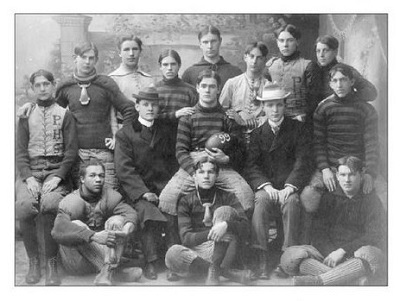
Still, 33 games were played by the high school teams belonging to the “Michigan Interscholastic Football League.” Pontiac, which defeated Bay City in the semifinals, emerged as the state’s first playoff champion with a thrilling 6-5 victory over Western representative Plainwell before a reported crowd of 1,000. Plainwell had downed Escanaba in the semis to reach the final game.
U.P. Power
Because of the complications, talk of disbanding the league erupted in the media. But, with some minor modifications, including more local control over scheduling, the playoffs were again planned for the fall of 1900.
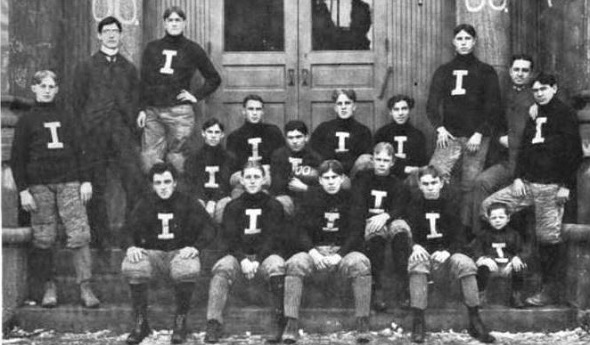
Ishpeming and the Michigan Military Academy of Orchard Lake emerged from a field of 34 teams to square off for the title at Regents Field. In a battle of “speed against weight,” the boys from the Upper Peninsula, averaging 135 pounds, completely outplayed their heavier opponent, and grabbed a 12-5 win. According to The Michigan Alumnus, financially, the event lost money, as a crowd of only around 300 attended the title game. Still, the university saw the “Interscholastic” as a success. According to the university’s annual, Michiganian, during the season, the Athletic Association was forced to apply “some severe measures in its governance of the football contests, thus showing members of the league that they must learn to be square and businesslike.”
On the other hand, the championship contest served as a great opportunity to expose athletes to the campus. Without question, recruitment of future university athletes was an underlying desire. Anderson of Ishpeming was identified as the top player of the day. According to the Alumnus, “Michigan needs a few such as he.”
By mid-November, the 1901 interscholastic series saw the race narrowed to Kalamazoo, Lansing, Orchard Lake, Ann Arbor, Alpena and South Haven in the Lower Peninsula, while Ishpeming, which knocked off Escanaba 11-0, had emerged again as the Upper Peninsula champion. Ultimately, Kalamazoo downed Lansing on Thanksgiving Day to set the stage for the title game on Saturday, Dec. 7.
Although cost concerns related to bringing Ishpeming to Ann Arbor threatened to derail plans for the championship game, the contest was played. In a close battle, the faster Ishpeming squad again prevailed, 27-21. The team returned to the U.P. to a great reception. According to the Detroit Free Press, “a procession was formed at the depot with the footballists occupying seats on a chariot. … Mine whistles and bells of the city sounded for thirty minutes, while thousands of school children and others gave school yells.” It was estimated that 8,000 fans came out, making a procession six blocks long.
In 1902, Escanaba nearly ended Ishpeming’s championship reign, as the teams played to a scoreless tie in early November. However, ties in Interscholastic League action meant the game had to be replayed. Ishpeming downed Escanaba, 11-5, in the rematch and again returned to Ann Arbor for the championship game. There they flexed their speed and skills in a 35-12 victory, this time over Lower Peninsula champion Benton Harbor in a game played at Michigan’s Ferry Field. A total of 34 high schools participated in the Interscholastic League that fall.
Financial challenges and eligibility questions
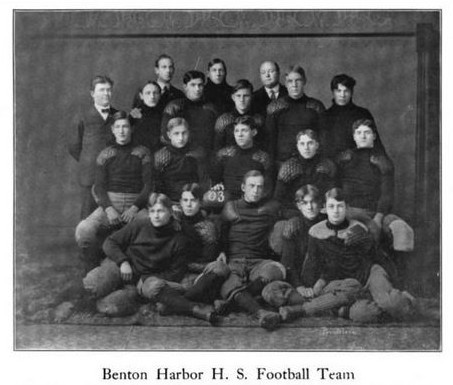
Benton Harbor returned to the championship game in 1903 with a squad averaging 160 pounds, unusually heavy for the time. Up north, Escanaba defeated Ishpeming 34-2 to punch its ticket to Ann Arbor. The state championship contest, played on Thanksgiving Day, was one-sided and decisive as Benton Harbor rolled to a 22-0 victory. According to press reports, at no time was their goal line “in danger.” The championship series, however, was threatened as university officials again declared the title game was simply unprofitable as travel costs outweighed ticket revenue.
Still, another attempt was made in 1904 as 46 schools, 29 from the Lower Peninsula and 17 from the U.P., opted to battle for the Interscholastic football crown. League contests opened Oct. 1 with the Lower Peninsula championship game scheduled for Nov. 19. Many schools, especially in the larger cities, continued to avoid participation, due to the inconvenience of arranging contests around Interscholastic dates, as well as the simple fact that more revenue could be generated by playing local or familiar opponents.
 In a major upset, Mount Pleasant won the 1904 Lower Peninsula championship honor by downing heavily-favored Benton Harbor 11-0 at Fancher Field in Mount Pleasant before a crowd of 1,800. Five passenger coaches, filled with Benton Harbor fans and a band, made the trip north for the early morning game. Fred Norcross, quarterback and incoming captain of the University of Michigan football team, was also in attendance. Quoted in the Michigan Daily, he lent some insight into the way the game was played at the time.
“It was a good clean game, free from slugging and unnecessary roughness, and the way the Mt. Pleasant boys worked to help the man with the ball along was great,” he said. “They would drag a man five yards after he was down.”
Escanaba, a 12-6 winner over Menominee, earned the U.P. crown. The Interscholastic championship game at Ann Arbor on Thanksgiving Day was surrounded with controversy. Just prior to the game, a protest had been raised by Benton Harbor with claims that Mount Pleasant had used an ineligible player in their contest. Bay City, defeated by Mount Pleasant in Interscholastic play the previous week, joined the protest. The complaints, it appears, were dismissed, as Escanaba defeated Mount Pleasant 16-5 for the state title. Following its school’s defeat in the title contest, the Mt. Pleasant Courier “denounced the Escanaba team as having three ineligibles.”
Following the game, newspapers reported that both Detroit Central and Muskegon finished the season undefeated and were considered outstanding teams, but since they did not compete in the Interscholastic series, both were unable to lay claim to the official state title.
Tightening the rules
Perhaps as a result of questions concerning eligibility that surrounded the previous season, the 1905-06 school year brought changes. The management duties of the Interscholastic Athletic League now fell into the hands of a state “Athletic Director,” the duties of which were assumed by Principal C. G. Wade of Flint. A tightening of regulations and rules tied to management of high school athletics in Michigan also were enacted. Very specific requirements for enrollment, age and allowed number of years of eligibility were defined. Players could not be compensated for their athletic skills. Transfer between schools now required certification of eligibility from a superintendent or principal before a student was allowed to compete at a different school. Football players needed to pass a physical examination and have parental consent to compete. Passing marks, as defined by the school, were now a requirement for play.
Participation decreased as some of the state’s larger schools joined the League.
“What is the matter with the high schools of the third inter-scholastic district?” asked a writer in the Benton Harbor News-Palladium at the beginning of the 1905 season when it was announced that only three teams – Benton Harbor, Plainwell and Allegan – would compete in their section of the Interscholastic League. “Where is Kalamazoo? Is South Haven afraid? Does Hastings know anything about football? Why don’t St. Joseph enter the race? What is the matter with Cassopolis and the other places in the district …”
The tournament fell into disarray in the final weeks of November. Ishpeming was identified as the U.P. champion, but as of Nov. 24, it appeared that the state title would not be decided. Frontrunners for the Lower Peninsula crown were Ann Arbor and Grand Rapids Central, but the schools couldn’t come to an agreement on a location for the game. A ruling by director Wade identified Grand Rapids as the proper venue, but Ann Arbor felt the game should be played locally.
Then Kalamazoo High School announced it felt it should be the team playing Ann Arbor for the Lower Peninsula crown as it had beaten Grand Rapids earlier in the year. With an undefeated and unscored upon record, Kalamazoo should be an obvious choice.
Wade noted that while Kalamazoo had impressive record, the school had chosen not to participate in Interscholastic League play. Since the game with Grand Rapids was not considered an Interscholastic contest, the loss didn’t affect Grand Rapids’ pursuit of the League title.
Finally, since Ann Arbor refused to travel, it were forced by the league to forfeit the semifinal game. So, a championship contest between Grand Rapids and Ishpeming was scheduled.
Plans to play the game at Ann Arbor, announced earlier in the season, were scuttled and the contest was scheduled for 10:30 a.m. at Ramona Park in Grand Rapids. The Upper Peninsula again emerged as champion, as Ishpeming exposed a weak Grand Rapids defense and posted a 17-5 victory. The move of the game to the site of one of the participants appeared to be a wise one, as 800 paid admissions were collected.
(In an interesting turn of events, Ann Arbor opted, instead, to play a Thanksgiving Day road game with Kalamazoo High. Kalamazoo downed Ann Arbor 16-0 to finish the year as the state’s first unbeaten, untied and unscored upon team.)
The format unravels
Nationally, the brutality and danger of football was being discussed, and calls were to ban the game. President Teddy Roosevelt heard the cries and convened a panel of football authorities to investigate and suggest changes to save the game he loved. In 1906, sweeping alterations to the rules were unveiled and opened the game to the forward pass.
That fall, Muskegon and Benton Harbor emerged as finalists for the Lower Peninsula title. Muskegon had defeated Benton Harbor earlier in the season; however, in a twist of league rules, since the game had not been scheduled by the League office, the result of the contest had no impact on the championship series. After much debate over location and selection of officials, a record-breaking crowd of 1,500 was expected in Muskegon for the rematch, as the implications from a victory drew interest well beyond the borders of both cities. Extra streetcars were scheduled to move the crowd to the site of the contest, and the newspaper social pages were filled with reports of folks heading to Muskegon for the game.
Outplayed and out punted, the “Red and White of Muskegon” fought to the finish before a crowd of “about 1,600 paid admissions,” but fell 20-0 to the “orange sox” of Benton Harbor. The visitors capitalized twice on Muskegon fumbles, scoring a touchdown early in the game and another off a mishandled punt.
Revenue of over $500 (equaling around $13,000 in 2016) was generated from ticket sales. With expenses of around $175, including the $125 paid to Benton Harbor management, organizers were pleased. The following week Benton Harbor agreed to bear the expense if Escanaba would “defend the championship of the Upper Peninsula” in a Saturday, Nov. 24 game to be played in Benton Harbor, with University of Michigan officials in charge.
The Escanaba team left Wednesday for the event and arrived on Friday. The visitors ran through signals at Benton Harbor’s Fourth Division Armory before retiring for the night.
“Before a madly enthusiastic throng of three thousand spectators, Benton Harbor ran wild, overwhelming their guests from Escanaba, 50-0.
More complications
Still, dissention surfaced. Officials at Muskegon High School announced plans to resume playing an independent schedule in 1907, due to concerns about play of ineligibles appearing in its game with Benton Harbor the previous year, and ringers appearing in a spring baseball championship sponsored by the Interscholastic. A newspaper article in October noted the league was down to three teams: Ann Arbor, Saginaw and Benton Harbor. According to a report in the Muskegon Chronicle, the “arbitrary manner in which the executive committee arranged games” was stated as the primary reason the League was disfavored. Because of this, it was generally expected that the Interscholastic League would wither and die within a year.
Yet by season’s end, Muskegon was involved in the mix for a state title.
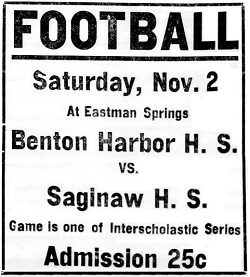 After three contests, it appears “the Red and White” had a change of heart and applied for membership in the Interscholastic League. As of Nov. 7, six teams were still in the state title race: Alpena, Saginaw, Muskegon, Big Rapids, Ann Arbor and Lansing.
In a bizarre twist, Muskegon’s later application and delays in paying a $12 membership fee to the League became the pivot point in the Interscholastic’s next move. According to a Nov. 14 Detroit Free Press article, “the question of Muskegon’s eligibility to compete for the state high school championship had been deferred (until a state board meeting) and that Saginaw would therefore play Ann Arbor. …The winner of this game will play Muskegon, if the latter is admitted, in the final of (the) state series.”
Ann Arbor High School, which had beaten Muskegon earlier in the year and stood unbeaten and unscored upon, was extremely upset by the decision. Ann Arbor now had to face Saginaw, also unbeaten, with the winner still facing the possibility of meeting once-beaten Muskegon.
A bizarre safety assessed against Ann Arbor in the final minutes of its battle with Saginaw made matters worse. Leading 6-5 near the close of the contest, an Ann Arbor player fielded a bounding punt, “lost his head” and “deliberately ran back (of) his own goal line,” where he touched it down “instead of trying to make a gain or calling ‘down’ when he picked up the ball.” The two points awarded to Saginaw were all that were necessary to win.
With that victory, many felt Saginaw had gained rightful ownership of the Lower Peninsula title. The state athletic board of control, at its meeting in Ann Arbor, formalized Muskegon’s acceptance into the Interscholastic, and voted to give Muskegon, as a member, the right to demand a game with Saginaw. Noting the earlier Ann Arbor loss, the board also suggested that, in the interest of true sportsmanship, Muskegon should concede the state crown.
Muskegon High School officials contacted Saginaw and did concede the Lower Peninsula title, but still requested a game.
Casting aside the format of past Interscholastic championships, Saginaw did not play the Upper Peninsula champion, Escanaba, but rather accepted the Muskegon challenge.
Some 400 Muskegon enthusiasts brought to Saginaw by train helped form the largest crowd ever at Recreation Park, estimated at 5,000. In the end, disappointment reigned on both sides as the contest ended in a scoreless tie.
Following the showdown, the Upper Peninsula media weighed in.
“The recent dispute between the high school football teams of Escanaba and Saginaw over conflicting claims to the state championship has caused much discussion, but as there exists no court for the decision on a controversy between an upper and lower peninsula athletic team, the matter will very likely die as it is at present and the state will have two champion football elevens,” stated the Hancock Journal.
According to the Sault Ste. Marie Evening News, Michigan needed a state interscholastic athletic association, and “it is evident that until some such organization is formed, there will be no deciding of a championship in case of contention from any of the teams in the race.”
At the conclusion of the season, “Buck” Read spoke about the failure of the Interscholastic as time went on.
“The interscholastic divided the state into sections, played the winners of the sections against each other, and finally by a process of elimination managed to arrive pretty closely at the real championship,” he said.
“The plan looked good on paper, and as long as the university exercised a direct regulation particularly in that game which was for several seasons played at Ann Arbor, the interscholastic awakened a general, definite interest. But a season prosecuted under such an uncertainly arranged schedule, as was necessarily the case, proved unusually ruinous financially to the schools participating. Often a match had to be played between towns several hundred miles apart, entailing great expense, and often providing a poor drawing card when one of the contestants was a team ordinarily of little reputation. So a number of the bigger schools drew out and arranged schedules on a financial basis. The university authorities too, finally refused to guarantee the concluding game.”
One last gasp, and a new beginning
Somehow, the Michigan Interscholastic League survived for another season, although with few participants.
Ann Arbor, led by three touchdowns from future U-M great John Maulbetsch, earned the League title, upsetting Benton Harbor, 16-5, at University of Michigan’s Ferry Field. Pontiac and the Detroit University School, teams with outstanding undefeated marks, then clamored for a chance to play Ann Arbor.
Both had competed outside the M.I.A.L. during the 1908 season. Ann Arbor ignored Detroit University School, likely the stronger of the two teams based on season results, and scheduled a contest with Pontiac for Thanksgiving Day. The game was won by Ann Arbor 24-0.
At the Schoolmasters’ Club meeting on April 2, 1909, the High School Athletic Committee addressed the broadest issue that the Michigan State Teachers’ Association faced. It was recommended “there be formed a State organization to be composed of all high schools of the State that will sign an agreement to abide by the laws passed at the meetings of the Schoolmasters’ Club.”
It is also recommended to the committee, “that (athletically) a full schedule of all the schools in this organization shall not be made but that the different schools make out their own schedule and from such schools in the organization as they most prefer.”
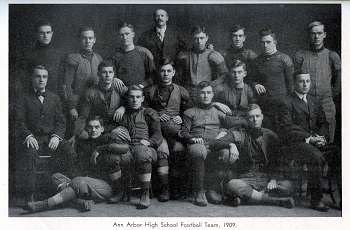 The upcoming 1909 season saw a further tightening of the athletic rules, as the Michigan Schoolmasters’ Association issued strict code that barred paid coaches, requiring instead that a school’s coach must be part of the faculty of the school. In addition, “sweaters and such awards cannot be made to the athletes, only ribbons and banners being given.”
In mid-August, the Detroit Free Press stated that the new rules would be unacceptable to most: “Most of (the state schools) are not prepared, and it looks like a safe bet that the Michigan Interscholastic contenders are not going to chase out some professor that knows football of a few years back and risk their reputations on his game.
“Then there is the matter of awards. The schoolmasters have tabooed the sweaters and that stuff, and will in the future award a ribbon or something similar,” continued the paper. “Where will the big old numeral of days gone by come in? How many football men will play for the honor of the school, and not have the pleasure of sporting the big letter on their manly breasts?”
The new rules, along with complaints concerning the handling of previous tournaments and various other issues, resulted in the final unraveling of the Interscholastic League.
“… Interest in high school football will not decline because of the death of the interscholastic league,” stated a September 1909 syndicated article that appeared in the Benton Harbor News-Palladium and the Grand Rapids Press. “The leading high school teams of the state have banded together in much the same old way and will play for the championship of the state just as though the league or even something better existed.”
With a number of athletes back, Ann Arbor again ended the year with Lower Peninsula laurels. Its schedule included wins over Muskegon, Detroit Central, Saginaw and Grand Rapids. On Thanksgiving Day, the “Purples” defeated Menominee, a power from the Upper Peninsula, 42-0.
“This victory gives the local high school a clear title to the state championship,” stated the Ann Arbor Daily Times News.
The following year saw a major change that eventually would set wheels in motion to create the system of determining football champions we have today.
On Oct. 28, 1910, at the M.S.T.A. convention held in Bay City, a new organization, the Michigan Interscholastic Association, was formed. It served the state’s schools until December 1924, when it was replaced by today’s Michigan High School Athletic Association.
The first MHSAA Football Playoffs were conducted in 1975. The 42nd version of the tournament concluded this Thanksgiving weekend.
 Ron Pesch has taken an active role in researching the history of MHSAA events since 1985 and began writing for MHSAA Finals programs in 1986, adding additional features and "flashbacks" in 1992. He inherited the title of MHSAA historian from the late Dick Kishpaugh following the 1993-94 school year, and resides in Muskegon. Contact him at [email protected] with ideas for historical articles.
PHOTOS: (Top) Ishpeming's 1900 football team, the second Interscholastic League champion. (Middle top) Pontiac's 1899 team, which won the first League title. (Middle) Benton Harbor's 1903 championship team. (Middle below) An advertisement tells of the 1907 Saginaw/Benton Harbor final. (Below) Ann Arbor's 1909 championship team. (Photos collected by Ron Pesch.)