

A Game for Every Fan: District Openers
October 30, 2014
By Geoff Kimmerly
Second Half editor
Friday begins another five-week journey to whittle 272 MHSAA football playoff qualifiers to nine champions.
But many more than nine teams have something to celebrate over the next month:
- Burton Atherton, Lapeer, Ypsilanti, Big Rapids Crossroads Academy and New Haven Merritt Academy are appearing in the playoffs for the first time. Lapeer is in its first year as a school.
- Brethren (1990), Manton (1994), Fraser (1998), Harrison (1999), Romulus (2000), Bad Axe (2001), Riverview Gabriel Richard (2003), Leroy Pine River (2005), Newberry (2005) and Quincy (2005) all are in the postseason for the first time in more than a decade.
- Rockford, with 20 straight appearances, has taken over the longest active playoff streak with Felch North Dickinson not qualifying this fall for the first time since 1990. Menominee has qualified 19 straight seasons, and Crystal Falls Forest Park is next with 18 straight.
- Beal City has made the playoffs 15 straight seasons and an MHSAA-best 32 times overall, following by Farmington Hills Harrison with 31 appearances and Forest Park with 30.
- All nine champions from 2013 are back, although Marine City is in Division 5 after winning Division 4 a year ago. All but one of last season’s 18 finalists made the field again. Ithaca is going for its fifth straight title, and Birmingham Brother Rice is seeking its fourth straight.
And it all begins this weekend. Read on for some of the best matchups from each division. All are Friday unless noted.
DIVISION 1
Fraser (6-3) at Dearborn Fordson (9-0)
Fraser was among big celebration stories Sunday after earning its first playoff berth since 1998 – in fact, the Ramblers have achieved their first winning season since 2001 and were 3-6 only a year ago. Fraser also opened this fall 1-3 before winning five straight to qualify – so there’s a lot here to praise. But Fordson has high expectations as well. The Tractors have made the playoffs nine straight seasons but not past the District opener since 2011. Three of their last five wins this fall are over playoff teams – and Fordson gave up single-digit points in seven victories.
Others that caught my eye: Waterford Mott (6-3) at Walled Lake Central (7-2), Plymouth (7-2) at Livonia Churchill (7-2), Hudsonville (5-4) at Holland West Ottawa (5-4).
DIVISION 2
Caledonia (7-2) at Muskegon Mona Shores (8-1), Saturday
For statewide fans, this is the most intriguing game of opening weekend. Their first meeting wasn’t much to discuss – Mona Shores won big, 40-7. But since, Caledonia has outscored its five opponents by a combined 187-27. Four of those opponents are in the playoffs, and total the Fighting Scots have beaten six playoff teams from arguably the strongest area of the state. That said, Mona Shores might be the best from the west right now, given arguably its most memorable win ever last week, 48-27 over Muskegon. Quarterback Tyree Jackson will finish his career among the leading passers in MHSAA history, and his offense is averaging 41 points per game.
Others that caught my eye: Portage Northern (6-3) at Portage Central (7-1), Farmington Hills Harrison (7-2) at Fenton (9-0), Southfield (6-3) at Detroit Martin Luther King (8-1).
DIVISION 3
East Grand Rapids (6-3) at Lowell (8-1)
The Red Arrows own four straight wins over their Ottawa-Kent Conference White rival. But it’s important to put the last couple of matchups in perspective; Lowell helped keep East Grand Rapids out of the playoffs in 2011 with a 42-39 win and then won 30-25 in Week 3 this fall. The Pioneers would surely enjoy returning to the playoffs after two years off by ending Lowell’s season in a District opener.
Others that caught my eye: Grand Rapids Forest Hills Northern (7-2) at Cedar Springs (8-1), Mount Pleasant (6-3) at Marquette (7-2) on Saturday, Grand Rapids Christian (5-4) at St. Johns (8-1).
DIVISION 4
Goodrich (7-2) at Saginaw Swan Valley (9-0)
It will be tough for Swan Valley to not look ahead to a possible District Final matchup with Lansing Sexton, the only team to beat the Vikings the last two seasons (in last year’s Regional Final). But they know to be careful with Goodrich, their District Final opponent in 2012 and the second-place team this fall in the solid Genesee Area Conference Red. Swan Valley has enjoyed senior running back Alex Grace to the tune of 7,055 rushing yards while building a 30-4 record over the last three seasons – he’s currently fifth all-time for career rushing yards in MHSAA history and could move up to third on the list with a big game Friday.
Others that caught my eye: Paw Paw (6-3) at Edwardsburg (8-1), Williamston (7-2) at Lansing Sexton (9-0), Detroit Country Day (5-4) at Detroit Denby (5-4) on Saturday.
DIVISION 5
Muskegon Oakridge (8-1) at Hopkins (8-1)
This is another of the few battles between league champions highlighting the first weekend; Hopkins won the O-K Silver and Oakridge claimed the West Michigan Conference title. Oakridge’s lone loss came on opening night to reigning Division 5 champion Grand Rapids West Catholic, and the Eagles fell just shy of playing for that title last fall losing to Menominee in a Semifinal. But Hopkins earned enough playoff points to host this week with a strong nonleague slate – in addition to beating Grand Rapids NorthPointe Christian to win its O-K division, the Vikings also beat Schoolcraft and lost to Allendale in nonconference play. All three are playing this weekend as well.
Others that caught my eye: Lakeview (8-1) at Remus Chippewa Hills (7-2), Newaygo (7-2) at Reed City (7-2), Stockbridge (6-3) at Olivet (7-2) on Saturday.
DIVISION 6
Montrose (6-3) at Flint Beecher (9-0)
With its long winning tradition and after losing by only a point to Ithaca in a Semifinal last fall, Montrose might still be considered by some the favorite in this District opener – despite losing to Beecher 19-14 only two weeks ago in the deciding game of the GAC Red. In fact, Beecher will make its eighth straight playoff appearance and finished perfect for the regular season for the second time in six years, and made the Semifinals in 2012. Montrose did give the Buccaneers their toughest game this season – but the Rams have plenty to prove with three losses over their last five games and no wins this season over teams with winning records.
Others that caught my eye: Niles Brandywine (8-1) at Watervliet (8-1), Manchester (8-1) at Clinton (9-0), Schoolcraft (6-3) at Constantine (8-1).
DIVISION 7
Iron Mountain (6-3) at Iron River West Iron County (8-1)
Despite the shared mineral in their names, these schools actually are about 45 miles apart along the Michigan/Wisconsin border. But the rivalry burns as if they are neighbors, even though they also play in different leagues. They’ve faced each other annually for nearly 50 years and often twice of late with a rematch in the playoffs. West Iron won the first game this year, 24-0, but the Mountaineers are 5-1 since despite one-point wins each of the last two weeks.
Others that caught my eye: Ishpeming Westwood (6-3) at Ishpeming (8-0), Pewamo-Westphalia (7-2) at Union City (8-1), Homer (7-2) at Hudson (8-1).
DIVISION 8
Hillman (8-1) at Johannesburg-Lewiston (8-1)
This is a rematch of a 2012 playoff opener, a 62-14 Johannesburg-Lewiston win, but things have changed slightly. That year Hillman was an at-large qualifier at 5-4; this season the Tigers have only a loss to undefeated Whittemore-Prescott. The Cardinals have beaten three playoff teams, falling only to St. Ignace in Week 5, and quietly built on one of the consistently strong programs in the northern Lower Peninsula – they’ve won at least eight games four seasons running.
Others that caught my eye: Indian River Inland Lakes (7-2) at Munising (8-1), Clarkston Everest Collegiate (6-2) at Waterford Our Lady (8-1) on Saturday, Pittsford (7-2) at Climax-Scotts (8-1).
8-PLAYER
Bellaire (7-2) at Cedarville (8-1) on Saturday
Cedarville’s football program probably has looked forward to this week for nearly a year – the Trojans were upset 28-26 in their playoff opener last season by league foe Engadine, a year after a similar upset at the hands of rival Rapid River in a 2012 Regional Final. Cedarville seems on the cusp of big things again – but this time must first face Bellaire, another Bridge Football Alliance opponent. The Eagles are seeking their first 8-player win in five games against the Trojans after falling to them 57-14 only two weeks ago.
Others that caught my eye: Kingston (6-3) at Owendale-Gagetown (8-1), Portland St. Patrick (8-1) at Lawrence (9-0) on Saturday, New Haven Merritt Academy (6-3) at Morrice (5-4) on Saturday.
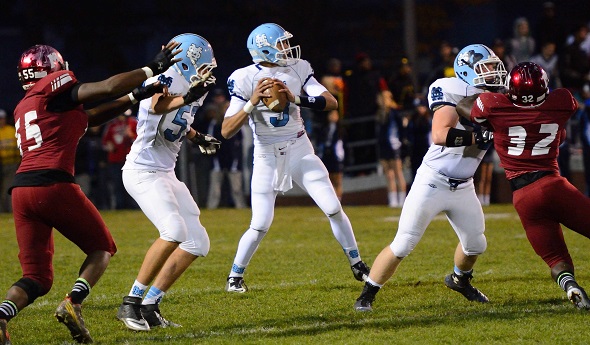
PHOTO: Mona Shores quarterback Tyree Jackson prepares to throw during last week’s victory over rival Muskegon. (Photo courtesy of Eric Sturr.)
1st & Goal: 2022 Week 6 Preview
By
Geoff Kimmerly
MHSAA.com senior editor
September 30, 2022
Many Michigan football league play right through the end of the regular season, although often league championships are decided by power-packed matchups in Weeks 6, 7 or 8.
 This Week 6 is shaping up as perhaps the week that may most shape the 2022 regular season.
A number of eventual conference champions could be decided tonight – some surely by the eight matchups of teams entering the weekend both 5-0.
Games below are Friday unless noted. Click for the full schedule from MHSAA.com and check out the broadcast schedule from MHSAA.tv.
Bay & Thumb
Saginaw Nouvel (4-1) at Saginaw Michigan Lutheran Seminary (5-0)
MLS quietly has been dominating this season, with its 233 points only 24 shy of the team’s total over nine games last season. While three wins have come against teams that remain without a victory, a fourth was 43-32 over Marine City Cardinal Mooney, which leads the Detroit Catholic League Intersectional 2. MLS’s next two games – this one against Nouvel and next week against Ithaca – should be similarly tough and will decide if the Cardinals will claim the Tri-Valley Conference 10-2 title, which would be their first league championship since their most recent overall winning season in 2019. Nouvel’s only loss was to Ithaca in Week 3.
Keep an eye on these FRIDAY Almont (3-2) at Croswell-Lexington (5-0), Grand Blanc (3-2) at Lapeer (5-0), Linden (4-1) at Swartz Creek (5-0), New Lothrop (5-0) at Montrose (3-2).
Greater Detroit
Warren De La Salle Collegiate (4-1) at Detroit Catholic Central (4-1), Sunday
Every season this game means something, and this season it’s likely to again determine the Detroit Catholic League Central title. DCC went undefeated in Central play to win the league championship in 2020, but relinquished it to the Pilots last season as De La Salle downed the Shamrocks 17-7 in what ended up the title decider. Both teams have done serious work over the first five weeks this fall. DCC came back from a season-opening loss to Clinton Township Chippewa Valley with wins over Davison, DeWitt, Detroit U-D Jesuit and Bloomfield Hills Brother Rice by two points. De La Salle’s only loss was by a point to Rice, and the Pilots own wins over Detroit Renaissance, Muskegon, Jesuit and Orchard Lake St. Mary’s.
Keep an eye on these FRIDAY Davison (4-1) at Walled Lake Western (5-0), Detroit Central (5-0) at Detroit Northwestern (4-1), Marine City (4-1) at Madison Heights Lamphere (4-1), Macomb Dakota (5-0) at Romeo (4-1).
Mid-Michigan
Portland (4-1) at Charlotte (5-0)
This could be Charlotte’s biggest game since 2008, when it shared the Capital Area Activities Conference Gold title with DeWitt and Haslett. A win over the Raiders would give the Orioles a share of the CAAC White championship – a nice jump after going 2-3 in league play last season. Charlotte has had only four overall winning seasons since 2008 but has all but guaranteed one this fall. Portland, meanwhile, is a five-point Week 2 loss from being undefeated and looking to take back the White after seeing a league title streak end at six last season.
Keep an eye on these FRIDAY Marshall (4-1) at Hastings (4-1), Gladstone (5-0) at Durand (5-0), DeWitt (3-2) at Grand Ledge (4-1), Olivet (4-1) at Pewamo-Westphalia (3-2).
Northern Lower Peninsula
Charlevoix (5-0) at Boyne City (5-0)
Boyne City’s last league loss was to eventual champion Charlevoix in 2020. Charlevoix’s only league loss since 2019 was last year to eventual champion Boyne City. And that makes for a pretty solid rivalry as this matchup could again decide the Northern Michigan Football Conference Leaders title. Charlevoix hasn’t given up a point since opening night – with a 48-0 shutout of third-place Elk Rapids among the four straight. Boyne City won by forfeit last week but is barreling along at 46 points per game – making the Ramblers’ offense vs. the Rayders’ defense the matchup of the night.
Keep an eye on these FRIDAY East Jordan (3-2) at Frankfort (4-1), Sault Ste. Marie (4-1) at Kingsley (3-2), Cadillac (3-2) at Petoskey (2-3), Evart (4-1) at McBain (2-3).
Southeast & Border
Clinton (5-0) at Dundee (5-0)
Dundee football re-arrived on the scene in 2019 with its first playoff appearance since 2013, and the Vikings took it a step farther last season making the District Finals for the first time since 2011. A win this week would be another giant step, as Clinton has won nine or more games the last three seasons and continues to be a major contender in the Lenawee County Athletic Association. Clinton has won its first three league games this fall by a combined 137-13, and Dundee has given up only 20 points over its first three including against two of the same opponents.
Keep an eye on these FRIDAY Union City (4-1) at Addison (4-1), Ann Arbor Huron (3-2) at Dexter (5-0), Napoleon (5-0) at Grass Lake (3-2), Tecumseh (5-0) at Jackson (3-2).
Southwest Corridor
Berrien Springs (5-0) at Buchanan (4-1)
These two are part of the inaugural Lakeland Conference, with Benton Harbor, Dowagiac and Niles Brandywine, and a win tonight would put Berrien Springs one away from earning the first league title (while a win combined with a Brandywine loss to Benton Harbor would give the Shamrocks a share of the championship). These two also are rivals from the former Berrien-Cass-St. Joseph Conference, and Berrien Springs has won six of the last seven meetings – but Buchanan already has more wins this fall than all of last season.
Keep an eye on these FRIDAY Edwardsburg (4-1) at Paw Paw (3-2), Portage Northern (3-2) at St. Joseph (4-1), Allegan (3-2) at Constantine (4-1), Battle Creek Central (4-1) at Portage Central (2-3).
Upper Peninsula
Calumet (3-2) at Iron Mountain (4-1)
Iron Mountain is up to No. 3 in Division 8 playoff-point average, ahead of four undefeated teams thanks to that lone loss coming to unbeaten Division 6 Negaunee. But Calumet has been a bit of a thorn during a strong five-year run by the Mountaineers, winning two of three meetings on the field since Iron Mountain joined the Western Peninsula Athletic Conference in 2018. The Copper Kings won last year’s matchup 21-6 and have picked up three straight wins (one a forfeit) this fall since opening the season with losses to Negaunee and Gladstone – arguably the two best teams in the Upper Peninsula.
Keep an eye on these FRIDAY Negaunee (5-0) vs. L'Anse (3-2), Maple City Glen Lake (3-2) at St. Ignace (4-1), Bark River-Harris (3-2) at Manistique (2-3). SATURDAY Detroit Old Redford (3-2) at Kingsford (3-2).
West Michigan
Grand Rapids Catholic Central (5-0) at Grand Rapids South Christian (5-0)
Grand Rapids Catholic Central’s 41-game winning streak may face one of its toughest challenges yet – and that’s saying something as the Cougars defeated South Christian by only a point in 2020 and have won three straight Division 4 or 5 Finals. GRCC already has outlasted Ada Forest Hills Eastern and held on against Cedar Springs to defeat the latter by a point. But the Sailors have yet to play a game closer than 22 points – that one a 28-6 win over Cedar Springs – and have given up only 33 points on the year.
Keep an eye on these FRIDAY Whitehall (5-0) at Muskegon Oakridge (5-0), Lowell (4-1) at Grand Rapids Forest Hills Central (5-0), Grandville (4-1) at Rockford (5-0), Muskegon Mona Shores (4-1) at Zeeland West (5-0).
8-Player
Morrice (5-0) at Merrill (5-0)
This almost assuredly will end up deciding the Central Michigan 8-Man Football Conference championship, as these two sit atop the standings and two games ahead of four more teams tied for third. Merrill is ranked No. 4 in Division 1, and Morrice is No. 6 in Division 2, and neither has faced a massive challenge yet – the closest game for both was a 22-point win over Breckenridge. Morrice has been among standard-setters in 8-player, with a combined 46-4 record over the last five seasons. But Merrill appears on the verge of joining the elite coming off its first win over annual power Portland St. Patrick since moving to 8-player in 2020.
Keep an eye on these FRIDAY Brown City (4-1) at Britton Deerfield (3-2), Climax-Scotts (5-0) at Colon (5-0), Pickford (4-1) at Munising (5-0), Martin (5-0) at Grand Rapids NorthPointe Christian (5-0).
Second Half’s weekly “1st & Goal” previews and reviews are powered by MI Student Aid, a part of the Office of Postsecondary Financial Planning located within the Michigan Department of Treasury. MI Student Aid encourages students to pursue postsecondary education by providing access to student financial resources and information. MI Student Aid administers the state’s 529 college savings programs (MET/MESP), as well as scholarship and grant programs that help make college Accessible, Affordable and Attainable for you. Connect with MI Student Aid at www.michigan.gov/mistudentaid and find more information on Facebook and Twitter @mistudentaid.
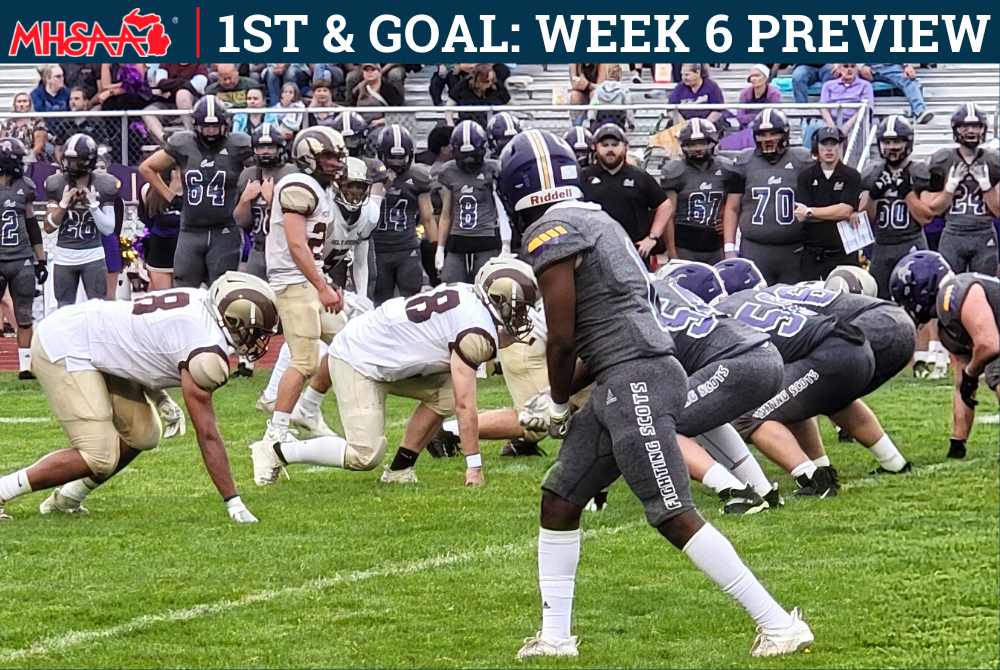
PHOTO Caledonia, on defense, faces Holt during a season opener. (Click for more from High School Sports Scene.)