

A Game for Every Fan: Regional Finals
November 15, 2013
By Geoff Kimmerly
Second Half editor
It’s both notable, yet logical, that 25 undefeated teams remain among the 68 still alive in the MHSAA football playoffs heading into this weekend.
At this point in the season, the best teams rise to the top. But maintaining perfection over 11 weeks is something worth celebrating regardless – even as at least three of those teams are guaranteed to fall this weekend.
Three of 32 11-player Regional Finals will feature matchups of undefeateds this weekend. Both 8-player Semifinals also feature one team that hasn't lost.
A total of 13 games will be played tonight, with the other 21 – including both 8-player games – kicking off Saturday. See below for all 34 matchups, plus a little extra on the headliner from each 11-player division and both 8-Player semis.
Remember to follow all of the action again on MHSAA Score Center. And check out our four games live on Fox Sports Detroit’s Prep Zone: Battle Creek Pennfield at Grand Rapids South Christian, Saginaw Swan Valley at Lansing Sexton, Melvindale at St. Clair and St. Ignace at Beal City.
Division 1
Macomb Dakota (11-0) at Detroit Cass Tech (11-0)
Cass Tech has won three games by 10 or fewer points, and might need to draw on that experience again in this Regional Final. Dakota’s success coming out of the solid Macomb Area Conference Red mirrors that of the Technicians, even as its stars are a little less known statewide. Cass Tech has won the last two Division 1 titles, and that know-how no doubt will come in handy in this titanic clash.
Other Regional Finals: Hudsonville (8-3) at Flint Carman-Ainsworth (10-1), Rochester Adams (8-3) at Clarkston (10-1), Detroit Catholic Central (9-2) at Temperance Bedford (11-0).
Division 2
Detroit Martin Luther King (9-1) at Wyandotte Roosevelt (11-0)
This is Roosevelt’s third straight Regional Final and it is playing for a second straight Semifinal berth against a team that lost only to Cass Tech this fall. The difference this time might be the Bears’ offense, which is averaging 45 points per game and already has scored 100 more than in any season of its modern history. They’ll need to light up the board to keep up with King playmakers Jalen Embry and Avonte Maddox, who both will play at high-major schools at the college level.
Other Regional Finals: Midland (10-1) at Muskegon (10-1), Farmington Hills Harrison (10-1) at Portage Central (11-0), Detroit U-D Jesuit (7-4) at Birmingham Brother Rice (11-0).
Division 3
Zeeland West (10-1) at Mount Pleasant (10-1)
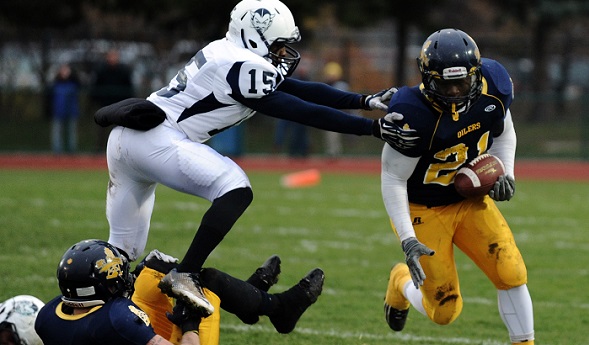
This has the feel of a Semifinal, with these two having survived wild runs already to get to this point. West avenged a Week 2 loss to Zeeland East to start the playoffs and then eliminated reigning champion Grand Rapids Christian last week – after closing the regular season with a 36-13 win over Byron Center, a possible opponent next week. Mount Pleasant bounced back this fall after finishing Division 3 runner-up in 2011 and then falling to 2-7 a year ago. The Oilers’ only loss was on opening night to DeWitt, which has emerged as the favorite in this division.
Other Regional Finals: Byron Center (8-3) at Stevensville Lakeshore (8-3), Eaton Rapids (7-4) at DeWitt (11-0), Melvindale (9-2) at St. Clair (10-1).
Division 4
Saginaw Swan Valley (11-0) at Lansing Sexton (11-0)
This game could be over in less than two hours with the way these two run the ball. Swan Valley junior Alex Grace is approaching the MHSAA single-season rushing record of 2,890 yards after also topping 2,000 last season. Sexton, meanwhile, hasn't scored fewer than 32 points since September and blends a strong inside running game with plenty of speed on the perimeter.
Other Regional Finals: Cadillac (11-0) at Comstock Park (11-0), Battle Creek Pennfield (10-1), at Grand Rapids South Christian (10-1), Detroit Country Day (8-3) at Marine City (10-1).
Division 5
Monroe St. Mary Catholic Central (10-1) at Livonia Clarenceville (11-0)
The last time Clarenceville made this kind of run was in 2001, when superstar Tim Shaw was finishing off a record-setting effort that would take him to Penn State and then the NFL. The Trojans have been rolling since opening this fall with three wins by seven or fewer points during the season’s first five weeks, although they had to survive a tough test in the District Final against Detroit University Prep. This is usual territory for St. Mary, which has won 10 games for the fifth time in six seasons and is playing for its second straight Semifinal berth.
Other Regional Finals: Standish-Sterling (9-1) at Menominee (11-0), Millington (9-2) at Muskegon Oakridge (10-1), Grand Rapids West Catholic (7-4) at Olivet (10-1).
Division 6
Madison Heights Madison (11-0) at Montrose (11-0)
Since the brackets came out four weeks ago, this has been seen as the likely matchup to decide which team might have the best chance to end Ithaca’s national-best winning streak (53 games). Coming off four straight shutouts, Madison barely survived last week against Flint Beecher, which plays in Montrose’s league and lost to the Rams by 16 in their matchup this fall. Montrose has crushed two strong opponents – Reese and Saginaw Nouvel – to start the playoffs and no doubt would love to see the Yellowjackets again after falling to them in the playoffs the last three years.
Other Regional Finals: Negaunee (10-1) at Ithaca (11-0), Schoolcraft (10-1) at Shelby (10-1), Constantine (7-4) at Clinton (11-0).
Division 7
Pewamo-Westphalia (10-1) at Harbor Beach (10-1)
Keyed by veteran quarterback Eli Kraft and a sturdy defense, Harbor Beach has made a nice jump into Division 7 after winning Division 8 in 2012. But Pewamo-Westphalia likely will be Harbor Beach’s strongest test to this point. P-W had to come back at the end last week to beat Carson City-Crystal but also beat a league champion the week before in Saugatuck.
Other Regional Finals: Lake City (10-1) at Ishpeming (11-0), Decatur (8-3) at Homer (10-1), Southfield Christian (10-1) at Detroit Loyola (11-0).
Division 8
Muskegon Catholic Central (9-2) at Mendon (11-0)
These southwestern powers are plenty familiar with each other – this will be their third straight playoff meeting and fifth in seven seasons. Muskegon Catholic hasn't lost since Week 2, also the last time it scored fewer than 40 points or gave up more than 16. Mendon is riding double figure wins for the seventh straight season with a combined score of 526-19 against its 11 opponents. That defensive effort is headed toward going down as one of the best in Michigan history.
Other Regional Finals: Felch North Dickinson (8-2) at Crystal Falls Forest Park (11-0), St. Ignace (9-2) at Beal City (11-0), Ottawa Lake Whiteford (9-2) at New Lothrop (11-0).
8-Player (Semifinals)
Kinde-North Huron (8-3) at Rapid River (11-0)
Rapid River has become an 8-player power, going 31-5 since making the switch three seasons ago. The Rockets are keyed by quarterback Jake Pearson, who has run for 2,166 yards and 39 touchdowns and throw for 963 yards and 13 more scores. North Huron is a great story as well; the Warriors were 0-9 in 2011 before improving to 6-5 last fall and then adding two more wins this season.
Lawrence (8-2) at Peck (11-0)
Peck rivals Rapid River as the most dominant team in 8-player this season, with all but two games decided by 20 points or more despite a schedule that included two matchups each against the first two 8-player MHSAA champions – Carsonville-Port Sanilac and Deckerville. The Pirates did beat Lawrence 61-38 all the way back in Week 4 – but the Tigers are primed to avenge. Last week they beat Battle Creek St. Philip after falling to St. Phil only two weeks prior.
PHOTO: Mount Pleasant (blue jerseys) ran away from Sault Ste. Marie 42-27 last week to earn this weekend’s matchup against Zeeland West. (Click to see more from High School Sports Scene.)
Chance Paying Off Big for Sturgis Again
By
Wes Morgan
Special for MHSAA.com
September 30, 2020
The entirety of 2020 thus far has been a matter of conjecture. Trying to predict anything with any degree of certainty – including the sporting world – has proved to be a worthless expenditure of time.
 That the Sturgis High School varsity football team would have as many victories in the first two weeks of the season as it had in the previous two years certainly wouldn’t have been the most absurd thought for Trojans fans. But based on recent history, it surely didn’t seem like the most likely scenario.
And it wasn’t the kind of lofty expectation anyone wanted to throw on the back of first-year head coach Chance Stewart, who was hired June 4.
The 2-0 start is the first for Sturgis since 2003. The 25-21 win over rival Three Rivers to start the year broke a seven-game losing streak for the Trojans, who finished 4-23 over the last three years.
Toss in the fact that the season itself almost didn’t materialize due to COVID-19 restrictions in the state, and that like every other program in Michigan, Sturgis will participate in the playoffs following an abbreviated regular season – and there’s a much louder buzz around town these days.
It will be only the Trojans’ third postseason appearance since Stewart’s final prep game at quarterback in Orange and Black in 2013 — a 16-0 Pre-District loss at St. Joseph. He went on to a brief stint at Western Michigan University and a phenomenal career at Hillsdale College, which yielded a G-MAC Player of the Year award, a single-season school and league record of 3,588 passing yards en route to a conference championship in 2018 and finishing with a school-record 10,064 passing yards. Stewart also recorded 73 career touchdowns in his 41 games played for the Chargers.
At just 24 years old, he’s not that far removed from the young men he’s now charged with overseeing at Sturgis. And in such bizarre times with protocols no one could have imagined just a year ago, Stewart is obviously pleased with how September unfolded.
“These kids are playing extremely hard right now,” Stewart said following the team’s 36-6 win over Allegan this past weekend. “The effort has been outrageously great for us the last two weeks. Finally getting the opportunity to come back after football was taken away from them, the effort was one thing we were hoping we wouldn’t have to worry about. And we didn’t have to. They came out ready to get after it.”
A total of 15 seniors are on the squad this year, but the roster changes weekly as Stewart has given junior varsity players an opportunity to play their way into Friday night spots with the new five-quarter rule instituted by the Michigan High School Athletic Association. Still, it’s the veteran group that mostly has fueled Sturgis so far.
“We have a great senior class here that’s leading the way for the rest of the guys, saying this is how things are going to be done now,” Stewart said. “That senior class really wants to go out on top and they really set the tone the first two weeks.”
Captains Rylee Cain (tight end/linebacker) and Brady Webb (quarterback, linebacker) were selected by their peers, and their production on the field has been solid. Webb threw for 81 yards and two touchdowns in the opener against the Wildcats. Defensively, Webb has logged 11.5 tackles (four for loss), and Cain has 13 tackles (four for loss) and an interception through the first two weeks, which included limited time on the field as the Trojans downed Allegan 36-6. Webb’s 28-yard hookup with Xander Cosby was a game-winner with 43 seconds remaining against Three Rivers.
 Stewart also pointed out the crucial play of senior Julian Alldridge, a right guard who will begin lining up at right tackle, and Jaden Bodi, who prepared in camp to play receiver and linebacker but was moved to right guard and defensive end.
“Alldridge has done a phenomenal job so far with helping out,” Stewart said. “From three weeks ago to now, (Bodi) is in two new positions with no questions asked. He just wants to do whatever he can to help the football team.”
Following Jimmy Lamb’s resignation from the head coaching position last year to focus on his new duties in an administrative role in the district, Sturgis athletics director Mark Adams believed Stewart, despite being green behind the ears, had enough experience on the field and the leadership skills to take over.
“That’s something you really need if you’re going to be a good coach,” Adams said. “When my son was growing up, Chance had his own football league at his house and teams from around (St. Joseph County) would come to it. He’s just that kind of guy. He’s organized, he’s imaginative, and talking to him in his interview about his X’s and O’s, I learned a lot of football from him then. He’s young and energetic and has a lot of great ideas, not just for football, but for the community and other things.”
Stewart always hoped to get an opportunity like this, he just didn’t expect it to come so quickly.
“It was special (playing quarterback here),” he said. “It’s special because my dad got to do it back in the 80s. Playing out here, wearing the Sturgis jersey has been really special to us.
Bigger than that, I think was just what the program was able to do for me to help me grow from just a 14-year-old scrawny kid into the person I am now. It’s because of those relationships I created out here. I was lucky enough to play for two coaches that really cared about their players in Coach (Bill) Keim and Coach Lamb — two guys to this day I still look up to. Now I get to give back in that same role that those guys were able to help me.”
 Wes Morgan has reported for the Kalamazoo Gazette, ESPN and ESPNChicago.com, 247Sports and Blue & Gold Illustrated over the last 12 years and is the publisher of JoeInsider.com. He can be reached at [email protected] with story ideas for Berrien, Cass, St. Joseph and Branch counties.
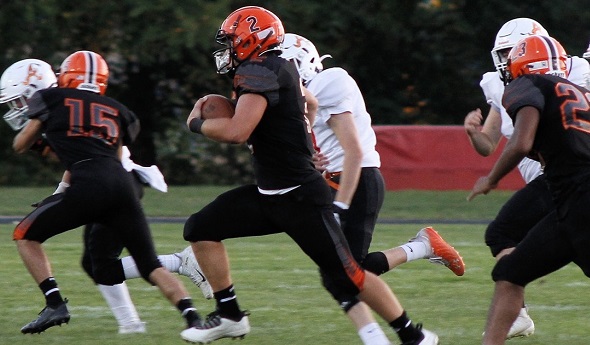
PHOTOS: (Top) A Sturgis ball carrier follows his blocks in Allegan territory during Friday’s win. (Middle) Chance Stewart has returned home to coach the high school program for which he starred at quarterback less than a decade ago. (Top photo by Scott Rains; middle by Wes Morgan.)