

A Game for Every Fan: Regional Finals
November 8, 2012
By Geoff Kimmerly
Second Half editor
Let's face it. In high school football especially, it's tough to predict which teams will be around when the big trophies are awarded Thanksgiving weekend. It wouldn't take much research to figure out how many top-ranked favorites have fallen long before finishing the drive for Detroit.
But here's a little indicator that's bearing out as this season's playoffs rush into their third weekend.
Of 64 teams still alive in the 11-player brackets, 53 ranked among the top half of their respective divisions in playoff point average. The four teams remaining in the 8-player bracket all ranked among the top six in that division.
That's rather logical, you might say. But it's also an endorsement for playing tough competition, and further makes it special when a team with a lower average breaks through at the end.
Those teams still alive despite bottom-16 playoff point averages? Congrats on great efforts by Detroit Catholic Central, Caledonia, St. Johns, Three Rivers, Clare, Newaygo, Constantine, Britton-Deerfield, Pewamo-Westphalia, Flint Beecher and Johannesburg-Lewiston.
This week's games are split evenly between Friday and Saturday, with 17 each day. Four Friday games will be streamed live on FoxSportsDetroit.com's Prep Zone: Montrose at Ithaca, Detrot Cass Tech at Saline, Saginaw Swan Valley at Croswell-Lexington and Three Rivers at Grand Rapids South Christian.
Below are all of the Regional Finals with a little extra on some of the best matchups, plus a look at both 8-player Semifinals. Visit the MHSAA Score Center for game times and dates, and all weekend for updated scores and schedules.
Division 1
Rockford (9-2) at Clarkston (11-0)
These two easily come to mind when Division 1 football is discussed. But oddly enough, they've never met. The Wolves are playing for their fourth Semifinal berth and second in four seasons, and were the most popular pick in Division 1 heading into the playoffs. But three-time MHSAA champion Rockford is finally humming after opening 1-2 this fall and losing quarterback Kyle Short for a time. He’s back, and the Rams are playing in their fifth-straight Regional Final.
Other Regional Finals: Detroit Catholic Central (7-4) at Plymouth (9-2), Detroit Cass Tech (9-2) at Saline (10-1), Macomb Dakota (10-1) at Lake Orion (10-1).
Division 2
Muskegon (10-1) at Midland (11-0)
The Big Reds no doubt enjoyed a sigh of relief after edging Lowell in last week’s District Final. But life gets no easier. Midland is working toward what would be the first 14-0 season in its similarly-impressive history, and is keyed by a likely all-state candidate at quarterback in Alec Johnson. Not that Muskegon will be intimidated – this will be its eighth game this fall against a playoff team.
Other Regional Finals: Caledonia (8-3) at Mattawan (10-1), Birmingham Brother Rice (9-2) at Walled Lake Western (9-2), Oak Park (9-2) at Wyandotte Roosevelt (10-1).
Division 3
Grand Rapids Christian (10-1) at Stevensville Lakeshore (11-0)
This may be the game of the weekend in Michigan. Neither has lost to an in-state team – Christian’s only defeat was to Ohio power Cincinnati Moeller – and both have crushed the majority of their opponents this fall. The Eagles scored a season-high 68 points against Zeeland West last week thanks to four touchdown passes plus four touchdown runs by quarterback Alex VandeVusse. This is Lakeshore’s fifth Regional Final over the last decade, and comes after a perfect run through the Southwest Michigan Activities Conference West – one of the state’s most competitive leagues this season.
Other Regional Finals: St. Johns (8-3) at DeWitt (9-2), Tecumseh (9-2) at Battle Creek Harper Creek (9-2), Detroit East English (9-2) at Orchard Lake St. Mary (9-2).
Division 4
Grosse Ile (10-1) at Detroit Country Day (9-2)
The Red Devils have won 10 games for the second straight season after making the Semifinals in 2011. This fall’s success has come against a schedule that has included six playoff teams. Country Day’s slate has included only three teams that made the postseason, but the Yellow Jackets beat a strong one last week in Pontiac Notre Dame and opened the playoffs by dropping previously-undefeated Clinton Township Clintondale 35-0.
Other Regional Finals: West Branch Ogemaw Heights (8-3) at Comstock Park (10-1), Three Rivers (8-3) at Grand Rapids South Christian (8-3), Saginaw Swan Valley (9-2) at Croswell-Lexington (11-0).
Division 5
River Rouge (11-0) at Ann Arbor Gabriel Richard (10-1)
As written on 2H on Monday, River Rouge is one of the best stories of the season – the Panthers are 11-0 for the first time and before last month had won a playoff game only once, in 2001. But this week’s opponent easily will be their toughest this season. Gabriel Richard hasn't given up a point in the playoffs, with a 24-0 win last week over a strong Lake Fenton team.
Other Regional Finals: Clare (9-2) at Menominee (10-1), Newaygo (9-2) at Grand Rapids West Catholic (8-3), Portland (10-1) at Flint Powers Catholic (11-0).
Division 6
Montrose (10-1) at Ithaca (11-0)
One of these weeks, an opponent is going to provide a strong challenge to Ithaca’s 39-game winning streak. Montrose might be it. The two have met in the playoffs the last two seasons, with Ithaca winning only 28-13 in last season’s District Final. Granted, it doesn't look as good for the Rams after surviving by a point in the District Semifinal and by just five against a good Millington team last week. But expect Montrose to bring its best, and Ithaca to match in front of a crowd that could approach 3,000 fans.
Other Regional Finals: Shelby (9-2) at Negaunee (10-1), Constantine (9-2) at Hillsdale (11-0), Monroe St. Mary Catholic Central (9-2) at Grass Lake (10-1).
Division 7
Britton Deerfield (8-3) at Detroit Loyola (11-0)
The Britton-Macon Tories hadn't made the MHSAA playoffs since reaching the Semifinals in 2000, before the school combined in 2010 with Deerfield – which hadn't fielded a football team since 1992. Britton-Deerfield has made the playoffs both years of its existence and has improved two wins on last season’s finish so far. Loyola had easily the highest playoff point average in Division 7 entering the playoffs and is in the Regional Final for the second year in a row. The Bulldogs also entered 11-0 last season and were shut out by Hudson, but have upped their offensive average this fall by a touchdown to more than 46 points per game.
Other Regional Finals: Lake City (10-1) at Ishpeming (10-1), Pewamo-Westphalia (8-3) at Decatur (9-2), Flint Beecher (7-4) at Saginaw Nouvel (9-2).
Division 8
St. Ignace (11-0) at Felch North Dickinson (10-0)
The Saints are playing for their second straight Semifinal berth, but it’s fair to say they’re even better this time around. After giving up a respectable 16 points per game last season, St. Ignace is giving up an average of only five and has five shutouts (not counting the forfeit win over Rudyard in Week 3). North Dickinson’s most noticeable improvement this fall has come on offense – the Nordics have upped their points per game from 38 in 2011 to 50 this fall.
Other Regional Finals: Johannesburg-Lewiston (9-2) at Beal City (11-0), Muskegon Catholic Central (8-3) at Mendon (11-0), Waterford Our Lady (9-2) at Harbor Beach (10-1).
8-Player (Semifinals)
Bellaire (8-3) at Rapid River (10-1)
It’s fair to call these teams two of the original powers in MHSAA 8-player football. Bellaire is 24-8 since making the switch in 2010, and that season finished “mythical” runner-up, that being the term because the championship game was organized by the two leagues and was not an MHSAA playoff game. Rapid River is 20-4 in two seasons as an 8-player program, and was the runner-up in last season’s inaugural championship game. The Rockets stunned the 8-player community last week by beating Cedarville 22-14 after falling to the Trojans 72-12 on Sept. 28.
Deckerville (10-1) at Portland St. Patrick (11-0)
These are both first-year 8-player programs, and it’s fair to say their moves were good ones. Deckerville’s only loss also was to Cedarville, but that was back on the final day of August. The Eagles' run opened with a 42-39 win over reigning MHSAA champ Carsonville-Port Sanilac. All but one of the Shamrocks' opponents were from the southwest part of the Lower Peninsula, but St. Patrick shouldn't be stunned by facing a little bit tougher competition after years of 11-player in the highly-competitive Central Michigan Athletic Conference.
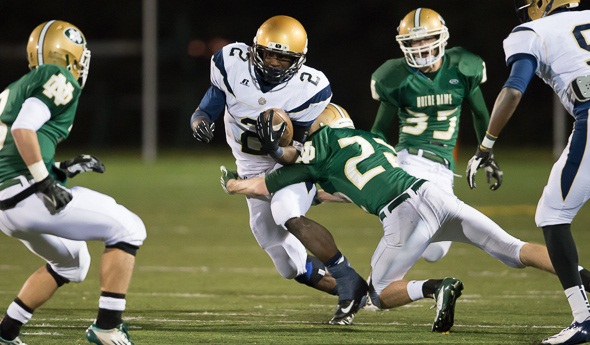
PHOTO: Detroit Country Day senior Trevor Woodland (2) tries to break a tackle by Pontiac Notre Dame senior Mark Juriga during last week’s District Final win for the Yellow Jackets. (Click to see more at Terry McNamara Photography.)
1st & Goal: 2022 Week 5 Preview
By
Geoff Kimmerly
MHSAA.com senior editor
September 23, 2022
This weekend is the midpoint of this regular season, and stands to be a turning point for several teams this season.
 Eight games will match teams undefeated so far this fall. A number of others will pit league title contenders against each other, with the Port Huron and Flint areas, Detroit Catholic League, Macomb County and rural Greater Lansing enjoying some of their best annual rivalry games over the next two days.
Games are Friday unless noted. Click for the full schedule from MHSAA.com and check out the broadcast schedule from MHSAA.tv.
Bay & Thumb
Frankenmuth (4-0) at Freeland (4-0)
This has become a league matchup with statewide appeal over the last few seasons. Frankenmuth has won the last three meetings, last season’s deciding the Tri-Valley Conference 10 title. But both went on to reach MHSAA Semifinals, Freeland in Division 4 and the Eagles in Division 5. Frankenmuth has handed lone losses this fall to Goodrich and Birch Run and given up only 30 points total. Freeland’s defense literally has been one better, giving up only 29 points so far.
Keep an eye on these FRIDAY Flint Hamady (4-0) at Flint Beecher (2-2), Port Huron Northern (4-0) at Port Huron (3-1), Sanford Meridian (3-1) at Gladwin (4-0), Millington (4-0) at Standish Sterling (4-0).
Greater Detroit
Clinton Township Chippewa Valley (4-0) at Macomb Dakota (4-0)
This is the midpoint as well in the Macomb Area Conference Red schedule – and these are the two contenders left without a defeat. They are frequently at the top, although last season they tied for third in the league standings. Dakota has won the last three meetings (starting with the 2019 playoffs), and both have done the work to make this arguably the best matchup in Week 5. Chippewa Valley’s season-opening win over Detroit Catholic Central keeps looking better and better. Same scenario for the Cougars, who defeated Bloomfield Hills Brother Rice in Week 1 and have given up 17 points over its four victories.
Keep an eye on these FRIDAY West Bloomfield (4-0) at Rochester Adams (3-1), Detroit Catholic Central (3-1) at Bloomfield Hills Brother Rice (2-2), Brighton (4-0) at Northville (4-0), Detroit Central (4-0) at Detroit Southeastern (3-1).
Mid-Michigan
Bay City Western (3-1) at Mount Pleasant (4-0)
The Warriors have looked like a Saginaw Valley League North contender especially the last two weeks with 20-plus point wins over Traverse City West and Midland Dow, and was on the cusp last season while losing to Dow by a point and Mount Pleasant 31-16. Western can become the team to chase this weekend by avenging that defeat to the Oilers, who are coming off one-score wins over Cadillac and Traverse City Central. Mount Pleasant has won the last seven games in this series.
Keep an eye on these FRIDAY Holt (2-2) at DeWitt (2-2), Grand Blanc (2-2) at East Lansing (4-0), Pewamo-Westphalia (3-1) at Fowler (4-0), Mason (4-0) at Haslett (3-1).
Northern Lower Peninsula
Cadillac (2-2) at Gaylord (3-1)
With the Big North Conference now at four teams for football, and these two coming off wins in their league openers, this matchup will decide a share of the BNC championship. Gaylord bounced back nicely from its Week 3 loss to Marquette to defeat Petoskey last week, while Cadillac has impressive one-score losses to Midland and Mount Pleasant. The Vikings won last year’s meeting with Gaylord 22-0, their fourth-straight victory in the series.
Keep an eye on these FRIDAY Kalkaska (2-2) at Boyne City (4-0), East Jordan (2-2) at Maple City Glen Lake (3-1), Lake City (2-2) at McBain (2-2). SATURDAY Sault Ste. Marie (4-0) at Ogemaw Heights (2-2).
Southeast & Border
Parma Western (2-2) at Jackson Northwest (3-1)
Jackson Northwest is on the rise as its third win last week guaranteed the Mounties their best finish since 2013 and equaled their number of victories the last three seasons combined. And suddenly, Northwest could figure into the Interstate 8 Athletic Conference race with four of the other top six teams in the standings coming up over the next five weeks. Western certainly can’t be overlooked among them; its losses were by seven points to Detroit Country Day and five to Jackson Lumen Christi.
Keep an eye on these FRIDAY Grass Lake (2-2) at Michigan Center (1-3), Hanover-Horton (2-2) at Napoleon (4-0), Petersburg Summerfield (2-2) at Ottawa Lake Whiteford (4-0), Chelsea (3-1) at Adrian (3-2).
Southwest Corridor
Plainwell (3-1) at Edwardsburg (3-1)
Edwardsburg’s Wolverine Conference winning streak lives at 35, but not without two of its most significant challenges over the last six seasons. Three Rivers pushed the Eddies to within eight points in Week 2, and Edwardsburg escaped with a three-point win over Vicksburg last week thanks to a last-second field goal. Plainwell has made the playoffs nine of the last 10 seasons (plus 2020, when all teams qualified) and would be a candidate to challenge the Eddies too – although Edwardsburg won last year’s matchup 49-0.
Keep an eye on these FRIDAY St. Joseph (3-1) at Portage Central (2-2), Homer (3-1) at Union City (3-1), Constantine (3-1) at Watervliet (3-1). SATURDAY South Lyon East (3-1) at Paw Paw (3-1).
Upper Peninsula
Bark River-Harris (3-1) at Iron Mountain (3-1)
Iron Mountain has won all six recent meetings, including one in the playoffs. But Bark River-Harris gave the Mountaineers their best matchup of those six last season, falling only 28-22. They play in different divisions of the Western Peninsula Athletic Conference, and both are championship contenders in their respective divisions – plus Bark River-Harris is ranked No. 6 and Iron Mountain No. 10 in Division 8 by the Michigan High School Football Coaches Association.
Keep an eye on these FRIDAY Negaunee (4-0) at Ishpeming (2-2), Houghton (3-1) at Hancock (1-3), Gladstone (4-0) at Marquette (1-3), Escanaba (1-3) at Kingsford (2-2).
West Michigan
Caledonia (4-0) at Grandville (4-0)
This, along with Rockford/East Kentwood matchup below, will bring the number of teams leading the Ottawa-Kent Conference Red from four to two by Friday night’s end. The intrigue here is both are undefeated overall – plus Grandville sees Rockford next week, and Caledonia sees East Kentwood. Grandville owns a 4-2 edge in this series since Caledonia moved to the Red in 2016, but Caledonia has won two of the last three including 24-14 last fall. The Fighting Scots are stoppers; they’ve given up 28 points total so far. But opening wins over Grand Blanc and Byron Center put Grandville into the spotlight quickly this season.
Keep an eye on these FRIDAY Rockford (4-0) at East Kentwood (3-1), Beal City (4-0) at Evart (4-0), Ada Forest Hills Eastern (4-0) at Grand Rapids Catholic Central (4-0), Zeeland West (4-0) at Muskegon (3-1).
8-Player
Brown City (4-0) at Martin (4-0)
Brown City is playing 8-player this fall for the first time and showed the fast start isn’t beginners’ luck again last week with a 58-40 win over perennial Finals contender Suttons Bay. Defeating Martin would be a similar if not more substantial accomplishment. The Clippers haven’t given up a point since Week 2 and moved up to No. 1 in Division 1 this week, while Brown City is No. 5.
Keep an eye on these FRIDAY Climax-Scotts (4-0) at Athens (3-1), Eau Claire (3-1) at Bridgman (4-0), Breckenridge (3-1) at Morrice (4-0). SATURDAY Merrill (4-0) at Portland St. Patrick (3-1).
Second Half’s weekly “1st & Goal” previews and reviews are powered by MI Student Aid, a part of the Office of Postsecondary Financial Planning located within the Michigan Department of Treasury. MI Student Aid encourages students to pursue postsecondary education by providing access to student financial resources and information. MI Student Aid administers the state’s 529 college savings programs (MET/MESP), as well as scholarship and grant programs that help make college Accessible, Affordable and Attainable for you. Connect with MI Student Aid at www.michigan.gov/mistudentaid and find more information on Facebook and Twitter @mistudentaid.
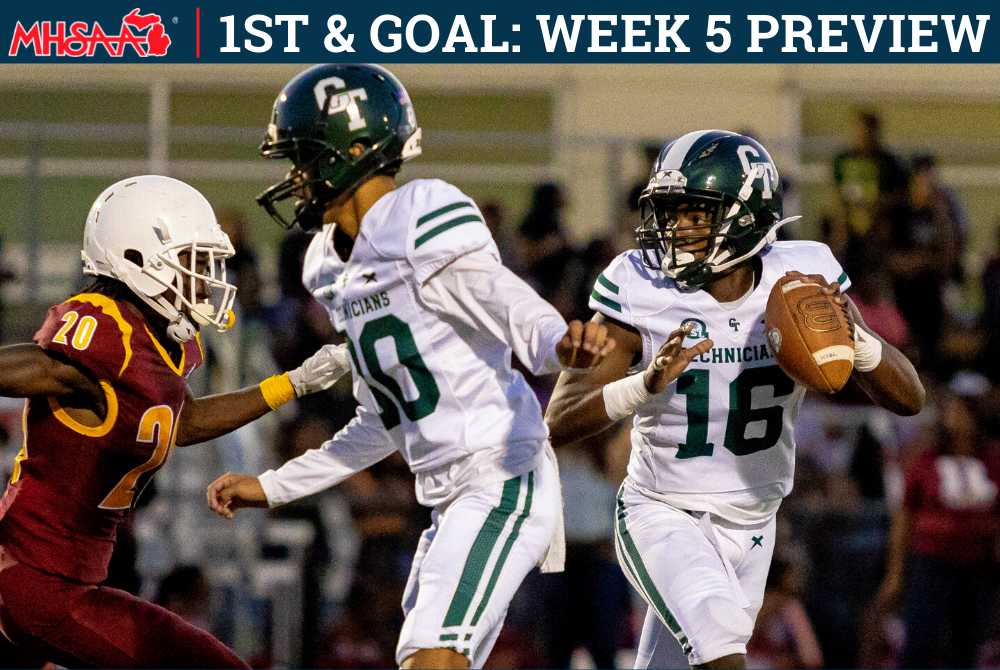
PHOTO Detroit Cass Tech quarterback Leeshaun Mumpfield drops back to pass against Detroit Renaissance during a Week 3 win. (Photo by Chardonne’ U of Olivia B. Photography.)