

A Game for Every Fan: Regional Finals
November 8, 2012
By Geoff Kimmerly
Second Half editor
Let's face it. In high school football especially, it's tough to predict which teams will be around when the big trophies are awarded Thanksgiving weekend. It wouldn't take much research to figure out how many top-ranked favorites have fallen long before finishing the drive for Detroit.
But here's a little indicator that's bearing out as this season's playoffs rush into their third weekend.
Of 64 teams still alive in the 11-player brackets, 53 ranked among the top half of their respective divisions in playoff point average. The four teams remaining in the 8-player bracket all ranked among the top six in that division.
That's rather logical, you might say. But it's also an endorsement for playing tough competition, and further makes it special when a team with a lower average breaks through at the end.
Those teams still alive despite bottom-16 playoff point averages? Congrats on great efforts by Detroit Catholic Central, Caledonia, St. Johns, Three Rivers, Clare, Newaygo, Constantine, Britton-Deerfield, Pewamo-Westphalia, Flint Beecher and Johannesburg-Lewiston.
This week's games are split evenly between Friday and Saturday, with 17 each day. Four Friday games will be streamed live on FoxSportsDetroit.com's Prep Zone: Montrose at Ithaca, Detrot Cass Tech at Saline, Saginaw Swan Valley at Croswell-Lexington and Three Rivers at Grand Rapids South Christian.
Below are all of the Regional Finals with a little extra on some of the best matchups, plus a look at both 8-player Semifinals. Visit the MHSAA Score Center for game times and dates, and all weekend for updated scores and schedules.
Division 1
Rockford (9-2) at Clarkston (11-0)
These two easily come to mind when Division 1 football is discussed. But oddly enough, they've never met. The Wolves are playing for their fourth Semifinal berth and second in four seasons, and were the most popular pick in Division 1 heading into the playoffs. But three-time MHSAA champion Rockford is finally humming after opening 1-2 this fall and losing quarterback Kyle Short for a time. He’s back, and the Rams are playing in their fifth-straight Regional Final.
Other Regional Finals: Detroit Catholic Central (7-4) at Plymouth (9-2), Detroit Cass Tech (9-2) at Saline (10-1), Macomb Dakota (10-1) at Lake Orion (10-1).
Division 2
Muskegon (10-1) at Midland (11-0)
The Big Reds no doubt enjoyed a sigh of relief after edging Lowell in last week’s District Final. But life gets no easier. Midland is working toward what would be the first 14-0 season in its similarly-impressive history, and is keyed by a likely all-state candidate at quarterback in Alec Johnson. Not that Muskegon will be intimidated – this will be its eighth game this fall against a playoff team.
Other Regional Finals: Caledonia (8-3) at Mattawan (10-1), Birmingham Brother Rice (9-2) at Walled Lake Western (9-2), Oak Park (9-2) at Wyandotte Roosevelt (10-1).
Division 3
Grand Rapids Christian (10-1) at Stevensville Lakeshore (11-0)
This may be the game of the weekend in Michigan. Neither has lost to an in-state team – Christian’s only defeat was to Ohio power Cincinnati Moeller – and both have crushed the majority of their opponents this fall. The Eagles scored a season-high 68 points against Zeeland West last week thanks to four touchdown passes plus four touchdown runs by quarterback Alex VandeVusse. This is Lakeshore’s fifth Regional Final over the last decade, and comes after a perfect run through the Southwest Michigan Activities Conference West – one of the state’s most competitive leagues this season.
Other Regional Finals: St. Johns (8-3) at DeWitt (9-2), Tecumseh (9-2) at Battle Creek Harper Creek (9-2), Detroit East English (9-2) at Orchard Lake St. Mary (9-2).
Division 4
Grosse Ile (10-1) at Detroit Country Day (9-2)
The Red Devils have won 10 games for the second straight season after making the Semifinals in 2011. This fall’s success has come against a schedule that has included six playoff teams. Country Day’s slate has included only three teams that made the postseason, but the Yellow Jackets beat a strong one last week in Pontiac Notre Dame and opened the playoffs by dropping previously-undefeated Clinton Township Clintondale 35-0.
Other Regional Finals: West Branch Ogemaw Heights (8-3) at Comstock Park (10-1), Three Rivers (8-3) at Grand Rapids South Christian (8-3), Saginaw Swan Valley (9-2) at Croswell-Lexington (11-0).
Division 5
River Rouge (11-0) at Ann Arbor Gabriel Richard (10-1)
As written on 2H on Monday, River Rouge is one of the best stories of the season – the Panthers are 11-0 for the first time and before last month had won a playoff game only once, in 2001. But this week’s opponent easily will be their toughest this season. Gabriel Richard hasn't given up a point in the playoffs, with a 24-0 win last week over a strong Lake Fenton team.
Other Regional Finals: Clare (9-2) at Menominee (10-1), Newaygo (9-2) at Grand Rapids West Catholic (8-3), Portland (10-1) at Flint Powers Catholic (11-0).
Division 6
Montrose (10-1) at Ithaca (11-0)
One of these weeks, an opponent is going to provide a strong challenge to Ithaca’s 39-game winning streak. Montrose might be it. The two have met in the playoffs the last two seasons, with Ithaca winning only 28-13 in last season’s District Final. Granted, it doesn't look as good for the Rams after surviving by a point in the District Semifinal and by just five against a good Millington team last week. But expect Montrose to bring its best, and Ithaca to match in front of a crowd that could approach 3,000 fans.
Other Regional Finals: Shelby (9-2) at Negaunee (10-1), Constantine (9-2) at Hillsdale (11-0), Monroe St. Mary Catholic Central (9-2) at Grass Lake (10-1).
Division 7
Britton Deerfield (8-3) at Detroit Loyola (11-0)
The Britton-Macon Tories hadn't made the MHSAA playoffs since reaching the Semifinals in 2000, before the school combined in 2010 with Deerfield – which hadn't fielded a football team since 1992. Britton-Deerfield has made the playoffs both years of its existence and has improved two wins on last season’s finish so far. Loyola had easily the highest playoff point average in Division 7 entering the playoffs and is in the Regional Final for the second year in a row. The Bulldogs also entered 11-0 last season and were shut out by Hudson, but have upped their offensive average this fall by a touchdown to more than 46 points per game.
Other Regional Finals: Lake City (10-1) at Ishpeming (10-1), Pewamo-Westphalia (8-3) at Decatur (9-2), Flint Beecher (7-4) at Saginaw Nouvel (9-2).
Division 8
St. Ignace (11-0) at Felch North Dickinson (10-0)
The Saints are playing for their second straight Semifinal berth, but it’s fair to say they’re even better this time around. After giving up a respectable 16 points per game last season, St. Ignace is giving up an average of only five and has five shutouts (not counting the forfeit win over Rudyard in Week 3). North Dickinson’s most noticeable improvement this fall has come on offense – the Nordics have upped their points per game from 38 in 2011 to 50 this fall.
Other Regional Finals: Johannesburg-Lewiston (9-2) at Beal City (11-0), Muskegon Catholic Central (8-3) at Mendon (11-0), Waterford Our Lady (9-2) at Harbor Beach (10-1).
8-Player (Semifinals)
Bellaire (8-3) at Rapid River (10-1)
It’s fair to call these teams two of the original powers in MHSAA 8-player football. Bellaire is 24-8 since making the switch in 2010, and that season finished “mythical” runner-up, that being the term because the championship game was organized by the two leagues and was not an MHSAA playoff game. Rapid River is 20-4 in two seasons as an 8-player program, and was the runner-up in last season’s inaugural championship game. The Rockets stunned the 8-player community last week by beating Cedarville 22-14 after falling to the Trojans 72-12 on Sept. 28.
Deckerville (10-1) at Portland St. Patrick (11-0)
These are both first-year 8-player programs, and it’s fair to say their moves were good ones. Deckerville’s only loss also was to Cedarville, but that was back on the final day of August. The Eagles' run opened with a 42-39 win over reigning MHSAA champ Carsonville-Port Sanilac. All but one of the Shamrocks' opponents were from the southwest part of the Lower Peninsula, but St. Patrick shouldn't be stunned by facing a little bit tougher competition after years of 11-player in the highly-competitive Central Michigan Athletic Conference.
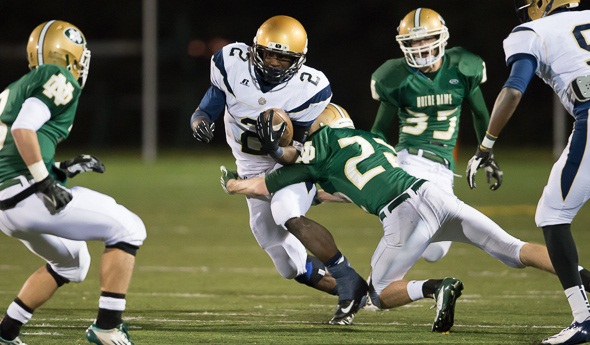
PHOTO: Detroit Country Day senior Trevor Woodland (2) tries to break a tackle by Pontiac Notre Dame senior Mark Juriga during last week’s District Final win for the Yellow Jackets. (Click to see more at Terry McNamara Photography.)
Dow Charged to Make Deep Playoff Run
November 10, 2015
By Bill Khan
Special for Second Half
MIDLAND — When Midland Dow football players looked at the playoff accomplishments of past Chargers teams, it felt like they were getting a lesson in ancient history.
 There was the 1976 team that won the MHSAA Class A championship back when there were only two rounds in the playoffs. There was the 1997 squad that reached the Class A title game, winning three times in the postseason before losing to Farmington Hills Harrison at the Pontiac Silverdome.
And that's it.
For a program as consistently solid as Dow, it seems strange that only two teams in school history were able to win more than one playoff game.
"Sometimes it's matchups, sometimes it's getting a couple breaks to go your way," Dow coach Jason Watkins said. "When you get to this round of the playoffs, all the teams are going to be good."
So far, none of the teams in their path have been better than the Chargers.
They have made a task that has been difficult for past Dow teams look easy, winning 42-7 over crosstown rival Midland in the first round before beating Fenton, 41-14, in the District championship game.
"It's a big win for the development of the program," Watkins said after eliminating Fenton for the second time in three years. "Since 2010, this is our fourth trip to this round; we came away empty each time. It's nice to be able to finish that and get that District championship. It's a good landmark for us. Let's try to grow the program."
The 10th-ranked Chargers (10-1) will travel to second-ranked Walled Lake Western (11-0) on Saturday to play for the Regional championship.
"It's awesome," Dow junior quarterback Bruce Mann said. "We're gonna be on the board for a long time. People are going to be able to see us and remember us."
It hasn't been a lack of opportunities that has made this season's achievement so rare for Dow. Beginning with the unbeaten 1976 MHSAA championship team, Dow has 30 winning seasons in the last 40. The Chargers have made the playoffs nine times in the last 19 years.
They won their playoff opener each of the past two years and in three of the previous five years, but had their seasons end in the second round.
"It feels great," Dow senior receiver Justin Cook said. "I've been on two losing teams in the District Finals the past two years. The third time's the charm, I guess. It feels really good to finally get the (second-round) win. We're clicking at the right time. We're getting better each week."
Those currently wearing the green and gold of Dow are mindful of those who went before them, laying the foundation for such a strong program.
"It's huge for everyone that is involved, all of the past classes who didn't make it this far or got beat at this step," senior receiver Mike Robb said. "It's a big deal."
 The season didn't begin like one that was shaping up to be special. The Chargers lost their opener to Mount Pleasant, 34-20. Not that there's any shame in that — the Oilers are 9-2 and still alive in Division 3.
In that game, Mann had only 26 yards of offense in the first half, as Dow fell behind 21-0 by halftime. He had 281 yards in the second half — and hasn't slowed up since.
It was Mann's first game in a Dow uniform after playing varsity as a freshman and sophomore for Bay City Western, where his dad, also Bruce Mann, formerly was the coach.
Led by Mann, the Chargers have scored at least 41 points in each of the last five games. Over that span, he is 81 for 109 (74.3 percent) passing for 1,451 yards and 24 touchdowns. For the season, he has 35 touchdown passes and only four interceptions in leading Dow to 10 consecutive victories.
"Coming into Dow, I had a bunch of friends, so it didn't take long to jell," Mann said. "It was just me calming down and realizing I'm not the only player and I have 10 other teammates behind me helping me succeed."
Mann has spread the wealth, throwing 11 touchdown passes to Robb, and nine apiece to Cook and Devontae Stine.
"Bruce has been picking up the offense each week," Cook said. "He's playing out of his mind. Every week, he's getting better. You can tell by the way he plays. He doesn't turn the ball over anymore."
Robb, the team's most dangerous receiving weapon, has become a dual threat in recent weeks.
Watkins moved him to defense for the regular-season finale against Midland. In that game, Robb returned an interception for a touchdown, in addition to catching four touchdown passes. In the playoff rematch a week later, Robb had two interceptions, returning one for a touchdown. Robb's hot streak continued against Fenton, as he caught two touchdown passes, blocked a punt and grabbed his fourth interception in three games.
"Right time, right place," Robb said of his newfound knack for picking off passes. "I love playing football. Wherever coach wants to put me, that's where I'll play."
"He's always been a special teams and offensive player for us," Watkins said. "We only moved him up to defense two weeks ago. It's something we saw in the scheme of things and the teams we were playing against. There was an opportunity to use his athleticism and some of his natural instincts. He's been on a pretty good little run the last couple weeks."
The same could be said for the Chargers as a whole, as they attempt to further enhance their legacy.
Years from now, perhaps 2015 will be spoken of with the same sense of awe as 1976 and 1997.
 Bill Khan served as a sportswriter at The Flint Journal from 1981-2011 and currently contributes to the State Champs! Sports Network. He can be reached at [email protected] with story ideas for Genesee, Lapeer, St. Clair, Sanilac, Huron, Tuscola, Saginaw, Bay, Arenac, Midland and Gladwin counties.
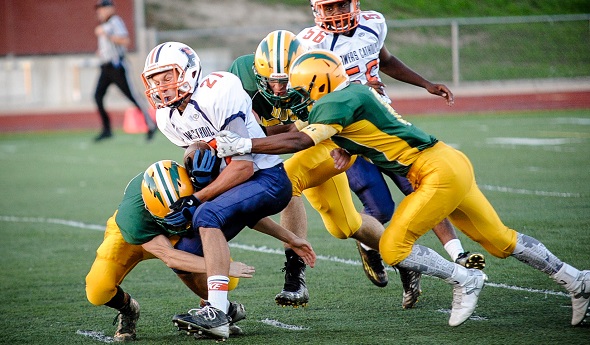
PHOTOS: (Top) A collection of Dow defenders makes a tackle during a win this season against Flint Powers Catholic. (Middle) Chargers quarterback Bruce Mann has thrown 35 touchdown passes this fall. (Click for more from HighSchoolSportsScene.com.)