

A Game for Every Fan: Week 1 Preview
August 26, 2015
By Geoff Kimmerly
Second Half editor
The first weekend of high school football season always is filled with new beginnings. But that doesn't mean that all making fresh starts are completely unfamiliar.
A pair of grand old stadiums will have new looks. Thousands of fans are expected to file into Flint’s Atwood Stadium on Thursday and Mount Pleasant’s Community Stadium on Friday for the first games after both received major renovations this offseason.
And plenty of stars from last season are back for another go. Thousands more will likely pour into Wayne State University on Saturday for the Prep Kickoff Classic to watch six of the Detroit area's annual MHSAA Finals contenders, and top teams from all over the state are facing off against each other to get 2015 underway.
There are no shortage of games to watch, no matter where you call home. Below is a look at games that stand out from each of eight regions across the state, plus from our group of 8-player matchups. All are Friday unless noted. Records listed are from 2014.
And make sure to follow results as they come in on the MHSAA Score Center, and come back to Second Half later Monday for our round up of the most significant results from the first week.
Bay & Thumb
Marysville (7-4) at Richmond (10-2) (Thurs.)
Richmond advanced to the Division 4 Regional Finals last season with its first double-digit win season since 2003 and thanks to two over Marysville – 47-0 on opening night and 48-6 in the District Final. But the Vikings quietly have earned six playoff berths in seven seasons and might have an opening for revenge this week with an experienced lineup taking on a Richmond team filled with new starters.
Others that caught my eye: Saginaw Nouvel (4-5) at New Lothrop (11-1) (Thurs.), Millington (9-2) at Vassar (5-4) (Thurs.), Davison (4-5) at Fenton (9-1) (Thurs.), Grand Blanc (5-4) at Flint Carman-Ainsworth (8-3).
Greater Detroit
Warren DeLaSalle (11-3) vs. Detroit Martin Luther King (8-2) at Wayne State (Sat.)
The reigning Division 2 champion, DeLaSalle, takes on a favorite this season in King. The Crusaders are keyed by some of the state’s most impressive offensive players in receiver Donnie Corley and running back Martell Pettaway, while the Pilots will attempt to slow them returning important cogs back from a defense that gave up only 12.8 points per game last fall.
Others that caught my eye: Clarkston (14-0) at Macomb Dakota (8-3) (Thurs.), East Kentwood (11-2) at Farmington Hills Harrison (10-3), Muskegon (12-2) at Detroit Catholic Central (4-5), Southfield (9-4) vs Detroit Cass Tech (12-1) at Wayne State (Sat.).
Mid-Michigan
Beal City (10-3) at Mount Pleasant Sacred Heart (5-5)
These nonconference rivals have opened with against other all but two seasons going back to 1991, and this weekend will do so to debut the renovated Community Stadium. The Aggies are coming off another long playoff run, just missing a third straight trip to the MHSAA Finals with a three-point loss in the Semifinal. Sacred Heart hasn’t made the Finals since 2010, but is riding 10 playoff appearances over 11 seasons and looking to avenge some heavy losses to Beal City as of late.
Others that caught my eye: Clare (8-3) at Ithaca (13-1) (Thurs.), Mason (8-4) at Okemos (6-4) (Thurs.), Madison Heights Madison (9-3) at Pewamo-Westphalia (10-3) (Thurs.), Midland Dow (10-1) at Mount Pleasant (7-4).
Northern Lower Peninsula
Mendon (10-2) at Boyne City (12-1) (Thurs.)
Boyne City is following up tying its best record ever and falling by only four in last season’s Division 6 Semifinals by taking on perennial power Mendon in what should be one of the state’s best games outside Detroit this weekend. The Hornets have won at least 10 games eight straight seasons and in 11 of the last 12. Boyne City has made the playoffs 10 of the last 12 seasons and set a school record scoring 500 points in 2014.
Others that caught my eye: Reed City (9-3) at Baldwin (10-2), Marquette (7-3) at Traverse City St. Francis (9-3), Johannesburg-Lewiston (9-2) at Mancelona (6-4), Sault Ste. Marie (5-4) at Petoskey (9-3).
Southeast & Border
Rockford (8-3) at Saline (12-2)
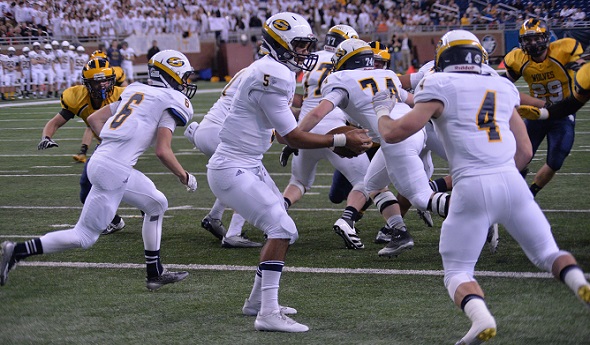
Expectations are high after Saline made the MHSAA Finals last season for the first time, falling to Clarkston 33-25 in the Division 1 championship game. Quarterback Joshua Jackson is among returnees and is considered one of the state’s most dynamic at his position. But teams learned long ago they can’t look past Rockford – and that’s hardly made a difference as the Rams haven’t missed the playoffs since 1994 and went 8-3 last season despite being outscored for the season.
Others that caught my eye: Grand Rapids Northview (6-4) at Chelsea (9-3) (Thurs.), Monroe St. Mary Catholic Central (13-1) at Tecumseh (5-5) (Thurs.), Pittsford (7-3) at Morenci (10-2), Clinton (10-1) at Manchester (8-2).
Southwest Corridor
Portage Northern (7-4) at Battle Creek Lakeview (9-2) (Thurs.)
These two are facing off on opening night for the second straight year and after three games of significance over the last two seasons. Although Portage Northern beat Lakeview 28-24 in last season’s opener, Lakeview beat the Huskies in their Division 2 District Final 21-0 after eliminating Northern in the first round in 2013, 31-7. Lakeview didn’t lose again after last season’s opener until falling in the Regional Final.
Others that caught my eye: Plainwell (8-2) at Three Rivers (6-4) (Thurs.), Caledonia (7-3) at Battle Creek Harper Creek (6-5), Stevensville Lakeshore (8-3) at Battle Creek Central (5-4), Mattawan (6-4) at Portage Central (7-2)
Upper Peninsula
Iron River West Iron County (9-2) at Munising (12-2)
Munising made last season’s Division 8 Final and pulled off its best finish since 1980 led by a handful of elite seniors whose only other loss last fall came on opening night – 28-6 to Iron River West Iron County. The combination of both should give these Mustangs plenty of motivation against a Wykons team that has won 19 of its last 20 regular-season games.
Others that caught my eye: Crystal Falls Forest Park (9-2) at Bark River-Harris (8-3), Iron Mountain (6-4) at Ishpeming (12-1), Central Lake (6-5) at St. Ignace (10-1), Marinette (3-6) (Wis.) at Menominee (12-1) (Sat.).
West Michigan
Jackson Lumen Christi (11-1) at Grand Rapids West Catholic (14-0)
Few teams in Michigan are replacing superstars on the level of graduated Lumen Christi running back Khari Willis and West Catholic quarterback Travis Russell. But both teams have been down this road before. West Catholic is the two-time reigning Division 5 champion and has 10 or more wins in six straight seasons; Lumen, while coming off its most wins since 2009, has made the playoffs 17 straight times.
Others that caught my eye: Grand Rapids Catholic Central (6-4) at East Grand Rapids (6-4) (Thurs.), Walled Lake Western (9-2) at Lowell (10-2) (Thurs.), Muskegon Catholic Central (14-0) at Muskegon Oakridge (8-2), Grand Rapids Christian (6-5) at Grand Rapids South Christian (12-2)
8-Player
Kingston (7-4) at Deckerville (9-3)
A couple pockets of 8-player dominance have cropped up over the first few seasons of the sport, and these are two of the best and most consistent programs coming from Michigan’s thumb. Deckerville won the MHSAA title in 2012 and made the Semifinals last season after sweeping Kingston 14-8 in Week 2 but then 72-22 in the Regional Final. They play twice this season during the regular season alone; this one doesn’t count in the North Central Thumb 8-Man League standings, but the rematch comes in Week 4.
Others that caught my eye: Owendale-Gagetown (8-2) at New Haven Merritt (6-4) (Thurs.), Rapid River (10-1) at Onaway (4-5).
PHOTO: Saline quarterback Joshua Jackson prepares to hand off during last season’s Division 1 Final against Clarkston. Both teams’ returns to the field this weekend are among the most highly-anticipated in Michigan.
Muskegon Grad Casts 'Magic' in HBO Series
June 15, 2020
By Tom Kendra
Special for Second Half
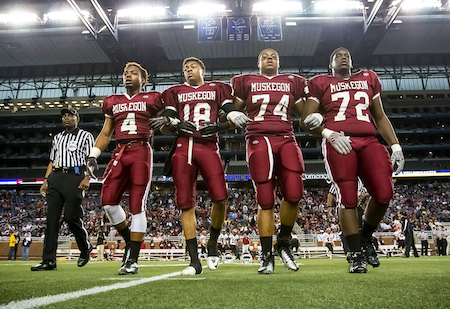
The last time many people saw Quincy Crosby was during his final high school football game at Ford Field back in 2012, when the 6-foot-3, 280-pounder was a senior captain for Muskegon High School.
 Chances are most didn’t notice him, since he was doing the unheralded dirty work as the starting center for the Big Reds, who lost a 35-28 heartbreaker to Bloomfield Hills Brother Rice that day in the MHSAA Division 2 Final.
The next time many see Crosby, he will be front and center, and impossible to miss, showing off an entirely different skill set.
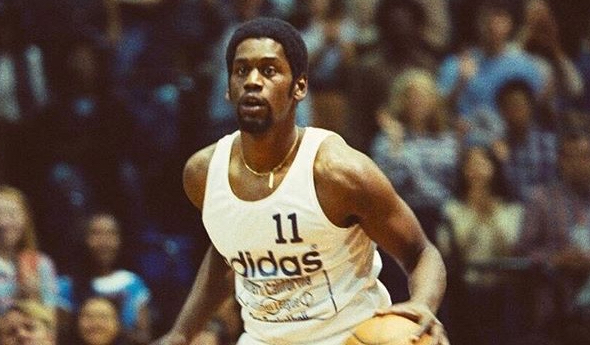
Crosby, 24, has transformed from bruising lineman to up-and-coming Hollywood star, who last year landed a dream role as Michigan’s own Earvin “Magic” Johnson in the upcoming HBO series focusing on the Los Angeles Lakers’ “Showtime” era of the 1980s.
“I’m just a kid from Muskegon; now I’m playing Magic on a TV show. How cool is that?” said Crosby, who played football and was a theater major at Kalamazoo College after his prep days. “I guess this is the big break I’ve been waiting for my whole life. Every part I didn’t get was worth it to get this one.”
The show, which is being produced by former Lakers standout Rick Fox, was originally titled “Showtime.” But that name was scrubbed when it was picked up by HBO, a competing network with Showtime. Right now, the series is referred to by the generic, “Untitled Lakers Project.”
The one-hour limited series drama is based on Jeff Pearlman’s book “Showtime: Magic, Kareem, Riley, and the Los Angeles Lakers Dynasty of the 1980s.” The Untitled Lakers Project is described by HBO as a fast-break series chronicling the professional and personal lives of the 1980s Los Angeles Lakers, one of sports’ most revered and dominant dynasties—a team that defined its era, both on and off the court.
The series features some big names, including John C. Reilly as Jerry Buss, Solomon Hughes as Kareem Abdul-Jabbar and Jason Clarke as Jerry West. In the cast list, Crosby goes by his stage name of Quincy Isaiah – which are his first and middle names, respectively.
The series was expected to debut this month to coincide with the NBA Finals, but production delays due to Covid-19 and the suspension and uncertainty of the NBA season have pushed that tentative starting date back to June, 2021.
The delay hasn’t kept Crosby off Cloud 9.
Crosby landed the part in early June of last year, and in the days following that announcement, he went to Game 5 of the NBA Finals, where Fox introduced him to celebrities like Jalen Rose, Jerry West and Common. Then he hung out in Las Vegas for some NBA summer-league games, where the stargazing continued. He has yet to meet Magic, but expects that to happen soon.
“Everyone is telling me this is a game-changer, that this is going to be huge,” Crosby said. “I’m just so thankful for the opportunity.”
Catching the bug
Muskegon High School football coach Shane Fairfield wasn’t surprised to learn that his former team captain and three-year varsity player had earned a leading role in a television show – but as a basketball star?
“I said: ‘Basketball? You ain’t got no game!” Fairfield said with a laugh. “But the reality is, that role was kind of made for him. Quincy has that charisma and that big, amazing smile, just like Magic.”
Crosby’s transition from one of the “Brothers of Destruction” on the Big Reds’ offensive line to thespian actually began a few months after that crushing loss to Brother Rice.
 That game started Muskegon’s incredible run of seven football Finals appearances in eight years, and the Big Reds have the winningest program in state football history and rank No. 7 in the nation with 859 wins (dating back to 1895). But the school had not been able to put on a spring musical in more than 20 years due to budget cuts.
But that spring, in a stroke of fortune, the school was selected in NBC’s 2013 “Smash” Make A Musical contest and awarded funding to put on the classic musical, “Thoroughly Modern Millie.”
Crosby said theater director Karli Baldus talked him into trying out for the show, and he landed the comical part of Ching Ho.
“I caught the bug, big time,” Crosby recalled with a laugh. “I thought it was the best thing.”
He also noticed parallels right away with football, with both requiring hours and hours of practice and repetition in preparation for game time – or show time.
“When I was playing football, I wouldn’t be able to think about anything else and I would just get zoned out on what I had to do on the line,” said Crosby. “It’s the same thing in acting. You practice until you know it by heart, and then you get out there and just let it go. Acting is all instincts.”
Crosby took acting classes at Kalamazoo, but due to football, never had enough time to be part of the big productions.
That all changed after performing a sketch in his television production class his junior year. He got pulled aside by his professor, who told Crosby he saw major acting potential in him and encouraged him to get more involved his senior year.
That heartfelt plea led Crosby to not only quit the football team after three years as a starter on the offensive line, but also to change his major from business to theater. He then blossomed on the stage his senior year, working behind the scenes in the fall production of “The Rocky Horror Picture Show” before earning major roles of Walter Lee Younger in “Raisin In The Sun” and Benny in “In The Heights.”
Finding the Magic
Shortly after graduating from K-College in 2017 with a theater degree, Crosby made his way to Hollywood to pursue his acting dream, only to find it was a bumpy road – to say the least.
Crosby was able to land small roles in short productions like “Corporate Coffee” and “Anomaly,” but his bid for major roles was met by rejection after rejection.
In those moments, he said, his background as an offensive lineman at Muskegon got him through.
“I learned to embrace the grind playing football at Muskegon,” said Crosby, the son of Delores Crosby and the late Gregory Crosby, who died when Quincy was just 3 years old. “You know, being an offensive lineman helped too. You get blamed when things go wrong and none of the praise when things go right, so you learn to just stay in your bubble and grind.”
 His Hollywood experience nearly ground to a halt in early 2019, and he was about to enlist in the Navy when his agent and fellow Muskegon native Terrance Williams helped him land the audition that would change his life.
Ironically, he didn’t even get a script until the day of the audition and while others had memorized their lines, Crosby read directly from the script. He still landed a callback for the lead role of Magic and, six days later, he was ready and brought his “A game.”
“Walking out of the callback, the casting director told me to keep my phone close because that was a really good audition,” said Crosby.
The only thing left was a basketball audition with Fox in a high school gym, which clinched the role, Crosby said.
Fox and Crosby then started making the Hollywood rounds before shooting the pilot in October, after which the series was picked up by HBO in November. After a lengthy delay due to Covid-19, the plan is to shoot the first year of the series this fall, starting when Magic was drafted by the Lakers out of Michigan State in 1979.
One benefit of the delay is that it has given Crosby time to watch reams of old Magic footage and try to capture his nuances – on and off the court.
“The good thing about playing Magic is that there is so much video and footage of him out there,” said Crosby. “There’s so many things I’ve picked up – the way he walks and the way he always says ‘right’ after sentences. I’m getting better and better at it.”
Meanwhile, back in Muskegon, the Big Reds’ coaching staff is continuing its year-round quest to get more players into college and prepared for life after high school. Fairfield said he can’t wait to have his team watch the Lakers series and see one of their own in a starring role.
“Quincy is an example to our kids that there are so many avenues to success,” Fairfield said. “Making the NFL is one-in-a-million. What we emphasize is that you take what you learn here – hard work, discipline, perseverance, humility – and you apply it to anything you want to do in life.”
This is the first installment in a weekly summer “Made in Michigan” series catching up with this state's past high school athletes as they continue their stories.
 Tom Kendra worked 23 years at The Muskegon Chronicle, including five as assistant sports editor and the final six as sports editor through 2011. E-mail him at [email protected] with story ideas for Muskegon, Oceana, Mason, Lake, Oceola, Mecosta and Newaygo counties.
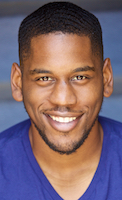
PHOTOS: (Top) Quincy Crosby plays Magic Johnson in an upcoming HBO series. (Middle) Crosby, now seven years after graduating from Muskegon High. (Below) Crosby, far right, heads to midfield with his teammates for the coin flip before the 2012 Division 2 Final at Ford Field. (Top and middle photos courtesy of Quincy Crosby. Below photo by Tim Reilly.)