

A Game for Every Fan: Week 1
August 23, 2012
By Geoff Kimmerly
Second Half editor
A few scenarios remain unique to high school football’s opening weekend, the newest of which begins again tonight all over Michigan.
If the casual fan with no ties to a particular team is going to check out a game, this is probably the time.
And while there are great matchups and major storylines all nine weeks of the regular season, this first one features so many that East Grand Rapids vs. Grand Rapids Catholic Central – which eventually could be remembered as one of the best games in the state this entire season – arguably isn’t the biggest this weekend in the Grand Rapids area alone.
Each week, Second Half will give you an idea of top games to watch near your community, or the extended surrounding area.
I’ve broken down the state into seven regions – hopefully you’ll be able to figure out which is where by the nicknames, or at least the games I’ve listed under each. I’ve done so by where the game will be played.
Click on Score Center to see game dates and times, and after the clocks run out, final scores from all over the state.
Greater Detroit
Detroit Cass Tech vs. Birmingham Brother Rice
This Saturday night matchup is the final game of the Prep Kickoff Classic at Wayne State, which will host six Detroit-area matchups on opening weekend. And it will be tough for any game before November at Ford Field to match the prestige of this opener featuring the reigning MHSAA Division 1 and 2 champions. The last time Cass Tech quarterback Jayru Campbell dressed for the Technicians, he threw five touchdown passes as a freshman in last fall’s Division 1 Final win over Detroit Catholic Central. Brother Rice quarterback Cheyne Lacanaria also is back after leading the Warriors to the Division 2 title, although they must replace graduated standout running back Devin Church. But Brother Rice can counter Campbell and an offense loaded with Division I college prospects with linebacker Jon Reschke, who has committed to Michigan State.
Others that caught my eye: Midland at Canton, Dearborn Fordson at Macomb Dakota, Warren DeLaSalle at Ann Arbor Pioneer, Bloomfield Hills Andover at Bloomfield Hills Lahser, Rochester Adams at Clarkston.
Southwest and Border
Battle Creek Central at Kalamazoo Central
This is one of the longest-running football rivalries in MHSAA history and will move into a tie for eighth all-time with this 109th straight meeting. Battle Creek Central leads the series 59-45-4, although Kalamazoo Central won 28-22 last fall. The Bearcats are hoping to open with their first win since 2010, while the Maroon Giants have gone 4-5 in each of the last four seasons and hope to push for their first playoff berth since 2004.
Others that caught my eye: Carleton Airport at Adrian, St. Joseph at Marshall, Portage Central at Battle Creek Harper Creek.
Mid-Michigan
Pewamo-Westphalia at Lansing Catholic
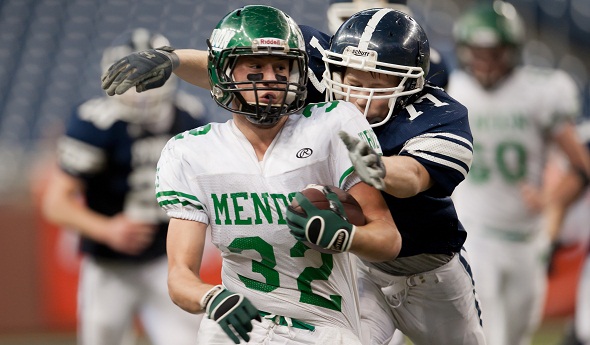
While the Saturday night game in Detroit features two teams that won titles at Ford Field last season, this matchup features two teams that finished as runners-up in their respective divisions – Division 7 and Division 5 – and are hoping to get back to Detroit with much different lineups. Both graduated standout quarterbacks and their best defenders from 2011, but both also will test new players early and often against top competition. Each plays in a tough league and will also face a reigning MHSAA champion later this fall. The Cougars get Division 7 champ Saginaw Nouvel next week, and the Pirates finish the regular season against Division 8 winner Mendon.
Others that caught my eye: Brighton at Novi, Jackson Lumen Christi at Chelsea, Mount Pleasant at DeWitt, Mendon at Fowler.
West Michigan
Lowell at Rockford
Last season, these two renewed a rivalry that previously had ended in 1973, before the playoff era had begun. These days, the Red Arrows and Rams are two of the state’s annual elite. Lowell won the 2011 game 28-7 on the way to its sixth straight season with at least 10 victories and the runner-up finish in Division 2. But Rockford won 11 straight after last season’s loss, and similarly has won at least that many games in seven of the last eight seasons.
Others that caught my eye: Grand Rapids Catholic Central at East Grand Rapids, Holt at Hudsonville, Orchard Lake St. Mary at Muskegon.
Bay and Thumb
Richmond at Marine City
New Marine City coach Ronald Glodich begins a new era but with hopes of similar success as had by retired coach Anthony Scarcelli, who led the Mariners to eight straight seasons of at least 10 wins and last season’s Division 4 runner-up finish. But Glodich will start with an immediate test in Richmond, which is coming off two straight losing seasons but improved by three wins from 2010 to 2011 and before the down streak made the playoffs 10 times in 11 seasons.
Others that caught my eye: Saginaw Swan Valley at St. Charles, Bay City Western at Flint Northern, Montrose at Reese.
Upper Peninsula
Ishpeming at Iron Mountain
There was a not-so-recent past when Ishpeming struggled to win this annual opening night matchup – Iron Mountain has been the victor in 15 of the last 20. But these two have split the last four openers, and both won District championships last season after Iron Mountain won and Ishpeming finished second in the Mid-Peninsula Athletic Conference.
Others that caught my eye: Detroit Denby at Marquette, Ishpeming Westwood at Stephenson, Pittsford at Iron River West Iron County.
Lower Up North
Traverse City St. Francis at Kingsley
Traverse City St. Francis isn’t in a league this season, but is playing six of the same opponents as in 2011 – when it advanced to a Division 7 Semifinal. The Gladiators open against Kingsley after beating the Stags 57-8 in last season’s opener. But Kingsley won six of its next eight games after that loss to make the playoffs, and were only a combined 12 points from an 8-1 finish.
Others that caught my eye: Elk Rapids at Mancelona, Manistee at Ludington, St. Ignace at Charlevoix.
PHOTO: Mendon and Fowler played for last season's Division 8 championship at Ford Field, and meet again Friday at Fowler in the season opener for both. (See more at Terry McNamara Photography.)
Western's White Enjoys 'Special' Career
By
Tom Markowski
Special for Second Half
May 4, 2016
WALLED LAKE – Seeking a higher level of performance, many high school athletes have channeled their energy to one sport.
 Many refer to this concentration as specialization – and Cody White, for one, isn’t buying it.
White, a junior at Walled Lake Western, is a three-sport athlete and he loves every minute of it. He plays basketball during the winter, baseball in the spring and football in the fall. During the summer he competes in AAU basketball, travel baseball, 7-on-7 football games with his Western teammates, and he participates in a few summer football camps.
White has played these same sports all throughout high school. His freshman year he competed in track and field, along with baseball. White hasn’t ruled out returning to track and field, in addition to baseball, as a senior – but this season he’s sticking with just baseball.
It’s a hectic schedule but, again, White wouldn’t have it any other way.
“I couldn’t see myself not competing in those sports,” he said. “I love them so much. I want to finish my senior year playing all three.”
White estimates that he’ll have two days off, away from sports, in June. In July he’ll take a week off, between his summer baseball team schedule ending and the start of football practice.
There’s no question White is driven, but it’s more than that. In some high schools, and with some coaches, playing multiple sports can be a challenge. There are some coaches who would prefer the students to play one sport and only one sport.
According to Western football coach Mike Zdebski, that isn’t the case at his school.
“We encourage them to play more than one sport,” Zdebski said. “For one, we want them to get their money’s worth. We have a pay-to-play policy of $425. You play one sport and it costs $425. You play three sports and it costs the same. And, two, playing other sports helps them develop other skills. In basketball you create space. In baseball you chase fly balls, and that helps with depth perception. Besides you get to work with other coaches and other teams.
“We’re lifting weights during the summer. If a kid is playing summer baseball or AAU basketball, if they have time they can come by and lift weights. And what we always tell them, if you’re tired let us know. You can take a break.”
Zdebski – whose team finished 12-1 last fall – was quick to point out some excellent athletes in the past, like former Kansas City Royals outfielder/Oakland Raiders running back Bo Jackson, who were multiple-sport athletes. And, more recently, there’s Luke Glendenning of the Detroit Red Wings. Glendenning was an all-state running back at East Grand Rapids.
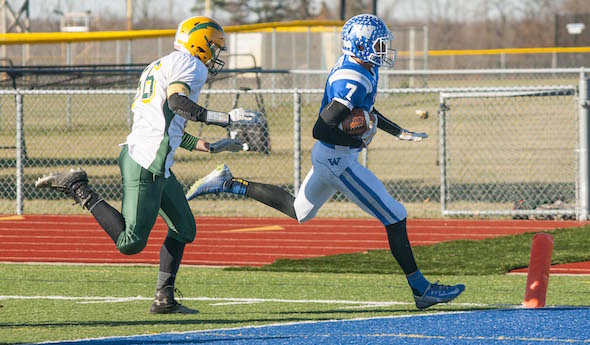
 When his high school career is done, White will play football in college. Two months ago he committed to sign with Michigan State this winter. At 6-foot-3 and 200 pounds, White played receiver, defensive back and also returned kicks last fall. He played a big role in Western’s run to the Division 2 Semifinals.
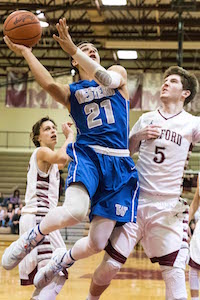
During baseball season, White pitches and plays middle infield and right field. He plays the wing and shooting guard in basketball.
His interest in playing a variety of sports came at an early age and, as is the case with most children, a family member was the one who introduced White to athletics. Former NFL player and Detroit Lions executive Sheldon White is his father, but the first sport White played, at age 3, was baseball. Two years later he began playing football and basketball.
Sheldon White also played three sports at his high school in Dayton, Ohio, (Meadowdale High) and helps his son manage his busy schedule, particularly during the offseason.
“Growing up was a little different (for me) than the usual kid,” Cody White said. “Going to Lions games and just being around football all the time. I think I love the game more because I was around it so much.
“But I think playing three sports helped me, too. The twisting of your hips in baseball, when you swing the bat, you’re using different muscles. And all the jumping you do in basketball. You have to move in tight spaces.
“With football, you’re with the football guys. By doing all three you meet different people.”
Playing multiple sports has definitely been the right road for White to follow. And his busy schedule hasn’t hindered his work in the classroom.
White has a 3.54 grade-point average pending his grades for this semester.
 Tom Markowski is a columnist and directs website coverage for the State Champs! Sports Network. He previously covered primarily high school sports for the The Detroit News from 1984-2014, focusing on the Detroit area and contributing to statewide coverage of football and basketball. Contact him at [email protected] with story ideas for Oakland, Macomb and Wayne counties.
PHOTOS: (Top) Cody White (right) runs away from a Midland Dow defender during their Regional Final this fall. (Middle) White works for a shot against Milford. (Photos by Teresa Presty.)