

A Game for Every Fan: Week 3
September 12, 2013
By Geoff Kimmerly
Second Half editor
This week has some of the best of everything for the Michigan high school football fan.
Two powers meet again in one of the most followed rivalry games in the state. Two neighbors face off in another that should draw an entire town. On perhaps a sadder but immediately urgent note, two more will meet again but for the final time.
See below for some of the best games to see in every corner of the state this weekend, and be sure to monitor all the scores at the MHSAA Score Center.
West Michigan
Rockford (2-0) at Muskegon (2-0)
Most seasons, this is arguably the most anticipated regular-season matchup in Michigan. And the excitement was tempered only slightly by Muskegon’s move to another division of the O-K Conference in 2012. Rockford holds a 4-2 advantage in the regular-season series since it began in 2007, but four of those games have been decided by eight or fewer points and Muskegon won last season, 21-9. The Big Reds, also last season’s Division 2 runner-up, have opened with big wins over Grand Haven and reigning Division 3 champ Grand Rapids Christian. Rockford’s slate has been similarly impressive – double-digit wins over Utica Eisenhower and Holt.
Others that caught my eye: Muskegon Mona Shores (2-0) at Caledonia (2-0), Grand Rapids West Catholic (0-2) at Grand Rapids South Christian (1-1), East Grand Rapids (2-0) at Holland West Ottawa (1-1), Ravenna (1-1) at Montague (1-1).
Bay and Thumb
Lapeer West (2-0) at Lapeer East (2-0)
These two schools will merge next fall, making this the final matchup between the rivals. West owns a 28-10 edge in the series dating to 1975, including seven wins in the teams’ last eight against each other. That said, East has bounced back from last fall’s three-win showing and outscored its first two opponents by a combined score of 51-0. West is playing this fall for a third straight playoff berth but this week for its first 3-0 start since 2009.
Others that caught my eye: Birmingham Brother Rice (2-0) at Flint Carman-Ainsworth (2-0), Essexville Garber (2-0) at Frankenmuth (1-1), Bay City Western (1-1) at Saginaw Arthur Hill (2-0), Freeland (2-0) at Saginaw Swan Valley (2-0).
Lower Up North
Traverse City Central (1-1) at Traverse City West (1-1)
The Nowak-Olson Memorial Trophy is again on the line with these rivals having split their last eight games against each other. This matchup also could go a long way toward deciding the Big North Conference champion. Central won 42-28 last season and finished undefeated in the league, while West settled for a second-place tie. Both rebounded from opening-night losses to win their first league game last week.
Others that caught my eye: Petoskey (2-0) at Cadillac (2-0), Traverse City St. Francis (1-1) at Elk Rapids (2-0), Suttons Bay (0-2) at Kingsley (1-1).
Upper Peninsula
Crystal Falls Forest Park (2-0) at Hurley, Wis. (2-0)
These two have built quite a rivalry in the Great Western Conference. At least one has won the league title over the last three seasons, and twice during that time they shared it – last season with Bessemer in a three-way split. The Trojans haven’t been tested yet, but Hurley had to fend off a challenge last week from Lake Linden-Hubbell in an eventual 30-20 win.
Others that caught my eye: Gwinn (1-1) at Manistique (0-2), Marquette (2-0) at Sault Ste. Marie (1-1), Powers North Central (2-0) at Lake Linden Hubbell (1-1), Kingsford (2-0) at Ishpeming Westwood (0-2).
Southwest and Border
Kalamazoo Central (2-0) at Portage Northern (2-0)
The Maroon Giants are back in some conversations they’ve missed out on the last few seasons thanks to their first 2-0 start since 2008 that could become their first 3-0 kickoff since 2004 – also the last season Kalamazoo Central made the playoffs. Portage Northern has beaten the Giants in eight straight, however, including 48-0 last season.
Others that caught my eye: Saugatuck (2-0) at Decatur (2-0), Plainwell (2-0) at Dowagiac (2-0), Portage Central (2-0) at Mattawan (1-1), Stevensville Lakeshore (2-0) at St. Joseph (2-0).
Greater Detroit and Southeast
Clinton Township Chippewa Valley (2-0) at Utica Eisenhower (1-1)
Chippewa Valley also has made its way back into the spotlight with its first 2-0 start since 2006 that’s included wins against regular playoff qualifiers Romeo and Dearborn. The good news for the Big Reds is they beat Eisenhower by two touchdowns in 2012 – which has be a confidence builder heading into a rematch with a rival that lost to a powerful Rockford team on opening night and is expected to be in Macomb Area Conference Red mix again.
Others that caught my eye: Warren Woods Tower (2-0) at Madison Heights Madison (2-0), Oak Park (2-0) at Rochester Adams (1-1), Harper Woods Chandler Park (2-0) at Warren DeLaSalle (1-1), Ottawa Lake Whiteford (2-0) at Clinton (2-0).
Mid-Michigan
Grand Ledge (0-2) at Lansing Sexton (2-0)
The surging Big Reds have made this game the no-brainer best in this area this week. Sexton has opened with solid wins over Chelsea and Monroe, and the smallest school in the Capital Area Activities Conference Blue now takes on the second-largest school in the entire Lansing area. Keep in mind the Comets’ start didn’t come against slouches; East Kentwood and Holland West Ottawa are among the strongest programs on the west side of the state. But Grand Ledge has to feel some urgency heading into a competitive league schedule.
Others that caught my eye: Fowlerville (1-1) at DeWitt (2-0), Portland (2-0) at Lansing Catholic (0-2), Haslett (1-1) at St. Johns (1-1), Charlotte (2-0) at Eaton Rapids (1-1).
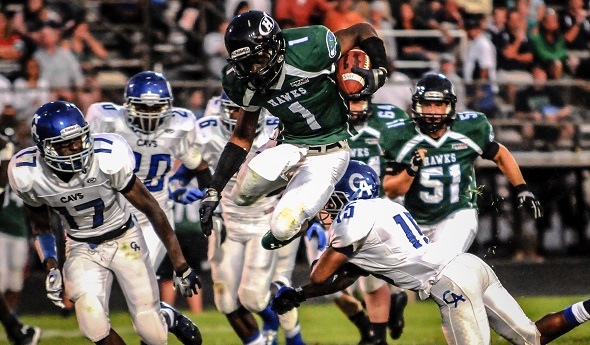
PHOTO: Flint Carman-Ainsworth (blue helmets) handled a solid Saginaw Heritage team last week, but gets another challenge this weekend in Birmingham Brother Rice. (Click to see more from High School Sports Scene.)

Football Finals Protocols Announced
November 21, 2016
By Geoff Kimmerly
Second Half editor
To provide for the convenience and safety of spectators attending the Michigan High School Athletic Association 11-Player Football Finals – presented by the Michigan National Guard – at Ford Field in Detroit, Nov. 25 and 26, attendees are being advised of a variety of items related to transportation and security – including policies regulating types of bags allowed into the stadium.
Parking will be available in Ford Field facilities and lots to the east and north of the stadium and costs $6. A map identifying the designated Ford Field lot (4) and parking deck can be found on the Football page of the MHSAA Website. (There also are a number of privately-operated parking facilities close to Ford Field, but their pricing may differ.)
Fans also are advised that tailgating, including the setting up and use of grilling equipment, and the consumption of alcohol, is prohibited in Ford Field parking facilities and lots.
Gates A, B and G will be available for public entrance during the event. Ticket sales will begin near Gates A and G at 8 a.m. each day, and the building will open its doors to spectators at 9 a.m. Tickets must be paid for in cash only.
Tickets are priced at $10 and allow a fan to see all four games in a single day. Spectators leaving the stadium will be required to purchase another ticket for re-entry. Children under the age of 2 will be admitted without charge for this event. There will not be a public Will Call window.
Upon arrival in the building, fans will find their designated seating areas on the South side of the field if their team is the designated home team for their contest and on the North side for the designated visiting team. Home teams this weekend are Detroit Catholic Central, Walled Lake Western, Muskegon, Grand Rapids Catholic Central, Menominee, Maple City Glen Lake, Pewamo-Westphalia and Muskegon Catholic Central. Brightly lit video boards above the seating areas will display the names of the participating teams each day, and fans should sit on the side of the stadium where they see their school’s name. For general fans, the entire lower bowl of Ford Field will be open for the event.
Security measures also will be in place to help assure spectator safety. Fans will be subject to a visual search, and Ford Field personnel reserve the right to request patrons open their coats, bags and other item-carrying vessels for visual inspection and deny entrance to individuals who do not cooperate.
Items which fans will be prohibited from bringing into the building include, but are not limited to, the following:
• Purses larger than a clutch bag, coolers, briefcases, backpacks, cinch bags, grocery & paper bags, duffle bags, luggage of any kind, computer and camera bags and large camera cases.
• Aerosol cans (hairspray, mace, pepper spray, etc.)
• Animals (except service animals to aid guests with disabilities)
• Balloons (air or helium)
• Balls (beach balls, footballs, etc.)
• Banners or large flags
• Cameras with lenses longer than five inches. Selfie Sticks also are prohibited.
• Decals, stickers, confetti or glitter
• Electronic equipment including laptop computers, video recorders (hand-held video cameras are allowed), tripods and wearable video cameras including Go Pros.
• Fireworks
• Food, beverages or liquids (cans, bottles, boxes, flasks, etc.)
• Illegal substances
• Knives, pocket knives, box cutters, scissors, etc.
• Laser pointers
• Markers (permanent) and/or paint
• Noisemaking devices (bells, horns, kazoos, whistles, etc.)
• Objects that can be used as missiles or projectiles (sticks, bats, clubs, Frisbees, etc.)
• Seat cushions
• Strollers and infant car seats or carriers
• Umbrellas (large size)
• Weapons
The following items will be permitted after inspection:
• Small bags, purses and fanny packs that do not exceed 8½ inches by 14 inches by 10 inches. An exception will be made for medically necessary items after proper inspection at a gate designated for this purpose.
• Diaper bags (only if accompanied by a child)
• Binoculars and binoculars cases
• Cameras and small camera cases (lenses may not measure longer than five inches)
• Small radios (no larger than the size of a football and used with an earpiece)
• Small hand-held video cameras (but no tripods or extension cords)
• Small, compact umbrellas (must be placed securely under seat)
• Posters and signs without poles or sticks, or larger than what one person can hold.
The complete list of prohibited items can be found on the Ford Field Website at the bottom of the web page under Stadium Info, Policies. Prohibited items that are discovered during security inspections at stadium entrances must either be returned to the owner's vehicle or discarded. Items will not be held for later pickup.
Fans are reminded that all image taking (still and video) may be only for personal, non-commercial use.