

A Game for Every Fan: Week 3
September 6, 2012
By Geoff Kimmerly
Second Half editor
It's coach speak for sure, but true all the same: First, teams focus on winning the league title. And after that, bigger things tend to take care of themselves.
Many across Michigan started that quest last weekend. But for most of the rest, the first steps toward a conference championship will come tonight.
Need a game to watch? No problem. See below for what's playing near you. And remember to visit the MHSAA Score Center for updated scores and standings
(All are tonight unless noted. Go to Score Center for additional dates and kickoff times.)
West Michigan
Muskegon (2-0) at Rockford (1-1)
After four seasons of defining the O-K Red as arguably the best league in the state, these two are now split up as Muskegon moved to the O-K Black this fall. But there will continue to be a share of statewide eyes watching this one. The Big Reds put potential playoff opponents back on notice by opening with a 21-14 win over reigning MHSAA Division 3 champion Orchard Lake St. Mary, and Rockford came back from a tough opening loss to Lowell by shutting out Holt last week, 22-0.
Others that caught my eye: East Kentwood at Grand Rapids Forest Hills Central, Grand Rapids Christian at Grand Rapids Kenowa Hills, Grand Haven at Lowell, Montague at Muskegon Oakridge.
Greater Detroit
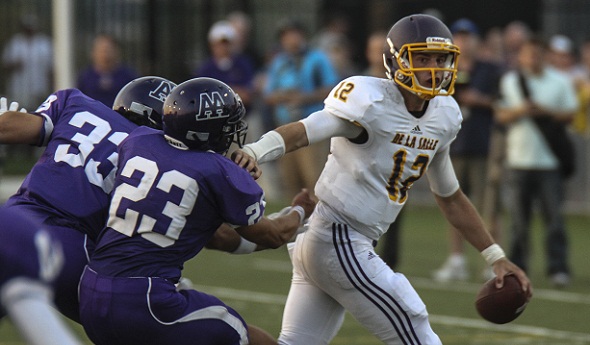
Dearborn Fordson (2-0) at Warren DeLaSalle (1-1), Saturday
The Detroit Catholic League Central also has annual claim as the state's toughest conference, so wins are at a premium for that league's teams -- and DeLaSalle has its work cut out tonight. Fordson has opened with victories over 2011 playoff teams Macomb Dakota and Redford Thurston, and fell to the Pilots only 31-28 a year ago. Quarterback Shane Morris and company will be hoping to shift momentum after last week's 49-13 loss to Cleveland St. Ignatius -- and with Birmingham Brother Rice and Detroit Catholic Central up next.
Others that caught my eye: Romeo at Macomb Dakota, Rochester Adams at Oak Park, Cincinnati Moeller at Detroit Catholic Central (Saturday), Detroit Renaissance at Detroit Cass Tech.
Upper Peninsula
Hurley, Wis., (2-0) at Crystal Falls Forest Park (2-0)
Hurley actually plays more teams from Michigan than from its home state, and has opened by dominating two of them by a combined score of 90-13. Forest Park just missed a ninth-straight season with at least 10 wins last fall in part because it lost to Hurley 33-16 -- the Trojans' only loss of the regular season. In fact, Forest Park has lost two of its last three against the Midgets, which probably gives this the sense of a rivalry game for the home team located only a few miles from the border.
Others that caught my eye: Bessemer at Baraga, Iron Mountain at Iron River West Iron County, Calumet at Ishpeming, Stephenson at Norway.
Southwest and Border
Dowagiac (2-0) at Plainwell (2-0)
The upstart Trojans are hoping to break a six-game losing streak to Dowagiac, although for the first time during that string they are no longer in the same division -- the Wolverine B split into North and South this fall. Still, this would be significant for a few reasons: Plainwell is 2-0 for the first time since 2001 and after finishing 0-9 only two seasons ago, and a win tonight would give the team its first 3-0 start since 1998. For Dowagiac, it's a chance to be 3-0 for the first time since 2006, and this potentially is its toughest test until the Wolverine B South finale against Edwardsburg on Oct. 12 or a week earlier against Three Rivers.
Others that caught my eye: Sturgis at Battle Creek Harper Creek, Olivet at Schoolcraft, St. Joseph Michigan Lutheran at St. Joseph Lake Michigan Catholic, Coloma at Paw Paw.
Bay and Thumb
Millington (2-0) at Frankenmuth (2-0)
For a few decades, this was THE GAME in the Tri-Valley Conference East just about every season. But the Cardinals have won four straight and at least 10 games total in each of the last three seasons, and often that sort of one-sidedness drains some of the mystique. In this case, that's doubtful. This matchup decided the league title again last fall, and Frankenmuth is 2-0 for the first time since 2007. But if the Eagles score tonight, it will be a first against Millington this season. The Cardinals have outscored their first two opponents by a combined 92-0.
Others that caught my eye: Comstock Park at Bay City John Glenn, Lapeer East at Lapeer West, Saginaw at Midland Dow, Alma at Freeland.
Lower Up North
Cadillac (2-0) at Petoskey (2-0)
Petoskey has won three of the last four Big North Conference championships, with that lone lapse in 2009 -- when Cadillac finished one game ahead to claim the title. The Northmen were first and the Vikings tied for second last season, and this could be the decider again. Petoskey won big last season, 63-24, but Cadillac is 2-0 for the first time since 2006.
Others that caught my eye: Benzie Central at Frankfort, Manton at McBain, Johannesburg-Lewiston at Mancelona, Elk Rapids at Traverse City St. Francis.
Mid-Michigan
Lansing Sexton (0-2) at Grand Ledge (2-0)
Sexton is anything but a typical 0-2 team; the Big Reds, who played in the Division 4 postseason in 2011, opened this fall with a loss to Division 1 power Plymouth before falling to Monroe by a point for the second straight season. Now comes another much larger school in Grand Ledge, which beat Sexton 14-0 last fall. The Comets began this season with a 40-30 loss to East Kentwood, but aren't having much trouble scoring -- the came back with a 31-10 win over Holland West Ottawa and are led by multi-talented quarterback Jalen Brady.
Others that caught my eye: Pewamo-Westphalia at Laingsburg, Portland at Corunna, Burr Oak at Portland St. Patrick, Morrice at Webberville.
PHOTO: Warren DeLaSalle quarterback Shane Morris attempts to break away from two Ann Arbor Pioneer defenders during their opening-night game, a 35-7 DeLaSalle win. (Click to see more from HighSchoolSportsScene.com.)
The Drive is Complete: Finals in Review
December 4, 2013
By Geoff Kimmerly
Second Half editor
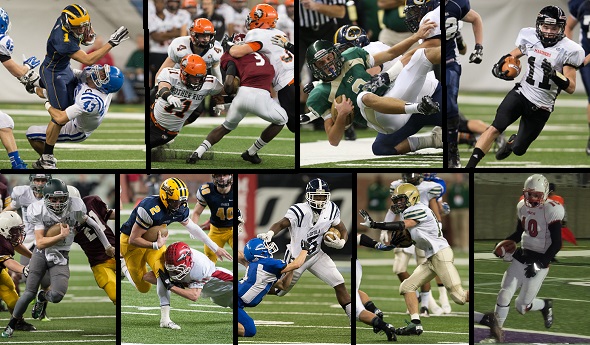
A crowd of more than 52,000 fans – 5,000 more than in 2012 – plus countless others watching on Fox Sports Detroit witnessed the end of one era, the beginning of another and the continuation of one of the most impressive in the nation while watching the MHSAA Football Finals over the last two weekends.
Second Half covered all nine championship games, with quick recaps and links to those stories below followed by notations of performances entered into the MHSAA record book and a report on some of the biggest and best stories to emerge from the 2013 11 and 8-Player Finals.
Finals in Review
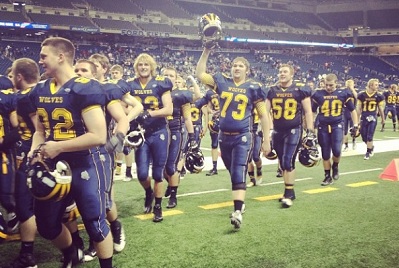 D1: Clarkston 32, Detroit Catholic Central 14 – Clarkston’s proud football tradition now includes its first MHSAA Finals appearance and championship, thanks in part to running back Ian Eriksen’s 237 yards and three touchdowns rushing. The Shamrocks fell in the championship game for the third straight season and despite avenging the first two losses by beating two-time reigning champion Detroit Cass Tech in the Semifinal. Click to read more.
D2: Birmingham Brother Rice 38, Muskegon 21 – The Warriors sent out longtime coach Al Fracassa with the team’s third straight MHSAA championship and first 14-0 season. Fracassa finished his career with a record of 430-117-7 at Brother Rice and Royal Oak Shrine and the most wins in Michigan football coaching history. Click to read more.
D3: Zeeland West 34, DeWitt 27 – The Dux have now won two MHSAA titles in two divisions over the last three seasons after also claiming the Division 4 championship in 2011. Zeeland West plowed to 441 yards rushing on 6.7 per carry. But to DeWitt’s credit, the Panthers didn’t let down despite an early 22-0 deficit and nearly blocked a punt late that could’ve set up a game-tying rally. Click to read more.
D4: Marine City 49, Grand Rapids South Christian 35 – In arguably the weekend’s most competitive scorefest, Marine City outlasted the reigning champion. The score was tied midway through the third quarter and South Christian pulled within seven points of the lead two minutes into the fourth. Click to read more.
D5: Grand Rapids West Catholic 27, Menominee 14 – Despite just making the playoffs at 5-4 and with a one-point win in Week 9, West Catholic marched through the postseason and beat Menominee for the fourth time in the playoffs in the last four seasons. The Falcons had finished runner-up in 2012, losing 12-9 to Portland. Click to read more.
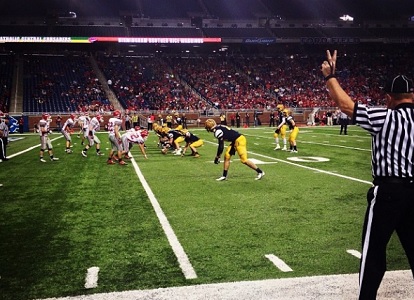
D6: Ithaca 41, Clinton 22 – Despite trailing as late as four minutes into the third quarter, the Yellowjackets kept their reign going another season with a fourth straight MHSAA title, one short of tying the football record for consecutive championships. Ithaca also added to their 56-game winning streak, which is tied for longest in the nation for 11-player teams. Click to read more.
D7: Ishpeming 22, Detroit Loyola 12 – The highly-anticipated rematch of the 2012 Final ended with the same victor as Hematites quarterback Alex Briones led his team to the championship for the second time by a nearly identical score. Ishpeming won last season 20-14 and entered these playoffs ranked No. 1, while Loyola was No. 2. Click to read more.
D8: Muskegon Catholic Central 35, Beal City 12 – The Crusaders locked down one of the highest scoring offenses in MHSAA history while senior Alex Lewandowski turned in one of the top Finals rushing performances of all-time with 218 yards and three touchdowns on the ground. It was MCC’s first championship since 2008. Click to read more.
8-Player: Peck 67, Rapid River 32 – Peck was 1-8 in 11-player football only two seasons ago before making the switch and ascending to the top of 8-player as the latest power to emerge from the Thumb area. Usually a running team, the Pirates took advantage of size on the perimeter to rule the air against Rapid River, which finished runner-up for the second time in three seasons. Click to read more.
Records Report
A number of team and individual entries have been added to the MHSAA Football Finals record book, found by clicking here. A breakdown:
- Clarkston’s Ian Eriksen ran for 242 yards (on 32 carries) to place eighth for most rush yards in a Final. Muskegon Catholic Central’s Alex Lewandowski ran 16 times for 218 yards, good for 16th on that list.
 The Finals featured a number of premiere quarterbacks, but two stuck out most. Birmingham Brother Rice’s Alex Malzone tied for the sixth-most completions, 20, on just 24 attempts. His 263 passing yards ranked 12th for a Final and his four touchdown passes tied for third most. Ithaca’s Travis Smith finished with the seventh-most yards of total offense (370) – adding to a number of entries from his 2011 Finals performance – while joining the lower part of the list for most passing yards with 244. He also threw four touchdown passes.
- DeWitt quarterback Jake Johnson joined some of his Panthers predecessors in the record listings with 289 passing yards (10th all-time) and 320 yards of total offense (11th). Grand Rapids West Catholic quarterback Travis Russell placed 13th on the total offense list with 309 yards, including 133 rushing. South Christian quarterback Jon Wassink joined a long list of those who have completed at least 18 passes, doing so for 240 yards and three TDs. And Muskegon quarterback Deshaun Thrower found teammate Justin Foster with an 86-yard TD pass, good for the fifth-longest pass play.
- Menominee’s Devon Harris and Birmingham Brother Rice’s Corey Lacanaria tied for fifth with 10 receptions a piece, Harris for 149 yards and Lacanaria for 125. Grand Rapids South Christian’s Eric VanVoorst tied for seventh on the catches list with nine for 149 yards, and Marine City’s Pete Patsalis became one of eight who have caught a Finals-best three touchdown passes.
- Marine City’s Olivia Viney tied the Finals record with seven extra-point kicks (see more on her below). Four other kickers made the record book list by connecting on all five of their attempts – Brother Rice’s Jason Alessi, South Christian’s Kyle Haan, Ithaca’s Alex Vanderploeg and Muskegon Catholic Central’s Griffin Seymour.
- Marine City’s Jarrett Mathison ran for the fourth-longest kickoff return, 91 yards for a touchdown. Clinton’s Mathew Sexton ran for the second-longest punt return, 86 yards for a score.
- Marine City’s 49 points were good to tie for sixth-most by a team in Finals history.
- Zeeland West’s offense tied for the fourth-most first downs with 26 and became the 19th team to not punt in a championship game. West’s 66 rush attempts were the second-most in a Final. Brother Rice tied for seventh with 24 first downs and Clarkston tied for ninth with 23.
- Detroit Catholic Central tied Farmington Hills Harrison for the most championship game appearances, with 16; the Shamrocks have won 10 titles. Brother Rice tied for third with 13 Finals berths and moved to sixth with nine championships – plus became one of six to win at least three straight. Muskegon moved up to tied for 12 with seven Finals appearances, Muskegon Catholic tied for sixth with 12 and South Christian is tied for 14th with six Finals appearances. DeWitt and Ishpeming both joined the lower end of that list, each notching their fifth. Ithaca is now tied for third on the list of consecutive titles with four straight, only one off tying that record. MCC also tied for sixth on the championship list by winning its ninth.
- A number of entries also were added to 8-Player Finals record book, which although in its infancy boasts some of the most impressive totals for either football format. Peck quarterback Tristen Haener was added for his 379 yards and seven touchdowns passing, plus his 382 total yards and five extra-point kicks. Teammate Kyle Abrego was added for his 236 yards and four touchdowns receiving, with all four of those coming in the third quarter. Rapid River quarterback Jake Pearson was added for scoring 26 points in the game as both teams combined for 99. A number of team totals reflecting some of the same categories also were added.
Stories behind the scores
Ready for a rematch: There were two from the 2012 Finals, and both ended the same way in 2013. Brother Rice repeated against Muskegon in Division 2 with many of the same players as stood out a year ago, and Ishpeming repeated against Detroit Loyola in Division 7 with a number of new faces make big contributions.
7 for 7: Marine City’s Olivia Viney was believed to be the first female athlete to play in an MHSAA football championship game, and she put up a performance that will live on in the MHSAA record book. Viney connected on all seven of her extra-point kicks, tying the MHSAA Finals record. Viney earned a Division 3 all-state honorable mention this spring on Marine City’s girls soccer team.
Good bye, Coach: Longtime Brother Rice coach Al Fracassa retired after the game with the most wins in MHSAA history and sixth-most nationally. He coached at Royal Oak Shrine from 1960-68 before taking over the Warriors in 1969.
Ithaca reigns on: The national winning streak and four straight titles are detailed a little bit above, and next season the Yellowjackets can tie East Grand Rapids and Farmington Hills Harrison with a fifth straight MHSAA title. Quarterback Travis Smith was the only Ithaca player to dress for all four championships, and his brother Jacob is set to take over behind center next fall.
 We are the champions: Clarkston has been in the conversation on Division 1 contenders for at least the last 14 seasons, and the Wolves brought home their first title after advancing from the Semifinals for the first time in four tries. They have won at least 10 games six times beginning in 1999 and are 24-2 over the last two seasons.
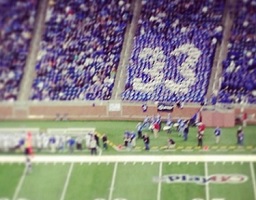
Remembering David: Although Detroit Catholic Central’s third straight loss in the Division 1 Final was heart-wrenching for the Shamrocks, their student body pulled off an awesome tribute. David Widzinski was a running back on the team last season and died in his sleep a year ago. DCC’s students, wearing blue and white shirts, created his No. 33 in the Ford Field stands, memorializing him as his jersey hung from the front railing of the section.
PHOTOS: (Top) Nine champions celebrated MHSAA titles over the last two weekends. (Middle top) Clarkston players march off the Ford Field turf celebrating their first MHSAA football championship. (Middle) Ithaca, from right, works against the Clinton defense in the Division 6 Final. (Below) Detroit Catholic Central students, in blue and white shirts, form a No. 33 to commemorate their deceased classmate (Click to see more like the middle photos on the MHSAA Instagram page.)