

A Game for Every Fan: Week 7
October 4, 2012
By Geoff Kimmerly
Second Half editor
Two thirds of the MHSAA football regular season are complete. And one tenth of Michigan’s teams are still perfect – at least two for only a few more hours.
A total of 59 teams are 6-0, and four are playing each other in two of our most significant clashes in the state this weekend.
See below for those matchups and more from your neighborhood. And be sure to check out the first-time, full-hour MHSAA Football Friday Overtime, kicking off with highlights from 13 games at 11:30 p.m. tonight on Fox Sports Detroit.
Also, remember to visit the MHSAA Score Center all weekend for updated scores and standings.
(All games below are tonight unless noted. Go to Score Center for additional dates and kickoff times.)
Mid-Michigan
Grand Ledge (5-1) at Lansing Everett (6-0)
The Vikings have turned aside all challengers in their pursuit of a first league title since 1986. But despite a 6-0 win over East Lansing last week, the toughest might still be yet to come. Grand Ledge has won five straight since opening with a loss to East Kentwood, and over the years has thrived in games when everyone else is talking more about the other team.
Others that caught my eye: Pewamo-Westphalia (5-1) at Fowler (5-1), Grand Blanc (4-2) at Hartland (6-0), Lansing Catholic (5-1) at Portland (6-0), Olivet (5-1) at Battle Creek Pennfield (5-1).
Thumb and Bay
Flint Carman-Ainsworth (6-0) at Flint Powers Catholic (6-0)
Powers' season has been plenty eventful; the reigning MHSAA Division 5 champion owns wins over reigning Division 7 champ Saginaw Nouvel and reigning Division 3 runner-up Mount Pleasant, and fought through an emotional evening a week ago to beat Davison on the same day as retired coach Jack Pratt's funeral. Carman-Ainsworth's journey to this potential Saginaw Valley Association South title decider has rolled along a little more quietly. All the Cavaliers have done is outscore their first three league opponents by a combined 148-8.
Others that caught my eye: Frankenmuth (6-0) at Essexville Garber (4-2), Freeland (5-1) at Hemlock (5-1), Marysville (5-1) at Marine City (5-1), Croswell-Lexington (6-0) at Almont (4-2).
Lower Up North
St. Ignace (6-0) at Pickford (5-1)
Both are newcomers to the Ski Valley Conference this fall, from different former leagues, and are dominating the North division. The winner tonight claims a share of the league title, and Pickford already has beaten third-place Pellston big. A sixth win would give the Panthers their most since 2007. The Saints aren't budging, outscoring opponents 253-12 so far.
Others that caught my eye: Maple City Glen Lake (6-0) at Frankfort (3-3), Grayling (6-0) at Kalkaska (5-1), Johannesburg-Lewiston (4-2) at Onaway (5-1), Benzie Central (3-3) at Kingsley (4-2).
Upper Peninsula
Ishepming (6-0) at Negaunee (6-0)
Two of six undefeated teams in the Upper Peninsula meet to decide at least a share of the Mid-Peninsula Conference – and eventually, this result could decide the whole title with the way these two have dominated. Negaunee has had a few close calls, but has some additional incentive after losing to Ishpeming in six of the last seven meetings.
Others that caught my eye: Marquette (4-2) at Menominee (5-1), Iron Mountain North Dickinson (6-0) at Powers North Central (4-2), Kingsford (5-1) at Iron Mountain (4-2), Rapid River (4-1) at Eben Junction Superior Central (5-1).
West Michigan
Muskegon Oakridge (6-0) at Shelby (5-1)
Winning the West Michigan Conference generally is a strong endorsement for a team's playoff hopes. Six of eight league teams still are up for automatic playoff berths, but Oakridge can claim a share of the championship tonight. Shelby's lone loss was to Montague, which lost to Oakridge; a Shelby win would create a three-way tie for first place between all three.
Others that caught my eye: Grand Rapids South Christian (4-2) at Grand Rapids Catholic Central (6-0), Caledonia (5-1) at Grand Rapids Forest Hills Central (4-2), East Grand Rapids (2-4) at Lowell (5-1), Grand Rapids Northview (5-1) at Cedar Springs (4-2).
Greater Detroit
Garden City (4-2) at Dearborn Heights Robichaud (6-0)
Robichaud hasn't been perfect this deep into a season since 1991, and got a lot of the heavy work out of the way last week by beating reigning league champion Redford Thurston to earn a share of the Western Wayne Athletic Conference Red. But the Bulldogs can't forget about Garden City, which like Thurston is just a win back of Robichaud and would create a three-way title with a win tonight.
Others that caught my eye: Farmington Hills Harrison (4-2) at Oak Park (6-0), Birmingham Seaholm (5-1) at Bloomfield Hills Lahser (5-1), Plymouth (5-1) at Canton (4-2), Detroit Catholic Central (4-2) at Birmingham Brother Rice (4-2), Saturday.
Southwest and Border
Dowagiac (6-0) at Three Rivers (4-2)
Dowagiac hasn't given up a point in three games and easily could look ahead to Edwardsburg, next week's opponent and the other team tied for first in the Wolverine B Conference South. But the Chieftains won't overlook Three Rivers, which is two eight-point losses from being 6-0 -- including one of those to Edwardsburg two weeks ago.
Others that caught my eye: Lawton (5-1) at Marcellus (5-1), Mattawan (6-0) at Portage Central (5-1), Niles Brandywine (4-2) at St. Joseph Lake Michigan Catholic (6-0), Hartford (5-1) at Decatur (5-1).
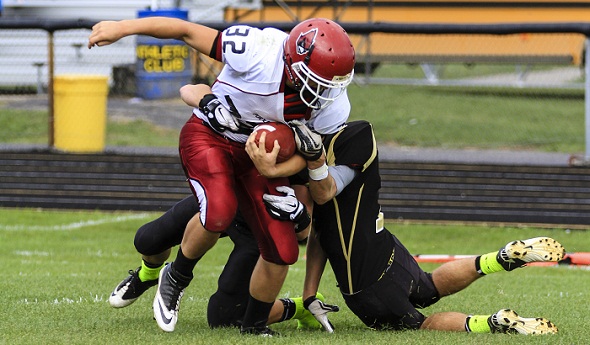
PHOTO: Portland running back Jacob Kimmell works to break away from multiple tacklers during the Raiders' 36-13 win over Corunna on Sept. 8. (Click to see more from HighSchoolSportsScene.com).
Zeeland West Puts 'T' in 3rd MHSAA Title
November 30, 2013
By Bill Khan
Special to Second Half
DETROIT — Danny Bauder would rather trade touches for trophies.
In most other offenses, a player of Bauder's ability would be a featured running back. What team wouldn't want to keep feeding the rock to a kid who ran for 1,796 yards and 28 touchdowns this season?
Bauder did all of that damage, despite the fact he shares the load in the shell game that is Zeeland West's run-oriented Wing-T offense.
He once again had maximum impact on minimal carries, running eight times for 144 yards and a touchdown in West's 34-27 victory over DeWitt in the MHSAA Division 3 championship game Saturday at Ford Field.
Two teammates had more carries than Bauder, as the Dux rolled up 441 rushing yards on 66 carries. Cole Hession had 26 carries for 122 yards, quarterback Casey Brinks had 11 carries for 66 yards and Grant Postma had six carries for 71 yards and two touchdowns.
They all shared in the same accomplishment with their teammates — West's third MHSAA title in the nine-year history of the school. The Dux (13-1) were Division 4 champions in 2006 and 2011.
"I love (our offense), because everyone has a chance to get the ball," said Bauder, who got things rolling with an 80-yard touchdown run on the second play from scrimmage. "We have three backs. We rotate them like every other drive. It's a good team offense. It's a team. I don't mind, just as long as we win."
 Led by its ground attack, West appeared to be on the verge of running away with this one, building a 28-7 halftime lead.
The Panthers wouldn't allow the Dux to coast to the championship that easily, however.
A 56-yard touchdown run by Chris Ruby and a 29-yard scoring strike from Jake Johnson to Josh Borta in a 72-second span got DeWitt within 28-20 with 6:50 left in the third quarter.
West responded with a 25-yard touchdown run by Brinks with 2:57 to go in the third, but an offense that averaged 48.9 points per game coming into the contest wouldn't score again. Junior defensive back Ben Zamiara led DeWitt's defensive charge with a game-high 20 tackles, 11 more than anyone else on either team. The Panthers held West to 1-for-4 on fourth-down conversions.
"I'm pretty sore right now," Hession said. "This is one of the games I've come out of the most sore. I can feel it right now, and my adrenaline is still rushing. Props to them, because they came out and they had three or four series where they stopped us on fourth down. Not many teams can do that. They're just good."
DeWitt closed the deficit to seven points when Johnson rolled left and hit a wide-open Borta for a 75-yard touchdown with 4:25 left in the game.
The Panthers' offense would watch the rest of the game on the sidelines. The Dux milked some clock by getting two first downs before dropping back to punt from its own 48 for the only time in the game. Postma barely got off the punt, but was knocked to the ground when a DeWitt defender caught him on the leg while going for a block. West retained the ball, running out the remaining 32 seconds by taking a knee one time.
"Our punter was already hurt," West coach John Shillito said. "He was on one leg. So, it was a great effort by Grant to get the ball off and it was a break for us. We knew the game was over. You knew that all you had to do was take a knee."
DeWitt coach Rob Zimmerman said going for the block was a risk the Panthers had to take, given the time on the clock and the potential field position.
"If they punt and pin us down at the 10, that's a long way to go," Zimmerman said. "We went for it. Obviously, it didn't turn out in our favor. You have to take chances when you're in that situation."
DeWitt tried in vain to play catch-up all night after falling behind 8-0 when Bauder took the ball around the left side of the Dux line and broke into the clear for an 80-yard touchdown just 45 seconds into the game. West, which attempted (and missed) only one extra-point kick all year, got two points on a pass from Brinks to Zach Poppema.
West scored on four of its five possessions in the first half, failing only on its second series when a fourth-and-five run from the DeWitt 13 came up a yard short.
The Dux shook off that temporary setback and scored on a 7-yard pass from Brinks to Hession on the first play of the second quarter. Hession ran for the 2-point conversion to make it 16-0.
Following a fumble at the West 49, the Dux took a 22-0 lead on an 18-yard run up the middle by Postma with 6:45 left in the first half. Brinks' conversion run failed.
DeWitt (13-1) finally put a drive together and got back in the game on a 4-yard touchdown pass from Johnson to Justice Shankel with 3:15 left in the first half. Cameron West's extra point made it a 22-7 game.
The Dux didn't get away from their ground game with time winding down in the first half, throwing only one pass on a seven-play, 80-yard drive that yielded a 12-yard touchdown run by Postma with 1:04 to go in the half. Postma's 2-point run failed, resulting in a 28-7 halftime lead for West.
"We dug ourselves too deep a hole," Zimmerman said. "I felt if we got one more possession, we had a shot."
Johnson, a junior, was 15 for 24 passing for 289 yards, three touchdowns and two interceptions for DeWitt. Brinks was 3 for 5 for 35 yards and a touchdown for West.
Borta grabbed five passes for 183 yards and two touchdowns.
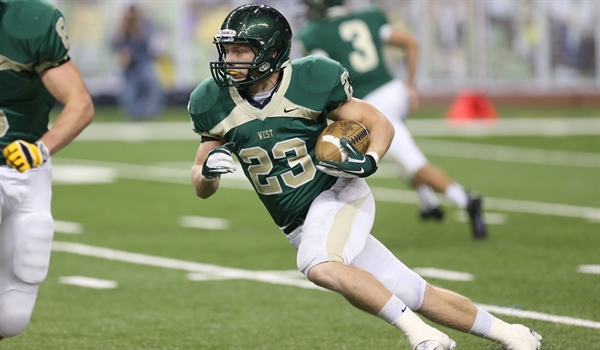
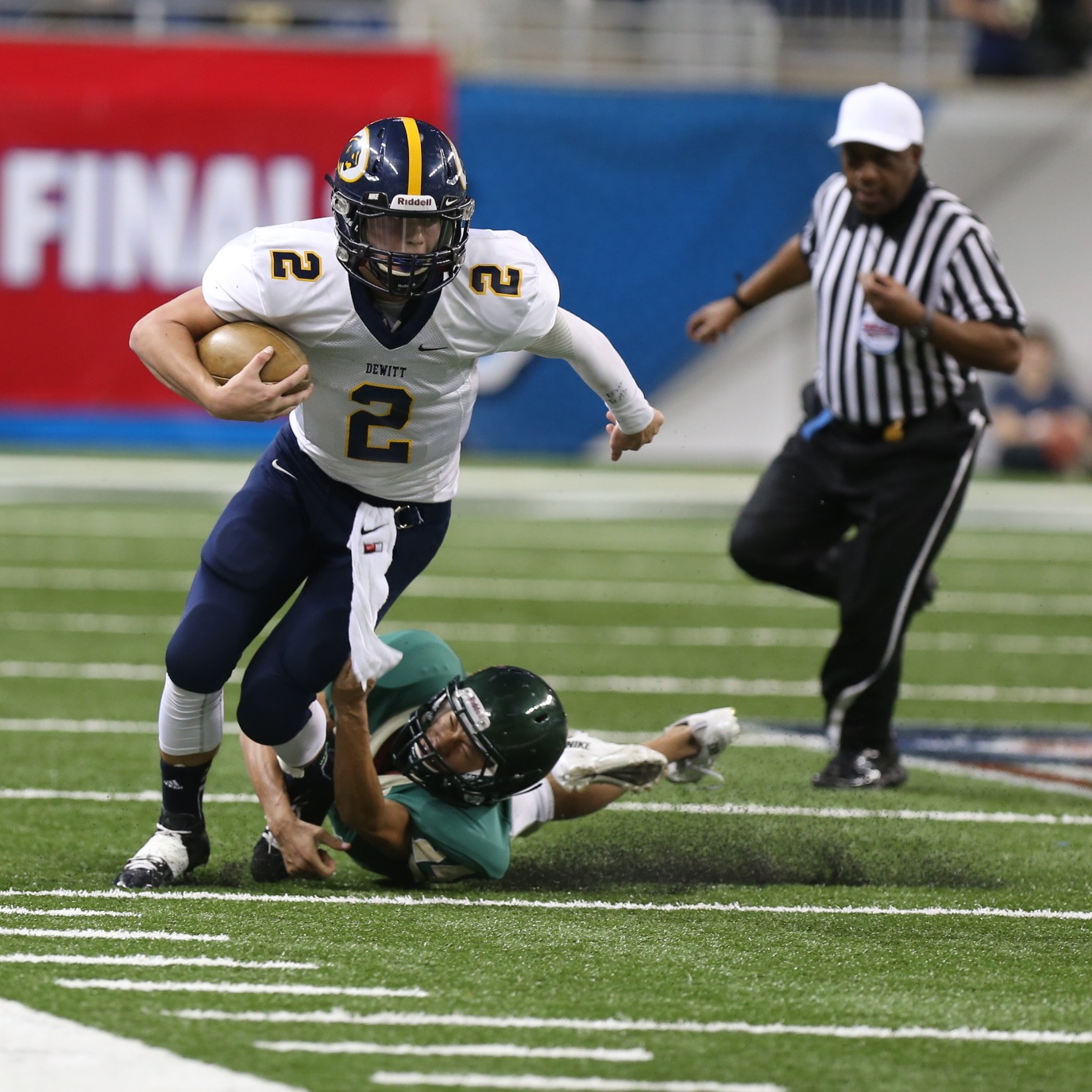
PHOTOS: (Top) Zeeland West running back Danny Bauder scampers ahead during Saturday's Division 3 Final. (Middle) DeWitt quarterback Jake Johnson tries to pull away from a Dux defender's grasp. (Photos by Hockey Weekly Action Photos).