

A Game for Every Fan: Week 9
October 23, 2014
By Geoff Kimmerly
Second Half editor
For 90 MHSAA football teams, this weekend could be the end – or a new beginning.
While 167 teams have qualified for this fall’s 11-player playoffs – and one more is assured of doing so thanks to a forfeit victory – 90 more still control their postseason destinies.
It’s win and in, with only eight games featuring matchups of 5-3 teams – meaning 82 at most can earn automatic berths this weekend. The average since the 256-team playoff format was introduced in 1999 is 234 automatic qualifiers. My guess for 2014: 230. Tune in Sunday.
Playoff pairings will be broadcast during the Sunday Selection Show at 7 p.m. on Fox Sports Detroit and posted to MHSAA.com at its conclusion. I’ll also post on Second Half my now-annual breakdown of some of the tougher decisions we faced as we grouped teams for the nine divisions.
Total, 272 will reach the playoffs – the top 16 8-player teams qualify for that bracket based on playoff-point average. Until then, the following will be among games we focus on most this weekend. All are Friday unless noted (there are 15 games statewide tonight and 10 on Saturday.).
Greater Detroit
Detroit Martin Luther King (8-0) vs. Detroit Cass Tech (8-0) at Ford Field
With all Detroit Public School League teams playing in one division this fall, but these two not meeting during the regular season, this has been even more highly anticipated than usual. Cass Tech has running back Mike Weber, committed to the University of Michigan, and is the team almost always talked about most from this league thanks to its four straight seasons of 11 or more wins and recent pair of MHSAA titles. But consider King’s quiet body of work – the Crusaders haven’t given up a point since September, have five shutouts total, and are led by Michigan State University-bound linebacker Tyriq Thompson.
Others that caught my eye: Orchard Lake St. Mary's (7-1) vs. Birmingham Brother Rice (8-0), Saturday at Ford Field; Clarkston (8-0) at Farmington Hills Harrison (7-1), Madison Heights Madison (7-1) at Walled Lake Western (7-1), Monroe (6-2) at Dearborn Fordson (8-0).
West Michigan
Muskegon Mona Shores (7-1) at Muskegon (8-0)
The top three games on this side of Michigan all feature Muskegon-area teams, and this has to be the biggest with Mona Shores capable of making it interesting again after arriving in 2013 with its first playoff berth after pushing the Big Reds to 26-20 in the Ottawa-Kent Conference Black opener. This time, this matchup concludes the league season with both tied for first; Mona Shores’ only loss was 10-7 to Rockford in Week 3, the last week this season as well that the Big Reds were challenged.
Others that caught my eye: Muskegon Orchard View (5-3) at Muskegon Oakridge (7-1), Muskegon Catholic Central (8-0) at Ravenna (7-1), Holland West Ottawa (5-3) at Rockford (6-2), Ada Forest Hills Eastern (4-4) at Cedar Springs (7-1).
Lower Up North
Traverse City Central (6-2) at Cadillac (8-0)
This Big North Conference decider has been foreseeable for about a month. Central suffered a 16-13 Week 6 loss to Petoskey, keeping this from being a true championship game. But the Trojans are driving to take a share of the title from Cadillac after falling to the Vikings 14-7 in their Week 9 matchup a year ago – and then missing the playoffs by a win. Cadillac has won 17 straight regular-season games and impressively scratched out two league wins by five or fewer points.
Others that caught my eye: Johannesburg-Lewiston (7-1) at Indian River Inland Lakes (7-1), Traverse City St. Francis (6-2) at Kingsley (5-3), Frankfort (5-2) at Onekama (5-3), Grayling (4-4) at Boyne City (8-0).
Upper Peninsula
Marquette (7-1) at Menominee (8-0)
The Great Northern Upper Peninsula Conference championship comes down to this; both are undefeated in the league, although with different stories along the way. Menominee is coming off two Wisconsin wins and didn’t let another league opponent within 14 points. Marquette is riding strong wins over Constantine and Negaunee the last two weeks, but won its other league games by two, eight and five points, respectively – and lost to the Maroons the last two seasons by a combined 93-14. That said, Marquette also is headed to the playoffs for the first time since 2011 and lost only on opening night.
Others that caught my eye: Lake Linden-Hubbell (7-1) at Crystal Falls Forest Park (6-1), Sault Ste. Marie (4-4) at Newberry (5-3), Ishpeming Westwood (6-2) at Negaunee (4-4), Iron River West Iron County (8-0) at Bark River-Harris (6-2).
Mid-Michigan
Monroe St. Mary Catholic Central (8-0) at Lansing Catholic (8-0)
It’s hard to imagine a better postseason primer for these MHSAA title contenders. St. Mary crushed the Huron League with four shutouts and gave up only 21 points total in seven games (and 34 for this season overall), and looks well on the way to another playoff run to go with its five District titles over the last six seasons. Lansing Catholic had only a bit tougher time with a bit stronger Capital Area Activities Conference White, but is averaging 41 points per game and approaching the offensive numbers put up when the team made the Division 5 Final in 2011.
Others that caught my eye: Goodrich (7-1) at St. Johns (7-1), Holt (3-5) at Grand Ledge (5-3), Lakeview (7-1) at Stanton Central Montcalm (5-3), Eaton Rapids (5-3) at Charlotte (4-4).
Bay and Thumb
Montrose (6-2) at New Lothrop (8-0)
Little has been said about New Lothrop since opening night, as it again didn’t face much challenge in the Genesee Area Conference Blue. But the Hornets – seeking their fourth straight perfect regular season – can boast a couple solid nonleague wins over playoff qualifier Traverse City St. Francis and Schoolcraft, playing tonight for an automatic bid. The GAC Red is much more competitive, and Montrose finished third this season – but is expected to be dangerous in the playoffs with their losses to Goodrich and Flint Beecher by a combined seven points.
Others that caught my eye: Flint Carman-Ainsworth (6-2) at Flint Powers Catholic (6-2), Northville (5-3) at Grand Blanc (5-3), Midland Dow (8-0) at Midland (4-4), Flushing (6-2) at Swartz Creek (5-3).
Southwest and Border
Hudson (7-1) at Hillsdale (7-1)
These two have done the work to reach this championship decider in the Lenawee County Athletic Association, both edging contender Ida in consecutive weeks and turning back potential playoff qualifier Onsted as well. Save for last week’s 38-18 win over Onsted, Hudson gave up only 14 points in its other five league games and owns four wins in its last five over Hillsdale including 16-7 in 2013. But the Hornets have enjoyed incredible success since joining the LCAA in 2012, with a 19-1 record in league games – that lone loss, of course, to Hudson last year. Hillsdale thrives on offense, averaging 45 points per game not counting the mere three it put up in its lone loss to Ohio’s Defiance Tinora in Week 2.
Others that caught my eye: Gobles (6-2) at Saugatuck (5-3), Manchester (7-1) at Union City (8-0), Reed City (7-1) at Schoolcraft (5-3), Portage Central (6-1) at St. Joseph (4-4).
8-player
Lawrence (8-0) at Battle Creek St. Philip (8-0) on Saturday
These two started a nice rivalry last season, when St. Philip won 54-50 in the final game of the regular season and then Lawrence won the rematch two weeks later, 58-28 in their Regional Final. But more might be riding tonight than taking the upper hand; despite being one of four undefeated teams in 8-player, Lawrence ranks only seventh in playoff-point average and could use a nice boost to guarantee some home-field advantage over the next couple of weeks. St. Philip has the second-highest playoff average and could take over the top spot.
Others that caught my eye: Bellaire (7-1) at Rapid River (8-0), Portland St. Patrick (7-1) at Morrice (5-3).
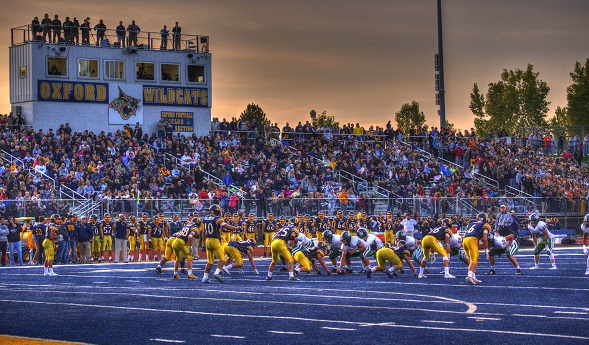
PHOTO: Oxford defeated Bloomfield Hills 35-14 last week to earn an automatic playoff berth and faces Oak Park this week. (Photo courtesy of Matt Johnson/Oxford High School.)

West Catholic Adds to Ford Field Fame
November 26, 2016
By Geoff Kimmerly
Second Half editor
DETROIT – November has become a regular part of the Grand Rapids West Catholic football schedule. Trips to Detroit are turning into a Thanksgiving weekend tradition.
But what the Falcons accomplished again Saturday was not lost on them.
Grand Rapids West Catholic won its fifth MHSAA football championship and became just the sixth school to win four straight, downing familiar playoff foe Menominee 43-7 in the Division 5 Final at Ford Field.
“There’s no word to describe it. Year after year, competing like that, getting to play 14 games – we’re very, very lucky and blessed,” said senior Sam Neville, who with David Fox played on all four champions. “That’s double what most people get to play over the course of their high school careers.”
This string was as impressive as any of the other three, for a few reasons.
West Catholic finished 12-2, despite playing without junior quarterback Gaetano Vallone for six weeks after he injured an elbow on opening night.
The Falcons, with a Week 3 loss to Zeeland West and a Week 9 defeat to Allendale, were then forced to play all of their playoff games on the road. They navigated a path highlighted by previously undefeated Portland, handed second losses to Lansing Catholic and Algonac and also beat another league champion in Berrien Springs.
They did so under the leadership of a new coach. Joe Hyland was hired this spring after the resignation of Dan Rohn, who had led the team to the first three titles of this streak. Hyland had been highly successful coaching in South Carolina before coming to West Catholic as a teacher and guidance counselor in fall 2015, but as with any change, there was a transition.
And then there was that Finals familiarity. The Falcons defeated the Maroons in 2013’s Division 5 Final to start this streak, and also in a Semifinal in 2014 and Regional Final last fall. It would be hard to find two high school programs 450 drive miles apart that know each other more.
“There’s a lot of people in our community and even statewide who talked about ‘November, November,’ but our discussions were always about today,” Hyland said. “And just feeling like if you do the right thing now, the rest will work out. And if we get beat by a good team on our best day, then you shake their hand and look them in the eye and congratulate them. But we really felt like on our best day, that wasn’t going to happen.”
Saturday had to be one of them.
Junior kicker Liam Putz started the scoring just 2:41 into the game with an MHSAA Finals-record 47-yard field goal, a yard longer that Josh Wuerful’s for Traverse City High against Detroit Catholic Central in the 1988 Class A championship game.
By the end of the first quarter, Vallone had thrown two touchdown passes. By halftime, he’d connected on four. The first, a 91-yarder to senior Brett Myers, was the fourth longest pass play in Finals history.
 Vallone finished 13 of 20 passing for 311 yards, the fifth most in Finals history. He spread the ball nicely with five receivers catching at least one pass; Neville had six catches for 117 yards and two scores, Meyers three for 143 yards and his long touchdown and senior Aaron Hall caught four balls for 66 yards and the other passing TD.
The 5-foot-10, 170-pound quarterback also ran for a team-high 83 yards and a score on 13 carries. His 394 total yards rank sixth on the Finals all-time list.
Menominee did achieve a little history as well. In addition to playing in their fifth Final, the Maroons scored their points on a 76-yard blocked field goal return by senior Hunter Hass – the first blocked field goal return touchdown in Finals history. The kick was blocked by senior Sam Larson, and Hass picked up the loose ball and ran down the left sideline for the score.
“All week we were practicing to block their punt, and it just so happened that we blocked their field goal,” Hass said. “I saw the ball. I just picked it up and ran into the end zone, just trying to get some points to get some momentum going for our team.”
But the rest of the afternoon was a struggle. The Maroons (12-2) gained only 163 yards and tied a Finals record held by two others teams with seven turnovers – three coming on fumbles.
They also played once more without all-state tailback Keifer Rasner, who missed the end of the season with an injury.
“When you turn the ball over that many times to a good team, you don’t have much of a shot,” Menominee coach Joe Noha said. “But I’m really proud of my guys. We really hung in there. We’ve had a lot of things happen in the last couple of weeks, but I’m really pleased with our effort and our fortitude to get here. And once you get here, finishing is difficult. Today was not our day.”
The MHSAA Football Finals are sponsored by the Michigan National Guard.
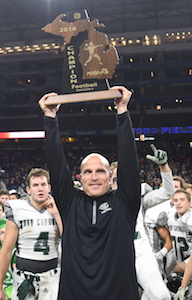
PHOTOS: (Top) Grand Rapids West Catholic’s Zane Timmer tries to break away from a Menominee tackler Saturday in the Division 5 Final. (Middle) Falcons coach Joe Hyland raises the championship trophy.