

Garza Shows Range, New Lothrop Reigns
By
Paul Costanzo
Special for MHSAA.com
January 23, 2021
DETROIT – It had been a while Saturday since the New Lothrop offense had made a big play.
The Hornets had seen a 28-point lead shrink to seven and were staring down another big third down. In need of a spark, they turned to the player who had given them so many earlier in the game, and once again, Julius Garza delivered.
Garza converted the third down, and eventually scored his fourth touchdown to help seal New Lothrop’s 42-35 victory over Traverse City St. Francis in the Division 7 Football Final at Ford Field.
“Their backers were keying on (Will) Muron all night, so I knew when they flew up, Julius would come open,” New Lothrop senior quarterback Cam Orr said. “I knew if I threw him the ball, he’d catch it no matter where it was.”
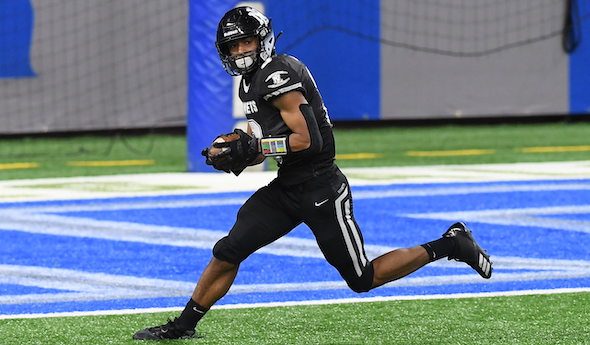
Garza scored four touchdowns in the game – two rushing, one receiving and one on a kick return – to tie him for fourth in MHSAA Finals history for touchdowns in a game. He had 139 yards receiving on four catches and 26 yards rushing on four carries.
It was his 3rd-and-6 conversion with his team in its own territory and clinging to a seven-point lead, however, that was likely his biggest play of the game. His 26-yard reception on the next play was also in the running, as was the nine-yard touchdown run that put New Lothrop up 42-28 with 2 minutes, 26 seconds to play.
“It means everything,” Garza said. “It’s kind of taken a little bit to settle in. I feel like I’m on top of the world right now. It’s really exciting. All the work we put in, and everything we do, for it to pay off, it means the world.”
The title was the Hornets’ third, and first since 2018. If not for a one-point Regional Final loss a year ago against eventual champion Pewamo-Westphalia, the program could be celebrating a three-peat.
“We’ve always had tremendous community backing. We’ve always had tremendous kids that have put in the same amount of work these guys have,” New Lothrop coach Clint Galvas said. “We were just unfortunately not able to get over that hump. Obviously in (2018) we were able to get over that hump and win a state title. Maybe that gave us the confidence we need moving forward as a program, like, ‘Hey, we can do this now.’ Winning a couple is special, but I’m not taking anything away from the previous teams we had, because we had some pretty darn good teams walk through these halls and wear the New Lothrop helmet, and they put in the work, too.”
At halftime, it looked as though New Lothrop (11-0) would be cruising to title No. 3, as it built a 35-7 lead, using explosive plays. Muron scored on the Hornets’ second offensive play with a 27-yard run, and after St. Francis answered with a three-yard Gabe Olivier touchdown run, Garza returned the ensuing kickoff 83 yards for a score.
 Garza added a 65-yard touchdown reception from Orr and a three-yard touchdown run, before Orr closed out the half with an 11-yard rushing score.
“Is Julius Garza having a heck of a day surprising? Not at all,” Galvas said. “Those of you who have been around and watched this kid, he was a two-way starter two years ago on the 2018 title team. The kid’s always been a player. … I think they came into the game like a lot of teams, they want to stop Cam and they want to stop Will on the edge. And I think if you do that, sometimes you forget about Julius Garza. We were able to get him a lot of one-on-one matchups with some backers and things, and he’s going to win those pretty much 10 out of 10 times. He’s a heck of an athlete.”
St. Francis (9-3) clawed back into the game in the second half, however, shutting the New Lothrop offense down and getting its own offense going – albeit in a different manner than the Hornets. The Gladiators power run game started to lean on New Lothrop and scored on its next three possessions prior to Garza’s late-game heroics, to nearly erase the deficit.
Aidan Schmuckal closed out a nine-play drive with a two-yard touchdown run midway through the third quarter, and Charlie Peterson scored on a one-yard sneak early in the fourth to close out a 14-play drive. Schmuckal’s second score, also a two-yard run, came with 6:46 to play and immediately followed a blocked punt by St. Francis’ Jimmy Muzljakovich.
“I felt like we played a doubleheader today,” St. Francis coach Josh Sellers said. “The score of the first game was 35-7, and the score of the second game was 28-7. Unfortunately, the math didn’t work out in our favor. We let too many big plays go in the first half, obviously. At 35-7 in the locker room, I told them, ‘You’ve got two choices: you can just pack up the tent stakes and go home now, or go out and try to win the second half,’ and they did. They won the second half with great effort, great belief in one another, and we just fell a little bit short today.”
St. Francis didn’t go away after Garza’s final touchdown, either, scoring with a seven-yard pass from Peterson to Josh Grove with 1:07 to play. New Lothrop recovered the onside kick, however, and after running three plays, Orr ran off the final seven seconds of the game by rolling to his left and throwing the ball high into the air down the field.
“We like to pride ourselves in our never-giving-up mentality,” Schmuckal said. “We’ve been a team that has been known to battle back and never give up. Going into that second half, I knew that we were never going to give up and we were going to fight to the bitter end, and that’s what we did.”
Schmuckal led St. Francis with 101 yards rushing, while Owen Mueller had 71 and Olivier had 69. Joey Donahue led the St. Francis defense with eight tackles, while Schmuckal had seven, including three for loss.
Orr led the Hornets in passing and rushing, throwing for 222 yards on 11-of-15 passing, and running for 122 yards on 17 carries. Alec Mangino led the New Lothrop defense with 12 tackles, while Garza had nine. Muron and Bryce Cheney each had an interception.
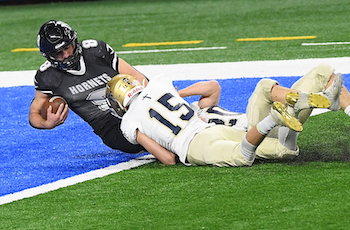
PHOTOS: (Top) New Lothrop’s Julius Garza looks to make one of his many big plays Saturday at Ford Field. (Middle) Hornets quarterback Cam Orr reaches the end zone as Traverse City St. Francis’ Gavin Nickodemus (15) and Gabe Olivier (20) bring him to the turf. (Click for more from Hockey Weekly Action Photos.)
Glen Lake Plays for Weekends Like This
November 15, 2019
By Chris Dobrowolski
Special for Second Half
There’s nothing that could spoil Jerry Angers’ mood right now.
 When you love coaching football as much as Maple City Glen Lake’s varsity leader, being able to continue preparing your team deep into the playoffs trumps any tough situations that might come along.
That’s why an early-season snowstorm that hammered Leelanau County and shut down a number of schools in the area hardly registered as problematic for Angers, who is guiding his Lakers into a Division 6 Regional championship game against Calumet on Saturday — a clash of 10-1 squads aiming to advance to the Semifinal round.
“It’s totally awesome,” said Angers, in his 11th year in charge of the Lakers. “We’re getting pounded with snow up here, and we’ve got guys plowing our field off. We practiced in the gym today because it was snowing so bad. We were told we had to go home early. I wouldn’t trade that adversity for anything.”
This will be the second time in the last four years Glen Lake has ventured to the Upper Peninsula to face the Copper Kings. In 2016 the two teams met in the same round of the postseason, with the Lakers pulling out a 14-0 win on the way to reaching the Division 6 Final against Jackson Lumen Christi, which won the title with a 26-14 victory. Nearly all of the 16 seniors on Glen Lake’s roster were freshmen on the 2016 team and have the experience of an eight-hour bus trip to the Keweenaw Peninsula under their belts.
“That’s a really cool similarity because those kids have experienced this trip,” said Angers. “They weren’t playing, but they experienced what it took to get there.”
Angers makes the experience more than just playing the game. Getting in a practice on the way to Calumet, the team meals, the hotel stay — each aspect becomes part of the joy of the journey.
“It’s fun getting on the bus and basically spending two days with the kids and experience all the different things,” said Angers. “It’s like college football life on the high school level.”
There’s little doubt this is a business trip for the Lakers, though.
“When we got into film session on Sunday, Coach just told us it’s college football 101,” said senior running back/linebacker Johnathan Wright. “Long bus ride. We’ve got to stay focused.
“(They are) definitely a typical U.P. power team. They want to run downhill and run the clock out and just keep smashing you in the mouth.”
Angers admits to being superstitious enough that he’s trying to mimic as much of the trip this time to the one in 2016 in hopes that it can lead to a similar outcome. Just maybe not an exact mirror, however.
Right as the Lakers were getting ready to head from the hotel to the field in that Regional contest in 2016, they realized they had been locked out of their bus. Without panicking, players had to file into parents’ vehicles to transport them to the game in time. The Lakers managed to overcome that moment of turmoil by winning the game.
“So, if that’s what goes wrong and you still get to play a game? I was laughing about it,” said Angers. “How many other people are playing football right now?”
The seeds for this season were sown during an up-and-down 5-5 campaign a year ago that included a first-round playoff loss to Beaverton. The senior class — which showed its potential when it got significant playing time and performed well in a postseason victory against Roscommon as freshmen — wanted to leave its own legacy with a deep playoff run like the one the Lakers experienced three years ago.
“That was a huge motivation,” said senior lineman Ben Kroll. “We hated how we exited last year. We did not like the way we played. We do a boot camp every summer before the season starts. It was definitely the best boot camp I’ve been to, how close we all were and how we get along. We’ll fight for each other every day.”
Glen Lake has good athletes at the skill positions. Wright is in his second year starting on offense — he’s also been a three-year starter at linebacker — and is the leading rusher. Quarterback Reece Hazelton, at 6-foot-7, has a greater stature than a typical high school quarterback, though his best sport is basketball. He signed his letter of intent Wednesday to play hoops for Ferris State. His favorite target is junior receiver Finn Hogan.
The line, a position group near and dear to Angers’ heart, is the heartbeat of the team, with seniors Garrett Tremble, Dylan Kilinski, River Dallas and Kroll, and junior tackle Sam Keys.
“Without them nothing would happen,” said Wright.
Angers makes sure everyone on the roster knows they have key roles, whether it’s starting on offense, defense or special teams. Guys who make up the scout team are held in high value. Angers can go down the line and name off kids on his team and big plays they’ve been able to make at some point this season.
“There’s 31 kids I can turn to at any time, and I feel very comfortable and confident that they’re going to go in and get the job done,” said Angers. “Next man up. You’re one play away from being a starter. I think these kids also understand that.”
The Lakers have gone through a brutal schedule nearly unscathed. Five of the nine teams on the schedule qualified for the playoffs, and four of those teams won at least one postseason game. The schedule is specifically created that way for Glen Lake to be properly prepared to handle tough teams during the playoffs.
The one slip up came in the seventh week when Kingsley — which remains undefeated and is playing for a Regional crown in Division 5 — handed the Lakers a 53-14 loss. Angers shoulders the blame, saying he didn’t have the Lakers ready for a game of that magnitude and Glen Lake was uncharacteristically sloppy.
“That was a real wake-up call, and I think that was really good for our team because now in these playoff runs we know we can’t take any days off, any moments off,” said Kroll.
The ultimate goal, of course, is to win the Division 6 championship at Ford Field. Two more wins and Glen Lake will be back in the position it was in three years ago, playing in Detroit with a title on the line. Glen Lake’s last football championship came in 1994 when the Lakers won the Class DD crown with a 20-10 victory against Waterford Our Lady of the Lakes.
“There’s nothing like it,” said Wright. “All the lights are on you. You’re at the center of a huge dome, and it feels amazing. I just want to get back to that.”
The memory of being in Detroit for Thanksgiving weekend is still fresh in Angers’ mind — arriving at the stadium and feeling the electricity in the air as an earlier game unfolded.
“One of the coolest experiences was when we were all walking in from the bus into the tunnel and there was a big play made in the game before us,” said Angers. “The crowd just erupted, and it just ran down that tunnel. My kids, they were just starry eyed and they looked at me and I went, ‘You’re in the big time boys.’”
And nothing could be better than that.
 Chris Dobrowolski has covered northern Lower Peninsula sports since 1999 at the Ogemaw County Herald, Alpena News, Traverse City Record-Eagle and currently as sports editor at the Antrim Kalkaska Review since 2016. He can be reached at [email protected] with story ideas for Manistee, Wexford, Missaukee, Roscommon, Ogemaw, Iosco, Alcona, Oscoda, Crawford, Kalkaska, Grand Traverse, Benzie, Leelanau, Antrim, Otsego, Montmorency, Alpena, Presque Isle, Cheboygan, Charlevoix and Emmet counties.
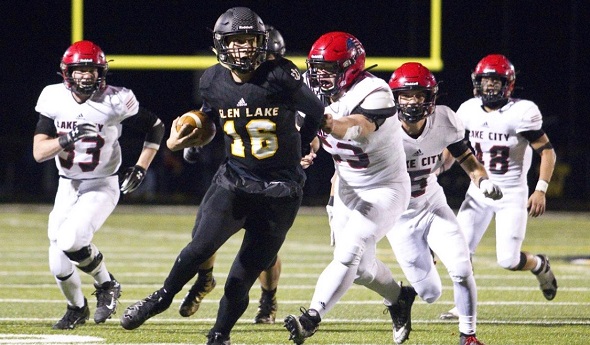
PHOTO: Maple City Glen Lake quarterback Reece Hazelton breaks free from Lake City defenders during a 30-19 Pre-District win. (Photo courtesy of the Traverse City Record-Eagle.)