

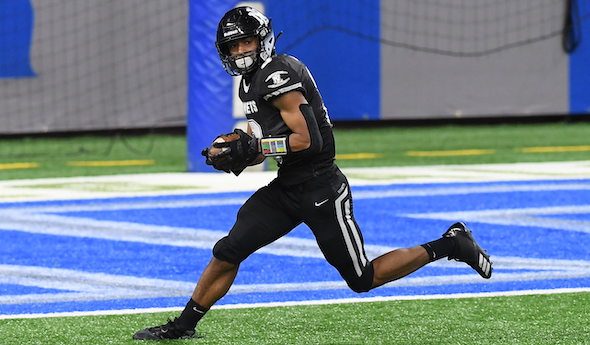
Garza Shows Range, New Lothrop Reigns
By
Paul Costanzo
Special for MHSAA.com
January 23, 2021
DETROIT – It had been a while Saturday since the New Lothrop offense had made a big play.
The Hornets had seen a 28-point lead shrink to seven and were staring down another big third down. In need of a spark, they turned to the player who had given them so many earlier in the game, and once again, Julius Garza delivered.
Garza converted the third down, and eventually scored his fourth touchdown to help seal New Lothrop’s 42-35 victory over Traverse City St. Francis in the Division 7 Football Final at Ford Field.
“Their backers were keying on (Will) Muron all night, so I knew when they flew up, Julius would come open,” New Lothrop senior quarterback Cam Orr said. “I knew if I threw him the ball, he’d catch it no matter where it was.”
Garza scored four touchdowns in the game – two rushing, one receiving and one on a kick return – to tie him for fourth in MHSAA Finals history for touchdowns in a game. He had 139 yards receiving on four catches and 26 yards rushing on four carries.
It was his 3rd-and-6 conversion with his team in its own territory and clinging to a seven-point lead, however, that was likely his biggest play of the game. His 26-yard reception on the next play was also in the running, as was the nine-yard touchdown run that put New Lothrop up 42-28 with 2 minutes, 26 seconds to play.
“It means everything,” Garza said. “It’s kind of taken a little bit to settle in. I feel like I’m on top of the world right now. It’s really exciting. All the work we put in, and everything we do, for it to pay off, it means the world.”
The title was the Hornets’ third, and first since 2018. If not for a one-point Regional Final loss a year ago against eventual champion Pewamo-Westphalia, the program could be celebrating a three-peat.
“We’ve always had tremendous community backing. We’ve always had tremendous kids that have put in the same amount of work these guys have,” New Lothrop coach Clint Galvas said. “We were just unfortunately not able to get over that hump. Obviously in (2018) we were able to get over that hump and win a state title. Maybe that gave us the confidence we need moving forward as a program, like, ‘Hey, we can do this now.’ Winning a couple is special, but I’m not taking anything away from the previous teams we had, because we had some pretty darn good teams walk through these halls and wear the New Lothrop helmet, and they put in the work, too.”
At halftime, it looked as though New Lothrop (11-0) would be cruising to title No. 3, as it built a 35-7 lead, using explosive plays. Muron scored on the Hornets’ second offensive play with a 27-yard run, and after St. Francis answered with a three-yard Gabe Olivier touchdown run, Garza returned the ensuing kickoff 83 yards for a score.
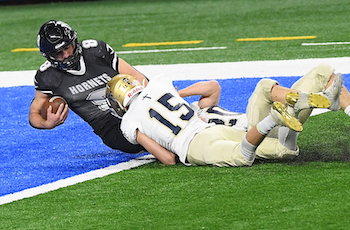 Garza added a 65-yard touchdown reception from Orr and a three-yard touchdown run, before Orr closed out the half with an 11-yard rushing score.
“Is Julius Garza having a heck of a day surprising? Not at all,” Galvas said. “Those of you who have been around and watched this kid, he was a two-way starter two years ago on the 2018 title team. The kid’s always been a player. … I think they came into the game like a lot of teams, they want to stop Cam and they want to stop Will on the edge. And I think if you do that, sometimes you forget about Julius Garza. We were able to get him a lot of one-on-one matchups with some backers and things, and he’s going to win those pretty much 10 out of 10 times. He’s a heck of an athlete.”
St. Francis (9-3) clawed back into the game in the second half, however, shutting the New Lothrop offense down and getting its own offense going – albeit in a different manner than the Hornets. The Gladiators power run game started to lean on New Lothrop and scored on its next three possessions prior to Garza’s late-game heroics, to nearly erase the deficit.
Aidan Schmuckal closed out a nine-play drive with a two-yard touchdown run midway through the third quarter, and Charlie Peterson scored on a one-yard sneak early in the fourth to close out a 14-play drive. Schmuckal’s second score, also a two-yard run, came with 6:46 to play and immediately followed a blocked punt by St. Francis’ Jimmy Muzljakovich.
“I felt like we played a doubleheader today,” St. Francis coach Josh Sellers said. “The score of the first game was 35-7, and the score of the second game was 28-7. Unfortunately, the math didn’t work out in our favor. We let too many big plays go in the first half, obviously. At 35-7 in the locker room, I told them, ‘You’ve got two choices: you can just pack up the tent stakes and go home now, or go out and try to win the second half,’ and they did. They won the second half with great effort, great belief in one another, and we just fell a little bit short today.”
St. Francis didn’t go away after Garza’s final touchdown, either, scoring with a seven-yard pass from Peterson to Josh Grove with 1:07 to play. New Lothrop recovered the onside kick, however, and after running three plays, Orr ran off the final seven seconds of the game by rolling to his left and throwing the ball high into the air down the field.
“We like to pride ourselves in our never-giving-up mentality,” Schmuckal said. “We’ve been a team that has been known to battle back and never give up. Going into that second half, I knew that we were never going to give up and we were going to fight to the bitter end, and that’s what we did.”
Schmuckal led St. Francis with 101 yards rushing, while Owen Mueller had 71 and Olivier had 69. Joey Donahue led the St. Francis defense with eight tackles, while Schmuckal had seven, including three for loss.
Orr led the Hornets in passing and rushing, throwing for 222 yards on 11-of-15 passing, and running for 122 yards on 17 carries. Alec Mangino led the New Lothrop defense with 12 tackles, while Garza had nine. Muron and Bryce Cheney each had an interception.
PHOTOS: (Top) New Lothrop’s Julius Garza looks to make one of his many big plays Saturday at Ford Field. (Middle) Hornets quarterback Cam Orr reaches the end zone as Traverse City St. Francis’ Gavin Nickodemus (15) and Gabe Olivier (20) bring him to the turf. (Click for more from Hockey Weekly Action Photos.)
Northern Powers Building on Tradition
October 28, 2016
By Dennis Chase
Special for Second Half
TRAVERSE CITY – Matt Stapleton jokes when he talks about his 19-year run as the Frankfort football coach.
 “If you ask how many games we’ve won while I’ve been here, the answer would be, ‘Not enough,’” he quipped. “And if you ask how many we’ve lost, it would be “Too many.’”
Well, nobody is asking that second question, particularly this season. Frankfort heads into tonight’s MHSAA Division 8 playoffs with a perfect 9-0 record. The Panthers are one of two unbeaten in the northern Lower Peninsula. Traverse City St. Francis is the other.
That should come as no surprise to those who follow football in the north. The two schools are the winningest programs, percentage-wise, in the area. St. Francis ranks seventh in the state with a winning percentage of 76.8 percent since the school started playing football in 1951. Frankfort ranks 24th with a 71.4 winning percentage since 1950.
St. Francis, which has won six MHSAA championships, just put together back-to-back unbeaten regular seasons for the second time in school history. The 1991-92 teams also accomplished the feat. Gladiators head coach Josh Sellers played on the 1991 team as did offensive line coach Aaron Biggar and offensive coordinator Scott Doriot, who was also the quarterback on the 1992 Class C title squad.
“After (last Friday’s win) I told the team, ‘Hey, welcome to the club, guys,” Sellers said.
“They took it in stride, but they should be happy and excited about it,” Doriot added. “It’s super special, a heck of an accomplishment.”
Frankfort, meanwhile, completed its first 9-0 regular season since 2004.
Now the two programs are back in familiar territory – the playoffs. St. Francis, which hosts Harbor Springs on Saturday in a Division 7 contest, is in the postseason for the 30th time since 1983. During one stretch, the Gladiators, who have reached the MHSAA Finals nine times, qualified 22 years in a row. Frankfort, which hosts Evart tonight, is in the playoffs for the 28th time in the last 32 years. The Panthers own two MHSAA crowns, and during one six-year stretch played for the title five times.
Maintaining that tradition is a powerful motivator at the two schools.
“It’s a ‘your turn’ mentality,” Stapleton said. “Each team has its own identity, but the goals remain the same. For this team, it’s our turn, our opportunity.”
The same holds true at St. Francis.
“We want to follow in the footsteps of the guys before us,” senior back Gabe Callery, a water boy on some previous MHSAA championship teams, said. “That’s why we set our goals so high, because we’ve seen what those teams did. Now we want to taste it for our own.”
Like many, Callery had an older brother play in the Gladiators program. So he and his teammates know the bar is set high.
“It’s expectations,” Sellers said. “The coaches don’t have to push (playoffs) as one of our goals. It’s engrained in the kids, especially in the multi-generational families that have been a part of the program here.”
St. Francis and Frankfort made strong playoff runs last season. The Gladiators reached the Division 6 Semifinals before losing to eventual champion Ithaca. Frankfort fell to Division 8 champion Muskegon Catholic Central in the Regional. St. Francis and Frankfort led those games in the second half.
Both teams have had just one tight game this season, and it came at home with Maple City Glen Lake. St. Francis downed the Lakers 21-13 in Week 2, while Frankfort rallied for a 26-21 triumph in Week 6. Those were the only two losses Glen Lake, a Division 6 qualifier, suffered during the regular season.
For the Panthers, that game was a defining moment. Not only did it put Frankfort in position to win the Northern Michigan Football League Leaders division, but it proved the Panthers could play with character and toughness under fire.
“That was an incredible (game), a good test for us to see if we could play at a high level for four quarters,” Stapleton said.
It helped to create an identity, he added.
 “In those (pressure) situations, do you crumble or step up?” he said. “We stepped up pretty well.”
The players thought so, too.
“After that game, we thought, ‘Wow, we could make something happen this year,’” Panthers senior quarterback Tige Stockdale said.
“It meant a lot to us,” junior running back/linebacker Griffin Kelly added. “That was one of our goals – to beat Glen Lake. We worked hard and (played) with a lot of heart. We were the underdogs. I don’t think they expected it.”
St. Francis, meanwhile, cruised to the Northern Michigan Football League’s Legends crown, taking the title outright with a 22-0 win over Boyne City last Friday.
The Gladiators are an experienced team with 19 seniors on the roster.
“Experience is our strength,” Sellers said. “A good number of our seniors were on varsity as sophomores, especially up front on the offensive line. We have two juniors on the front seven, and one is a third-year varsity starter.”
St. Francis lost some key cogs to graduation in the backfield, but Callery returned for his third varsity season.
“He didn’t get a lot of touches last year,” Sellers said, “so he’s making up for lost time.”
Callery leads the ground game with 891 yards in eight games (one win was a forfeit), averaging 9.1 yards per carry. Tim Bott’s average is even better at 12.5 yards per carry. He’s picked up 401 yards on just 32 carries. Joey Muzljakovich has 390 rushing yards.
Sophomore quarterback Danny Passinault, who won a three-way battle for the job, oversees the offense, which averages 40 points per game. He’s completed 26 of 44 passes for 509 yards and 12 touchdowns. Chris Kolarevic (seven) and Michael Hegewald (four) have caught 11 of the 12 TD passes.
“We’ve been on an upward trend (offensively) the last four or five games, although I didn’t think we played our best against Boyne,” Doriot said.
Defensively, the Gladiators are limiting opponents to six points and just under 170 yards in total offense per contest. Ryan Lints, Kolarevic, Muzljakovich and Matt Biggar are the team’s leading tacklers. Lints, a lineman, has five sacks, Callery three interceptions.
The Gladiators are relatively healthy entering the postseason.
“We had a hold-your-breath moment against Cheboygan when we lost (back) Connor McGee,” Sellers said. “He dislocated his elbow, and we thought he would be out five to six weeks. But we found out today (Monday) he’s back. He missed two games.”
 At Frankfort, Stapleton’s been pleased with his squad’s consistency in improving every week. He said that loss to Muskegon Catholic last November was a “springboard” for his players.
“Our kids were like, ‘We just went toe-to-toe with the team that won the last three (Division 8) state championships,’” Stapleton said. “Our kids felt disappointed because we could have won that game. We just didn’t finish.”
And that’s been the mindset this season.
Unlike St. Francis, the Panthers are not senior heavy. At times, Stapleton’s started four seniors on offense, four on defense.
Kelly is the sparkplug. He’s rushed for 1,250 yards on 132 carries (a 9.5-yard average) in eight games (one win was a forfeit).
“What’s nice about Grif is that he’s not consumed by statistics,” Stapleton said. “There’s only been three games he’s had carries in the fourth quarter.
“He’s a special player. He makes calling plays pretty easy. You want the ball in his hands. If he gets stuffed one play, he’s going to make something happen the next.”
Kelly runs behind a line that features 6-foot-3, 300-pound junior tackle Matt Stefanski, a “legitimate” college prospect, Stapleton said. The Panthers start three seniors and two juniors up front.
“I have a lot of trust in them,’ Kelly said of his line. “They’re outstanding.”
Stockdale is another weapon. He’s rushed for nearly 600 yards and passed for 300. He’s accounted for 15 touchdowns. Junior receiver Matt Loney is averaging 16 yards a reception for an offense that is scoring 43 points a game.
Kelly leads the defense with 85 tackles. Stefanski anchors the middle with seniors Colton Ryder and Wil Darling providing the pressure from their end positions and channeling plays to the interior.
Not unexpectedly, the future continues to look bright at St. Francis and Frankfort, too. The Gladiators junior varsity team finished unbeaten for the third year in a row, while the Frankfort JV team went 8-1, on the heels of two unbeaten campaigns.
For now, though, it’s a one-game-at-a-time mantra in the playoffs.
“We have one week guaranteed,” Frankfort’s Kelly said. “You never know if you’re going to have practice (the following) Monday.”
At St. Francis, Callery, for one, is savoring the final stretch of his high school career.
“Maybe it’s the weather getting cold, but it’s a different feel,” he said. “And if you don’t feel different during the playoffs, something’s wrong with you. It’s a special time.”
 Dennis Chase worked 32 years as a sportswriter at the Traverse City Record-Eagle, including as sports editor from 2000-14. He can be reached at [email protected] with story ideas for Manistee, Wexford, Missaukee, Roscommon, Ogemaw, Iosco, Alcona, Oscoda, Crawford, Kalkaska, Grand Traverse, Benzie, Leelanau, Antrim, Otsego, Montmorency, Alpena, Presque Isle, Cheboygan, Charlevoix and Emmet counties.
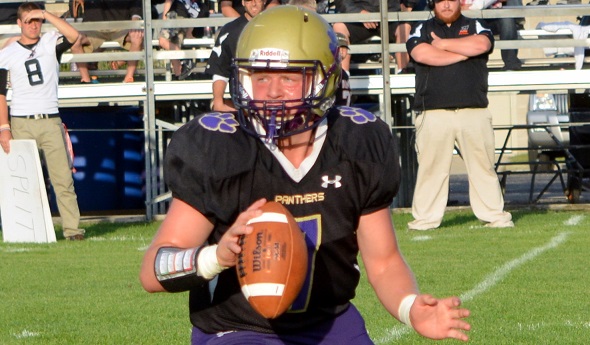
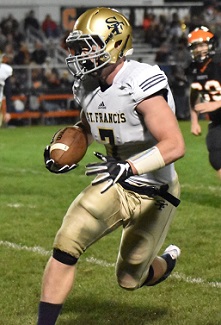
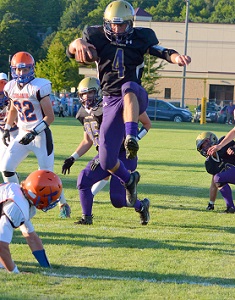
PHOTOS: (Top) Frankfort quarterback Tige Stockdale prepares to pitch during an Aug. 26 win over Manton. (Middle) St. Francis' Chris Kolarevic works upfield during his team's win over Cheboygan on Oct. 7. ( Below) Griffin Kelly (4) hurdles a would-be tackler for a touchdown against Central Lake on Sept. 2. (Photos by Amy Plumstead [Frankfort] and Leslie Julian [St. Francis].)