

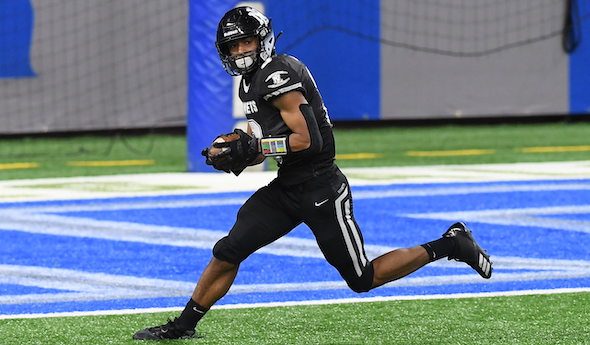
Garza Shows Range, New Lothrop Reigns
By
Paul Costanzo
Special for MHSAA.com
January 23, 2021
DETROIT – It had been a while Saturday since the New Lothrop offense had made a big play.
The Hornets had seen a 28-point lead shrink to seven and were staring down another big third down. In need of a spark, they turned to the player who had given them so many earlier in the game, and once again, Julius Garza delivered.
Garza converted the third down, and eventually scored his fourth touchdown to help seal New Lothrop’s 42-35 victory over Traverse City St. Francis in the Division 7 Football Final at Ford Field.
“Their backers were keying on (Will) Muron all night, so I knew when they flew up, Julius would come open,” New Lothrop senior quarterback Cam Orr said. “I knew if I threw him the ball, he’d catch it no matter where it was.”
Garza scored four touchdowns in the game – two rushing, one receiving and one on a kick return – to tie him for fourth in MHSAA Finals history for touchdowns in a game. He had 139 yards receiving on four catches and 26 yards rushing on four carries.
It was his 3rd-and-6 conversion with his team in its own territory and clinging to a seven-point lead, however, that was likely his biggest play of the game. His 26-yard reception on the next play was also in the running, as was the nine-yard touchdown run that put New Lothrop up 42-28 with 2 minutes, 26 seconds to play.
“It means everything,” Garza said. “It’s kind of taken a little bit to settle in. I feel like I’m on top of the world right now. It’s really exciting. All the work we put in, and everything we do, for it to pay off, it means the world.”
The title was the Hornets’ third, and first since 2018. If not for a one-point Regional Final loss a year ago against eventual champion Pewamo-Westphalia, the program could be celebrating a three-peat.
“We’ve always had tremendous community backing. We’ve always had tremendous kids that have put in the same amount of work these guys have,” New Lothrop coach Clint Galvas said. “We were just unfortunately not able to get over that hump. Obviously in (2018) we were able to get over that hump and win a state title. Maybe that gave us the confidence we need moving forward as a program, like, ‘Hey, we can do this now.’ Winning a couple is special, but I’m not taking anything away from the previous teams we had, because we had some pretty darn good teams walk through these halls and wear the New Lothrop helmet, and they put in the work, too.”
At halftime, it looked as though New Lothrop (11-0) would be cruising to title No. 3, as it built a 35-7 lead, using explosive plays. Muron scored on the Hornets’ second offensive play with a 27-yard run, and after St. Francis answered with a three-yard Gabe Olivier touchdown run, Garza returned the ensuing kickoff 83 yards for a score.
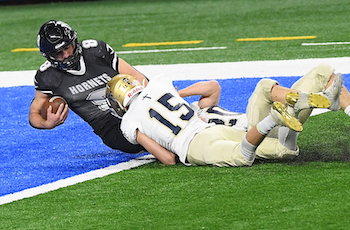 Garza added a 65-yard touchdown reception from Orr and a three-yard touchdown run, before Orr closed out the half with an 11-yard rushing score.
“Is Julius Garza having a heck of a day surprising? Not at all,” Galvas said. “Those of you who have been around and watched this kid, he was a two-way starter two years ago on the 2018 title team. The kid’s always been a player. … I think they came into the game like a lot of teams, they want to stop Cam and they want to stop Will on the edge. And I think if you do that, sometimes you forget about Julius Garza. We were able to get him a lot of one-on-one matchups with some backers and things, and he’s going to win those pretty much 10 out of 10 times. He’s a heck of an athlete.”
St. Francis (9-3) clawed back into the game in the second half, however, shutting the New Lothrop offense down and getting its own offense going – albeit in a different manner than the Hornets. The Gladiators power run game started to lean on New Lothrop and scored on its next three possessions prior to Garza’s late-game heroics, to nearly erase the deficit.
Aidan Schmuckal closed out a nine-play drive with a two-yard touchdown run midway through the third quarter, and Charlie Peterson scored on a one-yard sneak early in the fourth to close out a 14-play drive. Schmuckal’s second score, also a two-yard run, came with 6:46 to play and immediately followed a blocked punt by St. Francis’ Jimmy Muzljakovich.
“I felt like we played a doubleheader today,” St. Francis coach Josh Sellers said. “The score of the first game was 35-7, and the score of the second game was 28-7. Unfortunately, the math didn’t work out in our favor. We let too many big plays go in the first half, obviously. At 35-7 in the locker room, I told them, ‘You’ve got two choices: you can just pack up the tent stakes and go home now, or go out and try to win the second half,’ and they did. They won the second half with great effort, great belief in one another, and we just fell a little bit short today.”
St. Francis didn’t go away after Garza’s final touchdown, either, scoring with a seven-yard pass from Peterson to Josh Grove with 1:07 to play. New Lothrop recovered the onside kick, however, and after running three plays, Orr ran off the final seven seconds of the game by rolling to his left and throwing the ball high into the air down the field.
“We like to pride ourselves in our never-giving-up mentality,” Schmuckal said. “We’ve been a team that has been known to battle back and never give up. Going into that second half, I knew that we were never going to give up and we were going to fight to the bitter end, and that’s what we did.”
Schmuckal led St. Francis with 101 yards rushing, while Owen Mueller had 71 and Olivier had 69. Joey Donahue led the St. Francis defense with eight tackles, while Schmuckal had seven, including three for loss.
Orr led the Hornets in passing and rushing, throwing for 222 yards on 11-of-15 passing, and running for 122 yards on 17 carries. Alec Mangino led the New Lothrop defense with 12 tackles, while Garza had nine. Muron and Bryce Cheney each had an interception.
PHOTOS: (Top) New Lothrop’s Julius Garza looks to make one of his many big plays Saturday at Ford Field. (Middle) Hornets quarterback Cam Orr reaches the end zone as Traverse City St. Francis’ Gavin Nickodemus (15) and Gabe Olivier (20) bring him to the turf. (Click for more from Hockey Weekly Action Photos.)
A Game for Every Fan: Week 6
October 1, 2015
By Geoff Kimmerly
Second Half editor
Week 6 annually is one of celebration and sadness for Michigan high school football teams.
A total of 66 can clinch automatic playoff berths with a victory this weekend, joining Ishpeming, which qualified by winning the fifth game of its eight-game schedule a week ago. Meanwhile, 122 teams are 2-3 and can't afford another loss as they attempt to win out and clinch an automatic berth.
See below for some of the most intriguing games from each region of the state, and as always, follow results as they come in on the MHSAA Score Center.
Bay & Thumb
Ithaca (5-0) at Saginaw Michigan Lutheran Seminary (5-0)
Ithaca’s regular-season challenges are generally few; the Yellowjackets haven’t lost a regular-season game since Week 8 of 2009. But Michigan Lutheran Seminary gave Ithaca an early challenge last fall on the way to playing in a Division 7 Semifinal and is especially strong on defense again – Ithaca is one of only three teams over the last two seasons to score more than 15 points on the Cardinals.
Others that caught my eye: Flint Beecher (4-1) at Lake Fenton (4-1), Sterling Heights (4-1) at Marine City (3-2), Flint Carman-Ainsworth (3-2) at Midland (5-0), Elkton-Pigeon-Bay Port Laker (3-2) at Unionville-Sebewaing (4-1).
Greater Detroit
Detroit Cass Tech (4-1) at Detroit East English (5-0)
The Technicians are looking to bounce back from their first regular-season loss since 2012, by three last week to Detroit Martin Luther King. East English is no doubt ready to extend Cass Tech's new streak to two. The Bulldogs, who fell to King in Week 3 by five points, lost to Cass Tech twice last season by a combined 12 points – and like Cass Tech have had little trouble this season aside from the Crusaders.
Others that caught my eye: Walled Lake Northern (4-1) at Walled Lake Western (5-0), Allen Park (4-1) at Trenton (5-0), Northville (5-0) at Livonia Stevenson (5-0), Romeo (5-0) at Macomb Dakota (4-1).
Mid-Michigan
DeWitt (5-0) at Haslett (3-2)
This grand rivalry hasn’t been as much with DeWitt winning the last 12 meetings including multiple during the playoffs. But despite the Panthers’ 39-0 victory a year ago, the 2015 version should be much closer. Rebuilt DeWitt has done well against a solid schedule, but Haslett hasn’t been far behind with losses the last two weeks by a combined seven points. The Vikings should slow the tempo enough to stay within striking distance.
Others that caught my eye: Brighton (5-0) at Hartland (3-2), Lansing Sexton (1-4) at Holt (3-2), Olivet (3-2) at Stockbridge (4-1), Eaton Rapids (2-3) at Portland (5-0).
Northern Lower Peninsula
Beal City (4-1) at McBain (4-1)
Beal City has owned the Highland Conference for most of the last four seasons with 21 straight wins dating to a 2011 loss – to McBain. The Ramblers are hoping to break that streak as they continue toward what should be their best finish since at least 2011 – they’ve already equaled last season’s win total and avenged two of its five losses.
Others that caught my eye: Traverse City St. Francis (5-0) at Grayling (4-1), Boyne City (4-1) at Maple City Glen Lake (4-1), Lincoln Alcona (4-1) at Oscoda (4-1), Traverse City Central (5-0) at Petoskey (4-1).
Southeast & Border
Ann Arbor Pioneer (5-0) at Saline (5-0)
The last two meetings between these two haven’t been competitive, with Saline winning both by a combined score of 68-10. The Hornets haven’t given up a point in two weeks and can clinch a share of the Southeastern Conference Red title with a victory tonight. But this is Pioneer’s best team since 2012, when it split two games with Saline. The Pioneers have equaled last season’s five wins and come through in a pair of close games – good experience if this one goes to the wire as well.
Others that caught my eye: Pontiac Notre Dame Prep (4-1) at Ann Arbor Gabriel Richard (4-1), Ida (5-0) at Dundee (3-2), Homer (4-1) at Springport (3-2), Ypsilanti Lincoln (2-3) at Ypsilanti Community (2-3).
Southwest Corridor
Pittsford (4-1) at Climax-Scotts (5-0)
Climax-Scotts has won an incredible 42 straight games in the Southern Central Athletic Association, dating to a 2008 loss to Pittsford. The Wildcats are the team that most recently has come close to snapping that streak, in 2013, and fell to Climax-Scotts twice a year ago – but might be the only league team capable of slowing a Panthers attack averaging nearly 53 points per game.
Others that caught my eye: Jackson Lumen Christi (4-1) at Coldwater (5-0), Watervliet (4-1) at Constantine (3-2), Dowagiac (3-2) at Plainwell (3-2), Benton Harbor (3-2) at St. Joseph (4-1).
Upper Peninsula
Kingsford (3-2) at Marquette (2-3)
The Flivvers last week become one of the few of the past few seasons to come close to beating Menominee. But despite that three-point loss, Kingsford is driving toward a return to the playoffs after a season away and needs only one more win to equal last season’s total. Marquette has won two straight over the Flivvers, but this meeting is the most urgent of late because of an 0-3 start and tough games to finish against Negaunee and the Maroons.
Others that caught my eye: Escanaba (2-3) at Menominee (5-0), Hurley, Wis. (5-1) at Bark River-Harris (5-0), Iron River West Iron County (1-4) at Calumet (3-2), Sault Ste. Marie (3-2) at Gladstone (2-3).
West Michigan
Reed City (5-0) at Big Rapids (4-1)
Reed City gets overlooked a bit at the intersection between the Grand Rapids powers and the Big North Conference. But the Coyotes have won 36 of their last 37 games in the Central State Activities Association and can keep step with a sixth straight win over Big Rapids. That won't be as easy a task this fall, however; the Cardinals won four games total over 2013 and 2014, but are only a seven-point loss to Bay City John Glenn last week from perfection in 2015.
Others that caught my eye: East Grand Rapids (4-1) at Grand Rapids Christian (3-2), East Kentwood (4-1) at Hudsonville (4-1), Muskegon Reeths-Puffer (3-2) at Muskegon Mona Shores (5-0), Zeeland East (3-2) at Muskegon (5-0).
8-Player
Cedarville (4-1) at Posen (5-0)
Cedarville has lost only four games in five seasons of 8-player football, and to no one but rival Rapid River since 2011. But Posen could change things up in the Bridge Alliance Conference if it can continue a defensive performance rare for the 8-player game – the Vikings give up only 15 points per – and come back from the 52-0 loss to Cedarville on opening night a year ago.
Others that caught my eye: Deckerville (5-0) at Morrice (4-1), New Haven Merritt (4-1) at Owendale-Gagetown (5-0), Webberville (4-1) at Battle Creek St. Philip (5-0).
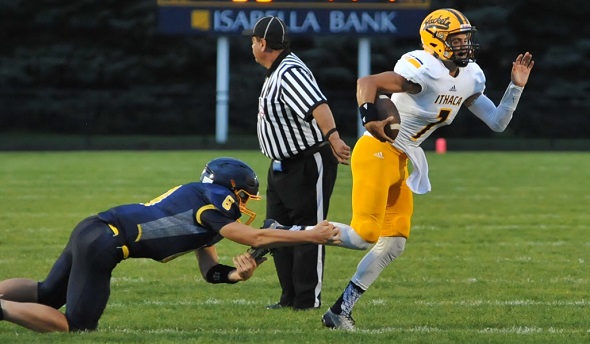
PHOTO: Ithaca’s Jake Smith tries to break the grasp of a Breckenridge tackler during a Week 4 win over the Huskies. (Click for more from HighSchoolSportsScene.com.)