

Gaylord's Teams Pursue Return to Elite
September 23, 2015
By Dennis Chase
Special for Second Half
GAYLORD – Gaylord High School is in the midst of a football revival.
Gaylord St. Mary is hoping it can say the same in a few years.
 Gaylord High is 4-0 and, among various media polls, ranked as high as No. 4 in Division 3. The senior-laden Blue Devils will be put to the test Friday, facing another unbeaten, Traverse City Central, on the road.
St. Mary, challenged by numbers, is 0-4. With just five seniors on the 25-player roster – there’s no junior varsity team – the Snowbirds are building for the future behind a "solid" sophomore class.
"We realize we're behind the eight ball in terms of numbers," St. Mary coach Kevin O'Connell said. "But we're very encouraged about what's coming up.
"We start six to seven sophomores on each side of the ball, plus a freshman. We're very young. We're a JV team playing on Friday night. We're OK with that because over the next two or three years we anticipate being very competitive."
Gaylord coach Will Cleaver can relate to that. Two years ago, in his first season back after a five-year hiatus, the Blue Devils started 0-8 before closing the campaign with a win over Alpena.
"That was a grind, a tough season," Cleaver said. "Our kids really had to learn a lot of things. We just weren't competitive."
But those underclassmen in 2013 stepped up, leading the Blue Devils to a 5-4 mark and near-playoff berth last season.
"The thing I was most proud about in 2014 was that we were competitive in every game," Cleaver said. "There were no blowouts, like in 2013. We were making progress."
The progress has continued. With the senior class leading the way, Gaylord football is returning to where it was when Cleaver first ran the program from 2000 to 2007. The Blue Devils went 55-24 during those eight years.
 "It's exciting to be in the situation we're in now," Cleaver said. "We're pleased with how our kids are progressing and responding. We've got some pretty good players. That makes it easier."
One of those players is senior running back/safety Shane Foster, who rushed for 148 yards and four touchdowns in last week's 52-8 win over Ogemaw Heights. Foster was on the varsity as a sophomore in 2013 – a time when success was elusive. Gaylord slipped to 7-38 in the five years after Cleaver left following the 2007 season.
"It's all about mindset really and that (2013) team didn't have a good mindset,” Foster said.
That's changing now.
"Last year we went 5-4," Foster said. "Obviously, we want to do better than that and make the playoffs. We realize we have to come together and work as a team to make that happen."
Gaylord’s athletic director Christian Wilson has watched his school’s progression – and it puts into perspective what St. Mary is going through. Those sophomores who had to play in 2013 have continued to work hard, especially in the weight room, he said, and now are reaping the benefits.
"Sometimes you have those years when you've got a lot of young kids playing," Wilson said. "But it's difficult to win games, especially in the Big North Conference, when your key players are sophomores or even juniors. You need to have senior leadership. We've been blessed with that this year."
"So goes your seniors, so goes your season, as a general rule," Cleaver added.
Seniors dominate the line on both sides of the ball for the Blue Devils. Foster is the leading ground gainer. Another senior, Jacob Freeman, is a threat, too. He returned a kick 60 yards for a score, hauled in a 37-yard touchdown pass from Nick Rowley and completed a 34-yard pass to Rowley on a trick play in the win over Ogemaw.
Rowley, a sophomore, gives the Blue Devils balance. He completed 12 of 15 passes for 170 yards in a Week 3 win over Escanaba.
"Our kids have caught on as to what it takes to win ... what it takes to play at a high level," Cleaver said. "It all has to come together. We have great kids, and I have a staff that does a great job with those kids. It's been very rewarding."
Foster credits the staff for turning the team's fortunes around. It all starts with Cleaver, who left in 2007 to work as a defensive line/quality control coach under Butch Jones at Central Michigan University. He spent the next season coaching inside linebackers at Liberty High School in Frisco, Texas, before returning to Gaylord and helping out in the youth football program.
 Cleaver, a financial adviser, said he didn't expect to return to the sidelines at the high school given the commitment it would take to rebuild the program. But his two sons, who were playing in the system, "begged" him to consider it. So a family meeting was called.
"I told them that if I'm going to do this, it's going to take a lot of work and you need to be on board," Cleaver said. "If everyone is not all in, it's not going to be worth it. Everybody voted and said 'Let's do it.'"
Gaylord started 4-0 last season, but a loss to Traverse City Central spiraled into a 1-4 finish.
"After that (loss to Central), it didn't go the way we planned," Foster said.
That's why Friday's showdown is critical for the Blue Devils.
"We're trying to make our statement here for the Big North Conference (title)," Foster said.
At St. Mary, there is no league title to play for this season. The goal is long range – boost numbers in the program. With Manistee Catholic Central switching to 8-player this fall, St. Mary is now the smallest Catholic school playing 11-player football in the northern Lower Peninsula. In fact, the Snowbirds, who co-op with Alba, are the sixth smallest program in the state with 133 high school students – 91 at St. Mary, 42 at Alba.
With three Ski Valley Conference members – Bellaire, Pellston and Onaway – playing 8-player, there was talk in the community about making that switch, too. But that's all it was – talk. Since then the school's made a commitment to 11-player by joining the Northern Michigan Football League, with play starting next season.
"We feel there's a good future here," new athletic director Jeff Hunter said. "We obviously have to work at increasing our numbers. The economy really hurt us for several years. It hurt everybody. This is a choice for people to send their kids here. We've seen our numbers go from the mid-60s (three years ago) to back into the 90s. I would like to see us with 150 kids in this high school in the next five years. We're working really hard."
Five of the 25 players on the roster are from Alba. Hunter said he's looking at other "co-op opportunities" as well in order to strengthen the program, although he did not want to elaborate at this time.
"Everybody wants us to be competitive, most everybody wants us to stay 11-man," he said. "I have some things in the works I'm pushing hard to try and get."
St. Mary has a proud tradition. The Snowbirds went 85-22 over a stretch from 1999 to 2009. They won 10 or more games five years in a row. Twice, in 1999 and 2002, St. Mary finished 13-1, falling in the MHSAA Division 8 Final, first to Mendon (7-6) and then to Waterford Our Lady of the Lakes (13-10).
Cleaver was the coach of the 1999 squad.
Hunter is certain St. Mary has the right coach in O'Connell to bring the Snowbirds back.
"Our current football staff is out of this world, entirely committed," he said. "We're not far from being competitive – three or four athletes. We're in most of these games. There's a lot to come, and Kevin is the guy to lead us."
St. Mary suffered two eight-point losses to start the season – 35-27 to Oscoda and 22-14 to Central Lake. O'Connell would like to have those games back.
"You can't turn the ball over five times one week and four the next and expect to win," he said.
The Snowbirds then ran into two of the area’s powerhouse teams, unbeaten and state-ranked St. Ignace and Johannesburg-Lewiston.
"We're taking our lumps right now, but we're definitely headed in the right direction," O'Connell insisted.
 "We have a solid group of athletes in our sophomore class. They're physically big enough to play. And we have a nice eighth grade class coming up."
O'Connell is putting added emphasis in a strength and conditioning program for all high school athletes, regardless of sport.
"We're making great headway and our kids, boys and girls, are getting on board with it," he said. "We want to be able to jump higher, run faster and be more explosive. Last I knew, those (concepts) applied to every sport."
With such a young roster, O'Connell admits he and his staff are spending more time teaching fundamentals than in the past when the school had a JV team. They're also trying to develop the mental aspects of the game, such as working with players in analyzing situations in order to slow the speed of the action down so it's not overwhelming.
O'Connell feels for the younger players who are not ready for varsity, but are thrust into competing with older players. He said they miss out "on those formative years" at the JV level where they can grow, learn the fundamentals, gain confidence and get game repetitions while playing opponents the same age.
Hunter hopes this is just a blip.
"Our intent next year is to have a JV team," he said.
With several smaller schools, especially in the northern Lower Peninsula, turning to 8-player to keep programs alive, O'Connell is concerned about the future for those who elect to stay in the 11-player game. As more Division 8 schools make the switch, more Division 7 schools drop down to create equal numbers for the playoffs – widening the enrollment gaps within the division.
But St. Mary is moving forward, ready to tackle the challenge. Hunter, a pilot for Southwest Airlines, thinks the program is ready to take off.
"Kevin believes we can be successful," he said. "A quality football program is one of the cornerstones to a growing school. A lot of people don't like (to hear) that, but I think it's true. A great athletic program is a draw.
"I'm hoping next year you're writing a different article, and that article will say here's the way to success."
 Dennis Chase worked 32 years as a sportswriter at the Traverse City Record-Eagle, including as sports editor from 2000-14. He can be reached at [email protected] with story ideas for Manistee, Wexford, Missaukee, Roscommon, Ogemaw, Iosco, Alcona, Oscoda, Crawford, Kalkaska, Grand Traverse, Benzie, Leelanau, Antrim, Otsego, Montmorency, Alpena, Presque Isle, Cheboygan, Charlevoix and Emmet counties.
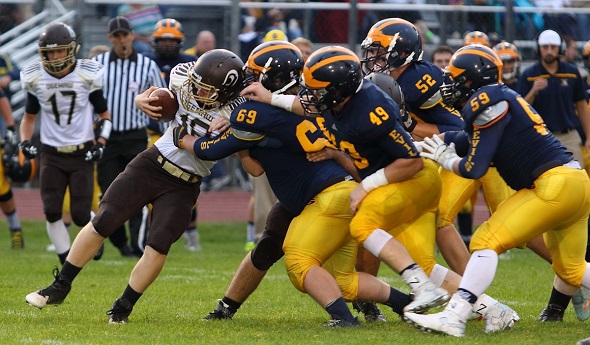
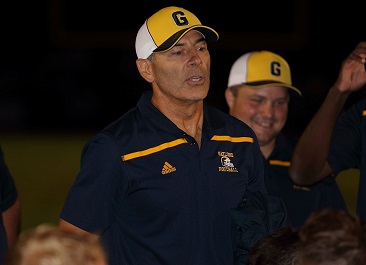
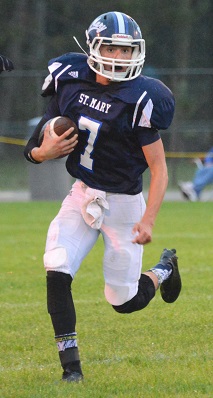
PHOTOS: (Top) Gaylord defenders stack up an Ogemaw Heights ball carrier during last week's win. (Middle top) Gaylord coach Will Cleaver addresses his team after a victory. (Middle below) St. Mary junior Josh Nowicki looks upfield for an opening. (Below) Older brother Adam Nowicki, a senior, turns the corner during the Snowbirds' game against Central Lake. (Gaylord photos by Rob DeForge/RD Sports photo; St. Mary photos by Bill Serveny/Gaylord Herald Times.)
Performance: Muskegon's La'Darius Jefferson
November 29, 2017
 La’Darius Jefferson
Muskegon senior – Football
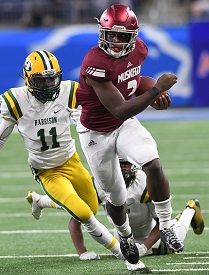
Muskegon’s 6-foot-2, 215-pound quarterback ran 32 times for 247 yards and four touchdowns to lead the Big Reds to a 28-10 win over Farmington Hills Harrison in Saturday’s Division 3 Final, earning Jefferson the Michigan Army National Guard “Performance of the Week.” The championship was Muskegon’s first since 2008 and came after the Big Reds fell by a point to Orchard Lake St. Mary’s in the 2016 championship game – when the Eaglets scored with four seconds to play.
Jefferson, who also celebrated his 18th birthday Saturday, finished this season with 2,097 yards and 33 touchdowns rushing and 1,205 yards and 21 touchdowns passing. His rushing touchdown total will make the MHSAA record book, and his performance Saturday earned four entries for accomplishments in a championship game. After splitting time at quarterback as a junior – and running for two touchdowns in the 2016 Final – Jefferson led arguably the best team in the state, regardless of division. The Big Reds scored 722 points, which rank third-most in state history, averaging 51.2 per game, which ranks 10th. Their average margin of victory was 45 points, and they outscored their five playoff opponents by a combined 221-36.
 Individual awards are piling up for Jefferson, who was named Division 3-4 Player of the Year by The Associated Press and statewide Michigan High School Football Player of the Year by MLive. He previously had committed to continue his football and academic careers at University of Central Florida, but has re-opened his recruiting with Michigan State and Georgia Tech among those recruiting him hardest. Jefferson, who also ran track last spring, has big plans aside from football; he carries a 3.4 cumulative grade-point average and is a member of National Honor Society, and he plans to study aerospace engineering wherever he ends up.
Coach Shane Fairfield said: “He is just a selfless kid that loves to win, that loves family. He’s driven by the relationships in his home. And he loves his teammates. And he was more vocal and determined this week to get this win, because his biggest thing is he wants all the kids who aren’t going to have the chance to experience what he’s going to experience after he graduates to have some type of experience that they can say either, ‘Hey, I played with La’Darius’ or ‘I won a state championship when I was in high school.’ And that’s it – he’s very aware of how lucky and fortunate he is to be in the position he is, and he just wants to share that with all of his teammates.”
Performance Point: “It’s amazing. It’s something people dream of,” Jefferson said. “People dream about scoring the last touchdown in their backyard, making the final hoop. It’s a blessing. I’m trying to hold my tears in. We worked so hard to get here. We’ve been gassed and pounded. It’s so special. … This is the best thing that’s ever happened to me besides my family.”
Team of destiny: “It’s something these boys have been dreaming about. I kid you not; I told Eli Jackson, 44, our eighth grade year that we were going to win it. I mean, we’re here.”
Motivated Muskegon: “We had a chip on our shoulder until (the clock) was zero-zero. We weren’t done. We had a chip on our shoulder all year. Everybody we played, we said we’re going to punish. … Everybody doubted us. Everybody said we lost Kalil Pimpleton, one of the best players in the state (who played this fall at Virginia Tech). We lost JaCorey Sullivan (Central Michigan) … Andrew Ward (Nebraska), one of the best defensive players in the state last year. We lost them big boys up front. So we overcame.”
 Checkmate: “I’ve been more humble (this season). I enjoy the moment. I feel like last year it was an amp moment; I wasn’t feeling it. I told myself, it’s all I’ve got. It’s my last job. I go through every day and I do a checklist. As a kid I dreamed about winning player of the year and breaking records and doing all this, and I did all that. The final checklist was win a state championship, and I can go home and check that off.”
Soaring on and off the field: “I know I want to be a successful young man beyond football. I want to go to college and study aerospace engineering, get my degree and help provide for my family. I’ve got goals beyond football. I thought as a kid that football was the only thing that I had, (but) I can do without football. I’m a great student. I work hard; I work my butt off in the classroom. I want to build planes. Who don’t want to build planes? Who don’t want to be like, ‘Oh, La’Darius built this big machine that’s flying?’ It’s cool; it’s unique.”
- Geoff Kimmerly, Second Half editor
Every week during the 2017-18 school year, Second Half and the Michigan Army National Guard will recognize a “Performance of the Week" from among the MHSAA's 750 member high schools.
The Michigan Army National Guard provides trained and ready forces in support of the National Military Strategy, and responds as needed to state, local, and regional emergencies to ensure peace, order, and public safety. The Guard adds value to our communities through continuous interaction. National Guard soldiers are part of the local community. Guardsmen typically train one weekend per month and two weeks in the summer. This training maintains readiness when needed, be it either to defend our nation's freedom or protect lives and property of Michigan citizens during a local natural disaster.
Previous 2017-18 honorees:
November 23: Ashley Turak, Farmington Hills Harrison swimming - Read
November 16: Bryce Veasley, West Bloomfield football - Read
November 9: Jose Penaloza, Holland soccer - Read
November 2: Karenna Duffey, Macomb L'Anse Creuse North cross country - Read
October 26: Anika Dy, Traverse City Central golf - Read
October 19: Andrew Zhang, Bloomfield Hills tennis - Read
October 12: Nolan Fugate, Grand Rapids Catholic Central football - Read
October 5: Marissa Ackerman, Munising tennis - Read
September 28: Minh Le, Portage Central soccer - Read
September 21: Olivia Theis, Lansing Catholic cross country - Read
September 14: Maddy Chinn, Pontiac Notre Dame Prep volleyball - Read
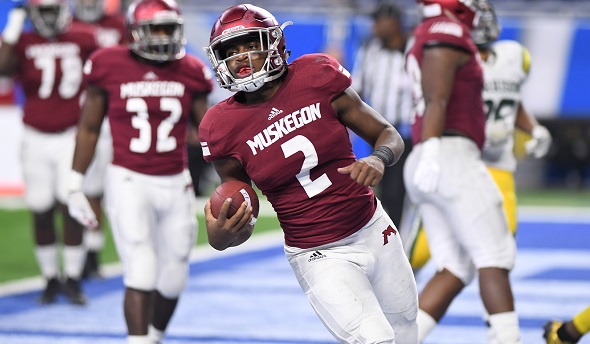
PHOTOS: (Top) La'Darius Jefferson crosses into the end zone for one of his four touchdowns during the Division 3 Final on Saturday at Ford Field. (Middle) Jefferson breaks into an opening while Harrison defenders pursue.