

Glen Lake Blazes Trail Back to Finals
November 23, 2016
By Dennis Chase
Special for Second Half
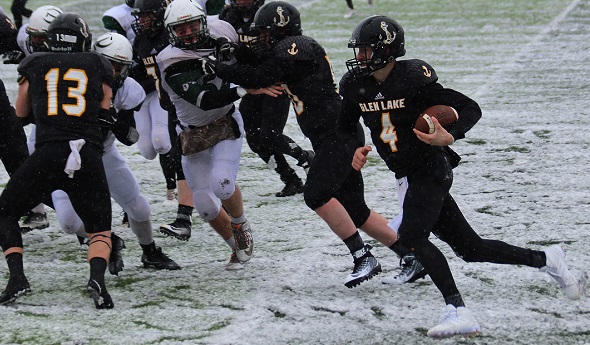
TRAVERSE CITY – Congratulatory messages streamed in Saturday after Maple City Glen Lake defeated Leroy Pine River 34-20 in a Division 6 football Semifinal at snow-covered Thirlby Field – a win that secured the Lakers’ first MHSAA Finals appearance in 20 years.
 Head coach Jerry Angers’ phone was particularly active. Among those calling or texting: Former Traverse City West coach Matt Prisk, who Angers previously worked under as a defensive coordinator; retiring St. Ignace coach Marty Spencer, whose Saints fell to defending Division 8 champion Muskegon Catholic earlier in the day; and Eric Gordon, the former Michigan State linebacker, who played for Prisk and Angers at West.
Angers, who was still fielding calls and texts late into the night Saturday, was “touched” by the show of support for his Glen Lake program.
Most of all, he was proud of his players, who kept improving every week to make this moment possible.
“They have worked hard for this opportunity,” he said. “I told them (after Saturday’s game), ‘You’re going to Ford Field. You’re one of 16 teams still playing. A lot of people will be watching, but I want you to enjoy it.’
“It’s like the Alan Jackson song ‘Remember When.’ I said in 20 years when you come back to see me I want you to say, ‘Remember when.’”
Glen Lake, which faces Jackson Lumen Christi for the title Friday, won the Class DD championship in 1994 under coach Bill Hollenbeck. The Lakers lost in the Class DD Final in 1996. Now, 20 years later, Glen Lake’s back.
“It’s an incredible feeling,” all-state linebacker Duke Angers, the coach’s son, said a few hours after the game. “It seems surreal right now. Growing up as a kid, you dream about playing at Ford Field. Now we get that opportunity. We’ll enjoy this for 24 hours and then get to work for Jackson Lumen Christi.”
Junior quarterback Cade Peterson, who rushed for 179 yards and three touchdowns in the win over Pine River, is also a coach’s son. His father, Tim, was head coach at Lake City for 15 seasons. The family moved into the Glen Lake school system this year. Tim is the quarterbacks coach for the Lakers.
“I’ve been going down to the state finals since I was 12,” Cade said. “And I would always think, ‘I want to play in this (state finals).’ Now it’s happening. You can ask any team in the state, and their ultimate goal would be to go to Ford Field and play for a state title. Only a few teams can say they accomplished that – and we did. As soon as that moment set in (Saturday), it was ‘Hey, we achieved our goal. Now let’s go win a state championship.’”
For Tim Peterson, who led Lake City to nine playoff berths, including Regional appearances in 2012 and 2013, it was a moment to savor.
“You work your whole life as a coach to try to get to the apex – and this is it,” he said. “We’re there. I couldn’t be happier for the kids, the program and the community.”
Now the task for the 11-2 Lakers is to a win a 12th game. Glen Lake will be taking on a program steeped in tradition. This will be Lumen Christi’s eighth MHSAA Finals appearance since 2000. The Titans have won five crowns during that span under coach Herb Brogan.
“Our kids have been facing challenges all year, and people keep underestimating them,” Tim Peterson said. “They just keep doing what they do – and they do it very well.”
Glen Lake’s losses were to Traverse City St. Francis (21-13) and Frankfort (26-21), teams that finished 11-1. The Lakers came in second to Frankfort in the Northern Michigan Football League’s Leaders division. Jerry Angers, now in his eighth season at the helm, said his team learned valuable lessons from those defeats.
“Sometimes losses are good for you,” he said. “We, as coaches and fans, never want to believe that, but in our two losses we had 15 or so penalties in one and five turnovers in the other. So you go back and you work on it. You try to reduce the penalties, reduce the turnovers. That became a great focus for our kids. I think we’ve had eight penalties in four playoff games – total. And we’ve kept our turnovers to a minimum. If you focus on the task at hand, and what’s in front of you, those things are going to be eliminated.”
Cade Peterson said the setbacks brought the team closer together, too.
“People can start pointing fingers (in defeat),” he said. “That didn’t go on here. Everybody picked each other up and kept fighting, kept going.”
 The 16 seniors on the team led the way.
“They set the tone,” Tim Peterson said. “The senior leadership has been phenomenal in keeping the focus.”
Glen Lake had to go on the road at Roscommon and Calumet to win two of its four playoff games. On Saturday, the Lakers, who were averaging 160 yards passing and 215 yards rushing per contest out of their spread offense, stuck to the ground to beat Pine River in blustery conditions that forced officials to clear snow off the artificial turf before and during the game.
Glen Lake rushed for 309 yards. In addition to Peterson’s 179 yards, Duke Angers picked up 59 and Nick Apsey 54. Apsey also hauled in two catches for 34 yards. The Laker backs – running behind a line that features tackles Jake Palmer and Brandon Tremble, guards Ryan Nadlicki and Zack Gushurst and center Tommy Kendall – averaged nearly five yards a carry. Nadlicki’s uncle, Mike, was a star on Traverse City’s state championship team in 1988.
“The weather forced us to be very one-dimensional (Saturday), but we’re real pleased with our ability to run the football as well as throw it,” Tim Peterson said. “That’s a good combination to have when you go deep into the playoffs because you never know what the weather will be.”
For the season, Cade Peterson’s completed 106 of 207 passes for 1,953 yards and 20 touchdowns. Jared Jackson, last year’s starting quarterback, has caught 30 passes, Apsey 23.
The 6-foot-4, 190-pound Peterson leads the team in rushing with 843 yards. Apsey, also a junior, has added 791 yards.
Defensively, Duke Angers, a four-year starter, is averaging 10 stops a game and Tony Duperon seven. Glen Lake is surrendering less than 200 yards in offense per game. Angers was the Traverse City Record-Eagle’s Defensive Player of the Year a year ago.
“As a football coach, he’s one of the best leaders and overall players that I’ve ever been associated with,” Jerry Angers said.
Jerry Angers led Glen Lake to back-to-back 9-2 seasons in 2012-13. The Lakers reached the District Finals those years.
Glen Lake qualified for the playoffs a year ago, finishing 5-5. This season, with a number of experienced players returning, coupled with the addition of Cade and Drew Peterson, the team has flourished. Drew is a sophomore defensive end and receiver. He had an interception Saturday.
Cade Peterson was a two-year starter at Lake City, throwing for 1,753 yards and 19 touchdowns as a sophomore.
“I feel a big part of why I’ve been successful (at Glen Lake) is because of how welcoming everybody was – not only the team and coaches, but the school and community,” he said.
“When those two (Peterson) boys walked in, our kids just grabbed them and said, ‘Hey, let’s go. You’re part of us now,’” Jerry Angers added.
Tim Peterson retired as a principal in June of 2015. He coached the Trojans that fall, but after the school year the family decided to make a move. Peterson was familiar with the Glen Lake area, since he worked camps with Hollenbeck. He was also good friends with Angers.
“It was time for a change,” Peterson explained. “We came up and looked at the academic piece of it, which is most important to us, and we said this is where we want to go.
“We’ve always said, at some point, we’d like to get here. This community is so supportive of their kids and of their school and that’s what you look for as a parent.”
Now the Lakers are one win away from a second MHSAA title. Regardless of what happens, though, Duke Angers said he believes his senior class has made an impact.
“We raised the bar a little,” he said. “We wanted to leave a trail to follow – and I think we have.”
 Dennis Chase worked 32 years as a sportswriter at the Traverse City Record-Eagle, including as sports editor from 2000-14. He can be reached at [email protected] with story ideas for Manistee, Wexford, Missaukee, Roscommon, Ogemaw, Iosco, Alcona, Oscoda, Crawford, Kalkaska, Grand Traverse, Benzie, Leelanau, Antrim, Otsego, Montmorency, Alpena, Presque Isle, Cheboygan, Charlevoix and Emmet counties.
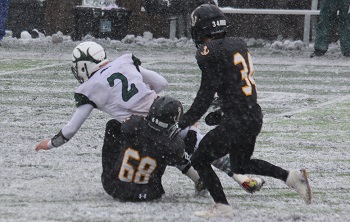
PHOTOS: (Top) Maple City Glen Lake’s Nick Apsey (5) follows his blockers on the way to the end zone during Saturday’s Semifinal win over Leroy Pine River. (Middle) Wes Peplinski (68) drops the Pine River quarterback in the 34-20 victory. (Photos by Kim Jackson.)
Inside Selection Sunday: Mapnalysis '18
October 21, 2018
By Geoff Kimmerly
Second Half editor
For a fading moment, we thought we saw the Big Dipper floating through the second floor of the MHSAA office Sunday morning.
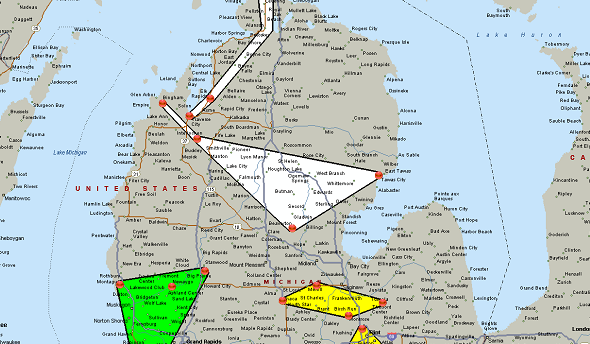
Michigan’s northernmost high school in Calumet held the handle – but the only place the rest of the Region pointed was to questions about how we could come up with such a disjointed scenario for this season’s Division 6 Playoffs.
Below – as has become an annual tradition – we’ll answer that question and a few more about this year’s selection process.
Our mission Sunday was to map 213 automatic qualifiers for 11-player football – and a record 43 additional qualifiers with 5-4 or 4-4 records – plus our top 32 8-player teams across 10 divisions of playoffs that will conclude with the latter Nov. 17 at Northern Michigan University and 11-player Nov. 23-24 at Ford Field.
As often noted in the past, this process didn’t start Sunday morning – but months and in some cases more than a year ago when athletic directors began scheduling games for this fall. We make sure all are loaded into our system by early summer, and then follow every score/cancellation/forfeit/additional change through Week 9’s final games – including this season those for 46 teams from other states or Ontario that played Michigan schools and needed to be followed as well because their successes affected MHSAA teams’ strengths of schedule.
Now that the maps are drawn, we line up all that will come with the next five weeks of games including assigning officials, gathering potential Semifinal sites and continuing our work with our Finals hosts to create memorable experiences as teams play for championships.
So we’re off. For those familiar with our playoff selection process, or who have read this report in the past and don’t want a refresher on how we do what we do, skip the next section and go directly to the “Observations & Answers: 2018.” For the rest, what follows is an explanation of how we selected the playoff pairings during the morning hours Sunday, followed by how we made some of the toughest decisions plus a few thoughts on the breakdown of the field. Go to this page on MHSAA.com to see the pairings in full.
Ground Rules
Our past: The MHSAA 11-player playoff structure – with 256 teams in eight divisions, and six wins equaling an automatic berth (or five wins for teams playing eight or fewer games) – debuted in 1999. An 8-player tournament was added in 2011, and in 2017 a second division of 8-player football was introduced.
The first playoffs were conducted in 1975 with four champions. Four more football classes were added in 1990 for a total of eight champions each fall. Through 1998, only 128 teams made the postseason, based on their playoff point averages within regions (four for each class) that were drawn before the beginning of the season. The drawing of Districts and Regionals after the end of the regular season did not begin until the most recent 11-player playoff expansion.
In early years of the current process, lines were drawn by hand. Dots representing qualifying schools were pasted on maps, one map for each division, and those maps were then covered by plastic sheets. Districts and Regionals literally were drawn with dry-erase markers.
Our present: After a late Saturday night tracking scores, we file in Sunday morning for a final round of gathering results we may still need (which can include making a few early a.m. calls to athletic directors and coaches). Re-checking and triple-checking of enrollments, what schools played in co-ops and opted to play as a higher class start a week in advance, and more numbers are crunched Sunday morning as the fields are set.
As noted above, this season there were 213 automatic qualifiers for the 11-player field by win total with the final 43 additional qualifiers then selected, by playoff-point average, one from each class in order (A, B, C, D) until the field was filled. There were only five Class D additional qualifiers with 5-4 or 4-4 (playing eight games) records from which we could choose – so with those five we added 13 teams from Class A and B and 12 from Class C.
Those 256 11-player teams are then split into eight equal divisions based on enrollment, and their locations are marked on digital maps that are projected on wall-size screens and then discussed by nearly half of the MHSAA staff plus a representative from the Michigan High School Football Coaches Association. Only the locations themselves are marked (by red dots) – not records, playoff point averages or names of the schools or towns. In fact, mentions of those are strictly prohibited. Records and playoff points are not part of the criteria. Matchups, rivalries, previous playoff pairings, etc. also DO NOT come into play.
The 8-player process is different for team selection and similar for designation of Regionals. We take the top 32 teams in 8-player based on playoff point average as our field, then re-sort those 32 by enrollment – the 16 biggest make up Division 1, followed by the next 16 in Division 2. There are no automatic qualifiers by record for 8-player.
Geography rules: This long has been rule number one for drawing MHSAA brackets in any sport. Travel distance and ease DO come into play. Jumping on a major highway clearly is easier than driving across county-wide back roads, and that’s taken into consideration. Also, remember there’s only one Mackinac Bridge and hence only one way to cross between peninsulas – and boats are not considered a possible form of transportation. When opponents from both peninsulas will be in the same District, distance to the bridge is far more important than as the bird flies.
Tradition doesn’t reign: Every group of 32 (or in 8-player, 16) dots is a new group – these 32 teams have not been placed in a bracket together before. How maps have been drawn in the past isn’t considered – it’s hard to say a division has been drawn in a certain way traditionally when this set of 32 teams is making up a division for the first time.
Observations & Answers: 2018
We always start with CONGRATULATIONS: And this season they go first to Detroit Community, Detroit Public Safety Academy and Dexter, which made the MHSAA Football Playoffs for the first time. Of 611 football varsities across the state, all but 12 have made the playoffs at least once. Rockford missed out on an automatic bid with a Week 9 loss, but received an additional qualifier berth to set the record by making the MHSAA Playoffs for the 24th straight season. Crystal Falls Forest Park (22 seasons), Stevensville Lakeshore (21), Macomb Dakota (18), Climax-Scotts (16) and Grand Rapids West Catholic (16) also extended their stays on the list for longest MHSAA playoff streaks.
Break the tie: We again had to break a tie (actually two for District rounds) as teams that will or could meet ended up with the same playoff point averages. Ties are broken by head-to-head competition first – if the teams played each other during the regular season – followed by opponents’ winning percentage as the second criteria and then a coin flip if those two won’t do it. Our tie-breaks this season both took place in Division 4 – Grand Rapids South Christian received a home game against Wyoming Godwin Heights this week and St. Clair will host North Branch if they meet in a District Final. There are more possible meetings of teams with same averages in later rounds, and those ties will be broken the same way.
What is up with Division 6: Last year I had a “worst map ever,” and two of them this year would be in contention. Division 6 is the first – but the explanation for how we came up with what we did is simple. Region 1 is made up of two Districts with six schools from the northern Lower Peninsula and two from the Upper Peninsula. So however the Districts were sliced, two Lower Peninsula schools had to go with the U.P. And we settled this one strictly by comparing highway mileages of those Lower Peninsula teams to Mackinac Bridge (again, the only way to travel between the peninsulas). In the end, we placed Elk Rapids (93 miles) and Traverse City St. Francis (124) with Escanaba and Ishpeming Westwood because they are closest to the Bridge – followed by Kingsley (126), Maple City Glen Lake (144), Beaverton (161) and Tawas (168). The optics are strange – it may look like Glen Lake is driving past Elk Rapids and St. Francis on the way to Beaverton this week and potentially Tawas next. But Glen Lake’s route still travels south of those two schools this week (and depending on its chosen route on the way to Tawas as well), making everything fit – strangely looking, but nonetheless.
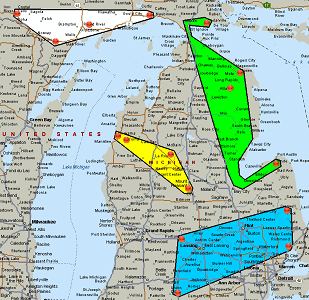 Lake Huron tour: You could see most of the American side by checking out this week’s Region 2 games in 8-player Division 2. This map also looks odd – there’s a bridge crossing and a drive around Saginaw Bay. Yet, after drawing this at least two more ways, we settled here – although Region 2 looks a little odd, all four teams are east of I-75 and north of Bay City.
Get your zoom on: We don’t enjoy splitting up teams that live next door to each other, but sometimes it’s a must. In Division 7 we were able to keep all eight Detroit-area and southeastern schools in Region 4, but the distance between its Districts came down to a few miles along I-96. In Division 2, we had to factor in outliers Port Huron Northern and Temperance Bedford – and the resulting Districts ended up splitting Livonia Churchill and Livonia Franklin.
At the end of the day …
I include this every year, but we draw the maps not knowing which schools are represented by the dots. At one point Sunday morning, I was wrong about which division we were considering at the time – and that’s a good thing. For the map drawing portion, it doesn’t matter.
But now that we know who is going where, here’s a glance at some stories that might emerge this week:
• We’ve got rivalries, like Portage Northern at Portage Central and Birmingham Groves at Birmingham Seaholm in Division 2, St. Johns at DeWitt and Haslett at East Lansing in Division 3, Constantine at Schoolcraft in Division 6 and Waterford Our Lady at Clarkston Everest Collegiate in Division 8 – plus Kingston at Deckerville in 8-player Division 1. There are many more we could mention – and some potential feuds renewed in two weeks as well depending on who wins this round.
• The Macomb Area Red, generally considered one of the strongest leagues annually in the state, sent four of six teams to the Division 1 playoffs – and they’re all in the same District. Champion Clinton Township Chippewa Valley (9-0) takes on Utica Eisenhower this week, and with a win would face either Macomb Dakota or Romeo after defeating both by just seven points during the regular season.
• Perhaps the most intriguing opener statewide is River Rouge (8-1) at Detroit Martin Luther King (7-2) in Division 3. Neither gets tested much during their league seasons, but both played tough nonleague opponents and the winner will be considered a favorite to make it to Ford Field.
• Farmington Hills Harrison holds the records for most MHSAA Finals appearances (18) and titles (13) and will play its final playoffs in Division 4 after finishing Division 3 runner-up a year ago. The school is closing next spring. Coach John Herrington is the winningest in state history with 441 wins and counting against only 111 losses (and a tie).
• There are a few annual powers not in the bracket this season – most notably Lowell, Muskegon Catholic Central and Menominee – and others like Rockford, Mendon and Grand Rapids West Catholic got in as additional qualifiers. West Catholic has won five straight Division 5 championships and opens at Hudsonville Unity Christian. The Falcons won the 2013 title after also entering as a 5-4 team.
• There are 34 teams entering the playoffs unbeaten, but only four Districts have multiple – Manistee and Reed City share one in Division 5, Traverse City St. Francis and Calumet in Division 6, Reading and Ottawa Lake Whiteford in Division 8, and Wyoming Tri-unity Christian and Morrice in 8-player Division 1. All of those potential matchups would happen in 11-Player District or 8-Player Regional Finals.
• This will be the eighth year of the 8-player tournament, and in Division 1 only Deckerville in 2012 has won an MHSAA championship in this format. In Division 2, reigning champion Crystal Falls Forest Park opens with 2015-16 back-to-back champion Powers North Central.
• In 8-player, three teams with 5-4 records didn’t make the field of 32, and two teams with 4-5 records advanced. This is the reality of measuring by playoff point average. Fife Lake Forest Area and Webberville are the 4-5 teams, and their opponents this season won more than 61 percent of their games. The three teams at 5-4 and one at 4-4 had opponents’ winning percentages between 38-56 percent.
Every school and every community can tell a story of making these playoffs, and over the next five weeks the fortunate will continue to write chapters filled with moments that will never be forgotten. We’re looking forward to watching them all unfold.
PHOTOS: (Top) The Division 6 map shows an odd-looking scenario with two Traverse City-area teams in the same District as two from the Upper Peninsula. (Middle) The 8-player Division 2 map shows how schools are connected to a District along the Lake Huron shoreline.